エピソード

  • Ambiguous Loss: Living Without Closure
    2026/09/07

    Ambiguous Loss – Living With Uncertainty

    How do we grieve something when we don't really know what we've lost — or whether it's truly gone?

    In this episode of The Counselling Room, I explore ambiguous loss — a type of loss that can leave us without clear answers, an ending or the sense of closure we might normally associate with grief.

    We look at what it can mean when someone is physically absent but still psychologically present in our thoughts and feelings, perhaps through estrangement, an absent parent or someone who is missing. I also explore the opposite — when somebody is physically present but psychologically absent, including the changes that can happen through dementia.

    What happens when we're caught somewhere between hope and acceptance? How do we move forward when part of us is still waiting for an answer? And how can uncertainty affect our relationships, identity and the way we imagine our future?

    Along the way, I also manage to question whether losing my mobile phone qualifies as ambiguous loss, AI makes an appearance, and somehow we end up with a little preview of a future visit from AI to The Counselling Room.

    Because sometimes loss isn't about somebody simply being here or gone. Sometimes it's about learning how to live with the uncertainty in between.


    Take care everyone

    Until next time

    Lynda Little (MBACP)

    BSc (Hons) Theraputic Counselling

    Online & Telephone Counselling Across the UK


    Professional Standards

    For reassurance, I am a registered member of the British Association for Counselling and Psychotherapy (BACP)

    This means I work within a recognised Ethical Framework, supported by regular supervision, ongoing professional development, and high standards of practice.


    Website


    AmbiguousLoss.com – Pauline Boss⁠

    続きを読む 一部表示
    11 分
  • The Drama Triangle: Victim, Rescuer or Persecutor?
    2026/08/03

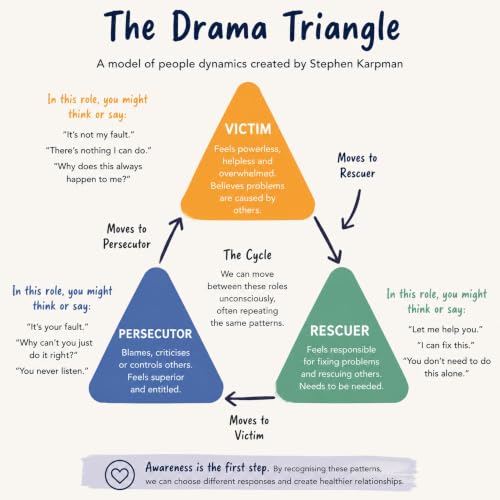
    The Drama Triangle – Understanding the Roles We Play

    In this month's episode of The Counselling Room, I explore Stephen Karpman's Drama Triangle and the three interchangeable roles we can all find ourselves moving between: The Victim, The Rescuer and The Persecutor.

    Using everyday examples from the workplace, family life, friendships and romantic relationships, I look at how these patterns can develop, why they often happen without us realising, and how they can influence the way we think, feel and respond to others.

    This episode is intended to support self-awareness and understanding rather than label or judge behaviour. By recognising these patterns, we create an opportunity to understand ourselves and others with greater compassion and to make different choices when we find ourselves repeating familiar roles.

    As always, this podcast is for psychoeducation and general reflection. It is designed to increase understanding of psychological concepts and is not a substitute for counselling, therapy or individual professional advice.

    Further Resources

    If today's topic has sparked your interest and you would like to explore it further, you may find these resources helpful.

    Books & Audiobooks

    • ​Games People Play – an introduction to Transactional Analysis.
    • ​The Body Keeps the Score – understanding trauma and its impact.
    • ​Attached – exploring attachment styles in relationships.
    • ​Adult Children of Emotionally Immature Parents – understanding relationship patterns and boundaries.

    Podcasts

    • ​Dr Julie Smith
    • ​Esther Perel
    • ​Brené Brown

    Professional Organisations & Trusted Websites

    • ​British Association for Counselling and Psychotherapy (BACP)
    • ​Mind
    • ​NHS

    Thank you for listening, and I hope this episode gives you a greater understanding of the patterns we can all experience in our relationships with ourselves and others.

    Take care everyone

    Until next time

    Lynda Little (MBACP)

    BSc (Hons) Theraputic Counselling

    Online & Telephone Counselling Across the UK


    Professional Standards

    For reassurance, I am a registered member of the British Association for Counselling and Psychotherapy (BACP)

    This means I work within a recognised Ethical Framework, supported by regular supervision, ongoing professional development, and high standards of practice.

    続きを読む 一部表示
    17 分
  • Considering Counselling? What Happens Next?
    2026/07/06

    Hello everyone and Welcome to The Counselling Room.

    In this month's Q&A episode, I answer some of the most common questions people ask when considering counselling. From choosing the right counsellor and understanding confidentiality, to knowing what to expect from sessions, this episode aims to provide reassurance, clarity, and confidence as you begin your counselling journey.

    Take care everyone

    Until next time

    Lynda Little (MBACP)

    BSc (Hons) Theraputic Counselling

    Online & Telephone Counselling Across the UK


    Professional Standards

    For reassurance, I am a registered member of the British Association for Counselling and Psychotherapy (BACP)

    This means I work within a recognised Ethical Framework, supported by regular supervision, ongoing professional development, and high standards of practice.


    続きを読む 一部表示
    25 分
  • Grief and loss: What can I say?
    2026/06/01

    Hello everyone, and Welcome to The Counselling Room

    Grief doesn’t follow a timeline — so why do we expect it to?

    In this episode, I explore the reality of grief and loss — and the ways it can change how we think, feel, and move through the world.

    Clients often describe grief as overwhelming, unpredictable, and deeply personal. From physical symptoms like exhaustion and nausea, to emotional experiences such as shock, numbness, and waves of feeling that come without warning — grief can impact every part of us.

    We also talk about:

    Why there are no “right” words when someone is grieving

    How well-meaning comments can sometimes feel difficult to hear

    The pressure of unspoken timelines and expectations around grief

    What it really means to support someone — even when you don’t know what to say

    A powerful client reflection compares grief to a wave — intense, consuming, and disorientating at first, before slowly becoming something quieter, more manageable, and connected to memory.

    This episode offers a space to reflect, feel understood, and be reminded that:

    however you grieve, your experience is valid

    If you’ve ever felt unsure how to support someone, or struggled to make sense of your own grief, this conversation may resonate with you.

    🎧 Take a moment, press play, and sit with this — you are not alone.

    Thankyou for listening, take care everyone, until next time.

    Lynda Little (MBACP)

    BACP Registered

    BSc (Hons) Theraputic Counselling

    Online & Telephone Counselling Across the UK

    Confidentiality Statement

    The content discussed is based on my professional training, experience as a counsellor, and observations of the themes many people encounter throughout life. No confidential information, identifying details, or individual client stories are ever used.

    Professional Standards

    For reassurance, I am a registered member of the British Association for Counselling and Psychotherapy

    This means I work within a recognised Ethical Framework, supported by regular supervision, ongoing professional development, and high standards of practice.


    続きを読む 一部表示
    11 分
  • Neurodiversity: What is It Like to be you?
    2026/05/04

    Hello everyone and Welcome to The Counselling Room.

    Whether you're neurodivergent, exploring whether you may be neurodivergent, supporting someone who is, or simply wanting to learn more, this episode is for you.

    In the counselling room, many people talk not only about receiving a diagnosis, but also about what happens afterwards. They describe feeling misunderstood, dismissed, or as though their experiences are questioned. For some, the diagnosis brings relief, understanding and self-acceptance. For others, it can also bring frustration when those around them struggle to acknowledge or believe their experience.

    Have you ever felt unheard, unseen or invalidated? Have you experienced disbelief from others? Or perhaps you're still trying to make sense of what being neurodivergent means for you.

    In this episode, we'll explore neurodiversity, the impact it can have on identity and relationships, and why feeling understood can be just as important as receiving a diagnosis.

    This podcast promotes understanding and support for those neurodivergent and to help them to say: ‘just because you can’t see my difference, doesn’t mean it’s not there’.

    Thankyou for listening, take care everyone, until next time.

    Lynda Little (MBACP)

    BSc (Hons) Therapeutic Counselling

    Online & Telephone Counselling Across the UK

    Confidentiality Statement

    The content discussed is based on my professional training, experience as a counsellor, and observations of the themes many people encounter throughout life. No confidential information, identifying details, or individual client stories are ever used.

    Professional Standards

    For reassurance, I am a registered member of the British Association for Counselling and Psychotherapy (BACP)

    This means I work within a recognised Ethical Framework, supported by regular supervision, ongoing professional development, and high standards of practice.


    続きを読む 一部表示
    9 分
  • Communication: Why Can’t We Say What We Really Think and Feel?
    2026/04/20

    Hello everyone and Welcome to The Counselling Room.

    What are your experiences with communication? Are you frustrated having the same conversations and not being fully heard? Maybe you think silence is now the better option, or you are thinking of leaving the situation.

    This episode explains why you may struggle to communicate effectively, how you can improve your communication with others, and finally feel validated for your thoughts and feelings, and be seen and heard for who you are.

    Thankyou for listening, take care everyone, until next time.

    Lynda Little MBACP)

    BSc (Hons) Theraputic Counselling

    Online & Telephone Counselling Across the UK

    Confidentiality Statement

    The content discussed is based on my professional training, experience as a counsellor, and observations of the themes many people encounter throughout life. No confidential information, identifying details, or individual client stories are ever used.

    Professional Standards

    For reassurance, I am a registered member of the British Association for Counselling and Psychotherapy

    This means I work within a recognised Ethical Framework, supported by regular supervision, ongoing professional development, and high standards of practice.


    続きを読む 一部表示
    13 分
  • Why I Said No to Counselling — and What Changed My Mind.
    2026/04/07

    Hello everyone and Welcome to The Counselling Room.

    This is my first podcast where I nervously but openly share my own journey from a counselling perspective of being an avoidant, non-believer to being the client — feeling vulnerable, exposed, and uncomfortable…

    Why would I tell a stranger how I’m feeling — wow!

    This is not a podcast giving reasons why you should go to counselling. It is not for everyone, and sometimes curiosity is enough.

    It’s a reflective, honest, amusing, and personal journey of why I said no to counselling, how it can be difficult to accept support, what can hold us back, and what can change when we begin to open up.

    To be professionally supported or not? That is the question

    It starts with understanding.

    I hope my vulnerability, of sharing my personal story, gives you a true unfiltered insight, into the struggle of attending counselling sessions, and saying how we really feel In counselling.

    Thankyou for listening.

    Take care, everyone, until next time.

    Lynda Little (MBACP)

    BSc (Hons) Theraputic Counselling

    I am a registered member of the British Association for Counselling and Psychotherapy (BACP), which means I follow a recognised Ethical Framework for good practice.This ensures that my work is supported through regular supervision, professional standards, and ongoing training.


    続きを読む 一部表示
    11 分