エピソード

  • John 10:1-9 · Hebrews 7:26-8:2 · John 10:9-16 · Luke 13:31-35 — Friday, November 13, 2026
    2026/11/13

    A daily note from the team at OCABS.ORG, drawing on the published works of Fr. Paul Nadim Tarazi, with citations to his books and lectures.

    Readings: John 10:1-9; Hebrews 7:26-8:2; John 10:9-16; Luke 13:31-35.

    John's parable of the sheepfold draws its vocabulary from Ezekiel. Fr. Paul points out that the Hebrew sha'ar ("gate") behind Ezekiel 46 becomes in the Septuagint pyle, except in one place where it is rendered thyra, the very Greek word John uses for Jesus as "the door." He lines up the correspondence: "he who enters by the door is the shepherd of the sheep"; "he calls his own sheep by name and leads them out"; "he goes before them." In his recorded comments Fr. Paul adds that the story's movement of going out and coming in reflects the sheep following a real shepherd's distinct call, and that without that voice the flock only scatters, so that scattered sheep "are dead sheep." Elsewhere he identifies the thieves and robbers who came before Jesus with the Jerusalem leadership, who conspire against Lazarus and so prove themselves thieves seeking to "kill and destroy."

    Jesus names himself both door and shepherd, and Fr. Paul notes that Jesus is not someone to be carried but his teaching, since the whole Gospel of John concerns the logos; one must "walk him," meaning walk his teaching. The hired hand who abandons the sheep at the sight of the wolf is contrasted with the one who owns the flock and lays down his life for it; Fr. Paul observes that this word for hireling occurs elsewhere in the New Testament only with the sons of Zebedee, carrying the same sense of one who serves his own interest. The gathering of the other sheep into "one flock, one shepherd" matches, in Fr. Paul's judgment, the same gathering of Jews and Gentiles into one people of God that Paul describes in Romans 11.

    Hebrews presents Christ as the high priest who needed no repeated sacrifice, since unlike the Levitical priests who offered first for their own sins and then for the people's, he offered himself once for all. Fr. Paul explains that this permanence is guaranteed by God's oath, sworn after the law and never to be revoked, in contrast to a law that "made nothing perfect." Seated now at the right hand of the Majesty, this priest serves "the true tabernacle which the Lord pitched, not man," a tent Fr. Paul reads alongside Hebrews' later language of copy and shadow, where the earthly sanctuary built by Moses according to a pattern shown him on the mountain only foreshadows the heavenly reality now opened in Christ.

    The root pair of the day · שׁ-כ-נ šin–kaf–nun, מִשְׁכָּן miškan · س–ك–ن sīn–kāf–nūn, مِسْكِين miskīn · dwelling-place; settle down; abide. The root behind miškan and miskīn yields Greek skene and kataskenoo, the very words for the tabernacle Hebrews says Christ now serves, "the true tabernacle which the Lord pitched, not man." The earthly miškan Moses built was only a dwelling-place foreshadowing the heavenly one now opened in Christ, the true place where God makes his dwelling among his people. cf. The Consolation of Consonants

    Sources: Tarazi, The New Testament: An Introduction, vol. 3, Johannine Writings, p. 199; Orthodox Audio Bible Commentary, John (vol. 43), part 1, at 3:04:03; Tarazi, The Rise of Scripture, p. 477; Tarazi, The New Testament: An Introduction, vol. 3, Johannine Writings, p. 198; Tarazi, The New Testament: An Introduction, vol. 3, Johannine Writings, p. 208; Tarazi, The New Testament: An Introduction, vol. 3, Johannine Writings, p. 198; Tarazi, Hebrews: A Commentary, p. 108; Tarazi, Hebrews: A Commentary, p. 102; Tarazi, Hebrews: A Commentary, p. 136; Tarazi, Hebrews: A Commentary, p. 99; Tarazi, The Rise of Scripture, p. 477; Tarazi, The New Testament: An Introduction, vol. 1, Paul and Mark, p. 96.

    The note on ocabs.org

    Opening music: Taksim Arbi, Bichi Slama, oud (Tunis, Archives de la Parole, 1930s), public domain. Source: gallica.bnf.fr / BnF.

    The digital voice Fāṭima (فَاطِمَة) is named in honor of the learned women of al-Andalus, particularly Fāṭima bint Yaḥyā al-Maghāmī, Fāṭima al-Sharrāṭ, and Fāṭima bint al-Muthannā, whose legacies embody the Andalusian traditions of scriptural scholarship, jurisprudence, education, and wisdom.

    続きを読む 一部表示
    7 分
  • 1 Thessalonians 5:1-8 · Luke 13:1-9 — Thursday, November 12, 2026
    2026/11/12

    A daily note from the team at OCABS.ORG, drawing on the published works of Fr. Paul Nadim Tarazi, with citations to his books and lectures.

    Readings: 1 Thessalonians 5:1-8; Luke 13:1-9.

    Paul tells the Thessalonians they need no instruction about the times and seasons, for they themselves know well that the day of the Lord comes "like a thief in the night," precisely when people are saying "peace and security." Fr. Paul traces this teaching of suddenness and hardship to the early church tradition of Jesus' own words about the last days, pointing to the close similarity between this passage and the material preserved in Luke's Gospel. The point is not calculating dates but readiness: believers are children of the day, not of night or darkness, so sleep and drunkenness, the behavior of night, are to be put away.

    Fr. Paul shows that sobriety in this passage is bound up with judgment language elsewhere in Paul's letters: the same verb for being sober found here is used in First Corinthians to say that in order to recognize the Lord's coming among us, it is not enough to be awake, "one is to be sober." Putting on the breastplate of faith and love and the helmet of the hope of salvation echoes Isaiah's armor imagery, and this hope is not an already-given assurance but points to an outcome still ahead, since Paul later has to insist unequivocally that "the Lord has not come yet." In his lecture on Luke, Fr. Paul links this same light and darkness contrast to Jesus telling his disciples to watch lest their hearts be weighed down with dissipation and drunkenness, addressed to believers themselves, not outsiders.

    On the Galileans and the tower of Siloam, Fr. Paul explains that Jesus refuses the assumption that such sufferers were greater sinners than others; rather, all alike are told that unless they repent they will perish in the same way. The parable of the barren fig tree that follows is read as addressed basically to the Gentiles: what happened to Israel will happen to them too if they fail to bear fruit, even if judgment is delayed while the vinedresser works the ground a while longer. Elsewhere Fr. Paul connects this fig-tree image to the wider scriptural pattern of trees mentioned alongside judgment, where a tree is finally cut down for not producing, so that a people, like a tree, is judged by its fruit.

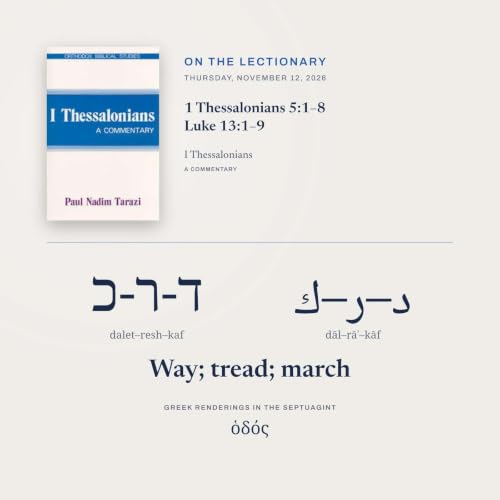
    The root pair of the day · ד-ר-כ dalet–resh–kaf, דֶּ֫רֶךְ derek · د–ر–ك dāl–rāʾ–kāf, أَدْرَكَ ʾadraka · way; tread; march. The root pair of the day, as in the Triliteral Root of the Day: דֶּ֫רֶךְ (derek) and أَدْرَكَ (ʾadraka), way; tread; march. Hear every passage of the pair at ocabs.org. cf. The Consolation of Consonants

    Sources: Tarazi, Decoding Genesis 1–11, p. 54; Tarazi, Ephesians and 2 Thessalonians: A Commentary, p. 41; Tarazi, 1 Corinthians: A Commentary, p. 283; Tarazi, I Thessalonians: A Commentary, p. 185; Tarazi, I Thessalonians: A Commentary, p. 42; Orthodox Audio Bible Commentary, Luke (vol. 42), part 2, at 2:32:21; Orthodox Audio Bible Commentary, Luke (vol. 42), part 2, at 43:54; Orthodox Audio Bible Commentary, Luke (vol. 42), part 2, at 41:46; Tarazi, Colossians and Philemon: A Commentary, p. 42.

    The note on ocabs.org

    Opening music: Taksim Arbi, Bichi Slama, oud (Tunis, Archives de la Parole, 1930s), public domain. Source: gallica.bnf.fr / BnF.

    The digital voice Fāṭima (فَاطِمَة) is named in honor of the learned women of al-Andalus, particularly Fāṭima bint Yaḥyā al-Maghāmī, Fāṭima al-Sharrāṭ, and Fāṭima bint al-Muthannā, whose legacies embody the Andalusian traditions of scriptural scholarship, jurisprudence, education, and wisdom.

    続きを読む 一部表示
    6 分
  • 1 Thessalonians 4:1-12 · Luke 12:48-59 — Wednesday, November 11, 2026
    2026/11/11

    A daily note from the team at OCABS.ORG, drawing on the published works of Fr. Paul Nadim Tarazi, with citations to his books and lectures.

    Readings: 1 Thessalonians 4:1-12; Luke 12:48-59.

    Paul tells the Thessalonians that God's call is a call into a new condition, not a reward for one already held: sanctification. Fr. Paul stresses that this sanctification is defined concretely as abstaining from akatharsia, uncleanness, which in Paul's letters stands opposed to holiness as the mark of those who believed in the living God. To reject this instruction, as the text says, is not to reject a human teacher but God himself, who has given the Holy Spirit. The passage also ties this holiness to the behavior Paul elsewhere calls walking: controlling the body, not wronging a brother, working quietly with one's own hands. None of it is a private mystical state; it is conduct that can be observed by outsiders.

    The epistle's call to abound more and more in love and quiet work matches what Fr. Paul finds in 2 Thessalonians: the gospel is an instruction for how to live, not a formula to recite, and those called are to imitate Paul's own example of laboring and not being a burden. This same letter shows that the believer's path is one of steadfastness while waiting, since the kingdom and glory are still ahead, not already possessed.

    In Luke, Jesus says that whoever is entrusted with much will have much required of him, a statement Fr. Paul reads through the parable of the steward: whether the servant knew his master's will or not, he is still held accountable, because his position required him to know it. The fire and division Jesus brings are read as the test of the gospel itself, a baptism of fire that Jesus undergoes first on the cross; the real struggle, Fr. Paul notes, is "not against the Romans, but for the gospel," waged by waiting on God rather than meeting force with force. The warning about reading the weather but not the times is applied specifically to hearers who must not presume they stand safe from the judgment already pronounced; "south wind" and "scorching heat" echo Old Testament images of divine wrath, so Jesus is pressing the crowds to recognize that the present moment is itself a moment of judgment, calling for settlement with one's accuser before being dragged to the judge.

    The root pair of the day · שׁ-ק-ט šin–qof–ṭet, שָׁקַט šaqaṭ · س–ك–ت sīn–kāf–tāʾ, سَكَتَ sakata · be quiet; undisturbed; at peace. Shaqat and sakata name a quietness that is tested from two sides. Paul uses it for the Thessalonians' ambition to lead a quiet life, working with their own hands rather than meddling, the visible fruit of sanctification. Yet the same root's example from Job 37:17 names the south wind, the very sign Jesus says the crowds read for scorching heat but fail to read as the time of judgment. cf. The Consolation of Consonants

    Sources: Orthodox Audio Bible Commentary, 2 Thessalonians (vol. 53), part 1, at 0:00; Tarazi, Galatians: A Commentary, p. 30; Tarazi, I Thessalonians: A Commentary, p. 97; Tarazi, Galatians: A Commentary, p. 44; Tarazi, Philippians: A Commentary, p. 58; Tarazi, Romans: A Commentary, p. 29; Tarazi, The New Testament: An Introduction, vol. 2, Luke and Acts, “Jesus the Cause of Division (49–53)”; Tarazi, The New Testament: An Introduction, vol. 2, Luke and Acts, “The Day of Judgment is Approaching (54–59)”; Tarazi, The Pastorals: A Commentary, p. 96; Tarazi, The New Testament: An Introduction, vol. 2, Luke and Acts, “The Day of Judgment is Approaching (54–59)”.

    The note on ocabs.org

    Opening music: Taksim Arbi, Bichi Slama, oud (Tunis, Archives de la Parole, 1930s), public domain. Source: gallica.bnf.fr / BnF.

    The digital voice Fāṭima (فَاطِمَة) is named in honor of the learned women of al-Andalus, particularly Fāṭima bint Yaḥyā al-Maghāmī, Fāṭima al-Sharrāṭ, and Fāṭima bint al-Muthannā, whose legacies embody the Andalusian traditions of scriptural scholarship, jurisprudence, education, and wisdom.

    続きを読む 一部表示
    7 分
  • 1 Thessalonians 3:9-13 · Luke 12:42-48 — Tuesday, November 10, 2026
    2026/11/10

    A daily note from the team at OCABS.ORG, drawing on the published works of Fr. Paul Nadim Tarazi, with citations to his books and lectures.

    Readings: 1 Thessalonians 3:9-13; Luke 12:42-48.

    Paul's prayer for the Thessalonians is set entirely before the coming judgment. Fr. Paul notes that the preposition "before" (emprosthen) appears in this letter almost always in connection with standing before God or Christ at the last day, so that the joy Paul feels for the Thessalonians is already a foretaste of "that ultimate joy that will fill up the Apostle's heart when he stands before the seat of God to be judged for his deeds." His fear throughout chapters two and three is that their faith might have faltered under the tempter's pressure, which would undo his own preaching; Timothy's good report turns that fear into thanksgiving and into the earnest, night-and-day request that Paul be allowed to see them again and "supplement what is lacking in their faith." The goal of the prayer in verse 13 is that their hearts be established blameless in holiness at the coming of the Lord Jesus with all his saints, the same blamelessness Paul elsewhere claims for his own apostolic conduct before that same tribunal.

    The gospel parable of the steward belongs, in Fr. Paul's reading, to Luke's larger dependence on Paul's own self-description as a steward of God's household. The faithful and wise steward found doing his duty mirrors Paul's statement that "it is required of stewards that they be found trustworthy," so that an untrustworthy servant cannot really be called a steward at all. The unfaithful servant who eats, drinks, and gets drunk is drawn in language Paul uses elsewhere for those unprepared for the Lord's coming, and his being placed "with the unfaithful" echoes Romans' language for those who rejected Paul's gospel. Full accountability governs the scene: the servant is beaten whether or not he knew the master's will, since his position required him to know it.

    Fr. Paul also reads the master's delay as God testing the household's resolve by seeming to withdraw, since he "repeatedly plays the role of the absentee landlord," the term prosopon originally meaning the mask an actor wears to play a part. Read alongside 1 Thessalonians, the two texts converge on the same point: both the apostle and the steward stand accountable before a Lord whose coming is certain but whose timing is hidden, and blamelessness or faithfulness is proven only in how one acts toward others in the meantime.

    The root pair of the day · א-ח-ר ʾalef–ḥet–resh, אַחַר ʾaḥar · أ–خ–ر hamza–khāʾ–rāʾ, آخِر ʾākhir · the hinder; to remain behind; delay. The pair šekar and sukārā names the drink of the steward who falls into excess, exactly the drunkenness (methuo) the unfaithful servant commits in Luke 12:45 while his lord delays. Fr. Paul reads this very behavior as marking the unprepared household, the opposite of the blamelessness Paul prays for in 1 Thessalonians 3:13. Intoxication there signals forgetfulness of the coming Lord. cf. The Consolation of Consonants

    Sources: Tarazi, I Thessalonians: A Commentary, p. 49; Tarazi, I Thessalonians: A Commentary, p. 50; Tarazi, I Thessalonians: A Commentary, p. 148; Tarazi, I Thessalonians: A Commentary, p. 152; Tarazi, I Thessalonians: A Commentary, p. 151; Tarazi, I Thessalonians: A Commentary, p. 117; Tarazi, The Pastorals: A Commentary, p. 96; Tarazi, Romans: A Commentary, p. 29; Tarazi, The New Testament: An Introduction, vol. 2, Luke and Acts, “Watchful Servants (35–48)”; Tarazi, The Rise of Scripture, p. 88; Tarazi, The Pastorals: A Commentary, p. 107; Tarazi, The New Testament: An Introduction, vol. 2, Luke and Acts, “Watchful Servants (35–48)”; Tarazi, Philippians: A Commentary, p. 70.

    The note on ocabs.org

    Opening music: Taksim Arbi, Bichi Slama, oud (Tunis, Archives de la Parole, 1930s), public domain. Source: gallica.bnf.fr / BnF.

    The digital voice Fāṭima (فَاطِمَة) is named in honor of the learned women of al-Andalus, particularly Fāṭima bint Yaḥyā al-Maghāmī, Fāṭima al-Sharrāṭ, and Fāṭima bint al-Muthannā, whose legacies embody the Andalusian traditions of scriptural scholarship, jurisprudence, education, and wisdom.

    続きを読む 一部表示
    5 分
  • 1 Thessalonians 2:20-3:8 — Monday, November 9, 2026
    2026/11/09

    A daily note from the team at OCABS.ORG, drawing on the published works of Fr. Paul Nadim Tarazi, with citations to his books and lectures.

    Readings: 1 Thessalonians 2:20-3:8.

    The reading shows Paul unable to bear separation from the Thessalonians: he says he could not "stand it any longer" and chose to be left alone in Athens so that Timothy could go check on them. Fr. Paul notes that the verb used, stego, means to suffer under an extreme difficulty, and that Paul used "left behind" rather than "remain," showing how costly this choice was for him after his own bitter experience in Athens. Timothy is sent not merely as a companion but as God's servant in the gospel, to establish and exhort, with the verb sterizo appearing four times across the two Thessalonian letters, a sign of how worried Paul was for that church.

    When Timothy returns with news of their faith and love, Fr. Paul stresses the unusual direction of the verb "to evangelize": here it is Paul and his companions who are evangelized by the report of the Thessalonians, the only such reversal in the New Testament. This shows that for Paul the gospel is not a possession the apostle hands down and keeps; its reality as good news depends on whether it bears fruit in the hearers, and that fruit becomes gospel again for the apostle himself. Fr. Paul compares this to Paul's planting and Apollos's watering while "God gave the growth," since the news that the Thessalonians stood fast was itself gladdening, so that Paul could say "for now we live, if you stand fast in the Lord."

    Fr. Paul links this passage to similar moments in Paul's other letters: the comfort Timothy's good news brings here parallels the comfort the Corinthians' zeal later brings in 2 Corinthians, and the commendation of Timothy as "brother and God's servant in the gospel" parallels how Paul later sends Epaphroditus to Philippi. In each case the apostle, aware that he will not always be present, sends a trusted helper and writes a letter so that his teaching continues after him. This pattern of dispatching co-workers and leaving written instruction, Fr. Paul observes, recurs at the end of several of Paul's letters as he prepares a path for those who will lead after he is gone.

    The root pair of the day · שׁ-ל-ה šin–lamed–he, שַׁלְוָה šalwah · س–ل–و sīn–lām–wāw, سَلْوَى salwā · quietness; be quiet; at ease. The root pair of the day, as in the Triliteral Root of the Day: שַׁלְוָה (šalwah) and سَلْوَى (salwā), quietness; be quiet; at ease. Hear every passage of the pair at ocabs.org. cf. The Consolation of Consonants

    Sources: Orthodox Audio Bible Commentary, 1 Thessalonians (vol. 52), part 1, at 0:00; Tarazi, 2 Corinthians: A Commentary, p. 157; Tarazi, I Thessalonians: A Commentary, p. 148; Tarazi, Philippians: A Commentary, p. 144; Tarazi, I Thessalonians: A Commentary, p. 146; Tarazi, Philippians: A Commentary, p. 189; Tarazi, I Thessalonians: A Commentary, p. 149; Tarazi, I Thessalonians: A Commentary, p. 143.

    The note on ocabs.org

    Opening music: Taksim Arbi, Bichi Slama, oud (Tunis, Archives de la Parole, 1930s), public domain. Source: gallica.bnf.fr / BnF.

    The digital voice Fāṭima (فَاطِمَة) is named in honor of the learned women of al-Andalus, particularly Fāṭima bint Yaḥyā al-Maghāmī, Fāṭima al-Sharrāṭ, and Fāṭima bint al-Muthannā, whose legacies embody the Andalusian traditions of scriptural scholarship, jurisprudence, education, and wisdom.

    続きを読む 一部表示
    5 分
  • Joshua 5:13-15 · Isaiah 14:7-20 · Matthew 28:16-20 · Hebrews 2:2-10 · Luke 10:16-21 · Ephesians 2:4-10 · Luke 8:41-56 — Sunday, November 8, 2026
    2026/11/08

    A daily note from the team at OCABS.ORG, drawing on the published works of Fr. Paul Nadim Tarazi, with citations to his books and lectures.

    Readings: Joshua 5:13-15; Isaiah 14:7-20; Matthew 28:16-20; Hebrews 2:2-10; Luke 10:16-21; Ephesians 2:4-10; Luke 8:41-56.

    In Joshua 5:13-15, the one who meets Joshua is not identified as God outright but as "the commander of the Lord's army," and it is this figure, not Joshua, who leads the conquest, just as it was the Lord himself and not Moses who led the people out of Egypt. Fr. Paul notes the deliberate parallel: Joshua is told to remove his sandals "for the place where you stand is holy," the same command given to Moses at the burning bush. Joshua's own task is never military command but fidelity to the Law, reciting it "day and night" so that right behavior, not strategy, secures success; the fighting belongs solely to the commander of the Lord's army.

    Isaiah's taunt against the king of Babylon, a mashal or instructional story, pictures a ruler so puffed up he says in his heart, "I will ascend into heaven! I will exalt my throne above the stars of God!" Fr. Paul points out the irony that this self-declared would-be god is, after all, only a man, echoing the psalm's judgment on the "gods" who nonetheless "die like men." Unlike the kings of the nations who "lie in glory, each in his own tomb," this king is cast out like a loathed, unburied branch. The whole scene belongs to a larger pattern in which God's wrath on the nations' arrogance accompanies his plan to bring both Israel and the nations together into a new Zion.

    Matthew's closing commission sends the eleven to a mountain in Galilee, where some worship Jesus and "some doubted," a doubt Fr. Paul links elsewhere in the Gospel to the disciples' recurring "little faith" in the context of the open mission to the Gentiles. Jesus declares that "all authority in heaven and on earth has been given to me" and sends the disciples to "make disciples of all nations," a mission Fr. Paul describes as a centrifugal movement initiated by the Lord himself, extending to "the close of the age" when the Son of Man will judge all the nations that have by then been forewarned through this very teaching.

    The root pair of the day · צ-ר-ר ṣade–resh–resh, צָרָה ṣarah · ض–ر–ر ḍād–rāʾ–rāʾ, يَضُرَّ yaḍurra · straits; bind; tie up. The root pair of the day, as in the Triliteral Root of the Day: צָרָה (ṣarah) and يَضُرَّ (yaḍurra), straits; bind; tie up. Hear every passage of the pair at ocabs.org. cf. The Consolation of Consonants

    Sources: Tarazi, Joshua: A Commentary, p. 32; Tarazi, Joshua: A Commentary, p. 121; Tarazi, Joshua: A Commentary, p. 44; Tarazi, Joshua: A Commentary, p. 72; Tarazi, Land and Covenant, p. 124; Tarazi, Joshua: A Commentary, p. 78; Tarazi, Isaiah: A Commentary, p. 110; Tarazi, Isaiah: A Commentary, p. 107; Tarazi, Isaiah: A Commentary, p. 106; Tarazi, Isaiah: A Commentary, p. 104; Tarazi, Isaiah: A Commentary, p. 110; Tarazi, Isaiah: A Commentary, p. 108; Tarazi, Decoding Genesis 1–11, p. 302; Tarazi, Land and Covenant, p. 224; Tarazi, Decoding Genesis 1–11, p. 297; Tarazi, The New Testament: An Introduction, vol. 4, Matthew and the Canon, p. 210.

    The note on ocabs.org

    Opening music: Taksim Arbi, Bichi Slama, oud (Tunis, Archives de la Parole, 1930s), public domain. Source: gallica.bnf.fr / BnF.

    The digital voice Fāṭima (فَاطِمَة) is named in honor of the learned women of al-Andalus, particularly Fāṭima bint Yaḥyā al-Maghāmī, Fāṭima al-Sharrāṭ, and Fāṭima bint al-Muthannā, whose legacies embody the Andalusian traditions of scriptural scholarship, jurisprudence, education, and wisdom.

    続きを読む 一部表示
    7 分
  • 2 Corinthians 8:1-5 · Luke 9:1-6 — Saturday, November 7, 2026
    2026/11/07

    A daily note from the team at OCABS.ORG, drawing on the published works of Fr. Paul Nadim Tarazi, with citations to his books and lectures.

    Readings: 2 Corinthians 8:1-5; Luke 9:1-6.

    Paul's description of the Macedonians in 2 Corinthians 8:1-5 ties their giving to the collection for Jerusalem promised at the meeting recorded in Galatians, where Paul agreed to "remember the poor." Fr. Paul notes that the churches' response was not only "of their own free will" but exceeded even Paul's own hope, and that the key reason for it was that "first they gave themselves to the Lord and to us by the will of God." The giving itself is called grace, kharis, a gift of God rather than a human achievement, so that the Corinthians are not to feel superior for their own expected contribution.

    Fr. Paul links the Macedonians' "severe test of affliction" and "abundance of joy" to Paul's own language in chapter 7 about being comforted in affliction, showing that the collection itself functions as a test, a dokime, of whether the churches will share table fellowship with those in need. Titus and the Macedonians are described with the same word, authairetoi, acting of their own accord, so that their earnestness becomes the standard Paul holds up before the Corinthians as he presses them toward the same obedience.

    The passages on Luke 9:1-6 describe the twelve sent out with authority to heal and to preach the kingdom, taking nothing for the journey and depending entirely on reception into a house, with the shaking off of dust serving, in Fr. Paul's reading, as "a testimony against" those who refuse. He treats this healing, therapeia, as pointing beyond itself to the healing of the nations, a note that resonates with the epistle's theme of giving oneself first before giving anything else.

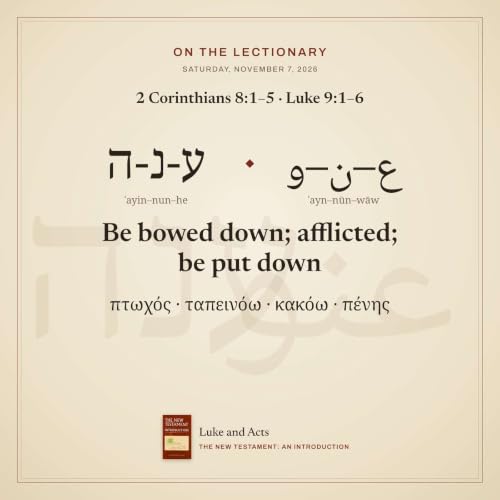
    The root pair of the day · ע-נ-ה ʿayin–nun–he, עָנָה ʿanah · ع–ن–و ʿayn–nūn–wāw, عَنَتِ ʿanati · be bowed down; afflicted; be put down. The pair ʿod and ʿād carries the sense of a witness or testimony, Hebrew ʿed and ʿedut, matched to Greek marturion. This is the very word behind Luke 9:5, where the disciples shake dust from their feet 'for a testimony against' those who refuse them. Fr. Paul reads that act as a marturion, a sign that outlasts the moment of rejection itself. cf. The Consolation of Consonants

    Sources: Tarazi, 2 Corinthians: A Commentary, p. 164; Tarazi, 2 Corinthians: A Commentary, p. 161; Tarazi, 2 Corinthians: A Commentary, p. 163; Tarazi, 2 Corinthians: A Commentary, p. 165; Tarazi, 2 Corinthians: A Commentary, p. 162; Tarazi, 2 Corinthians: A Commentary, p. 163; Tarazi, The Rise of Scripture, p. 456; Tarazi, The New Testament: An Introduction, vol. 2, Luke and Acts, “Watchful Servants (35–48)”; Tarazi, Galatians: A Commentary, p. 255.

    The note on ocabs.org

    Opening music: Taksim Arbi, Bichi Slama, oud (Tunis, Archives de la Parole, 1930s), public domain. Source: gallica.bnf.fr / BnF.

    The digital voice Fāṭima (فَاطِمَة) is named in honor of the learned women of al-Andalus, particularly Fāṭima bint Yaḥyā al-Maghāmī, Fāṭima al-Sharrāṭ, and Fāṭima bint al-Muthannā, whose legacies embody the Andalusian traditions of scriptural scholarship, jurisprudence, education, and wisdom.

    続きを読む 一部表示
    5 分
  • 1 Thessalonians 2:14-19 · Luke 12:2-12 — Friday, November 6, 2026
    2026/11/06

    A daily note from the team at OCABS.ORG, drawing on the published works of Fr. Paul Nadim Tarazi, with citations to his books and lectures.

    Readings: 1 Thessalonians 2:14-19; Luke 12:2-12.

    Paul tells the Thessalonians that they became imitators of the churches in Judea, suffering from their own countrymen what those churches suffered from the Jews "who killed both the Lord Jesus and the prophets, and drove us out, and displease God and oppose all men." Fr. Paul reads this as naming specifically the leaders who hindered Paul from speaking to the Gentiles, the same verb for hindering that recurs wherever the Gentile mission is at stake. He stresses that the text must be read whole: cut off mid-sentence it becomes a slogan, but read fully it is about those in a position of responsibility who block the gospel's reach and so fill up the measure of their sins, bringing wrath on themselves at last.

    Paul's grief at being kept from Thessalonica he attributes to Satan, whom Fr. Paul describes as the prosecutor of the divine court, one who accuses but does not judge; the hearer's business is to settle with the Judge, not fear the accuser. Paul's hope, joy, and crown of boasting at the Lord's coming are the Thessalonians themselves, standing before God's judgment seat, and Fr. Paul links this same "before" language to the moment Paul will render account for his apostleship, so that any boasting is not premature but reserved for that day.

    In Luke, Fr. Paul says that what is hidden will be revealed at the day of judgment, and the warning to fear not those who kill the body but him who can cast into Gehenna means fearing the one whose judgment actually counts, since no one sends anyone to Gehenna but God himself at his judgment. Confessing the Son of Man before men carries through to the unforgivable sin of blasphemy against the Spirit, which he explains as denying, after having once confessed, that the Son of Man speaks in God's name. When believers are brought before synagogues and rulers, the Spirit teaching them in that hour is not a prompt to wait for but the content of the gospel already given, which they are simply to speak.

    The root pair of the day · שׁ-ל-ט šin–lamed–ṭet, שָׁלַט šalaṭ · س–ل–ط sīn–lām–ṭāʾ, سُلْطان sulṭān · domineer; be master of; lord it. šalaṭ and sulṭān name domineering authority, exousiazo in Greek. In Luke 12:11 believers are brought before 'rulers and authorities,' yet Jesus tells them to fear not these but the One who can cast into Gehenna. Luke 22:25 recalls earthly rulers who 'lord it over' their people—unlike the Spirit's authority, which simply gives believers what to say before such powers. cf. The Consolation of Consonants

    Sources: Tarazi, The New Testament: An Introduction, vol. 2, Luke and Acts, “Lament over Jerusalem (31–35)”; Tarazi, The New Testament: An Introduction, vol. 1, Paul and Mark, p. 137; Tarazi, The New Testament: An Introduction, vol. 2, Luke and Acts, “Imprisonment and Deliverance at Philippi (16–37)”; Orthodox Audio Bible Commentary, 1 Thessalonians (vol. 52), part 1, at 0:00; Tarazi, 1 Corinthians: A Commentary, p. 167; Tarazi, I Thessalonians: A Commentary, p. 49; Tarazi, The New Testament: An Introduction, vol. 2, Luke and Acts, “The Church at Antioch (19–30)”; Tarazi, I Thessalonians: A Commentary, p. 152; Orthodox Audio Bible Commentary, Luke (vol. 42), part 2, at 18:49; Orthodox Audio Bible Commentary, Luke (vol. 42), part 2, at 21:11; Orthodox Audio Bible Commentary, Luke (vol. 42), part 2, at 23:15; Tarazi, The New Testament: An Introduction, vol. 3, Johannine Writings, p. 274.

    The note on ocabs.org

    Opening music: Taksim Arbi, Bichi Slama, oud (Tunis, Archives de la Parole, 1930s), public domain. Source: gallica.bnf.fr / BnF.

    The digital voice Fāṭima (فَاطِمَة) is named in honor of the learned women of al-Andalus, particularly Fāṭima bint Yaḥyā al-Maghāmī, Fāṭima al-Sharrāṭ, and Fāṭima bint al-Muthannā, whose legacies embody the Andalusian traditions of scriptural scholarship, jurisprudence, education, and wisdom.

    続きを読む 一部表示
    6 分