

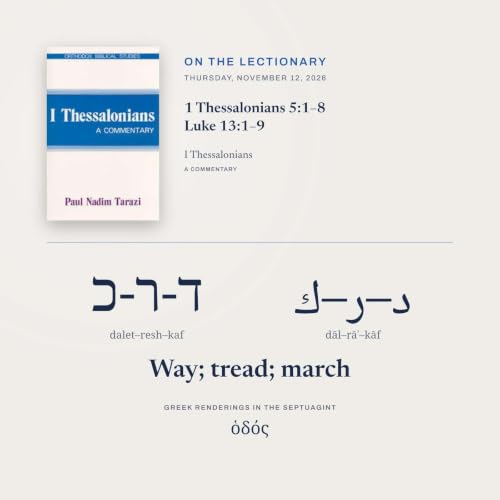
1 Thessalonians 5:1-8 · Luke 13:1-9 — Thursday, November 12, 2026
カートのアイテムが多すぎます
カートに追加できませんでした。
ウィッシュリストに追加できませんでした。
ほしい物リストの削除に失敗しました。
ポッドキャストのフォローに失敗しました
ポッドキャストのフォロー解除に失敗しました

1 Thessalonians 5:1-8 · Luke 13:1-9 — Thursday, November 12, 2026
-
ナレーター:
-
著者:
A daily note from the team at OCABS.ORG, drawing on the published works of Fr. Paul Nadim Tarazi, with citations to his books and lectures.
Readings: 1 Thessalonians 5:1-8; Luke 13:1-9.
Paul tells the Thessalonians they need no instruction about the times and seasons, for they themselves know well that the day of the Lord comes "like a thief in the night," precisely when people are saying "peace and security." Fr. Paul traces this teaching of suddenness and hardship to the early church tradition of Jesus' own words about the last days, pointing to the close similarity between this passage and the material preserved in Luke's Gospel. The point is not calculating dates but readiness: believers are children of the day, not of night or darkness, so sleep and drunkenness, the behavior of night, are to be put away.
Fr. Paul shows that sobriety in this passage is bound up with judgment language elsewhere in Paul's letters: the same verb for being sober found here is used in First Corinthians to say that in order to recognize the Lord's coming among us, it is not enough to be awake, "one is to be sober." Putting on the breastplate of faith and love and the helmet of the hope of salvation echoes Isaiah's armor imagery, and this hope is not an already-given assurance but points to an outcome still ahead, since Paul later has to insist unequivocally that "the Lord has not come yet." In his lecture on Luke, Fr. Paul links this same light and darkness contrast to Jesus telling his disciples to watch lest their hearts be weighed down with dissipation and drunkenness, addressed to believers themselves, not outsiders.
On the Galileans and the tower of Siloam, Fr. Paul explains that Jesus refuses the assumption that such sufferers were greater sinners than others; rather, all alike are told that unless they repent they will perish in the same way. The parable of the barren fig tree that follows is read as addressed basically to the Gentiles: what happened to Israel will happen to them too if they fail to bear fruit, even if judgment is delayed while the vinedresser works the ground a while longer. Elsewhere Fr. Paul connects this fig-tree image to the wider scriptural pattern of trees mentioned alongside judgment, where a tree is finally cut down for not producing, so that a people, like a tree, is judged by its fruit.
The root pair of the day · ד-ר-כ dalet–resh–kaf, דֶּ֫רֶךְ derek · د–ر–ك dāl–rāʾ–kāf, أَدْرَكَ ʾadraka · way; tread; march. The root pair of the day, as in the Triliteral Root of the Day: דֶּ֫רֶךְ (derek) and أَدْرَكَ (ʾadraka), way; tread; march. Hear every passage of the pair at ocabs.org. cf. The Consolation of Consonants
Sources: Tarazi, Decoding Genesis 1–11, p. 54; Tarazi, Ephesians and 2 Thessalonians: A Commentary, p. 41; Tarazi, 1 Corinthians: A Commentary, p. 283; Tarazi, I Thessalonians: A Commentary, p. 185; Tarazi, I Thessalonians: A Commentary, p. 42; Orthodox Audio Bible Commentary, Luke (vol. 42), part 2, at 2:32:21; Orthodox Audio Bible Commentary, Luke (vol. 42), part 2, at 43:54; Orthodox Audio Bible Commentary, Luke (vol. 42), part 2, at 41:46; Tarazi, Colossians and Philemon: A Commentary, p. 42.
The note on ocabs.org
Opening music: Taksim Arbi, Bichi Slama, oud (Tunis, Archives de la Parole, 1930s), public domain. Source: gallica.bnf.fr / BnF.
The digital voice Fāṭima (فَاطِمَة) is named in honor of the learned women of al-Andalus, particularly Fāṭima bint Yaḥyā al-Maghāmī, Fāṭima al-Sharrāṭ, and Fāṭima bint al-Muthannā, whose legacies embody the Andalusian traditions of scriptural scholarship, jurisprudence, education, and wisdom.