

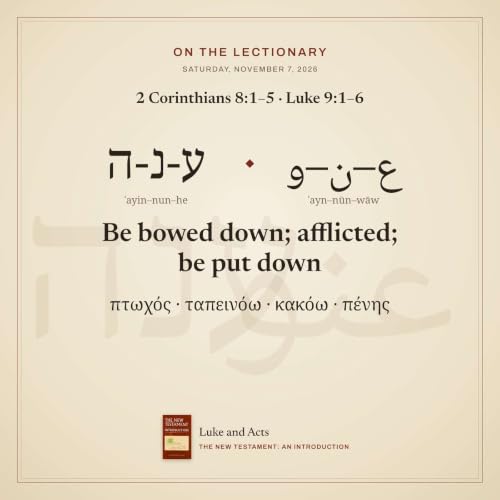
2 Corinthians 8:1-5 · Luke 9:1-6 — Saturday, November 7, 2026
カートのアイテムが多すぎます
カートに追加できませんでした。
ウィッシュリストに追加できませんでした。
ほしい物リストの削除に失敗しました。
ポッドキャストのフォローに失敗しました
ポッドキャストのフォロー解除に失敗しました

2 Corinthians 8:1-5 · Luke 9:1-6 — Saturday, November 7, 2026
-
ナレーター:
-
著者:
A daily note from the team at OCABS.ORG, drawing on the published works of Fr. Paul Nadim Tarazi, with citations to his books and lectures.
Readings: 2 Corinthians 8:1-5; Luke 9:1-6.
Paul's description of the Macedonians in 2 Corinthians 8:1-5 ties their giving to the collection for Jerusalem promised at the meeting recorded in Galatians, where Paul agreed to "remember the poor." Fr. Paul notes that the churches' response was not only "of their own free will" but exceeded even Paul's own hope, and that the key reason for it was that "first they gave themselves to the Lord and to us by the will of God." The giving itself is called grace, kharis, a gift of God rather than a human achievement, so that the Corinthians are not to feel superior for their own expected contribution.
Fr. Paul links the Macedonians' "severe test of affliction" and "abundance of joy" to Paul's own language in chapter 7 about being comforted in affliction, showing that the collection itself functions as a test, a dokime, of whether the churches will share table fellowship with those in need. Titus and the Macedonians are described with the same word, authairetoi, acting of their own accord, so that their earnestness becomes the standard Paul holds up before the Corinthians as he presses them toward the same obedience.
The passages on Luke 9:1-6 describe the twelve sent out with authority to heal and to preach the kingdom, taking nothing for the journey and depending entirely on reception into a house, with the shaking off of dust serving, in Fr. Paul's reading, as "a testimony against" those who refuse. He treats this healing, therapeia, as pointing beyond itself to the healing of the nations, a note that resonates with the epistle's theme of giving oneself first before giving anything else.
The root pair of the day · ע-נ-ה ʿayin–nun–he, עָנָה ʿanah · ع–ن–و ʿayn–nūn–wāw, عَنَتِ ʿanati · be bowed down; afflicted; be put down. The pair ʿod and ʿād carries the sense of a witness or testimony, Hebrew ʿed and ʿedut, matched to Greek marturion. This is the very word behind Luke 9:5, where the disciples shake dust from their feet 'for a testimony against' those who refuse them. Fr. Paul reads that act as a marturion, a sign that outlasts the moment of rejection itself. cf. The Consolation of Consonants
Sources: Tarazi, 2 Corinthians: A Commentary, p. 164; Tarazi, 2 Corinthians: A Commentary, p. 161; Tarazi, 2 Corinthians: A Commentary, p. 163; Tarazi, 2 Corinthians: A Commentary, p. 165; Tarazi, 2 Corinthians: A Commentary, p. 162; Tarazi, 2 Corinthians: A Commentary, p. 163; Tarazi, The Rise of Scripture, p. 456; Tarazi, The New Testament: An Introduction, vol. 2, Luke and Acts, “Watchful Servants (35–48)”; Tarazi, Galatians: A Commentary, p. 255.
The note on ocabs.org
Opening music: Taksim Arbi, Bichi Slama, oud (Tunis, Archives de la Parole, 1930s), public domain. Source: gallica.bnf.fr / BnF.
The digital voice Fāṭima (فَاطِمَة) is named in honor of the learned women of al-Andalus, particularly Fāṭima bint Yaḥyā al-Maghāmī, Fāṭima al-Sharrāṭ, and Fāṭima bint al-Muthannā, whose legacies embody the Andalusian traditions of scriptural scholarship, jurisprudence, education, and wisdom.