『On the Lectionary』のカバーアート

On the Lectionary

On the Lectionary

著者: The Ephesus School
無料で聴く

概要
A daily note from the team at OCABS.ORG, drawing on the published works of Fr. Paul Nadim Tarazi, with citations to his books and lectures. Every day: the readings of the Orthodox lectionary read in full, a short note on them, and a root pair from the Consolation of Consonants, Hebrew and Arabic, chosen for the day’s readings. About five minutes a day, from OCABS on the Ephesus School Network. Read each note, with its citations, at ocabs.org.© Copyright The Ephesus School Network, 2026. All rights reserved. キリスト教 スピリチュアリティ 聖職・福音主義
エピソード
  • John 10:1-9 · Hebrews 7:26-8:2 · John 10:9-16 · Luke 13:31-35 — Friday, November 13, 2026
    2026/11/13

    A daily note from the team at OCABS.ORG, drawing on the published works of Fr. Paul Nadim Tarazi, with citations to his books and lectures.

    Readings: John 10:1-9; Hebrews 7:26-8:2; John 10:9-16; Luke 13:31-35.

    John's parable of the sheepfold draws its vocabulary from Ezekiel. Fr. Paul points out that the Hebrew sha'ar ("gate") behind Ezekiel 46 becomes in the Septuagint pyle, except in one place where it is rendered thyra, the very Greek word John uses for Jesus as "the door." He lines up the correspondence: "he who enters by the door is the shepherd of the sheep"; "he calls his own sheep by name and leads them out"; "he goes before them." In his recorded comments Fr. Paul adds that the story's movement of going out and coming in reflects the sheep following a real shepherd's distinct call, and that without that voice the flock only scatters, so that scattered sheep "are dead sheep." Elsewhere he identifies the thieves and robbers who came before Jesus with the Jerusalem leadership, who conspire against Lazarus and so prove themselves thieves seeking to "kill and destroy."

    Jesus names himself both door and shepherd, and Fr. Paul notes that Jesus is not someone to be carried but his teaching, since the whole Gospel of John concerns the logos; one must "walk him," meaning walk his teaching. The hired hand who abandons the sheep at the sight of the wolf is contrasted with the one who owns the flock and lays down his life for it; Fr. Paul observes that this word for hireling occurs elsewhere in the New Testament only with the sons of Zebedee, carrying the same sense of one who serves his own interest. The gathering of the other sheep into "one flock, one shepherd" matches, in Fr. Paul's judgment, the same gathering of Jews and Gentiles into one people of God that Paul describes in Romans 11.

    Hebrews presents Christ as the high priest who needed no repeated sacrifice, since unlike the Levitical priests who offered first for their own sins and then for the people's, he offered himself once for all. Fr. Paul explains that this permanence is guaranteed by God's oath, sworn after the law and never to be revoked, in contrast to a law that "made nothing perfect." Seated now at the right hand of the Majesty, this priest serves "the true tabernacle which the Lord pitched, not man," a tent Fr. Paul reads alongside Hebrews' later language of copy and shadow, where the earthly sanctuary built by Moses according to a pattern shown him on the mountain only foreshadows the heavenly reality now opened in Christ.

    The root pair of the day · שׁ-כ-נ šin–kaf–nun, מִשְׁכָּן miškan · س–ك–ن sīn–kāf–nūn, مِسْكِين miskīn · dwelling-place; settle down; abide. The root behind miškan and miskīn yields Greek skene and kataskenoo, the very words for the tabernacle Hebrews says Christ now serves, "the true tabernacle which the Lord pitched, not man." The earthly miškan Moses built was only a dwelling-place foreshadowing the heavenly one now opened in Christ, the true place where God makes his dwelling among his people. cf. The Consolation of Consonants

    Sources: Tarazi, The New Testament: An Introduction, vol. 3, Johannine Writings, p. 199; Orthodox Audio Bible Commentary, John (vol. 43), part 1, at 3:04:03; Tarazi, The Rise of Scripture, p. 477; Tarazi, The New Testament: An Introduction, vol. 3, Johannine Writings, p. 198; Tarazi, The New Testament: An Introduction, vol. 3, Johannine Writings, p. 208; Tarazi, The New Testament: An Introduction, vol. 3, Johannine Writings, p. 198; Tarazi, Hebrews: A Commentary, p. 108; Tarazi, Hebrews: A Commentary, p. 102; Tarazi, Hebrews: A Commentary, p. 136; Tarazi, Hebrews: A Commentary, p. 99; Tarazi, The Rise of Scripture, p. 477; Tarazi, The New Testament: An Introduction, vol. 1, Paul and Mark, p. 96.

    The note on ocabs.org

    Opening music: Taksim Arbi, Bichi Slama, oud (Tunis, Archives de la Parole, 1930s), public domain. Source: gallica.bnf.fr / BnF.

    The digital voice Fāṭima (فَاطِمَة) is named in honor of the learned women of al-Andalus, particularly Fāṭima bint Yaḥyā al-Maghāmī, Fāṭima al-Sharrāṭ, and Fāṭima bint al-Muthannā, whose legacies embody the Andalusian traditions of scriptural scholarship, jurisprudence, education, and wisdom.

    続きを読む 一部表示
    7 分
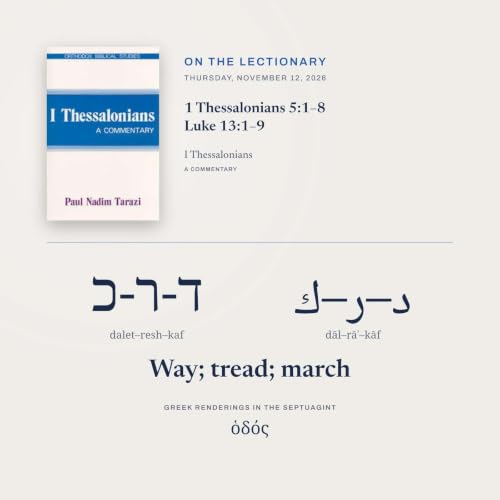
  • 1 Thessalonians 5:1-8 · Luke 13:1-9 — Thursday, November 12, 2026
    2026/11/12

    A daily note from the team at OCABS.ORG, drawing on the published works of Fr. Paul Nadim Tarazi, with citations to his books and lectures.

    Readings: 1 Thessalonians 5:1-8; Luke 13:1-9.

    Paul tells the Thessalonians they need no instruction about the times and seasons, for they themselves know well that the day of the Lord comes "like a thief in the night," precisely when people are saying "peace and security." Fr. Paul traces this teaching of suddenness and hardship to the early church tradition of Jesus' own words about the last days, pointing to the close similarity between this passage and the material preserved in Luke's Gospel. The point is not calculating dates but readiness: believers are children of the day, not of night or darkness, so sleep and drunkenness, the behavior of night, are to be put away.

    Fr. Paul shows that sobriety in this passage is bound up with judgment language elsewhere in Paul's letters: the same verb for being sober found here is used in First Corinthians to say that in order to recognize the Lord's coming among us, it is not enough to be awake, "one is to be sober." Putting on the breastplate of faith and love and the helmet of the hope of salvation echoes Isaiah's armor imagery, and this hope is not an already-given assurance but points to an outcome still ahead, since Paul later has to insist unequivocally that "the Lord has not come yet." In his lecture on Luke, Fr. Paul links this same light and darkness contrast to Jesus telling his disciples to watch lest their hearts be weighed down with dissipation and drunkenness, addressed to believers themselves, not outsiders.

    On the Galileans and the tower of Siloam, Fr. Paul explains that Jesus refuses the assumption that such sufferers were greater sinners than others; rather, all alike are told that unless they repent they will perish in the same way. The parable of the barren fig tree that follows is read as addressed basically to the Gentiles: what happened to Israel will happen to them too if they fail to bear fruit, even if judgment is delayed while the vinedresser works the ground a while longer. Elsewhere Fr. Paul connects this fig-tree image to the wider scriptural pattern of trees mentioned alongside judgment, where a tree is finally cut down for not producing, so that a people, like a tree, is judged by its fruit.

    The root pair of the day · ד-ר-כ dalet–resh–kaf, דֶּ֫רֶךְ derek · د–ر–ك dāl–rāʾ–kāf, أَدْرَكَ ʾadraka · way; tread; march. The root pair of the day, as in the Triliteral Root of the Day: דֶּ֫רֶךְ (derek) and أَدْرَكَ (ʾadraka), way; tread; march. Hear every passage of the pair at ocabs.org. cf. The Consolation of Consonants

    Sources: Tarazi, Decoding Genesis 1–11, p. 54; Tarazi, Ephesians and 2 Thessalonians: A Commentary, p. 41; Tarazi, 1 Corinthians: A Commentary, p. 283; Tarazi, I Thessalonians: A Commentary, p. 185; Tarazi, I Thessalonians: A Commentary, p. 42; Orthodox Audio Bible Commentary, Luke (vol. 42), part 2, at 2:32:21; Orthodox Audio Bible Commentary, Luke (vol. 42), part 2, at 43:54; Orthodox Audio Bible Commentary, Luke (vol. 42), part 2, at 41:46; Tarazi, Colossians and Philemon: A Commentary, p. 42.

    The note on ocabs.org

    Opening music: Taksim Arbi, Bichi Slama, oud (Tunis, Archives de la Parole, 1930s), public domain. Source: gallica.bnf.fr / BnF.

    The digital voice Fāṭima (فَاطِمَة) is named in honor of the learned women of al-Andalus, particularly Fāṭima bint Yaḥyā al-Maghāmī, Fāṭima al-Sharrāṭ, and Fāṭima bint al-Muthannā, whose legacies embody the Andalusian traditions of scriptural scholarship, jurisprudence, education, and wisdom.

    続きを読む 一部表示
    6 分
  • 1 Thessalonians 4:1-12 · Luke 12:48-59 — Wednesday, November 11, 2026
    2026/11/11

    A daily note from the team at OCABS.ORG, drawing on the published works of Fr. Paul Nadim Tarazi, with citations to his books and lectures.

    Readings: 1 Thessalonians 4:1-12; Luke 12:48-59.

    Paul tells the Thessalonians that God's call is a call into a new condition, not a reward for one already held: sanctification. Fr. Paul stresses that this sanctification is defined concretely as abstaining from akatharsia, uncleanness, which in Paul's letters stands opposed to holiness as the mark of those who believed in the living God. To reject this instruction, as the text says, is not to reject a human teacher but God himself, who has given the Holy Spirit. The passage also ties this holiness to the behavior Paul elsewhere calls walking: controlling the body, not wronging a brother, working quietly with one's own hands. None of it is a private mystical state; it is conduct that can be observed by outsiders.

    The epistle's call to abound more and more in love and quiet work matches what Fr. Paul finds in 2 Thessalonians: the gospel is an instruction for how to live, not a formula to recite, and those called are to imitate Paul's own example of laboring and not being a burden. This same letter shows that the believer's path is one of steadfastness while waiting, since the kingdom and glory are still ahead, not already possessed.

    In Luke, Jesus says that whoever is entrusted with much will have much required of him, a statement Fr. Paul reads through the parable of the steward: whether the servant knew his master's will or not, he is still held accountable, because his position required him to know it. The fire and division Jesus brings are read as the test of the gospel itself, a baptism of fire that Jesus undergoes first on the cross; the real struggle, Fr. Paul notes, is "not against the Romans, but for the gospel," waged by waiting on God rather than meeting force with force. The warning about reading the weather but not the times is applied specifically to hearers who must not presume they stand safe from the judgment already pronounced; "south wind" and "scorching heat" echo Old Testament images of divine wrath, so Jesus is pressing the crowds to recognize that the present moment is itself a moment of judgment, calling for settlement with one's accuser before being dragged to the judge.

    The root pair of the day · שׁ-ק-ט šin–qof–ṭet, שָׁקַט šaqaṭ · س–ك–ت sīn–kāf–tāʾ, سَكَتَ sakata · be quiet; undisturbed; at peace. Shaqat and sakata name a quietness that is tested from two sides. Paul uses it for the Thessalonians' ambition to lead a quiet life, working with their own hands rather than meddling, the visible fruit of sanctification. Yet the same root's example from Job 37:17 names the south wind, the very sign Jesus says the crowds read for scorching heat but fail to read as the time of judgment. cf. The Consolation of Consonants

    Sources: Orthodox Audio Bible Commentary, 2 Thessalonians (vol. 53), part 1, at 0:00; Tarazi, Galatians: A Commentary, p. 30; Tarazi, I Thessalonians: A Commentary, p. 97; Tarazi, Galatians: A Commentary, p. 44; Tarazi, Philippians: A Commentary, p. 58; Tarazi, Romans: A Commentary, p. 29; Tarazi, The New Testament: An Introduction, vol. 2, Luke and Acts, “Jesus the Cause of Division (49–53)”; Tarazi, The New Testament: An Introduction, vol. 2, Luke and Acts, “The Day of Judgment is Approaching (54–59)”; Tarazi, The Pastorals: A Commentary, p. 96; Tarazi, The New Testament: An Introduction, vol. 2, Luke and Acts, “The Day of Judgment is Approaching (54–59)”.

    The note on ocabs.org

    Opening music: Taksim Arbi, Bichi Slama, oud (Tunis, Archives de la Parole, 1930s), public domain. Source: gallica.bnf.fr / BnF.

    The digital voice Fāṭima (فَاطِمَة) is named in honor of the learned women of al-Andalus, particularly Fāṭima bint Yaḥyā al-Maghāmī, Fāṭima al-Sharrāṭ, and Fāṭima bint al-Muthannā, whose legacies embody the Andalusian traditions of scriptural scholarship, jurisprudence, education, and wisdom.

    続きを読む 一部表示
    7 分
adbl_web_anon_alc_button_suppression_t1
まだレビューはありません