• 366: Get Closer to Revenue with Saul Marquez
    2026/09/24
    https://youtu.be/lrnG7ydEErk Saul Marquez, Founder and CEO of Outcomes Rocket, helps medtech and healthtech companies get closer to revenue through healthcare-focused marketing strategy and execution. Driven by a desire to be a source of love and inspiration, Saul supports healthcare innovators whose work helps people live healthier, longer lives. He believes companies improving healthcare deserve to succeed and should not have to navigate growth alone. In this conversation, Saul shares his Leverage the 3 Forms of Marketing Framework—Owned (podcast, books, content), Earned (Stages, Testimonials), and Paid (Drive Traffic to What Converts). He explains why companies need a clear strategy and strong owned assets before pursuing earned exposure, and why paid marketing should amplify a funnel that already converts. Saul also discusses growing through primary research, thought leadership, podcasting, and conferences rather than relying on cold outreach. He shares why marketing metrics must connect to pipeline and revenue, and how sales blockers, opportunities, and needs can guide the creation of campaigns and sales enablement assets. — Get Closer to Revenue with Saul Marquez Good day, dear listeners. Steve Preda here with The Management Blueprint Podcast, and my guest today is Saul Marquez, the Founder and CEO of Outcomes Rocket, a healthcare-exclusive marketing strategy and full-service marketing execution firm that helps medtech and healthtech companies accelerate their growth. Saul, welcome to the show. Steve, such a pleasure to be here with you and your listeners. Thank you for the opportunity. Well, I really have to get my A-game today because I rarely find a podcaster who’s recorded more episodes than I have. You beat that by a multiple of five or six. So definitely, I have to be on my best performance. But my first question is always the same, at least recently. What is your personal “Why,” and how are you manifesting it in your business? My personal Why. I did some thinking. This was probably about 20 years ago. I did this program. I’ve always been very reflective, and I’m a big journaler. I love to write my thoughts. And I had the chance to, about 20 years ago, do a program called Date With Destiny. It’s a Tony Robbins program. It was a game changer for me. Five days with people that want to just crush it in life—personal, professional, financial, right? Like, they just want to do the best. And so I had these five days to myself to really look inside, journal, question. And during that session, he has what he calls your primary question. You sort of look inside and you ask and you think about, like, what are those words, the stories that you tell yourself? And the primary question is that question that drives your life. And I was able to uncover that my primary question is, “I want to be a source of love and inspiration to myself and others.” And so I’m driven by love. I’m driven by inspiration. And so that’s my primary question and my primary Why. And then, when you think about it professionally, Steve, I’m very driven by mission. So because of that, I started my career in medical devices around the same time that I actually did the seminar. And I’m driven by being able to help people live better lives and increase health span, not just lifespan. And that’s why the work that we do focuses around leaders innovating in the healthcare space. So very driven by those things. But these are very noble ideas. And I mean, who wouldn’t want to live better, live longer? That’s an obvious need from everyone, really. And it’s a great thing if you can create an impact in that realm, that then you are creating something very valuable. You are, Steve. And the data point here that I’ll share to pair the purposefulness, the data point, because we’re very data-driven as a business, and I’m a data geek, is that healthcare is essentially 18% of U.S. GDP, which represents $4.8 trillion annually. It’s larger than the German economy, and that’s just the U.S. alone. So whenever anybody says, “Oh, your niche is healthcare,” I say, “Well, I mean, my economy that I’m focused on is healthcare.” It’s huge. Of course. Yeah. Yeah. Yeah. And probably, I mean, we can get into whether that’s not an overinflated number. Is it really that proportionate value? But if you think about it, the biggest resource is humans, then spending 18% of GDP on the biggest resource is not much. It definitely isn’t. And then if you sort of zoom out and you take a look at globally, GDP focused on healthcare, it’s definitely higher than most first-world countries. And the outcomes aren’t commensurate to the investment. So the opportunity to improve access, affordability, better outcomes is a huge opportunity. And I'm in awe, and I have major respect for all the entrepreneurs and business leaders in this space that are looking to improve those metrics for us in...
    続きを読む 一部表示
    36 分
  • 370: 15 Ways to Boost Your Direct Mail with Brad Kugler
    2026/10/14
    https://youtu.be/0tIqsoczeVM Bradley Kugler, Founder and CEO of DirectMail2.0, helps marketers uncover 15 Ways to Boost Your Direct Mail by combining physical campaigns with digital tracking, targeting, and attribution technologies. Driven by a desire to help others, Bradley shares the experience and lessons he has gained from building businesses, navigating disruption, and reinventing his career. His goal is to help marketers achieve stronger results while ensuring that traditional direct mail remains relevant in a digital-first world. In this conversation, Bradley introduces The Direct Mail Edge Framework—Tactile Makes Memorable, Use for $1000+ Offerings, No Privacy Regulations, and Access Multiple Readers. He explains why direct mail is most effective when customer value justifies the cost, how a physical piece can reach multiple household members, and why less mailbox competition makes mail more memorable than digital advertising. Bradley also discusses combining direct mail with email, social media, programmatic advertising, QR codes, and call tracking to create eight to twelve impressions per target. He shares how his AI platform analyzes more than 80,000 campaigns, 2.1 billion mail pieces, and 18 creative attributes to predict engagement and improve campaigns before they are mailed. — 15 Ways to Boost Your Direct Mail with Brad Kugler Good day, listeners. Steve Preda here with Management Blueprint. And my guest today is Bradley Kugler, the Founder and CEO of DirectMail2.0, an omnichannel marketing system designed to seamlessly track direct mail campaigns and enhance overall results by integrating 15 digital technologies in one user-friendly platform. Brad, welcome to the show. Steve, thank you for having me. I’m happy to be here and spread the word on something that is old that is new again. Well, I’ve been a big fan of direct mail for my entrepreneurial life, and I’m very curious about the state of the art and whether it’s still alive and in what areas it’s still alive and whether it’s thriving, so we can dive into that. But before we go there, I want to ask my favorite question. What is your personal why, and how are you manifesting it in your business? I would say my personal why, I always like helping other people. I get the most satisfaction about taking the experience, wisdom, and knowledge I’ve gained over the years, as I’m not a young man anymore. Tried a lot of things. A lot of things haven’t worked. And I’m able to impart this, and I really love to share and help other people, which is the main reason I do this podcast. I feel that I do have some valuable things to share, and I’m very proud of what I’ve done and my family and my children. And if I can help one person, even if I have to talk to 10,000, then I feel it was worth it.Share on X I love it. I mean, ultimately, that’s what’s behind the best advice that people have, and I’ve heard a lot, is helping other people and how do you contribute to human flourishing, as Eric Kreitz says in his latest book. So let’s talk about direct mail because I built my first business on the back of direct mail. I was part of Dan Kennedy’s subscribers of his newsletter, and then he was a big copywriter. You probably heard of him. I copied some of his techniques and that of some other copywriters, and it worked really well. And when I moved here, it kind of stopped working, and I thought this was because I was doing something wrong, which probably was the case. So tell me about the state of direct mail and how it works and how it has changed over the past 10 years or so.  Absolutely, and if you don’t mind, I’m going to just tell a quick story of how I arrived here. For 23 years, me and my brother and my father had a business distributing packaged media. Packaged media is DVDs, CDs, VHS, things that nobody uses anymore. One of our most successful marketing actions is we would send postcards of black-and-white 1930s disasters, ships turning over in a harbor, a train crash, a plane crash, and we would send these things to video stores and companies as a kind of an impingement-type photograph and tell them, “We’re here to solve your problems. If you had a disaster with inventory or managing your inventory, this is what we’re here to do.” And it worked phenomenally for almost two decades. All right? It stopped working. It stopped working because there were less and less video stores, and people weren’t selling packaged media. It wasn’t for the fact that the marketing stopped working. The market changed, and we were facing impending doom. There was no way around it, and that isn’t really what triggered me, “I want to get in the direct mail business.” It wasn’t. It was the thought of knowing that I’m in a business that’s disrupted by technology. Everything was going streaming. Packaged media was no longer to be, and there was nothing I could do about it. So I spent about a...
    続きを読む 一部表示
    31 分
  • 367: Implement the Law Firm Success Formula with Jay Berkowitz
    2026/10/01
    https://youtu.be/vZe016EjE-c Jay Berkowitz, Founder and CEO of Ten Golden Rules, helps law firms implement the Law Firm Success Formula to attract qualified prospects, convert more opportunities, and build five-star operations. Driven by a strong desire to win, Jay applies his competitive nature to helping clients rank higher, sign more cases, earn stronger reviews, and generate valuable referrals. In this conversation, Jay introduces The AI Visibility Optimization Framework—Collect Prospect FAQs, Publish Answers Regularly, Become an Expert on Reddit & Quora, and Blog on Customer-Generated Topics. He explains how businesses can identify real customer questions from sales calls, intake conversations, and AI-generated transcripts, then answer them through videos, blogs, FAQs, and social content. Jay also discusses optimizing websites and Google Business Profiles, responding quickly and empathetically to inquiries, and delivering five-star service that generates reviews and referrals. He shares how referrals, conference speaking, webinars, podcasts, and high-value content drive agency growth and how EOS helped him develop leaders as the company expanded. — Implement the Law Firm Success Formula with Jay Berkowitz Good day. Steve Preda here with the Management Blueprint, and my guest today is Jay Berkowitz, the Founder and CEO of Ten Golden Rules, a two-time Inc. 5000 digital marketing agency that helps law firms generate more qualified leads and clients. Jay, welcome to the show. Thank you so much. Great to be here, Steve. So we already talked a little bit about it, but I was really curious about why you focus on law firms. There are so many marketing agencies out there, but I’ve never seen anyone that focused on such a narrow niche. And then I’m going to link it to my favorite question. So what is your personal Why, and how are you manifesting it in your Ten Golden Rules agency? And maybe there’s a connection to law firms as well? Well, I’ll start with my personal Why, and my personal Why is I really like to win. And I’ve done the StrengthsFinder and different psychology tests, and I’m in the top—whatever—one or five percentile of people who are competitive. And so I was competitive in sports, but I really want to do well in business, and I want my clients to do well. Like, I really, really hate it if my client’s not right at the top of Google and if my client’s not growing in more new cases signed every month. So that seems to be a really great fit for the business I’m in, which is helping clients with growth strategies, part of which is the marketing piece, getting new traffic to their website. Part of it is conversion, so we do a lot of work with our clients on getting a higher percentage of the folks who do show up to call, to click, to fill out a form. And then we work with their intake teams on converting those opportunities. And the final piece we work with them is really running a five-star operation—meaning that they’re getting more five-star Google reviews and getting more referrals from past clients and referral partners. So we do a lot of work in those three pieces of the business to help law firms grow, and I really want them to win because when they win, I win. Selfishly. No, I love it. I love it. So are you like an outsourced marketing department and marketing-sales department for these law firms? How do you see yourselves? What is the role that you fulfill? Yeah, I mean, we are a consulting agency. So first and foremost, we’re going to help them strategically figure out where to focus. And we have a fully functioning digital marketing agency, so we do websites and SEO and Local Services Ads and pay-per-click and social media and video and lots of AI. And then as a part of our consulting practice, we help with intake consulting that I mentioned before and five-star operations. And a big part of that is just finding the right partners because we’ll do high-level intake coaching and point out if they’re not answering the phone, if they’re not putting the right people on the phone, and then we’ll connect them with one of the top intake coaches in the legal industry. If their back end is a little rough and needs some help, there’s a number of partners. Like, for example, there’s a really great software called Case Status we recommend to all of our clients. And imagine Case Status is an app. So, like, when we all order an Uber or order food, we get updates. “Hey, your driver’s been selected. Your driver will be here in 10 minutes. Your driver’s waiting outside. Do you want to have a conversation with your driver? What temperature do you want?” And so there’s a great app called Case Status, which can manage the case in an app format that consumers are really used to. “Hey, we got your MRI booked, and here’s the location, and here’s the time. Don’t forget your MRI is tomorrow at 8:00 A.M. Here’s the location. If ...
    続きを読む 一部表示
    29 分
  • 368: Build a Sense of Belonging with Debbie Howard
    2026/10/08
    https://youtu.be/dNEb8GCeA-k Debbie Howard, CEO of Senior Living SMART, helps senior living operators build a sense of belonging while guiding older adults and their families through complex, emotional decisions. After working at the community, regional, divisional, and national levels, Debbie founded the agency to make senior living easier to understand, more transparent, and more centered on the consumer. Her mission is to help prospects become the heroes of their own stories while giving operators the strategy, technology, analytics, and resources required to grow. In this conversation, Debbie introduces The 3W Senior Living Growth Framework—Whether (move or not yet), Where (brands, amenities, reputation), and When (degree of urgency). She explains how senior living marketers can map consumer questions, content, and channels to each decision stage while addressing both emotional and informational needs. Debbie also discusses creating an always-on nurturing system with no dead ends between marketing and sales, measuring each channel’s contribution across a 28-to-42-touchpoint journey, and prioritizing long-term revenue over short-term occupancy. She shares how proprietary products such as marketing certification, transparent pricing, virtual tours, and predictive move-in modeling can create better consumer experiences and more scalable agency growth. — Build a Sense of Belonging with Debbie Howard Good day, dear listeners. Steve Preda here with the Management Blueprint, and today my guest is Debbie Howard, the CEO of Senior Living SMART, an agency with a strategic focus on innovative marketing and sales enhancement, propelling the growth of occupancy rates through targeted strategies of senior living homes, I presume. Debbie, welcome to the show. Thanks, Steve. Thanks for having me. Well, that’s super exciting to have you because I don’t remember having anyone running senior living homes or a business regarding to that. So my first question will probably resonate with you. What is your personal Why, and how are you manifesting it in Senior Living SMART? Yeah. So before starting the company, I kind of grew up in senior living, senior housing. And just so listeners know, like, what does that mean? It really means anything in the spectrum of aging, from 55-plus kind of luxury living to retirement, active adult, and then some of the needs-based care, like assisted living and memory care, or a continuum of care, which is typically nonprofit. That would be, you know, CCRCs or, like, continuing care retirement communities or life plan communities. And so it’s a big business. And we are an aging population, and the business is booming and doing very well. But I grew up in a time when people didn’t understand what senior living was. They only kind of knew their home and the home. And nobody ever wanted to go to the home. And so then came an industry that no one really had a lot of knowledge about, which was beautiful, luxury, private-pay lifestyle plus healthcare, which was not a nursing home and provided more support than home care could. And so it was a new market. It was something that was kind of a blue ocean at the time, so we were selling a concept that nobody really understood. I started working at the community level, helping families make the best decision for themselves or their loved one.Share on X And then I was at the regional level, the divisional vice president level, and the national VP of sales and marketing for one of the top five publicly traded companies in the industry. And it just always bothered me that nobody was really interested in making things easy for the consumer, for the prospect. The brands were focused on themselves and telling their story rather than making the prospect the hero of the story. And it was more outbound marketing. It was more secret keeping. Like, “We’re not going to really tell you anything. We’re going to force you to call or come in because we know everything about this industry that you don’t understand.” And people were in an emotional state, right? There’s a lot going on. It’s a big deal to move into one of these communities, and nobody kind of walked alongside the prospect and really helped guide them, and we thought we could do better. So we started Senior Living SMART. SMART’s an acronym for Strategy, Marketing Automation, Analytics, Resources, and Technology. Strategy because a lot of operators have tactics but not strategy. Marketing because at the point 14 years ago when we started the company, digital marketing was just coming out, so they had a lot of traditional marketing, but they were really confused and wary of digital. There was no marketing automation. Analytics, because they either had no data or they didn’t understand the numbers and information they had. Resources, because they didn’t know where to go for what. What’s the best CRM? Where do I get floor plans? Nobody understood. We’...
    続きを読む 一部表示
    33 分
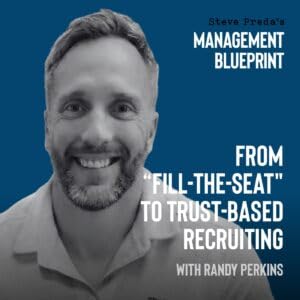
  • 369: From “Fill-the-Seat” to Trust-Based Recruiting with Randy Perkins
    2026/10/13
    https://youtu.be/WqR_N4qFZbE Randy Perkins, CEO and Co-Founder of FreightPro.ai, is helping commercial transportation move From “Fill-the-Seat” to Trust-Based Recruiting by connecting quality drivers with quality carriers. Driven by a desire to support underrepresented people, Randy built FreightPro.ai to give drivers a stronger voice, help carriers create safer workplaces, and raise standards across the transportation industry. In this conversation, Randy introduces The Aligned Driver Recruiting Framework—Build Driver and Carrier Profiles, Validate with Research & Questions, Match Driver and Environment, Build Trust Through Human Touch, and Refine Continually. He explains why effective recruiting requires understanding a driver’s experience, endorsements, safety record, home-time needs, personality, and ability to handle specific routes and working conditions. Randy also discusses using AI and FMCSA data to evaluate 25 qualification measures, reduce recruiting noise, and identify stronger matches without replacing human judgment. He shares why trust and consistency drive growth, how FreightPro.ai combines blue-collar industry knowledge with technology, and his vision for connecting fragmented transportation data into one secure network. — From “Fill-the-Seat” to Trust-Based Recruiting with Randy Perkins Good day. Steve Preda with The Management Blueprint. And my guest today is Randy Perkins, the CEO and co-founder at FreightPro.ai, building a platform centered on commercial driver recruiting, retention, and workforce alignment for carriers, 3PLs, and transportation companies. Randy, welcome to the show. Pleasure to be here, Steve. Thanks so much for having me. Well, absolutely. I’m curious about this business that you’re in. We talked a little bit about the podcast recording that I’m always thinking about what these drivers’ lives are like, and you see that there are all those stickers in the back of trucks that they try to recruit drivers. So it’s going to be a tricky business, and you’re in the middle of it. So we’re going to talk about this. But before we start on this, I’m curious about what is your personal why, and how are you manifesting it in FreightPro.ai? My personal why. That’s a touchy subject. It’s a good subject, but it’s touchy. I got a soft spot for individuals that need others. I grew up in a less-than-ideal environment, and I wish that I had more individuals that would’ve helped me out. So growing up my whole life, I knew I wanted to contribute something in regard to giving back to somebody that needed it.Share on X I started off coaching with children, doing things of that nature, have my own children. It’s a blessing. And then also got into logistics. Through getting into logistics, I worked at ITS. We were a great brokerage there. They were one of the best in class. Man, it was phenomenal. My exposure in that realm of logistics, which is broker-to-carrier and broker-to-shipper, shined light on a layer deeper, which was the driver-to-carrier. And it struck me similarly to children, where it was a class that is underrepresented and means so much to the industry, right? Where the futures of drivers are just as important. And I don’t know of an industry where you can have somebody that has the potential to make upwards of six figures plus and not have to have a resume or have any sort of consistent tenure at any one job, where you don’t have to have professionalism to back it. And that’s driven, I think, partly in context to the stereotypes that have been driven over the years. Drivers for the longest time were classified as unintellectual, right? Didn’t have an education. They got classified as roughnecks, brutes. The reality is they are roughnecks to a certain extent because they have to be, because that environment is critical. It is extremely dangerous. And yeah, so to a certain extent, but that’s in a positive way, not in a negative. But for a long time, those stereotypes that were landed have stuck, and there’s been a stigma. And drivers have essentially turned into a recurring revolving door of employment, where they’re tossed to the curb during slow times and they’re brought on real quick, and it’s a knee-jerk reaction. And how do you expect to have any sort of quality on the road and safety if the carriers and drivers don’t take it seriously to work amongst themselves? And that was what kicked open the door for me when I was at ITS, and I was like, “Man, you hear carriers talking about their drivers and drivers talking about their carriers, and I’m going, “Man, how come there’s not just a mutual agreement where everybody worked together collaboratively?” And I knew that I couldn’t accomplish that at ITS, so I broke off and started FreightPro. And the whole mission of FreightPro was to raise the standard of the industry, and we’re starting off by working diligently on engaging drivers via ...
    続きを読む 一部表示
    28 分
  • 375: Build a Supergroup of Retired Experts with Tom Pugh
    2026/10/26
    https://youtu.be/wlAcWeaQaFs Tom Pugh, Founder and former CEO of Pugh Associates, shows experienced professionals how to build a supergroup of retired experts by staying in their swim lane, recruiting seasoned peers, and pursuing complex opportunities years in advance. After 35 years in Navy and defense engineering, Tom started his consulting business at 60 to use his expertise while staying home to support his wife. In this conversation, Tom introduces The Supergroup of Experts Framework—Stick to Your Swim-lane, Keep Tabs on Talented Peers, Identify Opportunities, Nurture Decision Makers, and Eat What You Kill Together. He explains how he assembled experienced engineers, offered their expertise on a fractional basis, and paired them with younger professionals to transfer knowledge. Tom also shares why in-person presence drives growth, how shared-risk compensation helped launch the firm, and why complex contracts should be pursued years before an RFP appears. — Build a Supergroup of Retired Experts with Tom Pugh Good day, listeners. Steve Preda here with the Management Blueprint Podcast. And my guest today is Thomas Pugh, the Founder and former CEO of Pugh Associates, a firm that supports the U.S. Navy, Army, and Coast Guard customers with combat system engineering, integration, test, and program management services. Thomas now consults and advises defense, maritime, and space organizations managing complex technical programs. Tom, welcome to the show. Yeah. Well, hey, thank you for having me, and I’ve enjoyed chatting with you just before the show, and I look forward to getting on with it. Be good. All right. Well, my first question is really my favorite question that I ask on this podcast. What is your personal why, and how have you manifested it through your business and perhaps your current consulting career? Yeah. So it’s an interesting evolution. And I worked for the Navy. I got an engineering degree many, many years ago at Florida Tech, and in my first job, I ended up working for the Navy in their engineering system commands. And spent a bunch of years there. Got involved in the Aegis system, which is an air defense system, and along the way, spent a bunch of years with that. Had a chance to go into private industry, worked for Northrop Grumman, and I was on a new ship class design, a Zumwalt class, as a systems engineer. And so, as we got to a critical design review, the tasking kind of ended for the systems engineering group. And I had to either get a new charge number, to quote my boss. If anybody who’s worked for a large corporation, you’ve probably heard that. I don’t know. What’s a charge number? What’s a charge number? Is it like a salary? Yeah. It’s a new project to work on where they’ll pay you. You couldn’t stay on overhead very long because you were making too much money as an engineer. Okay. Got it. Yeah. So they didn’t want you on overhead. So when I say get a new charge number, it’s a new project to work. And it coincided with my wife having some health problems. And so the why I started the business was I looked at what I was getting, what Northrop Grumman was charging for me versus how much they actually paid me. And I’m sitting there going, “I really need to help my wife out a little bit,” and going to work every day. Why don’t I print up some business cards? And I got my son to build a website. And I said, “You know what, Northrop, I appreciate everything that you’ve done for me,” and we parted ways, and I started a consulting business. So that was the why. It was, “Hey, I have something to offer.” At that point, I had 35 years' experience or so, and why not provide that as a consultant and be able to help stay at home?Share on X So that’s the why I started the business, and that pretty much sums it up. So how old were you when you started, if I may ask? Good question. I started the business, so I must have been 60. Wow. Yeah. Yeah, I was 60. That’s very courageous to start a business at 60. Yeah, well, so all you entrepreneurs out there, when you feel like you’re stepping off a cliff, you’re giving up. At that point, I had a six-figure salary, and I’m going into this abyss where there isn’t any salary. And then you’re sitting there going, “Okay, how am I going to do this?” Right? Back in the day, Steve, I don’t know if you ever remember, you’re old enough to probably have seen it, but we had a guy who would come on an advertisement, and he was making believe he was selling whatever he was selling. And he said, “I can do that. I can do that.” And then as soon as he hung up with the person he was selling, he says, “How am I going to do that?” Sell first and figure out later. Yeah. It’s like you’re stepping off into an abyss and giving up a very comfortable salary, but it was worth it because I was able to stay home with my wife. Yeah. But it was scary. And ...
    続きを読む 一部表示
    27 分
  • 372: Create Digestible & Resonant Content with Mimi Banks
    2026/10/19
    https://youtu.be/oIGvtm47c2c Mimi Banks, Founder and CEO of MB Social, helps beauty brands create digestible & resonant content while building social media communities where every customer feels heard. Drawing on 15 years at L’Oréal USA and her experience leading social media for Lancôme, Mimi built a fully distributed agency around warmth, attention, honesty, and genuine community engagement. In this conversation, Mimi introduces The User-Generated Content Framework—Make It Look Real, Don’t Over-Produce, Use the Product Sensibly, Ensure Light & Sound Works, and Keep the Product Up Close. She explains how brands can create user-generated content that feels relatable while maintaining professional quality. Mimi also discusses using AI to extend limited creative assets without creating fake influencers, growing through social listening and the question “How can I help?”, and keeping humans involved in community management. She shares why brands must listen before engaging on Reddit and how MB Social and Med Creator 101 help beauty brands and healthcare professionals strengthen their social media presence. — Create Digestible & Resonant Content with Mimi Banks Good day. Steve Preda here, and my guest today on the Management Blueprint, Mimi Banks, the Founder and CEO of MB Social, a leading full-service social media agency specializing in beauty, with a strong focus on skincare. MB Social is based in LA but has a fully distributed workforce, and it partners with top-tier brands and experts. Mimi spent 15 years at L’Oréal USA in New York and Paris, where she led social media for Lancôme. So Mimi, welcome to the show. Thank you for having me. I think you’re the first beauty entrepreneur on this show, so— Oh, really? Wow. It’s pretty special. 360 episodes in, great to have you here. Wow. Thank you for having me. I’m excited to represent the beauty industry today. That’s right. You also have a company name which is similar to my former company name. Yours is MB Social. We were MB Partners. Oh, I love it. Yeah. I love it. It kind of resonates with that. So jumping in, what is your personal why, and how are you manifesting it at MB Social? So just to get straight to the point, my why comes down to one belief. Everyone wants to feel heard. I learned that pioneering community management benchmark at L’Oréal long before community management was even a job title, and I built MB Social entirely on it. Behind every comment, every DM, every tagged post is a real person who wants to be heard, who deserves a real response.Share on X Wow. And then, so how do I manifest that? I manifest it every day by treating our clients and their audiences in a way I’d want to be treated, with warmth, attention, and honesty. So it’s why our community managers do what they do. They learn the inside jokes. They learn the regulars, and this is actually also how I run MB Social. We listen, and we care. Love it. That’s our operating system. That’s a pretty robust one, I must say. I like to think of a company as it’s a group of people dedicated to a mission. And if you engage and energize and inspire and care for these people, then you can’t go too much wrong. That’s true. Yeah. So tell me about how you came with this idea that you wanted to… I mean, you had a great career working for the greatest brands in beauty. What prompted you to strike out on your own, or strike out on your own? So essentially, at age 30-something, I was given the opportunity to lead social media for the Lancôme brand. Just started it. And I found that, again, at age 30-something, I fell in love with this job. I had been working for a long time, still passionate about working for L’Oréal, but I hadn’t found my why, and then it clicked for me. I fell in love. I saw that I was good at it. But what happened was, even after two years winning awards, doing all of the things, being the first, getting cited in the greatest publications, or exceeding my goals, there was nowhere to go. I was too early, and this was in 2014. So I did what many entrepreneurs do, and I followed my belief. I got offered a job to work at a startup that was all about user-generated content, which was absolutely amazing. And there I took the leap for six months. People thought I was crazy, but I went based on my belief and my hunch, and the rest is history. I then started off my path with saying, “How can I help?” And that’s been the motto that we’ve had for the past 12 years at MB Social. So this startup that you joined was MB Social, or? No. So the startup I joined was a startup called Preen.Me. It was a community of creators. They created user-generated content for beauty brands. So I was really passionate about user-generated content, again, in 2014, so it was amazing. And a friend of mine who used to work at L’Oréal worked there. And so I left my job that was in a corporate environment, ...
    続きを読む 一部表示
    30 分
  • 371: Make Your Crops Bigger, Healthier & Cheaper with Doug Kremer
    2026/10/16
    https://youtu.be/COQT4g-johk Doug Kremer, CEO of TerraMax, Inc., helps growers discover how to Make Your Crops Bigger, Healthier & Cheaper through scientifically validated microbial products for seeds, crops, lawns, and turf. Driven by scientific curiosity and a desire to reduce agriculture’s reliance on chemical inputs, Doug has spent more than 40 years exploring how beneficial bacteria can improve nutrient efficiency, promote plant growth, and support more environmentally responsible production. In this conversation, Doug introduces The Crop Nutrition Framework—Proper Nutrient Addition, Pathogenic Control, Irrigation, Soil Health, and Soil Tilth. He explains why microbial products should complement conventional fertilizers rather than immediately replace them, how soil structure affects water drainage and oxygen transfer, and why field trials are essential for proving microbial performance. Doug also discusses expanding TerraMax beyond its science-led roots, communicating its value more effectively, and reaching growers through stronger sales and distribution networks. — Make Your Crops Bigger, Healthier & Cheaper with Doug Kremer Good day, dear listeners. Steve Preda here with the Management Blueprint Podcast, and my guest today is Doug Kremer, the CEO of TerraMax, Inc., an agricultural manufacturer applying bacteria to produce powders and liquids for seeds, crops, lawns, and turf to naturally promote plant growth. Doug, welcome to the show. Thank you very much, Steve. It’s a pleasure to be here and meet you. Yeah, I’m very excited because you are running an agricultural production company, which is kind of a unique animal on this show. So I’d love to dig in more. But let me start with my favorite question. What is your personal why, and how are you manifesting it in TerraMax, Inc.? First off, I found that to be a very interesting question. My background is more technical, genetic engineering, et cetera. I got into microbes. Literally, it was a fascinating subject to me, partly because most of what we’ve learned was, at the time, 30 years ago, academia, and there was very little successful use of microbes generally, other than other types of products that may not have performed up to the standards that people have gotten used to with chemistries, right? So I’ve been in science for 40-plus years. I looked at that as an opportunity. So there is a piece of the committed or should-be-committed individual who said, “I think I can do this better.” So the why was really, if we’re going to complain about the impact of chemistries, yet we don’t develop products that can supplant them in the marketplace, that’s on us. You don’t cross your fingers and hope that nature is going to fool people. That’s why we do field trials, that’s why we do these things, but the onus is on us to develop those. So I took that seriously and, like I said, as a challenge. And in the first two years of our company’s life, that’s what I was working on. It was a very small group back then. And so it was taking seriously what we’re doing, and that may sound funny to people, and I’m sure there are people that will disagree, but sending those products through their paces, or the bacteria in some instances. So scientifically generating the data was a big part of what I’ve done and what we’ve done. I really need to, these days, talk much more in plural. We’re still a very small company. We’ve been around for 28-plus years, but we’re 29 people. And only a portion of that, a small portion of that, about five people, is dedicated to the research end. But we were lacking a lot of the data we needed in showing the responses. So I hate to get technical right away on this, but things like N-15 work, which is proving that the nitrogen in a plant came from your bacteria. That’s something that was really important to me. Quantifying nitrogen from microbes, while there has been a ton of work on it, is still very prey to the environmental conditions. So there’s always room for improvement, is I think what that comes down to. Yeah. But the why, to be—I ramble, and I apologize—but the why was really the personal inquisitiveness to go after these questions, and can we make them? And I could share data with you or anyone who is interested, basically, on what that path has described to us. And I’m happy to tell you we have been fairly successful at the science portion of this. We’re still not where I would like to see us in a business sense. But I believe we’re well-known for our approach using the rigors of science where it’s applicable. Because believe me, when you go out in nature, there’s a lot of variables that you didn’t think about in terms of the expression that these things could have. But in a nutshell, it was a great challenge. Yeah. No, I love it. I mean, it sounds like it’s a very visionary approach. You realize that we are… I mean, I’m interpreting it...
    続きを読む 一部表示
    28 分