エピソード

  • Play Your Way to a Stronger Brain: Video Games, Wearables & Brain Health with Dr. Julia Scott, Ph.D.
    2026/09/02
    For a long time, video games and brain health existed in completely separate conversations. Games were entertainment — a guilty pleasure at best, a concern at worst. That is changing. And the science behind that change is more compelling than most people realize.In this episode Dr. Krystal Culler and co-host Dr. Jonathan Artz, MD sit down with Dr. Julia Scott, Ph.D. — neuroscientist, researcher, and co-founder of Gambit Labs — to explore video games and wearable sensors as genuine tools for brain health. Not as a replacement for the fundamentals, but as a powerful and increasingly accessible addition to our brain care toolkit — one that can reveal things about our brains we have never been able to see before.What You'll Learn in This Episode🧠 What types of video games Dr. Scott's work focuses on — and how they differ from passive gaming experiences🧠 What is actually happening in the brain when we play the right kind of game — and why games accelerate learning in ways traditional training cannot🧠 Why every game is quietly generating a portrait of your brain through patterns of behavior🧠 The difference between games designed for cognitive assessment versus intervention — and why that distinction matters🧠 What dark mechanics are — and how some games deliberately hijack dopamine systems to override good judgment🧠 What happens when wearable sensor data is integrated into gameplay in real time — and what that unlocks about self-awareness and self-regulation🧠 Why agency is the central value driving the work at Gambit Labs🧠 What Gambit Labs is building for neurodivergent youth — biofeedback-enhanced games focused on executive function and self-regulation🧠 Where the field is heading Key Takeaways✔ Not all games are created equal — the games that matter for brain health are built with intention and clinical science✔ Every game generates a portrait of your brain through patterns of behavior — strategy, reaction time, reward processing, and more✔ Wearable sensors become 10x more powerful when paired with strategically designed games — giving you the relationship between brain state and behavior in real time✔ Agency over your brain health begins with knowledge — when you can see what is happening inside, you can do something about it✔ The FDA has now cleared a second game-based ADHD intervention — the proof of principle that this approach works is no longer in question✔ Games are not just play — they are play with purposeEarn FREE CEsThis podcast qualifies for continuing education credit for the following healthcare professionals: Physicians (AMA PRA Category 1 Credit™), Nurses (ANCC), Pharmacists (ACPE), Physician Associates (AAPA), Dentists (ADA CERP), Dietitians (CDR), Social Workers (ASWB), Psychologists (APA), Athletic Trainers (BOC), and Interprofessional Continuing Education (IPCE).Each eligible episode offers 0.5 hours of FREE CE credit. Not seeing your profession listed? You will receive a Certificate of Participation to submit to your licensing board for possible credit approval. Join the Learn at Pinnacle app to earn FREE CE credit for listening to this episode — available on the Apple App Store and Google Play.Support the PodcastIf you enjoyed this episode, please help us grow the conversation around better brain health:Follow or subscribe to the Let's Talk Brain Health! PodcastLeave a rating or reviewShare this episode with a friend, colleague, or fellow brain health advocateThank you for investing your time and energy into your brain health. A special thank you to Dr. Julia Scott for reminding us that games are not just play — they are play with purpose. 🧠🎮ResourcesConnect with Dr. Julia Scott LinkedIn and YouTube PlaylistDiscover Dr. Julia Scott's work at the Brain and Memory Care Lab at Santa Clara UniversityLearn more about Gambit LabsRead more about XRSI for technology privacy and safetyExplore Rachel Kowert's Gaming Guide for Parents online here
    続きを読む 一部表示
    35 分
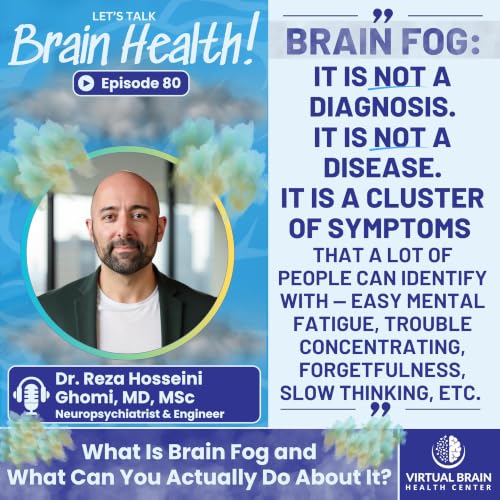
  • What Is Brain Fog and What Can You Actually Do About It? with Dr. Reza Hosseini Ghomi, MD, MSc
    2026/08/19

    You know something is off. The word you were reaching for is gone. The thought dissolves before you finish it. You read the same sentence three times and still cannot hold onto it.

    That is brain fog. And in this episode of the Let's Talk Brain Health! Podcast, Dr. Krystal Culler sits down with Dr. Reza Hosseini Ghomi — neuropsychiatrist, biomedical engineer, and serial health-tech founder — to finally give it the language, the science, and the path forward it deserves.

    Brain fog is one of the most common complaints in brain health — and one of the most dismissed. Most people are told they are tired, stressed, or just getting older. Today that changes.

    Dr. Ghomi sees patients with a focus on neurodegenerative disorders and cognitive health across a wide range of conditions — including the growing wave of post-COVID cognitive complaints. His message is clear: brain fog is real, it is worth investigating, and in most cases it is reversible.

    What You'll Learn in This Episode

    🧠 What brain fog actually is — and why it is a symptom cluster, not a diagnosis

    🧠 The full range of symptoms to recognize — from mental fatigue and forgetfulness to word-finding difficulties and slow processing

    🧠 How brain fog may present differently in women versus men — including perimenopause, postpartum, thyroid disorders, and hormonal shifts

    🧠 How to talk to a healthcare provider about brain fog — and what to bring to that appointment to be taken seriously

    🧠 The biggest myths and misconceptions about brain fog — including why "it's all in your head" is both wrong and dismissive

    🧠 The three most evidence-informed lifestyle factors contributing to brain fog — sleep, physical activity, and metabolic and nutritional stability

    🧠 Why blood sugar swings, vitamin deficiencies, and iron levels matter more than most people realize

    🧠 How wearable devices and symptom tracking can help you and your provider identify patterns

    🧠 A real patient case study — a woman in her late 40s caring for a parent with Alzheimer's who recovered from significant brain fog in 90 days

    🧠 Why brain fog is a signal — not a sentence — and what that means for your brain health journey

    Key Takeaways

    ✔ Brain fog is not a diagnosis — it is a cluster of symptoms worth tracking, naming, and taking to a provider

    ✔ It is almost always reversible — and the sooner you address it, the more preventable the underlying causes become

    ✔ Sleep is the highest-leverage lifestyle factor — protect it like the non-negotiable it is

    ✔ Come to your appointment with data — a symptom diary, medications, supplements, and nutritional patterns make a significant difference

    ✔ Do not accept dismissal — advocate for yourself, and if one provider does not help, find another

    ✔ Brain fog is your brain communicating — not failing. Listen to what it is asking for

    Earn FREE CE/CMEs

    This podcast qualifies for continuing education credit for the following healthcare professionals: Physicians (AMA PRA Category 1 Credit™), Nurses (ANCC), Pharmacists (ACPE), Physician Associates (AAPA), Dentists (ADA CERP), Dietitians (CDR), Social Workers (ASWB), Psychologists (APA), Athletic Trainers (BOC), and Interprofessional Continuing Education (IPCE).

    Each eligible episode offers 0.5 hours of FREE CE credit. Not seeing your profession listed? You will receive a Certificate of Participation to submit to your licensing board for possible credit approval.

    Join the Learn at Pinnacle app to earn FREE CE credit for listening to this episode — available on the Apple App Store and Google Play.

    Thank you for investing your time and energy into your brain health. A special thank you to Dr. Reza Hosseini Ghomi, MD for reminding us that brain fog is a signal — not a sentence — and that you are allowed to feel better.

    Resources

    • Continue to learn more with Dr. Reza Hosseini Ghomi at rezahg.com

    • Stay connected with Dr. Ghomi on social media on LinkedIn, Instagram, and TikTok @drrezaghomi


    続きを読む 一部表示
    33 分
  • Your Body Is Talking — Are You Listening? A Brain Care Story of Chronic Pain, Nervous System Health & Recovery with Nora Rodden, MS, MBA
    2026/08/05
    What if the symptoms your body was sending you were trying to tell you something your mind had not yet figured out how to hear?In this episode of the Let's Talk Brain Health! Podcast, Dr. Krystal Culler makes space for a story. Because at the heart of brain health is not just the science— it is the lived experience. The hard seasons. The wisdom that only comes from having walked through something yourself and come out the other side with something worth sharing.Nora Rodden is the Founder and CEO of Nervana, an AI-powered digital health company helping people with chronic symptoms explore the psychological and emotional factors that may be contributing to how they feel. But before the company and the Harvard MBA, Nora spent years navigating chronic back pain following a car accident, debilitating GI symptoms, and insomnia — searching desperately for answers that conventional medicine could not give her. What she eventually discovered changed everything. And she has dedicated her career to making sure others do not have to search as long as she did.This is her brain care story.What You'll Learn in This Episode🧠 Nora's journey from a car accident at college to years of chronic pain, GI symptoms, and insomnia, and what it felt like to navigate all three simultaneously in her early 20s🧠 Why chronic symptoms can be an invisible illness and the emotional and financial toll of searching endlessly for answers🧠 How the nervous system gets stuck in a chronic fight or flight state and why that can perpetuate physical symptoms long after the original injury has healed🧠 What the mind-body connection actually means 🧠 The Harvard clinical trial that changed Nora's life and what a structured mind-body program actually looks like in practice🧠 Why your brain's predictive processes matter for chronic symptoms and how neuroplastic recovery approaches work🧠 How Nora built Nervana to make structured mind-body programs accessible to anyone with chronic symptoms🧠 What it means to learn your brain and body's language — and how that changes everything🧠 The one piece of advice Nora would give her earlier self Key Takeaways✔ Chronic symptoms are not your fault — and understanding that changes everything✔ The nervous system can get stuck in fight or flight long after the original trigger is gone — and that perpetuation is real, physical, and treatable✔ Your brain and your body are not separate — considering both is essential to healing✔ A structured program removes the cognitive load of behavior change — and that matters more than most people realize✔ You do not have to figure this out alone. Community, recovery stories, and the right tools at the right time make all the difference✔ Give yourself some grace. Whatever you are experiencing — listen to your body, listen to your brain, and get a little closer to understanding what might be happening internally.Earn FREE CEsThis podcast qualifies for continuing education credit across 10 healthcare professions. Join the Learn at Pinnacle app to learn more and earn FREE CE/CME credit for listening to this episode!Support the PodcastIf you enjoyed this episode, please help us grow the conversation around better brain health:Follow or subscribe to the Let's Talk Brain Health! Podcast on your favorite platformLeave a rating or reviewShare this episode with a friend, colleague, caregiver, or fellow brain health advocateThank you for investing your time and energy into your brain health. A special thank you to Nora Rodden for trusting me with her story — and for turning her own hard season into a resource for everyone still searching for answers.ResourcesLearn more about Nora's work and explore the Nervana app at trynervana.comConnect with Nora on LinkedInExplore free mind-body recovery resources at the Association for Treatment of Neuroplastic Symptoms at symptomatic.me Read Scarcity Brain by Michael Easter — recommended by Nora and reviewed by the Neuro Nook (book club)
    続きを読む 一部表示
    40 分
  • More Walking, Less Dementia: What Your Feet Are Telling Your Brain About Health and Longevity with Dr. Courtney Conley, DC & Dr. Milica McDowell, DPT
    2026/07/22
    This podcast episode is a conversation from the Neuro Nook (book club) where Dr. Krystal Culler and co-host Heather Elwell spoke with the authors of the National Bestseller Walk: Rediscover the Most Natural Way to Boost Your Health and Longevity, One Step at a Time — Dr. Courtney Conley, DC and Dr. Milica McDowell, DPT — for a conversation that may likely shift change the way you think about walking. Today, fewer people realize they need to walk each day.What You'll Learn in This Episode🧠 Why walking belongs alongside breathing and sleeping as one of the three essential physiological functions we need to survive🧠 The surprising foot-brain connection 🧠 What to look for when you look down at your feet🧠 What an efficient walking gait actually looks like — and the simple cue that changes everything: roll the earth away🧠 What makes a healthy shoe choice — and the three criteria to look for when buying footwear🧠 Gait speed as the sixth vital sign — and what your walking speed can predict about your cognitive health up to nine years in advance🧠 The step count research on dementia risk — and why 3,800 to 9,800 steps per day could reduce your risk by 25 to 51 percent🧠 How walking impacts mental health — and why 5,000 steps per day has been shown to reduce symptoms of depression🧠 The power of the five-minute micro walk — and why five minutes is enough 🧠 Movement snacks from the book 🧠 How to find time for walking in a busy life Key Takeaways✔ Walking is a physiological necessity — not optional, not a luxury, and not a low-level activity✔ Your foot occupies massive real estate in your brain's sensory map — what happens from the ground up matters deeply for your overall health✔ Gait speed is the sixth vital sign — and it can predict cognitive decline up to nine years before diagnosis✔ Walking 3,800 steps per day reduces dementia risk by 25% — walking 9,800 reduces it by more than 50%✔ Five minutes counts — the micro walk is real, accessible, and powerful✔ Walk more, die less — the research is overwhelming and the prescription is freeThe Neuro Nook Rx from Walk📋 Add Vitamin W (Walk) to your daily brain care. Start with 5-minute intervals (≈500 steps) and build up to 30–35+ minutes a day (≈5+ days/week).📋 Take a brisk walk (≈112 steps/per minute) for 30 minutes per day.Earn FREE CEsThis podcast qualifies for the following credit types:: Physicians: AMA PRA Category 1 Credit™ (CME)Nurses: ANCCPharmacists: ACPEPhysician Associates: AAPADentists: ADA CERPDietitians: CDRSocial Workers: ASWBPsychologists: APAAthletic Trainers: BOCInterprofessional Continuing Education: IPCE Join the Learn at Pinnacle app to earn FREE CE credit for listening to this episode!Support the PodcastIf you enjoyed this episode, please help us grow the conversation around better brain health:Follow or subscribe to the Let's Talk Brain Health! PodcastLeave a rating or reviewShare this episode with a friend, colleague, caregiver, or fellow brain health advocateThank you for investing your time and energy into your brain health. A special thank you to Dr. Courtney Conley, DC and Dr. Milica McDowell, DPT for calling us into a collective all to action– and promise to keep walking with them?ResourcesReview the Neuro Nook Book Club Summary of the book– Walk: Rediscover the Most Natural Way to Boost Your Health and Longevity, One Step at a Time– Including the Q&A and Final Takeaways from the authors on Substack Grab your copy of Walk: Rediscover the Most Natural Way to Boost Your Health and Longevity, One Step at a TimeExplore Dr. Courtney Conley's work and education platform at Gait Happens and connect with them on Instagram and YouTubeFollow Dr. Courtney Conley, DC on her personal Instagram and SubstackFollow Dr. Milica McDowell, DPT on Instagram and SubstackLearn more about the Neuro Nook Book Club from the Virtual Brain Health Center
    続きを読む 一部表示
    44 分
  • Hardwired for the Negative–But Not Stuck There: the Negativity Bias & The Science of Gratitude with Dr. Diego Salinas, MD, NBC-HWC
    2026/07/08
    Your brain is not working against you. It is working for you — the best way it knows how. But sometimes that wiring gets in the way.In this episode of the Let's Talk Brain Health! Podcast, Dr. Krystal Culler sits down with Dr. Diego Salinas — pediatrician, neuroscientist, and board-certified health and wellness coach — for a rich, practical, and deeply human conversation about two things that are more connected than most people realize: your brain's built-in negativity bias and the science of gratitude.We explore why your brain holds onto the hard stuff, what happens during emotional flooding, and how understanding that wiring gives you the power to work with your brain instead of against it. Because here is what the science is telling us: we are not at the mercy of our brains. We can train them. And the tools to do that are more accessible than most people think.What You'll Learn in This Episode🧠 What the negativity bias is — and why it is a survival mechanism, not a character flaw🧠 What is actually happening in the brain during emotional flooding — the amygdala, limbic system, and prefrontal cortex explained🧠 Why emotional validation measurably lowers amygdala activation — and what it actually means to validate an emotion🧠 The HALT check-in — a simple tool for identifying what is driving a heightened emotional state🧠 How the language you use — "I am excited" vs. "I am stressed" — can change your brain's recovery time🧠 Where gratitude enters the brain and how it helps rebalance the negativity bias🧠 Why gratitude is not toxic positivity — it is corrective lenses for a brain already biased toward the negative🧠 Dr. Diego's three-category gratitude method: the big things, the under-the-radar things, and the comically small things🧠 Why you should practice gratitude before you need it — and how to make it stick in daily lifeKey Takeaways✔ The negativity bias is not a character flaw — it is your brain doing its job✔ Emotional validation means acknowledging that what someone felt was real — and it measurably changes brain state✔ Gratitude gives your brain corrective lenses to also see what is good — factual, not fantastical✔ Small, consistent practice rewires the brain over time — neurons that fire together wire together✔ Practice gratitude before you need it. It is a protective tool, not just a reactive one✔ We are all sloppy stardust in the messy middle — compassion for yourself is part of the practiceEarn FREE CEsThis podcast qualifies for the following credit types: AMA PRA Category 1, ANCC, AAPA, APA, ASWB, and IPCE. Join the Learn at Pinnacle app to earn FREE CE credit for listening to this episode!Support the PodcastIf you enjoyed this episode, please help us grow the conversation around better brain health:Follow or subscribe to the Let's Talk Brain Health! Podcast on your favorite streaming platformLeave a rating or reviewShare this episode with a friend, colleague, or fellow brain health advocateThank you for investing your time and energy into your brain health. A special thank you to Dr. Diego Salinas for reminding us that life is a constant restart — and that is exactly enough.ResourcesConnect with Dr. Diego Salinas, MD, on LinkedIn or view his coaching profile on ViblyLearn more about Vibly, an all-in-one platform for health coachesStay connected with Vibly on Instagram, Facebook, and LinkedInWatch the "It's Not About the Nail" videoExplore previous podcast episodes on brain-based behavior change and brain health coaching
    続きを読む 一部表示
    45 分
  • Sunlight Is the Unspoken Nutrient: Vision, Light & Brain Health with Dr. Marion Van Horn, PhD
    2026/06/24
    When was the last time you stepped outside and just looked up?Not at your phone. Not at a screen. Just up — at the sky, the light, the world around you. If it has been a while, your brain has noticed. And this week's guest is going to tell you exactly why that matters.In this episode of the Let's Talk Brain Health! Podcast, Dr. Krystal Culler sits down with Dr. Marion Van Horn — neuroscientist, science communicator, and mother of three — for a conversation that will change the way you think about your eyes, your light environment, and your brain health.Vision is not just seeing. It is how your brain regulates your mood, sets your sleep, manages your emotions, and builds its picture of the world — all in milliseconds. And natural light — something most of us walk past every day — is one of the most powerful inputs our brains receive. Dr. Marion calls it the unspoken nutrient. And after this episode, you will never think about sunlight the same way again.This episode also features a special collaboration —'Take a Brain Break'—' coloring page created by Dr. Marion Van Horn, Dr. Maria Zamfir, and Dr. Krystal Culler. Find it free in the show notes.What You'll Learn in This Episode🧠 How the brain actually learns to see — and why vision is not automatic at birth🧠 What neuroplasticity means for visual development across the lifespan🧠 Why natural sunlight is the unspoken nutrient your brain needs every day🧠 The relationship between light, circadian rhythms, sleep, and mood🧠 What screens and artificial light are doing to your brain and body🧠 How visual pathways connect directly to emotional centers — including the amygdala🧠 Why going outside when you feel overwhelmed works neurologically — not just psychologically🧠 How the two eyes work together to create three-dimensional vision🧠 Why vision loss is a modifiable risk factor for dementia — and why your annual eye exam matters🧠 Practical steps to protect your visual brain health starting todayKey Takeaways✔ Natural light is the unspoken nutrient — get outside within the first hour of waking, even for a few minutes✔ Vision actively regulates how you feel and how you interact with the world — it is so much more than seeing✔ Your eyes are part of your brain — protecting your vision is protecting your brain✔ Going outside changes your gaze, your nervous system, and your emotional state✔ Uncorrected vision loss increases dementia risk — prioritize your annual eye exam at every age✔ Small consistent habits — morning light, noticing the sunrise, watching the moon — add up over timeEarn FREE CEsThis podcast qualifies for the following credit types: AMA PRA Category 1, ANCC, AAPA, APA, ASWB, and IPCE. Join the Learn at Pinnacle app to earn FREE CE credit for listening to this episode!Support the PodcastIf you enjoyed this episode, please help us grow the conversation around better brain health:Follow or subscribe to the Let's Talk Brain Health! PodcastLeave a rating or reviewShare this episode with a friend, colleague, or fellow brain health advocateThank you for investing your time and energy into your brain health. A special thank you to Dr. Marion Van Horn, PhD for reminding us that one of the most powerful things we can do for our brains costs nothing at all. Go outside. Look up.Resources:Explore Marion’s work and resources on ⁠her website⁠Connect with Marion on Social media @marion.phd on ⁠Instagram ⁠Download Our “Let’s Take A Brain Break” coloring page on our websiteContinue to learn from The Neuron Family on Instagram or their newsletterCheck out The Neuron Family’s colouring books on its website or LinkTr.eeOrder Volume 1: The BrainOrder Volume 2: How We FeelOrder Volume 3: How We See
    続きを読む 一部表示
    39 分
  • Why Your Brain Needs Play: Creativity, Confidence & Connection with Rachael Renae
    2026/06/10
    What if one of the most powerful tools for your brain health has been sitting on the shelf since childhood — and you just forgot to pick it back up? In this episode of the Let's Talk Brain Health! Podcast, Dr. Krystal Culler, DBH, MA sits down with Rachael Renae— artist, play enthusiast, creative educator, and debut author of Prioritize Play: Express Your Creativity, Boost Your Confidence, and Foster Deeper Connection — for a conversation that will change the way you think about play, creativity, connection, and what it truly means to care for your brain.We often hear brain health advice centered on movement, sleep, nutrition, and stress management. But how often are we told to write a haiku between meetings, make a seasonal play playlist, or simply follow the fun — just for the brain-building benefit of it? The science says we should be.A former engineer with over a decade in her field, Rachael discovered that what was missing from her life wasn't a career change — it was play. This conversation is for anyone who has ever said "I'm not creative," "I don't have time for play," or quietly wondered why life feels a little gray lately.What You'll Learn in This Episode🧠 Why play is not frivolous — it is a brain-building practice backed by science🧠 What play actually is and the key ingredients that make something truly playful for adults🧠 Why every single person is creative, whether they believe it or not🧠 What the brain loses across creativity, confidence, and connection when play disappears🧠 How play supports stress reduction, emotional processing, neuroplasticity, and social bonding🧠 How to find time for play using things you are already doing every day🧠 Practical 5-minute play challenges — no equipment, no budget, no free afternoon required🧠 What the "Friend File" is and how it addresses loneliness and social isolation🧠 How to rewire your brain to seek wonder in everyday routines🧠 The power of the seasonal "playlist" — a to-do list made up entirely of play activitiesKey Takeaways✔ Play belongs on your to-do list right next to the groceries and the bills✔ Creativity is not a talent reserved for artists — it is a built-in human need✔ Small, consistent, intentional moments of play rewire the brain toward curiosity and connection✔ Non-zero play days are enough — one small playful moment today is a powerful place to startEarn FREE CEsThis podcast qualifies for the following credit types: AMA PRA Category 1, ANCC, AAPA, APA, ASWB, and IPCE. Join the Learn at Pinnacle app to earn FREE CE credit for listening to this episode!ResourcesExplore Rachael’s work and resources on her websiteCheck out her new book, “Prioritize Play: Express Your Creativity, Boost Your Confidence, and Foster Deeper Connection”Learn more about Rachael’s creative community, the Juice BoxListen to the “Chaotic Creatives” podcast on Apple & SpotifyConnect with Rachael on Social media @RachaelRenae on Instagram Learn more about our “A Kids Book About Brain Health” on our website and download our free coloring pages– fun for all ages! Support the PodcastIf you enjoyed this episode, please help us grow the conversation around better brain health:Follow or subscribe to the Let's Talk Brain Health! PodcastLeave a rating or reviewShare this episode with a friend, colleague, caregiver, or fellow brain health advocateExplore Previous Episodes Related to the Topic of Play:Episode 7: The Creative Path to Optimal Brain Health with Ty HaglerEpisode 27: The Fun Habit: Exploring the Science of Fun for Brain Health with Dr. Mike Rucker, Ph.D.Episode 74: The Arts as the Fifth Pillar of Health: Brain Health, Longevity, and Dementia Prevention with Dr. Daisy Fancourt, Ph.D.Thank you for investing your time and energy into your brain health. A special thank you to Rachael Renae for reminding us all that a more joyful, connected, and fulfilling life is only one playful moment away.
    続きを読む 一部表示
    42 分
  • The Arts as the Fifth Pillar of Health: Brain Health, Longevity, and Dementia Prevention with Dr. Daisy Fancourt, Ph.D.
    2026/05/13
    **This special podcast episode was recorded live as part of the Virtual Brain Health Center’s Neuro Nook book club, where readers explored The Art Cure together before welcoming Dr. Fancourt for this live discussion.What if one of the most powerful tools for supporting brain health has been hiding in plain sight?In this episode of the Let’s Talk Brain Health! Podcast, Dr. Krystal Culler and Heather Elwell, co-host of the Neuro Nook brain health book club, sit down with internationally recognized researcher Dr. Daisy Fancourt, author of The Art Cure: The Science of How the Arts Save Lives, for a fascinating conversation about why the arts may be the forgotten fifth pillar of health.We often hear health advice centered on movement, sleep, nutrition, stress management, and routine medical care. But how often are we told to read a book, visit a museum, sing, dance, paint, or attend a live performance for our health?The science says we should be.Dr. Fancourt shares decades of research showing how arts engagement supports mental health, physical health, social wellbeing, and cognitive health. Whether you identify as creative or not, this episode may change how you think about what belongs in your personal brain health routine.What You’ll Learn in This Episode🧠 Why the arts are considered the forgotten fifth pillar of health🧠 What counts as “arts engagement” & why it is broader than many people realize🧠 The difference between active participation and receptive engagement, and why both matter🧠 What happens in the brain when you listen to music, read, dance, create, or experience the arts🧠 How arts engagement influences dopamine, stress hormones, inflammation, and emotional well-being🧠 The connection between the arts, neuroplasticity, cognitive reserve, and dementia risk reduction🧠 New research linking arts engagement to biological aging and longevity🧠 Why arts participation supports healthy aging across the lifespan🧠 Practical ways to build creative engagement into your everyday routine🧠 Why equitable access to the arts is also a public health issueWho Should ListenThis episode is for: Adults interested in brain health & healthy aging Individuals concerned about memory or dementia preventionHealthcare and public health professionalsEducators & community leadersArtists, creatives, and arts advocatesAnyone who has ever said, “I’m not artistic,” or “I’m not creative”Key Takeaways✔ The arts are not a luxury. They are a meaningful health behavior✔ Arts participation may help strengthen cognitive reserve and protect long-term brain health✔ Both creating art and experiencing art offer measurable health benefits✔ Small, consistent creative habits can make a difference over time✔ Healthy aging is not only about what you remove from life. It is also about what you addEarn FREE CEsThe podcast qualifies for the following credit types: AMA PRA Category 1, ANCC, AAPA, APA, ASWB, and IPCE.Join the Learn at Pinnacle app ⁠⁠to earn FREE CE Credit for listening to this episode!Support the PodcastIf you enjoyed this episode, please help us grow the conversation around better brain health:Follow or subscribe to the Let’s Talk Brain Health! PodcastLeave a rating or reviewShare this episode with a friend, colleague, book club, or fellow brain health advocateThank you for investing your time and energy into your brain health.A special thank you to Dr. Daisy Fancourt for sharing her expertise and advocacy, and to our Neuro Nook community for making this live book club conversation possible.Resources:Explore the additional resources from “The Art Cure” book and projectConnect with The Social Biobehavioural Research Group, Dr. Daisy Fancourt’s Research Lab Subscribe to Dr. Fancourt’s NewsletterFollow the Social Biobehavioural Research Group on LinkedIn, X, & Blue SkyLearn more about the Neuro Nook (book club) from the Virtual Brain Health CenterReview the Neuro Nook (book club) summary of The Art Cure
    続きを読む 一部表示
    34 分