エピソード

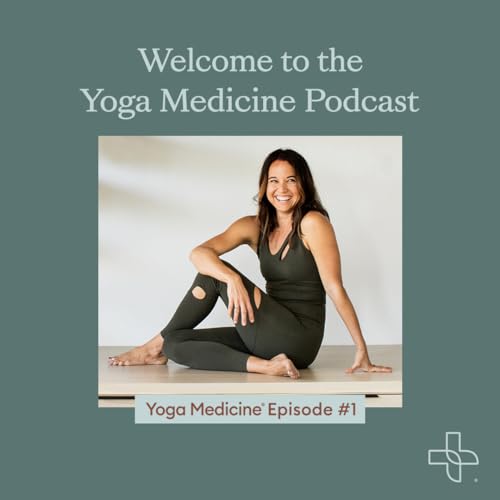
  • Welcome to the Yoga Medicine Podcast!
    2021/10/28

    Welcome to the very first episode of Yoga Medicine! In this inaugural episode, Tiffany Cruikshank and Rachel Land discuss why they started this journey together, what to expect from the Yoga Medicine podcast, and how to get the most out of your yoga practice and your life.

    Both women train yoga teachers to really understand the body and, with this podcast, they hope to dive deeper into topics that you can't cover in a traditional yoga class. This podcast is really about the intersection of science and research with traditional practices and our personal experiences.

    Show Notes:

    • What to expect from the Yoga Medicine podcast [1:00]
    • Our mission and who this podcast is for [2:00]
    • Some benefits & perks of yoga [7:30]
    • Preview of what's to come [9:45]
    • What are our plans for the Yoga Medicine Podcast [15:30]
    • How often Yoga Medicine will air [16:30]

    Links Mentioned:

    • Watch this episode on YouTube

    You can learn more about this episode, and see the full show notes at www.YogaMedicine.com/podcast-01.

    And you can find out more about insider tips, online classes or information on our teacher trainings at www.YogaMedicine.com.

    To support our work, please leave us a 5 star review with your feedback on iTunes/Apple Podcasts.

    続きを読む 一部表示
    19 分
  • The Placebo Effect with Katja Bartsch, Part 1
    2021/10/28

    This episode is the first part of the conversation with Tiffany Cruikshank and Katja Barsch on the Placebo Effect and how it relates to yoga.

    Katja is a Yoga Medicine instructor and a researcher with a focus on fascia. She runs anatomy and fascia physiology yoga teacher trainings around Europe and contributes research roundups to several Yoga Medicine trainings. She is currently working on her PhD under the skillful guidance of Dr Robert Schleip and is a Board-Certified Structural Integration Practitioner (BCSI; ATSI) trained by Tom Myers and his Anatomy Trains school. We are honored to have her researchers eye for our research focused episodes.

    Together, we dive into the history of the Placebo Effect, how it can be used for the treatment of pain and chronic pain, and how that relates to its function in yoga classes. We also discuss how the Placebo Effect relates to expectation and why, as teachers, our words matter so much.

    Listen and learn about some possible positive effects that the Placebo Effect can have, how genetics affect the Placebo Effect, and how to use the Placebo Effect in yoga.

    Show Notes:

    • What is a placebo [0:45]
    • What is the Placebo Effect [2:00]
    • What are some possible positive effects that the Placebo Effect can have [3:45]
    • What is the Nocebo Effect [4:45]
    • What is the history of the Placebo Effect [6:45]
    • How to use the Placebo Effect in yoga [14:00]
    • How is the Placebo Effect used in medicine [16:00]
    • Which external factors can effect a placebo study [17:00]
    • What are open placebos used for [19:00]
    • How do genetics affect the Placebo Effect [32:30]

    Links Mentioned:

    • Watch this episode on YouTube
    • Placebo Effect References
    • Connect with Katja Barsch:

    Facebook | Instagram | Kalamana Yoga

    You can learn more about this episode, and see the full show notes at www.YogaMedicine.com/podcast-02.

    And you can find out more about insider tips, online classes or information on our teacher trainings at www.YogaMedicine.com.

    To support our work, please leave us a 5 star review with your feedback on iTunes/Apple Podcasts.

    続きを読む 一部表示
    43 分
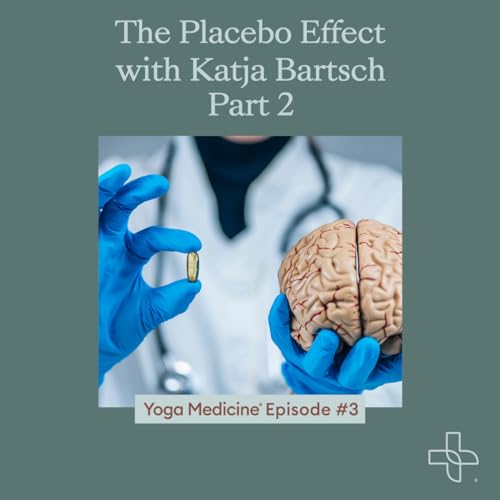
  • The Placebo Effect with Katja Bartsch, Part 2
    2021/11/04

    Today we are continuing our discussion on the Placebo Effect. In the first half we talked about what the Placebo Effect is, why it is so important, and how it applies to the work we do. In this episode we dive into the many ways that placebo effects relate to lifestyle, movement, and yoga.

    In this episode, you'll learn how your mindset affects your relationship to exercise, why meditation is the groundwork for what yoga teachers do, why our language matters and why exercise you enjoy is so important.

    Show Notes:

    • How does stress & mindset influence the immune system [2:00]
    • Is yoga a cure all? [4:00]
    • How does your support system affect healing [5:25]
    • How does marketing affect your relationship with exercise & food [8:20]
    • Importance of exercise you enjoy [16:18]
    • Belief in self & influences capacity [23:08]
    • How our expectations shape us & the Rosenthal Effect [26:50]
    • How expectations influence our teaching [28:50]
    • Limitations of the Placebo Effect [32:00]
    • Harnessing the power of the mind & our intention [35:02]

    Links Mentioned:

    • Watch this episode on YouTube
    • The Intention Experiment: Using Your Thoughts to Change Your Life and the World by Lynne McTaggart
    • Placebo Effect References
    • Connect with Katja Barsch:

    Facebook | Instagram | Kalamana Yoga | YMO Teacher

    You can learn more about this episode, and see the full show notes at www.YogaMedicine.com/podcast-03.

    And you can find out more about insider tips, online classes or information on our teacher trainings at www.YogaMedicine.com.

    To support our work, please leave us a 5 star review with your feedback on iTunes/Apple Podcasts.
    続きを読む 一部表示
    37 分
  • Find Ease in Uncertainty with Diane Malaspina PhD
    2021/11/11
    Today's guest gives us a masterclass in how yoga can help us navigate life's uncertainty with a little more grace. Diane Malaspina is an Applied Psychologist and yoga teacher with over 15 years of experience in the health and wellness field. Diane has a B.S. in Psychology, a Master of Education, and a PhD in Educational and Developmental Psychology. Rachel and Diane discuss why she was drawn to psychology as an area of study, how yoga and meditation turned out to be exactly what she needed as a stressed-out grad student, and how she started teaching yoga almost by accident when her favorite teacher called in sick. Diane also talks about how the pandemic forced her, as it did many of us, to completely change her professional plans but also allowed her the time and space to reconsider how to best spend her energy and time. Listen in to find out why the expression "no news is good news" doesn't actually ring true for many of us and how yoga and meditation can help us shift our baseline to change our relationship with stress and uncertainty. Show Notes: What drew Diane to the study of psychology [2:40]Diane's discovery of yoga practice and introduction to teaching [4:44]Why are we so afraid of uncertainty [22:07]How the stress response can help us shift into problem-solving mode [22:45]What the Yerkes–Dodson law teaches us about optimal stress levels [24:54]The physiological effects of prolonged stress [26:18]The power of trained awareness [26:46]Three options in the face of stress and uncertainty [27:57]Cultivating acceptance in situations we can't change [30:41]Practices Diane uses to support mental health through the pandemic [33:45]Training your brain to react more positively to uncertainty [39:28]Practicing resilience on the yoga mat [43:23]How to bias ourselves toward growth [47:03]The power of the pause [53:13] Links Mentioned: Watch this episode on YouTubeInside the Yoga Sutras Online CourseWorking with Grief Online CourseExploring the Yamas through Meditation & Practice Online CourseYoga Medicine OnlineMental Health & Wellness Yoga Teacher TrainingConnect with Diane Malaspina: Facebook | Instagram | Diane Malaspina | YM Online Guest Teacher You can learn more about this episode, and see the full show notes at www.YogaMedicine.com/podcast-04. And you can find out more about insider tips, online classes or information on our teacher trainings at www.YogaMedicine.com. To support our work, please leave us a 5 star review with your feedback on iTunes/Apple Podcasts.
    続きを読む 一部表示
    57 分
  • Sustainability & Yoga with Tiffany Cruikshank and Rachel Land
    2021/11/18

    Today Rachel and Tiffany talk about all of the ways we find the inspiration we need to create positive behaviors and maintain them long-term -- whether that's in our yoga practice, our teaching, or really, in any aspect of our lives.

    We discuss the paths that each of us took to get to the kind of yoga that we practice and teach today and share how our practice has evolved over the years. We also talk about why curiosity is a superpower, and how to keep your yoga practice, and teaching, from becoming a chore.

    Listen in to learn how we come up with ideas for our yoga classes and courses, and our tips for teachers, whether just starting out or maintaining momentum over the years.

    Show Notes:

    • What brings Tiffany back to her yoga mat again and again? [1:35]
    • Determining what we need in our yoga practice [4:51]
    • How has Tiffany's yoga practice changed over the years? [8:59]
    • Tiffany's yoga practice today [15:41]
    • Overcome feeling uninspired to practice [23:41]
    • The greatest tool for a sustainable yoga practice [26:22]
    • What inspires Rachel and Tiffany to keep learning and teaching [28:42]
    • How Tiffany develops new class and course content ideas [33:56]
    • The pressure to maintain inspiration and creativity [37:09]
    • How to keep yoga from becoming a chore [39:36]
    • Capturing creative ideas for future practices and classes [41:22]
    • The power of simplicity [45:37]
    • Avoiding burnout [47:57]
    • The myth that teaching yoga should never feel like "work" [51:07]
    • Advice for new yoga teachers [53:13]
    • Managing your energy and maintaining clarity to keep teaching over the long-term [57:44]

    Links Mentioned:

    • Watch this episode on YouTube

    You can learn more about this episode, and see the full show notes at www.YogaMedicine.com/podcast-05.

    And you can find out more about insider tips, online classes or information on our teacher trainings at www.YogaMedicine.com.

    To support our work, please leave us a 5 star review with your feedback on iTunes/Apple Podcasts.

    続きを読む 一部表示
    1 時間 7 分
  • The Power of Mindfulness with Dr. Rashmi Bismark MD MPH
    2021/11/25
    Today Rachel talks about the power of mindfulness with Dr. Rashmi Bismark MD MPH, a U.S.-trained physician who is board certified in both preventative medicine and public health. Dr. Rashmi is uniquely qualified to speak on the impact of mindfulness practices as, in parallel with her conventional medical studies, she also studied alternative and complementary therapies including Ayurveda, yoga, meditation, and mindfulness. Dr. Rashmi specializes in preventative medicine and blends eastern and western traditions in her medical practice. Her mission is to help individuals and communities rediscover their true nature, redefine their relationships with the world around them, and harness the power within themselves to be healthy, well and resilient. Listen in to this episode as Rachel and Dr. Rashmi discuss her unique pathway to medicine, how she began teaching mindfulness and yoga, what inspired her award-winning illustrated children's book, Finding Om, and her thoughts on the difference between cultural appreciation and appropriation. Through it all, you'll hear recurring themes around the importance of curiosity and trust. Show Notes: An early personal experience with Ayurveda sparks Dr. Rashmi's curiosity [3:53]Dr. Rashmi's medical training, blending eastern and western approaches [6:15]Dr. Rashmi's initial exposure to yoga through her father and grandmother [17:39]Where yoga teacher training fitted into the picture [21:01]Passing yogic traditions on to Dr. Rashmi's daughters [24:16]The inspiration for the book Finding Om [26:05]Cultural appreciation versus cultural appropriation [30:50]Why representation in children's literature matters [38:53]What mindfulness practices can teach us in uncomfortable or unresolved situations [43:21]The challenge of translating traditional concepts to clinical settings [44:52]Tips to start a mindfulness practice [50:21] Links Mentioned: Watch this episode on YouTubeYoga & Mindfulness 101 for Physicians & Healthcare Providers Online CourseYin & Meditation Yoga Teacher TrainingAyurvedic Foundations for Clinicians with Dr. Siri ChandYoga Medicine OnlineConnect with Dr. Rashmi Bismark: Facebook | Instagram | Twitter | R S Bismark MD | YM Online Guest Teacher You can learn more about this episode, and see the full show notes at www.YogaMedicine.com/podcast-06. And you can find out more about insider tips, online classes or information on our teacher trainings at www.YogaMedicine.com. To support our work, please leave us a 5 star review with your feedback on iTunes/Apple Podcasts.
    続きを読む 一部表示
    56 分
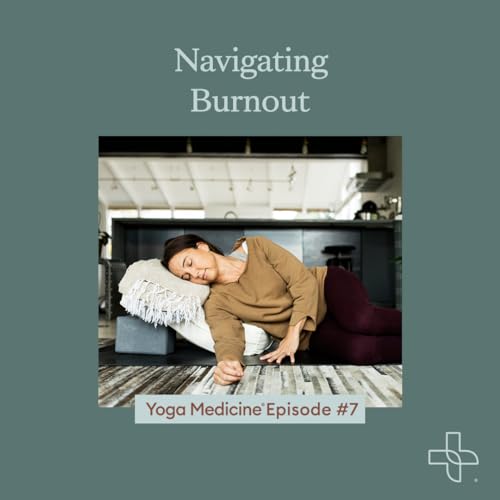
  • Navigating Burnout with Tiffany Cruikshank & Rachel Land
    2021/12/02

    We've all experienced burnout, whether in our work or our home lives, and it can leave us feeling so overwhelmed that we don't know how to start finding our way out of it.

    Today Tiffany and Rachel talk about what burnout is — what it looks and feels like, including some signals that can help us recognize it early. We share our personal experiences of burnout and offer a range strategies to explore (some of which may surprise you). We build a simple three-step plan to navigate out of burnout, and emphasize the importance of each of us tailoring that plan to our individual needs.

    Listen in to find out how to get through burnout without losing your way.

    Show Notes:

    • What does burnout look and feel like; early warning signs to look out for [2:40]
    • "Languishing" as a subtle version of burnout [8:32]
    • A range of strategies to help manage burnout [12:14]
    • Going deeper than the cliche of "self-care" [17:22]
    • Why it can be tough to improve sleep quality during times of stress [21:19]
    • Viewing burnout through the lens of Traditional Chinese Medicine [23:02]
    • The preciousness of rest to rebuild resilience [25:42]
    • Recharging through curiosity and creativity [29:20]
    • Counter negativity with a gratitude practice [32:33]
    • Can we avoid burnout if our job is our passion? [38:39]
    • Which burnout strategy will be most effective for you? [42:55]
    • The characteristics of an actionable burnout management plan [45:02]

    Links Mentioned:

    • Watch this episode on YouTube

    You can learn more about this episode, and see the full show notes at www.YogaMedicine.com/podcast-07.

    And you can find out more about insider tips, online classes or information on our teacher trainings at www.YogaMedicine.com.

    To support our work, please leave us a 5 star review with your feedback on iTunes/Apple Podcasts.

    続きを読む 一部表示
    53 分
  • Ready to Research with Katja Bartsch, Part 1
    2021/12/09

    Today we are diving into the many reasons research is important both for clinicians and yoga teachers -- and we are very happy to have Katja Bartsch back with us to do it. Katja also joined us for our recent episodes on the Placebo Effect and she focuses a lot of her energy on doing her own research and combing through the research that others are doing on the topic of yoga.

    There is a lot of research currently being done that relates to the yoga world, but how do we sift through and find high-quality research? How can we analyze it and apply it to our own lives? In this episode, Katja and Tiffany talk about how to evaluate research and apply a critical lens to find high quality research.

    They'll talk on the limitations of specific types of research and discuss the strengths & limitations of different types of studies. They also talk about the way that information application is evolving with time and how to make the most of the research we do by blending it with all that we've learned through our own experiences.

    Listen in as Katja and Tiffany discuss why research is so valuable, where to look for the good stuff, and how to filter through this information with a critical eye.

    Show Notes:

    • Why it is so important to consider research [4:04]
    • Research limitations [6:57]
    • Sources for good quality research [12:02]
    • Pros of using PubMed [13:50]
    • The importance of peer-review in articles [15:07]
    • How to know if an article has been peer reviewed [16:45]
    • What are the components of a typical study [21:17]
    • What is a case study [28:54]
    • What is a cohort study [32:04]
    • Benefits of cohort studies [36:58]
    • Important aspects of randomized controlled trials (RCTs) [38:10]
    • How to do a double-blind test [42:42]

    Links Mentioned:

    • Watch this episode on YouTube
    • Ready to Research Resources Doc
    • Evidence Pyramid
    • Connect with Katja Bartsch:

    Facebook | Instagram | Kalamana Yoga | YM Online Teacher

    You can learn more about this episode, and see the full show notes at www.YogaMedicine.com/podcast-08.

    And you can find out more about insider tips, online classes or information on our teacher trainings at www.YogaMedicine.com.

    To support our work, please leave us a 5 star review with your feedback on iTunes/Apple Podcasts.

    続きを読む 一部表示
    45 分