エピソード

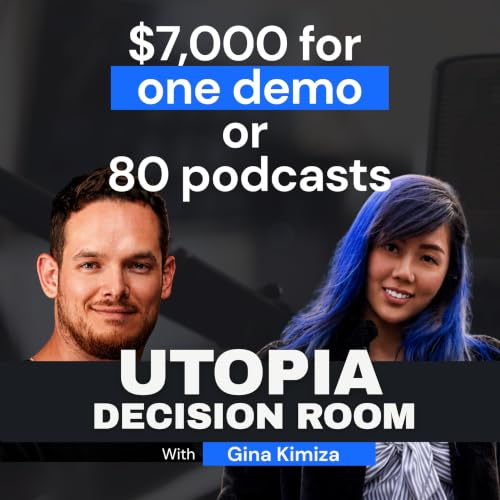
  • $7,000 for one demo. Or 80 podcasts.
    2026/08/12

    Gal Ko (Podstar / Bold PMM) on borrowed trust: why he tells most founders not to start their own show, the 7,000 dollar demo versus 80 shows on the same budget, why 1,000 of the right listeners beat 100,000 of the wrong ones, and the STAGE framework for scoring a show before you say yes.

    New episode every Wednesday — subscribe.

    Apply to Utopia: https://www.utopia-club.com/

    Watch on YouTube: https://www.youtube.com/@utopiaclubdecisions

    続きを読む 一部表示
    48 分
  • AI is already recommending software to your buyers. Is yours in the answer?
    2026/08/05

    Jason Yang (Egaki AI) on generative engine optimization: the quiet death of keyword SEO, why AI classifies generic content as slop, and how a competitor’s comparison article can define your category if you don’t.New episode every Wednesday — subscribe.

    Apply to Utopia: https://www.utopia-club.com/Watch on YouTube: https://www.youtube.com/@utopiaclubdecisions

    続きを読む 一部表示
    59 分
  • The person who loves your health-tech demo isn't the person who signs the check
    2026/08/03

    Why does a clinician loving your product have nothing to do with whether an institution buys it?In this episode of The Decision Room — the Utopia Club podcast for software founders scaling in the US — Dr. Rachel, co-founder of The Babble Group, breaks down why healthcare software founders consistently misread the buying decision, and the distribution system she built after watching companies learn this the hard way.The Decision Room is hosted by Gina Kimiza, founder of Utopia Club, a private network for software founders building or entering the US market. Every episode is one founder, one decision, one pivot — told by the founder who made it.In this conversation, we go deep on the gap between clinician adoption and institutional purchasing, why healthcare buying decisions run through a hierarchy nobody warns you about, and why "the product is great" is never enough to win a pilot. Rachel splits the buyer from the user — and explains why every founder selling into healthcare needs to translate clinical value into institutional value before they ever build a pitch.The Babble Group is a clinician-led distribution company helping assistive technology and clinical software companies break into US healthcare and education institutions, currently working with 15+ product partners.What we cover:→ Why clinician love for a product doesn't translate to institutional adoption→ The hierarchy of decision-makers inside healthcare institutions — and who actually pulls the trigger→ Why pilots are their own sales cycle, and how to nurture clinician buy-in during one→ Translating clinical value into institutional value: cost savings, reduced turnover, reduced risk→ Why clinicians are barred by their code of ethics from profiting off recommendations — and why that's the whole trust mechanism→ Building your own distribution vs. borrowing someone else's trust→ The chicken-and-egg problem of building a track record institutions will actually accept→ The #1 mistake non-US founders make entering the US healthcare market→ Why storytelling — not just the product — is what actually sells→ What separates founders who break into institutions from the ones who stay stuckThe Decision Room is a podcast for software founders building in the US, non-US founders crossing into the US market, B2B operators, investors tracking deal flow, and partners in the GTM, EOR, and founder-network space.About Utopia Club:Utopia Club is a private network for software founders building or entering the US market. Members get curated peer access, monthly decision pods, and a closed community of 200+ software founders. Founded by Gina Kimiza.→ Apply: utopia-club.com→ Decision Room newsletter: fuacollective.substack.comAbout The Decision Room:The Decision Room is the Utopia Club podcast. One founder. One decision. One pivot in the US market — told by the founder who made it. Hosted by Gina Kimiza.About the guest:Dr. Rachel is a speech-language pathologist with a doctorate in speech-language pathology and 18 years of clinical practice, primarily in pediatrics. She later became the first US-based customer success manager for Voiceitt, an Israeli speech-recognition company, helping it enter the US market. She now co-runs The Babble Group with Katie Siever — a clinician-led distribution company helping assistive technology and clinical software companies enter US healthcare and education institutions.→ Follow Rachel on LinkedIn: / dr-rachel-khasky-levy-89635b1b → Follow Kim on LinkedIn: www.linkedin.com/in/ginakimiza#UtopiaClub #TheDecisionRoom #HealthcareTech #SoftwareFounders #B2BSaaS

    続きを読む 一部表示
    50 分
  • The $200K deals big consulting won't touch.
    2026/07/21

    In Episode 04 of The Decision Room — the Utopia Club podcast for software founders scaling in the US — Ilan Man, founder of Paradox Machines, explains why the biggest players in data and AI ignore an entire market — and how he's building a company on the deals they call "peanuts."The Decision Room is hosted by Gina Kimiza, founder of Utopia Club, a private network for software founders building or entering the US market. Every episode is one founder, one decision, one pivot — told by the founder who made it.In this conversation, we go deep on the mid-market gap in data and AI infrastructure. Palantir and Databricks solve data for billion-dollar companies. Big consultancies won't touch $50K–200K contracts. Ilan spent 20 years building data systems — including helping Brooklyn Data Co. through an acquisition — and now he's bringing enterprise-grade data infrastructure to the companies priced out of the enterprise tier.Paradox Machines is a full-stack data and AI company that embeds lean teams into mid-market businesses and deploys managed data platforms — outcome-based pricing, no billable hours. Backed by Infinity Constellation.What we cover:→ Why he left a post-exit career to become a first-time founder at 20 years in→ The mid-market opportunity: $50K–200K contracts big consulting calls "peanuts"→ Why he chose a venture studio over bootstrapping or raising VC→ The data room playbook: start 3 years before your exit, not 3 months→ How AI collapsed the cost of exit preparation — and what that means for your multiple→ Selling to PE firms and family offices: "Is what you're saying making me money?"→ Why genuine beats polished in professional services sales→ Running a two-founder household — and the stoic system that keeps it working→ His advice for operators who haven't taken the leap yetThe Decision Room is a podcast for software founders building in the US, non-US founders crossing into the US market, B2B operators, investors tracking deal flow, and partners in the GTM, EOR, and founder-network space.About Utopia Club:Utopia Club is a private network for software founders building or entering the US market. Members get curated peer access, monthly decision pods, and a closed community of 200+ software founders. Founded by Gina Kimiza.→ Apply: utopia-club.com→ Decision Room newsletter: fuacollective.substack.comAbout The Decision Room:The Decision Room is the Utopia Club podcast. One founder. One decision. One pivot in the US market — told by the founder who made it. Hosted by Gina Kimiza.→ Follow Kim on LinkedIn: www.linkedin.com/in/ginakimizaAbout the guest:Ilan Man is the founder of Paradox Machines, a full-stack data and AI company deploying managed data platforms for mid-market businesses. 20 years in data, including helping lead Brooklyn Data Co. through its acquisition. Backed by Infinity Constellation. Based in Brooklyn, New York.→ Follow Ilan on LinkedIn: https://www.linkedin.com/in/ilanman/

    #UtopiaClub #TheDecisionRoom #DataInfrastructure #SoftwareFounders #B2BSaaS

    続きを読む 一部表示
    57 分
  • E3: He pivoted 22 times. Wrong wasn't an option.
    2026/07/02

    He pivoted 22 times and built the AI that governments trust with their most critical decisions. Wrong wasn't an option.In Episode 03 of The Decision Room — the Utopia Club podcast for software founders scaling in the US — Nissim Titan, CEO and founder of 4Cast, unpacks the decision intelligence framework he built over 20 years inside homeland security, defense, and government — and how he turned it into a multimillion-dollar AI enterprise operating across 3 continents.The Decision Room is hosted by Gina Kimiza, founder of Utopia Club, a private network for software founders building or entering the US market. Every episode is one founder, one number, one decision — told by the founder who made it.In this conversation, we go deep on why generative AI is only 60% accurate for high-stakes decisions, how Nissim built a decision intelligence platform before the category had a name, and what 22 company pivots taught him about surviving — and scaling — in the US market as a non-US founder.4Cast is an AI-powered decision intelligence platform serving defense, homeland security, critical infrastructure, and enterprise decision-makers across the US, Europe, and Israel.What we cover:→ Why generative AI gets decisions 60% right — and why that's unacceptable for enterprise→ Decision intelligence vs. AI: the category distinction every software founder needs to understand→ 22 pivots in 8 years — what Nissim changed and why→ How to build B2B enterprise trust in the US market as a non-US founder→ The US market entry playbook: boots on the ground, local hires, and the SelectUSA conference→ Why he expanded to 3 continents before most founders find product-market fit→ Hiring for attitude over expertise — and when that rule breaks→ Making every major decision alone: the founder who never had a board room→ What decision intelligence means for software founders building with AI right nowThe Decision Room is a podcast for software founders scaling in the US, non-US founders making the US crossing, B2B operators, investors tracking deal flow, and partners in the GTM, EOR, and founder-network space.About Utopia Club:Utopia Club is a private network for software founders building or entering the US market. Members get curated peer access, monthly decision pods, and a closed community of software founders. Founded by Gina Kimiza.→ Apply: utopia-club.com→ Decision Room newsletter: fuacollective.substack.comAbout The Decision Room:The Decision Room is the Utopia Club podcast. One founder. One decision. One pivot in the US market — told by the founder who made it. Hosted by Gina Kimiza.→ Follow Kim on LinkedIn: www.linkedin.com/in/ginakimizaAbout the guest:Nissim Titan is the CEO and founder of 4Cast, an AI-powered decision intelligence platform serving defense, critical infrastructure, and enterprise clients across the US, Europe, and Israel. Over 20 years of experience in homeland security, energy, utilities, and government. B.Sc. and M.Sc. in Industrial Management and Engineering, B.Arch from Tel Aviv University.→ Follow Nissim on LinkedIn: / nissim-titan-9880a580


    #UtopiaClub #TheDecisionRoom #AIStartup #SoftwareFounders #B2BSaaS #DecisionIntelligence #StartupPivot #USMarketEntry #EnterpriseAI #SaaSFounder #FounderStory #B2BSales

    続きを読む 一部表示
    39 分
  • E2: Why high performers stay single
    2026/05/21
    In Episode 02 of The Decision Room — the Utopia Club podcast for software founders scaling in the US — Sonny Uppal, founder of Laguna, sits with the contradiction at the centre of his own company. He spent a decade at Citadel and Bold Trading building systems to strip emotion out of financial decisions. Then he built a dating app whose entire thesis is that emotion is the one signal existing apps have never been able to model.The Decision Room is hosted by Gina Kimiza, founder of Utopia Club. Every episode: one founder, one decision, one pivot — told by the founder who made it.Sonny read the SEC filings on Match Group and Hinge. He went undercover with matchmakers charging $5,000 a date. Then he built a psycholinguistic model that reads a person's deeper psychology from three questions, back-tested it on long-term couples, and watched users describe the output as "eerily accurate." Women, who swipe right on men 4% of the time on Tinder and Hinge, swipe right 37% of the time on Laguna.What we cover:→ Why Tinder, Hinge and Bumble have no real moat→ What Sonny found in their SEC filings→ The $5,000-per-date matchmaking industry, from the inside→ Psycholinguistic modeling: three questions, deep compatibility→ Why "eerily accurate" beats Hinge's "secret sauce"→ The 1-match-per-month reality for the average man on Hinge→ The 4% to 37% jump on Laguna — a 9x lift→ The photo gender-gap: 100% of women care, 0% of men do→ How women can spot a serious guy in the top 10%→ Why power couples often have more friction→ Genesis, Laguna, Vibescape: one engine, three markets→ The four-dimensional cold start problem unique to dating→ Why distribution beats product in 2026For software founders building in the US, non-US founders crossing into the US market, B2B operators, investors tracking deal flow, and partners in the GTM, EOR, and founder-network space.Chapters:00:00 — Cold open: the Citadel quant who bet on emotion00:32 — Quant trading at 20, the pivot to AI ventures02:08 — Why the Tinder–Hinge–Bumble oligopoly has no moat03:33 — What the SEC filings revealed04:31 — Undercover on $5,000-per-date matchmakers05:35 — Psycholinguistic modeling: three questions06:11 — Back-testing on long-term couples07:30 — Why "eerily accurate" beats "secret sauce"09:30 — Why Sonny is the one fixing this11:05 — The three C's of lasting relationships11:54 — Arranged marriages in the US12:18 — Have you used Laguna yourself? The fiancée story13:25 — New York dating and 1 match per month15:08 — Why men are stuck in the bottom 80%18:25 — 4% to 37%: why women swipe 9x more on Laguna21:55 — The photo gender-gap nobody talks about24:35 — Designing for long-term: Laguna's survivorship bias26:15 — Dating as a founder: the emotional budget problem29:25 — How women spot a serious guy in the top 10%34:08 — Compatibility and ambition: why power couples fail36:36 — Genesis, Laguna, Vibescape: one engine, three markets41:14 — The four-dimensional cold start problem43:55 — Getting the first hundred users44:30 — Who Sonny calls for hard decisions45:33 — Distribution beats product in 2026About Utopia Club:A private network for software founders building or entering the US market. Curated peer access, monthly decision pods, 200+ software founders. Founded by Gina Kimiza. → Apply: utopia-club.comAbout The Decision Room:The Utopia Club podcast. One founder. One decision. One pivot in the US market — told by the founder who made it. Hosted by Gina Kimiza.→ Newsletter: fuacollective.substack.comAbout the guest:Sonny Uppal is the founder of Laguna, an AI-native dating app built on psycholinguistic modeling. Laguna sits inside Genesis, his predictive social science company, alongside Vibescape. Previously quant at Citadel and Bold Trading. Based in New York.→ Follow Sonny: https://www.linkedin.com/in/sonny-uppal-7b74b122→ Follow Kim: www.linkedin.com/in/ginakimiza
    続きを読む 一部表示
    45 分
  • E1: Why this founder won't let AI do the math (and what he built instead)
    2026/05/20

    In Episode 01 of The Decision Room — the Utopia Club podcast for software founders scaling in the US — Hisham Juneidi, founder of⁨ ⁨‪@Quotix-ThePricingLayer‬, explains the architecture mistake almost every AI startup is making, and the system he built to fix it.The Decision Room is hosted by Gina Kimiza, founder of Utopia Club, a private network for software founders building or entering the US market. Every episode is one founder, one decision, one pivot — told by the founder who made it.In this conversation, we go deep on AI hallucination, LLM math accuracy, and why building B2B products entirely inside AI creates a "black box" customers won't tolerate. Hisham splits AI from the calculation engine — and explains why every software founder building with LLMs should be making the same call.Quotix is an AI-powered quoting and pricing engine for B2B service businesses, currently in early deployment with HVAC and property management companies.

    What we cover:→ Why AI hallucinates on math (and what's happening under the hood)→ The dual-engine architecture: AI for reasoning, separate engine for calculations→ Why "black box" AI is unsellable to B2B businesses→ The 2-year agency detour (Edge Node) that led to Quotix→ How Hisham found his ICP — and why agencies, not end customers, are the right wedge→ The 70-80% of HVAC businesses he'll never sell to→ Solo founder uncertainty and how he runs without a fixed schedule→ What he'd do differently if he started over tomorrow

    The Decision Room is a podcast for software founders building in the US, non-US founders crossing into the US market, B2B operators, investors tracking deal flow, and partners in the GTM, EOR, and founder-network space.


    Chapters:00:00 — Cold open: "AI should not touch the math"00:45 — Who Hisham is and what Quotix does03:20 — The architecture decision: splitting AI from calculations08:15 — Why "black box" AI doesn't work for business products12:40 — Edge Node: the 2-year detour to Quotix17:30 — Finding the ICP: from generic agency to HVAC pricing22:10 — Why he targets agencies, not end customers26:00 — Solo founder uncertainty29:15 — What he'd do differently31:30 — Kim's close


    About Utopia Club:Utopia Club is a private network for software founders building or entering the US market. Members get curated peer access, monthly decision pods, and a closed community of 200+ software founders. Founded by Gina Kimiza.→ Apply: utopia-club.comAbout The Decision Room:The Decision Room is the Utopia Club podcast. One founder. One decision. One pivot in the US market — told by the founder who made it. Hosted by Gina Kimiza.→ Decision Room newsletter: fuacollective.substack.comAbout the guest:Hisham Juneidi is the founder of Quotix, an AI-powered quoting and pricing platform for B2B service businesses. CS at Virginia Tech, Data Science at Fairfield University. Previously ran Edge Node, an AI automation agency. Based in Connecticut.


    → Follow Hisham on LinkedIn: www.linkedin.com/in/hisham-juneidi-590828170→ Follow Kim on LinkedIn: www.linkedin.com/in/ginakimiza

    続きを読む 一部表示
    31 分