エピソード

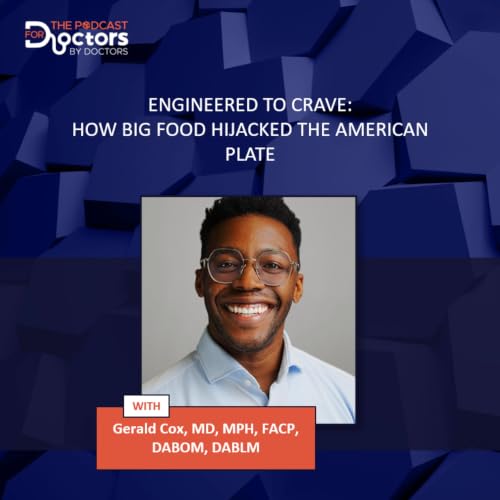
  • Gerald Cox, MD and Anafer Barrera, RDN- Engineered to Crave: How Big Food Hijacked the American Plate (Part 2)
    2026/08/12

    Dr. Gerald A. Cox and registered dietitian Anafer Barrera join host Dr. Ned Palmer for the second installment of the three-part series, moving the conversation about ultra-processed foods out of the abstract and into the exam room. The question is no longer just what's wrong with the modern food supply. It's how clinicians can actually talk about it with patients in a way that helps rather than shames.

    Dr. Cox and Anafer make the case that every nutrition conversation starts with tone. Before a single recommendation lands, patients need to feel heard rather than blamed, because food is rarely just fuel. It's routine, reward, emotion, and sometimes an addiction-like pull. The two walk through the NOVA classification that gives "ultra-processed" its precise meaning, from minimally processed foods all the way to the soft drinks, instant noodles, and cured meats drawing the most scrutiny. They dig into the mounting evidence tying these foods to cognitive decline and dementia, whether the risk is dose-dependent, and why food itself can become a source of anxiety when nutrition advice tips into fear.

    The conversation also takes on the harder, more practical questions. What does this look like in a high-volume clinic with ten minutes per patient? The guests trade the checklist for a single opening question: how important is diet to you, and what's your biggest barrier? They champion an "add, don't just subtract" approach, one that asks patients to eat enough earlier in the day, build in variety, drink water when a craving might be thirst, and stop treating counseling as a list of foods to give up. They also widen the lens to the systems patients live inside, where cheap, marketed, convenient food is the default. Along the way they point to a local program that doubles SNAP dollars at the farmer's market and the case for subsidizing real food over industrial staples.

    Throughout, one idea anchors the discussion: the goal isn't moderation or willpower. It's diversity, addition, and empathy. Meet patients where they are, treat food as a tool for support rather than a moral battleground, and the whole conversation shifts from blame to nourishment, from restriction to expansion, from individual failing to structural understanding.

    続きを読む 一部表示
    54 分
  • Casey Wiley, M.Ed — The $50,000 Cliff: How the New Loan Rules Are Quietly Rewriting Who Gets to Become a Doctor
    2026/07/22

    Casey Wiley joins Dr. Michael Jerkins to unpack the biggest shift in medical school financing in decades: the July 2026 elimination of Grad PLUS loans under the One Big Beautiful Bill Act. For roughly twenty years, students could borrow up to the full cost of attendance. Now federal borrowing is capped at $50,000 a year—and for many trainees, that opens a funding gap of $25,000, $70,000, or more.

    Casey, the mind behind the Med School Money Guy channel, walks through what actually changed and who it hits first. He explains the confusing line between "legacy" and "new" borrowers, the aggregate and lifetime caps that can quietly run out mid-degree, and the rise of private loans as the new gap-filler—along with everything students give up when they leave the federal system, from income-driven repayment to PSLF. He makes the case that credit score has become a gatekeeper to a medical career, with 10–15% of first-years unable to qualify for the loans they now depend on.

    The conversation also takes on the harder questions. Who gets squeezed out when funding depends on creditworthiness and co-signers—and what does that mean for a physician pipeline already trying to reach rural, lower-income, and first-generation students? Is tuition-free medical school a real fix or a fundraising fantasy? And amid the caution, where's the good news? Casey points to the new RAP repayment plan as the bill's genuine silver lining: congressionally durable, interest-subsidized, and structured to keep balances from ballooning during residency.

    Throughout, one theme anchors the discussion: the rules are changing faster than the advice can keep up. Understanding them now—before June application deadlines and August panic—is the difference between a manageable plan and a career-altering scramble.

    続きを読む 一部表示
    50 分
  • Gerald Cox, MD – Engineered to Crave: How Big Food Hijacked the American Plate
    2026/07/15

    Dr. Gerald Cox joins Dr. Palmer for a revealing conversation about a shift most clinicians were never trained to see—how the food on our shelves stopped being food and became a product, deliberately designed to be difficult to stop eating. As a preventive medicine specialist focused on reversing cardiometabolic disease, with roots in obesity, lifestyle, and internal medicine, Dr. Cox brings both the science and a personal story: his own adolescence as an overweight kid who thought he was simply making bad choices, before realizing the choices themselves had been engineered.

    Dr. Cox walks through the machinery hiding behind familiar labels. He explains how "flavor engineering" blends taste, aroma, color, and texture to defeat moderation, and why a "healthy" protein bar can carry a paragraph of unfamiliar ingredients. He traces how tobacco companies—under public-health pressure in the 1980s—bought their way into the food supply, bringing Oreos, Kool-Aid, Lunchables, and their marketing playbooks with them. And he connects high-fat, high-salt, low-fiber formulations to the brain's dopamine and reward pathways, explaining why "bet you can't have just one" was never a joke.

    The episode also takes on the harder questions underneath the trend lines. When food behavior is shaped by biochemistry and industry design, how should clinicians respond—with blame, or with grace and tools like the Yale Food Addiction Scale? What does the latest research from the Lancet and the American Journal of Public Health reveal about engineering techniques and their public-health cost? And with "Make America Healthy Again" messaging, the FDA's "natural" loophole, and food dyes all moving into the political mainstream, could this be a once-in-a-generation opening for real reform?

    Throughout, one truth anchors the discussion: this isn't a story about willpower—it's about environment. Understanding how the modern food supply was built is the first step toward meeting patients with compassion, and toward giving them back some control over what ends up on their plate.

    続きを読む 一部表示
    51 分
  • Christopher Garofalo, MD – Walking Away from Employment: A Practice Owner's Playbook
    2026/06/17

    Dr. Christopher Garofalo joins Dr. Michael Jerkins for a wide-ranging conversation about a transformation few in medicine are tracking closely—the slow disappearance of the physician-owned practices, and what it means for the doctors and patients left in its wake. As a family physician, longtime private practice owner, and advocate inside organized medicine, Dr. Garofalo has watched the ownership model erode from the inside, and has a clear-eyed view of how policy, private equity, and the insurance industry have reshaped what it means to practice independently.

    Dr. Garofalo walks through the levers physicians rarely realize they can pull: how simply showing up in advocacy circles translates into tangible wins like prior authorization reform, why direct primary care is quietly rebuilding a relationship between doctor and patient that insurance long ago broke, and how policies restricting physician ownership of hospitals and surgery centers have quietly tilted the field toward consolidation.

    The episode also takes on the harder structural questions underneath the trend lines: What happens to access and cost when monopolies and vertical integration replace independent practices? Why has the dental profession protected ownership while medicine surrendered it? And could AI tools and new financing models finally make private practice viable again for the next generation of doctors?

    Throughout the conversation, one truth anchors the discussion: practice ownership is not nostalgia—it is infrastructure. Restoring it is how physicians regain autonomy, how patients regain access, and how medicine regains the room to be practiced the way it was always meant to be practiced.

    続きを読む 一部表示
    51 分
  • Dr. Josh Daily, MD – The Financial Blind Spot in Medicine
    2026/05/20

    Dr. Josh Daily joins Dr. Michael Jerkins for a candid conversation about a quiet crisis in medicine—one hiding in plain sight on every trainee's loan statement and every attending's pay stub. As a pediatric cardiologist, program director, and co-director of a medical student course on financial essentials for physicians, Dr. Daily has a clear view of why only 9% of doctors say they feel extremely confident managing their finances—and why that number, troubling as it is, makes complete sense given how little financial training physicians actually receive.

    Dr. Daily walks through the tools doctors are rarely given but desperately need: how to think about net present value when your debt looks bigger than your starting salary, why the timing of promotion can shape lifetime earnings more than the specialty you choose, and how recent federal loan caps of $200,000 could quietly reshape who gets to become a doctor in the first place.

    The episode also takes on the harder cultural questions underneath the numbers: What happens when "medicine as a calling" becomes the language used to justify being underpaid and overworked? Why is the pay gap between pediatric and adult subspecialties widening at exactly the level where trainees decide their futures? And when does additional training actually pay off—financially and otherwise?

    Throughout the conversation, one truth anchors the discussion: financial literacy is not the opposite of a meaningful medical career—it is what protects it. Understanding the math is how physicians stay in medicine, stay whole, and stay free to practice the way they always intended.

    続きを読む 一部表示
    49 分
  • Shay Taylor-Allen, MD – From Janitor to Yale Resident: Breaking Barriers in Medicine
    2026/05/13

    Dr. Shay Taylor-Allen joins Dr. Michael Jerkins for a deeply personal and inspiring conversation about her extraordinary path through medicine—one that began not in a classroom or clinic, but cleaning the halls of Yale New Haven Hospital, the very institution where she was born and would one day match into her dream anesthesia residency.

    Dr. Allen opens up about the experiences that drew her to medicine: watching her mother navigate healthcare disparities and gaining a ground-level view of hospital life that most physicians never see. That perspective, she argues, is not a liability but a gift—one that cultivated a depth of empathy and human connection that now defines her approach to patient care.

    The episode also takes on the harder questions facing medicine today: How do you stay grounded in your purpose when the financial reality of medical training is overwhelming? Is social media a legitimate tool for mentorship and representation? And what does it really take to build a culture where janitors and attendings see themselves as part of the same team?

    Throughout the episode, one truth anchors every chapter of her journey: where you start does not determine where you can go. Resilience, community, and a commitment to genuine human connection are what carry you forward.

    続きを読む 一部表示
    44 分
  • Raj Dasgupta, MD & Ted O’Connell, MD – Rethinking Medical Education in the Age of AI
    2026/04/15

    Dr. Raj Dasgupta and Dr. Ted O’Connell join Dr. Michael Jerkins for a wide-ranging conversation on how medical education must evolve in an era shaped by artificial intelligence, shifting exam structures, and changing patient expectations.

    From AI-powered learning tools to real-time evidence appraisal, the discussion explores how today’s trainees access information and how educators must adapt without compromising clinical reasoning. Dr. Dasgupta and Dr. O’Connell unpack the opportunities AI presents in both education and practice, while emphasizing the importance of teaching humility, source verification, and critical thinking in a world of instant answers.

    The episode also tackles system-level questions: Has making USMLE Step 1 pass/fail helped or hurt? Do duty-hour restrictions produce better-trained physicians? And are we giving learners enough early, hands-on patient care in an increasingly team-based healthcare model?

    Amid debates about automation and exam design, one theme remains constant: the human element of medicine is irreplaceable. Empathy, bedside presence, and the ability to make a patient feel seen cannot be outsourced to technology.

    続きを読む 一部表示
    57 分
  • Peter Brodeur, MD – AI in Healthcare: What Helps, What Hurts, and What Comes Next
    2026/03/11

    Internal medicine resident and AI healthcare researcher Dr. Peter Brodeur joins Dr. Michael Jerkins for a grounded, practical conversation on how artificial intelligence is actually showing up in medicine today and where it’s headed next. From AI scribes and automated workflows to clinical decision support, Dr. Brodeur breaks down what’s delivering real value versus what’s still more promise than payoff.

    The discussion explores AI’s impact on physician burnout, workflow efficiency, and patient engagement, while unpacking critical concerns around safety, liability, automation bias, and the risk of deskilling clinicians. Dr. Brodeur also shares insights from recent research on where AI performs best, why “human-in-the-loop” systems matter, and how medical education may evolve alongside these tools.

    Can AI truly improve care without compromising clinical judgment? And how should doctors think about adopting new technology without losing the human side of medicine?

    Dr. Brodeur closes with a look at what responsible AI integration could mean for the future of healthcare and why cautious optimism, not blind adoption, is the path forward.

    続きを読む 一部表示
    53 分