エピソード

  • Episode 25: Computer vision and trustworthy AI (with Chen Chen)
    2026/07/24
    Artificial intelligence is rapidly transforming healthcare, but how do we ensure clinicians and patients can trust the algorithms behind it?

    In this episode of The Digital Twin Theory, we speak with Dr. Chen Chen, Assistant Professor at the University of Sheffield, about the exciting world of computer vision and trustworthy AI.

    Together, we explore how machines are learning to interpret medical images, why multimodal AI is opening new possibilities for diagnosis and treatment, and what it takes to build intelligent systems that are transparent, reliable and safe for clinical use.

    Whether you're a researcher, clinician, student or simply curious about the future of digital health, this episode offers an accessible introduction to one of the fastest-growing fields in modern medicine.
    続きを読む 一部表示
    28 分
  • Episode 24: Computer models, AI, and the challenge ovarian cancer (with Marilisa Cortesi)
    2026/06/26
    Ovarian cancer remains one of the most complex and challenging cancers to understand and treat. But how can computational models, artificial intelligence, and in silico medicine help researchers and clinicians tackle this disease?

    In this episode of The Digital Twin Theory, host Davide Montesarchio speaks with Dr. Marilisa Cortesi, biomedical engineer, Marie Skłodowska-Curie Global Fellow, and Assistant Professor at the University of Bologna.

    Together, we discuss the clinical challenges of ovarian cancer, the integration of computational modelling and experimental research, and the growing role of AI in oncology.

    The conversation explores the promises and limitations of artificial intelligence, the ongoing debate around the "black box" problem, and the potential of digital twins and virtual patients to transform personalised cancer care.

    Join us for an insightful discussion on how engineering, biology, and medicine are converging to shape the future of cancer research.
    続きを読む 一部表示
    26 分
  • Episode 23: Making innovation come true (with Rossana Alessandrello)
    2026/05/29
    Innovation in healthcare does not end with research, regulation, or clinical validation. There is another critical step that often remains invisible: public procurement.

    How do healthcare systems decide which technologies to adopt? How does innovation move from the lab into real clinical practice? And what role does value-based procurement play in the future of in silico medicine?

    In this episode, we speak with Rossana Alessandrello, Value Based Procurement Director at AQuAS – Agència de Qualitat i Avaluació Sanitàries de Catalunya, about the complex pathway connecting innovation, healthcare systems, and patient impact.

    A thoughtful conversation on one of the most important and least discussed aspects of healthcare innovation.
    続きを読む 一部表示
    31 分
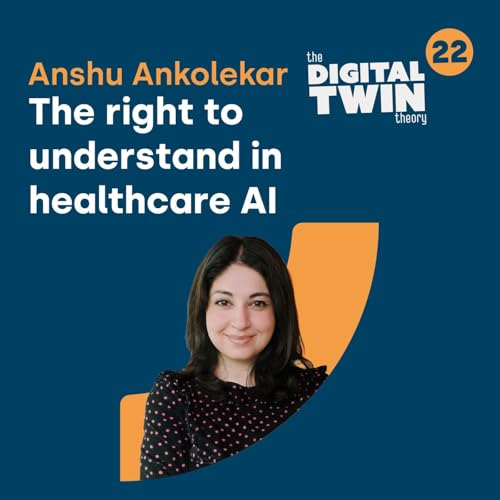
  • Episode 22: The right to understand in healthcare AI (with Anshu Ankolekar)
    2026/04/30
    In this episode, we speak with Anshu Ankolekar, researcher at the MAASTRO Clinic in the Netherlands, where she works on AI applications in oncology, clinical decision support systems, patient-centered AI design, and healthcare regulation.

    We explore what it really means AI explainability for patients and clinicians, also touching topics like bringing AI into real-world care, the risk of added workload for clinicians, cognitive biases, and the important of the collaboration between developers, clinicians, and patient advocates.

    続きを読む 一部表示
    24 分
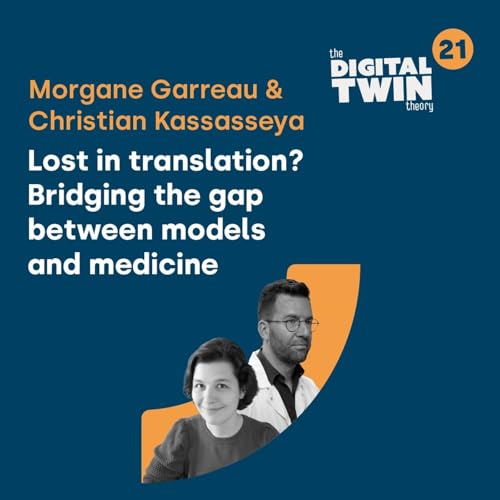
  • Episode 21: Lost in Translation? Bridging the gap between models and medicine (with Morgane Garreau & Christian Kassasseya)
    2026/03/30
    A recurring theme that emerged during the production of The Digital Twin Theory is how to bring AI, modelling and simulation into everyday clinical practice.

    As these technologies mature, this will become one of the key challenges—and opportunities—in healthcare. But the issue is not new. How can modellers develop tools that are not only effective and efficient, but also truly integrated into clinical workflows?

    At its core, the challenge is communication—and it is far from trivial. Even the word “model” means different things: for clinicians, it often refers to something tangible, like an animal model; for engineers, it is something abstract, living inside a computer.

    Bridging this gap is essential. Involving clinicians early in the development of new technologies can make all the difference.That’s why we brought together biomedical engineer Morgane Garreau and physician Christian Kassasseya, who work closely together, to share how this collaboration works in practice.
    続きを読む 一部表示
    29 分
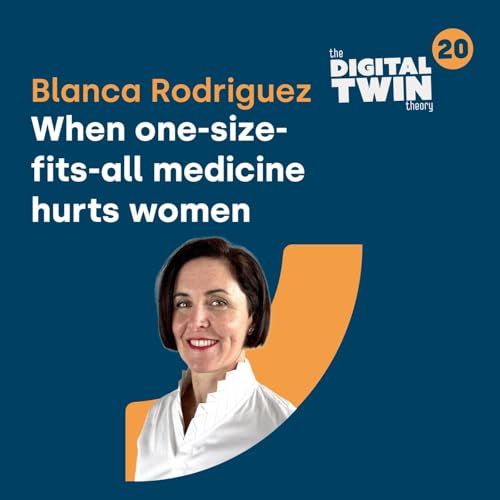
  • Episode 20: When one-size-fits-all medicine hurts women (with Blanca Rodriguez)
    2026/02/27
    In this episode of The Digital Twin Theory, Blanca Rodríguez (University of Oxford) explores sex differences in healthcare and the impact of bias in research and treatment. She explains how digital twins, AI, and computational models can enable sex-aware, personalised medicine, reshaping diagnosis, therapies, and the concept of the “average patient.”
    続きを読む 一部表示
    18 分
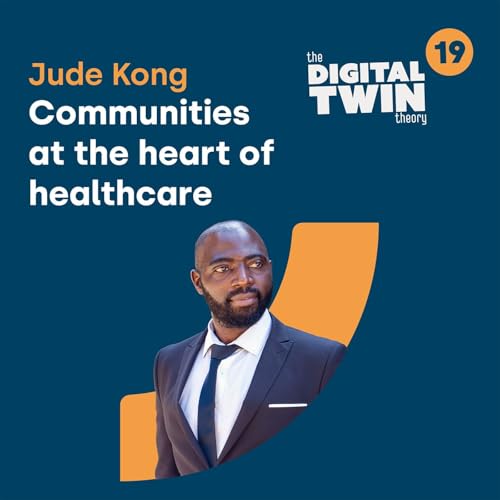
  • Episode 19: Communities at the heart of healthcare (with Jude Kong)
    2026/01/29
    Healthcare is about people as much as science. In this episode, we talk with Jude Dzevela Kong, Director of AIMMLab at the University of Toronto and Co-Director of ACADIC, about community-driven approaches to healthcare innovation.

    Jude explains how involving local communities and patients from problem definition to implementation leads to more effective, inclusive, and sustainable solutions. From empowering local communities to enabling global knowledge exchange, this conversation highlights why scientists must walk alongside communities to ensure healthcare truly leaves no one behind.
    続きを読む 一部表示
    27 分
  • Episode 18: Human motion, resolved (with Scott Delp)
    2025/12/19
    In the final episode of 2025, we sit down with Scott Delp, Professor of Bioengineering, Mechanical Engineering, and Orthopaedic Surgery at Stanford University, and Director of the Wu Tsai Human Performance Alliance and the RESTORE Center.

    We met Professor Delp at the iSi Health Conference in September 2025, where we recorded a wide-ranging and insightful conversation on the role of in silico medicine in human health and performance. Together, we explore how computational models and digital simulations can help prevent injuries, accelerate recovery, and enhance human performance—all while prioritising safety and clinical rigor.
    続きを読む 一部表示
    15 分