エピソード

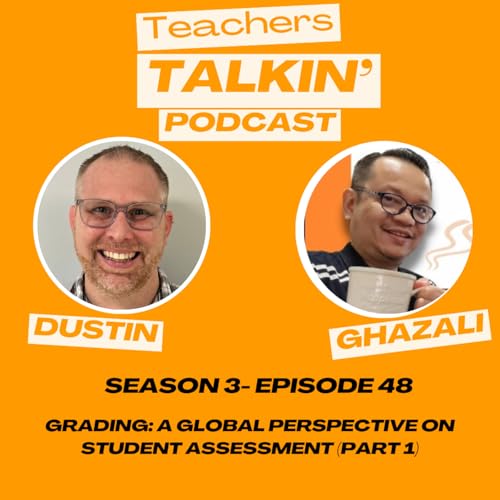
  • Grading: A Global Perspective on Student Assessment (Part 1)
    2026/02/23

    Dustin Tatroe and Ghazali Abdul Wahab launch a two-part conversation on “grades that tell the truth,” focusing in Part 1 on accuracy—what grades should measure, why they often don’t, and how grading practices shape teacher workload and student motivation. They compare contexts in Singapore and the United States: Ghazali outlines Singapore’s high-stakes structure (PSLE with banded scoring, O/N Level exams, removal of midyear exams, and three weighted assessments plus a year-end exam that make up recorded grades), where most day-to-day work is formative and not entered into the gradebook. Dustin contrasts this with common U.S. practices where teachers frequently grade nearly everything, often required to post multiple grades per week, leading to 60+ grades per semester and significant grading volume.

    They discuss stress and equity issues tied to high-stakes exams and school prestige, including Singapore’s tuition industry and U.S. funding disparities across districts. The conversation emphasizes the value of clear rubrics, shared language, exemplars, and peer marking to reduce subjectivity and improve feedback. Dustin argues against grading homework and other practice behaviors, recommending that practice work receive feedback but not be recorded as grades, and that recorded grades focus on independent demonstrations of mastery. Ghazali reinforces a mindset shift away from believing formative practice must be graded to matter, advocating for feedback that supports learning and risk-taking.

    Interested in joining us on the podcast? We’re always looking for passionate educators and school leaders to share their insights—no need to be an “expert.” Tell us what you’d like to talk about here: https://forms.gle/RCeUFhmvLxY1nRwU9

    続きを読む 一部表示
    1 時間
  • Mentorship Matters: Building Support Systems That Keep Teachers Thriving
    2026/02/09

    In this episode, Dustin and Ghazali welcome Jennifer Hartman, an associate principal at Memorial Junior High in Lansing, Illinois, to discuss the critical importance of structured mentoring programs in education. Jennifer shares her unique journey from aspiring dentist to educational leader and her passion for supporting new educators. They dive into the development of effective mentoring strategies that not only improve teacher retention but also create lasting pipelines of leadership in schools. Jennifer highlights the importance of classroom management, personalized mentoring approaches, and the profound impact of mentors in her own career. Whether you're an educator or an administrator, this episode offers insightful and practical advice on fostering a supportive and growth-oriented environment for new teachers.

    Interested in being a guest? Tell us what you’d like to talk about here: https://forms.gle/RCeUFhmvLxY1nRwU9

    続きを読む 一部表示
    49 分
  • Why Teachers Stay and Why They Leave
    2026/01/26

    Dustin and Ghazali dive into the crucial topic of teacher retention in this episode titled "Why Teachers Stay and Why They Leave." They address the guiding question: What keeps teachers in the classroom, and how do we make teaching sustainable without lowering expectations for students or educators? They discuss common misconceptions about teacher attrition, emphasizing issues beyond pay, such as professional autonomy and administrative support. Dustin and Gali also explore signs of teacher burnout, share personal experiences, and offer strategies to create a balanced and sustainable teaching environment. They highlight the importance of trust, autonomy, collegial support, and professional growth. This episode provides valuable insights for educators and school leaders aiming to enhance teacher retention and improve the overall educational environment.

    Interested in joining us on the podcast? We’re always looking for passionate educators and school leaders to share their insights—no need to be an “expert.” Tell us what you’d like to talk about here: https://forms.gle/RCeUFhmvLxY1nRwU9
    続きを読む 一部表示
    1 時間 4 分
  • Building Bridges with Other Cultures
    2026/01/12

    Dustin and Ghazali dive deep into the topic of cultural awareness and internationalization in education on this episode of Teachers Talking. Their guiding question: How can educators create meaningful connections across cultures locally, nationally, and globally, so students grow in empathy, understanding, and real-world readiness? They start by defining culture in a school context, discussing both visible and invisible layers, and the importance of students understanding that culture is something within them every day—shaped by their families, values, and lived experiences. They highlight strategies to help students see and respect cultural differences and overcome challenges such as language barriers and biases, while stressing that building cultural awareness should be a continuous, integrated effort in the classroom, not a standalone lesson. By fostering curiosity, empathy, and open communication, teachers can help students expand their cultural horizons and prepare for a globally connected world.

    Interested in joining us on the podcast? We’re always looking for passionate educators and school leaders to share their insights—no need to be an “expert.” Tell us what you’d like to talk about here: https://forms.gle/RCeUFhmvLxY1nRwU9

    続きを読む 一部表示
    45 分
  • Play Without Overwhelm: Designing Joyful, Accessible Learning
    2025/12/29

    Dustin and Ghazali are joined by Aditya Prakash, founder & CEO of SKIDOS Labs, to explore how playful design can turn “screen time” into learning time for our youngest learners. Their guiding question: How can beloved characters, adaptive game design, and thoughtful UX turn practice into joyful mastery for every child—without overstimulation?

    With SKIDOS focused on ages 3–7, Aditya shares why open-ended pretend play is the engine of engagement, how the team aligns early numeracy/literacy/SEL to global outcomes, and why parents are part of the loop from onboarding to progress dashboards. He explains accessibility choices guided by WCAG (simple color palettes, dyslexia-friendly fonts, minimal on-screen text, voice/visual prompts) and a unique “safe space” that kids can enter—or that auto-triggers after extended play—to regulate stimulation. Recognizable IP (e.g., The Smurfs) helps kids persist with tasks (like exploring instruments in a music room), while the product stays calm, inclusive, and developmentally appropriate.

    They also dig into SKIDOS’s use of AI: machine-learning personalization built from learner behavior data and AI to speed internal workflows—without exposing children directly to LLMs. Aditya touches on localization plans, parent-led SEL activities mapped to CASEL, availability across iOS/Android/Amazon/web (free to try, subscription for full access), and what it takes to keep curiosity at the center of early learning.

    Interested in joining us on the podcast? We’re always looking for passionate educators and school leaders to share their insights—no need to be an “expert.” Tell us what you’d like to talk about here: https://forms.gle/RCeUFhmvLxY1nRwU9

    続きを読む 一部表示
    41 分
  • Hard Conversations, Strong Partnerships
    2025/12/15

    Dustin and Ghazali get real about parent communication in Hard Conversations, Strong Partnerships—a practical episode on preventing most tense meetings before they ever happen. Their guiding question: How can teachers head off 80% of “hard” parent conferences—and turn the rest into collaborative problem-solving?

    They share concrete moves for the first weeks of school (positive check-ins, asking families’ contact preferences, and steady transparency around grades/expectations), plus systems that keep everyone aligned: student-led bi-weekly update emails, inviting parents into LMS/grade portals, work portfolios to make progress visible, and simple co-created trackers (from blue-book notes to assignment checklists) to reduce repeat issues. When emotions run high, they model de-escalation—listen fully, name what you hear, avoid blame, and pivot to “what we can do” language—then repair the relationship so the focus returns to the child’s success.

    You’ll walk away with ready-to-use scripts, documentation ideas, and a calmer approach to tough moments that builds trust—with families and with colleagues.

    Interested in joining us on the podcast? We’re always looking for passionate educators and school leaders to share their insights—no need to be an “expert.” Tell us what you’d like to talk about here: https://forms.gle/RCeUFhmvLxY1nRwU9

    続きを読む 一部表示
    1 時間
  • AI Transforming Education: Innovation Meets the Classroom
    2025/12/01

    Dustin and Ghazali flip roles in this episode as Ghazali joins as the guest to talk about a question he’s been helping educators tackle around the world: How can we harness AI to enhance instruction while protecting the human connection that makes great teaching possible?

    Drawing on two years of classroom work in Singapore, Ghazali shares concrete examples of AI’s real impact on students—from custom chatbots that helped his class prepare for high-stakes interviews and resumes, to a writing process where students plan and draft first, then use AI mind maps and feedback to refine their thinking instead of letting the tool do the work for them. Along the way, he surfaces a central idea: used well, AI can actually deepen relationships, because it frees time and creates more success moments for students.

    They also unpack teacher-facing AI—tools that speed up planning, feedback, and resource creation—alongside the risks of over-reliance, security concerns, and students starting to “sound like ChatGPT.” Rather than mastering everything, Ghazali argues for a mindset shift: start small, learn one tool well, and let AI act as a multiplier while you stay firmly in charge of the pedagogy.

    Interested in joining us on the podcast? We’re always looking for passionate educators and school leaders to share their insights—no need to be an “expert.” Tell us what you’d like to talk about here: https://forms.gle/RCeUFhmvLxY1nRwU9

    続きを読む 一部表示
    46 分
  • Try Again: The Power of Encouragement in the Classroom
    2025/11/16

    Dustin and Ghazali are joined by Mirriam Chintu to explore how something as simple as “try again” can transform how students see themselves as learners. Their guiding question: How can positive reinforcement reshape the way students experience learning and behavior in school?

    Drawing on more than 20 years of teaching experience from grades 3–7 and now junior secondary English in Zambia, Mirriam shares how students’ home lives, histories, and daily struggles show up in the classroom—and why that context matters when they make mistakes. She reflects on the damage caused by shame, harsh responses, and labeling, and contrasts that with classrooms grounded in encouragement, patience, and belief. Through stories of wrong answers turned into growth moments, she shows how simple shifts in language and tone can build confidence instead of fear.

    The conversation also turns toward teacher growth and school culture. Mirriam talks about how her own mindset has changed over time, how positive reinforcement has reshaped her identity as an educator, and what it would mean for entire schools—leaders included—to operate from a place of trust and care rather than punishment. As a teacher, school planner, and recent graduate with a master’s in education administration and management, she brings both classroom wisdom and a systems lens to what real encouragement can do.

    Interested in joining us on the podcast? We’re always looking for passionate educators and school leaders to share their insights—no need to be an “expert.” Tell us what you’d like to talk about here: https://forms.gle/RCeUFhmvLxY1nRwU9

    続きを読む 一部表示
    26 分