エピソード

  • Commercial Real Estate Syndications: How Passive Investors Access Larger Deals, How the Economics Work, and What to Look for in a Sponsor
    2026/11/22

    EPISODE 16 | Commercial Real Estate Syndications

    How Passive Investors Access Larger Deals, How the Economics Work, and What to Look for in a Sponsor

    Season 2 | Zoned Commercial Podcast

    What if you could invest in a multimillion-dollar commercial property without buying or managing the entire building yourself?

    In Episode 16 of Zoned Commercial, host Roy Malkison explains how real estate syndications allow investors to pool capital, access larger commercial properties, and participate in investment opportunities managed by experienced sponsors.

    Discover how syndications work, how returns are distributed, what risks investors face, and why evaluating the sponsor is just as important as evaluating the property.

    IN THIS EPISODE

    1. Understanding Real Estate Syndications

    How pooled investments work, the responsibilities of General Partners (GPs), and the role of passive Limited Partners (LPs).

    2. Securities Laws & Investor Eligibility

    SEC Regulation D, Rule 506(b) vs. 506(c), accredited investor requirements, and Private Placement Memorandums (PPMs).

    3. How Investors Make Money

    Preferred returns, equity splits, distribution waterfalls, sponsor fees, and profit-sharing structures.

    4. Evaluating the Sponsor

    Why experience, completed deals, investor references, financial commitment, and transparency are critical.

    5. Investor Due Diligence

    Reviewing financial projections, market conditions, operating agreements, capital calls, and downside scenarios.

    6. Understanding Investment Risks

    Comparing core, value-add, and opportunistic deals, including their potential returns and risks.

    7. Syndications vs. Direct Ownership

    The differences in control, diversification, liquidity, management responsibilities, and investment strategy.

    8. Tax Considerations

    Depreciation benefits, pass-through taxation, K-1 reporting, and passive activity limitations.

    KEY TAKEAWAY

    In a syndication, you're not just investing in real estate. You're investing in the sponsor's ability to execute.

    A great property with the wrong sponsor can become a bad investment.

    Evaluate the sponsor, understand the financial assumptions, review the legal documents, and know the risks before investing.

    Better information. Better decisions. Bigger profits.

    CONNECT WITH ROY MALKISON

    Founder | Malkison Company

    Real Estate · Loans · Insurance · Business Brokerage

    Phone: (972) 918-5500 Website: https://malkison.com

    Zoned Commercial — The Official Podcast of Malkison Company

    NEXT EPISODE: Ground-Up Commercial Development — From Land Acquisition to Construction and Certificate of Occupancy.

    DISCLAIMER: Educational purposes only. Not financial, legal, tax, or investment advice. Investments involve risk, including potential loss of capital. Consult qualified professionals.

    #ZonedCommercial #CommercialRealEstate #RealEstateSyndication #PassiveInvesting #RealEstateInvesting #MalkisonCompany #RoyMalkison

    続きを読む 一部表示
    31 分
  • Buying a Business vs. Buying the Building: When to Own Your Space, When to Keep Leasing, and When the Real Opportunity Is the Business Itself
    2026/11/14

    EPISODE 15 | Buying a Business vs. Buying the Building

    When to Own Your Space, When to Keep Leasing, and When the Real Opportunity Is the Business Itself

    Season 2 | Zoned Commercial Podcast

    Should you buy the building your business operates in, continue leasing, or invest in acquiring an existing business?

    In Episode 15 of Zoned Commercial, host Roy Malkison explores one of the biggest financial decisions business owners face: where should you invest your capital to maximize income, flexibility, and long-term wealth?

    From commercial property ownership and SBA financing to business acquisitions and valuations, this episode explains the financial opportunities, risks, and strategies behind each option.

    🎙️ IN THIS EPISODE

    1. Buy vs. Lease

    When commercial property ownership makes sense, when leasing offers greater flexibility, and how business growth affects the decision.

    2. Financial Benefits of Ownership

    Building equity, property appreciation, tax deductions, and potentially retaining your building as a retirement income asset after selling your business.

    3. SBA 7(a) vs. SBA 504 Financing

    How SBA loans can help eligible business owners acquire commercial real estate with lower down payments, including certain 10% down structures.

    4. Buying an Existing Business

    How acquiring a profitable business compares with buying commercial property, including income potential and operational risks.

    5. Business Valuation

    Understanding Seller's Discretionary Earnings (SDE), EBITDA multiples, recurring revenue, and owner dependency.

    6. Business Acquisition Financing

    Using SBA 7(a) loans, seller financing, and other funding structures while preserving working capital.

    7. Real Estate vs. Business Investment

    Comparing cash flow, appreciation, investment returns, liquidity, management responsibilities, and risk.

    8. Due Diligence Before Buying

    Reviewing financial records, customer concentration, contracts, inventory, receivables, and seller transition support.

    💡 KEY TAKEAWAY

    Sometimes the smartest investment is buying the building. Sometimes it's leasing. And sometimes the real opportunity is buying the business itself.

    The right decision depends on your financial position, business stability, growth plans, and long-term goals.

    A powerful wealth-building strategy is owning both your operating business and its real estate, allowing you to build equity while generating business income.

    Better information. Better decisions. Bigger profits.

    📞 CONNECT WITH ROY MALKISON

    Founder | Malkison Company

    Real Estate · Loans · Insurance · Business Brokerage

    Phone: (972) 918-5500 Website: https://malkison.com

    Zoned Commercial — The Official Podcast of Malkison Company

    Subscribe for weekly discussions on commercial real estate, lending, insurance, investing, and business.

    NEXT EPISODE: Commercial Real Estate Syndications — How They Work and What Investors Should Know.

    DISCLAIMER: Educational purposes only. Not legal, tax, financial, or investment advice. Consult qualified professionals before making investment decisions.

    #ZonedCommercial #CommercialRealEstate #BuyVsLease #BusinessAcquisition #SBA504 #SBA7a #BusinessBrokerage #RealEstateInvesting #MalkisonCompany #RoyMalkison

    続きを読む 一部表示
    31 分
  • Commercial Real Estate Taxes Deep Dive: Depreciation, Cost Segregation, Bonus Depreciation, 1031 Exchanges, and the Tax Advantages Most Investors Leave on the Table
    2026/11/07

    EPISODE 14 | Commercial Real Estate Taxes Deep Dive

    Depreciation, Cost Segregation, Bonus Depreciation, 1031 Exchanges, and the Tax Advantages Most Investors Leave on the Table

    Season 2 | Episode 14 | Zoned Commercial Podcast

    Most commercial real estate investors focus on purchase price, cash flow, cap rates, and appreciation. But what about the money they unnecessarily lose to taxes?

    The difference between a tax-aware investor and one who ignores tax strategy can amount to hundreds of thousands of dollars over the life of a commercial real estate portfolio.

    In Episode 14 of Zoned Commercial, host Roy Malkison explores the tax strategies investors should understand before buying, holding, improving, or selling commercial property.

    Discover how legitimate tax strategies can help preserve capital, improve after-tax returns, and build long-term wealth.

    🎙️ IN THIS EPISODE

    1. Depreciation — The Foundation

    How depreciation creates non-cash deductions, why commercial buildings generally use a 39-year schedule, and how these deductions reduce taxable rental income.

    2. Cost Segregation — Accelerating Deductions

    How engineering-based studies identify building components eligible for shorter depreciation schedules and potentially substantial early-year tax benefits.

    3. Bonus Depreciation — First-Year Benefits

    How bonus depreciation works with cost segregation, which assets qualify, and why acquisition timing and applicable tax laws matter.

    4. Real Estate Professional Status

    Understanding the 750-hour requirement, material participation, passive activity limitations, and when rental losses may offset other income.

    5. 1031 Exchanges — The Tax Math

    How properly structured exchanges can defer capital gains taxes and depreciation recapture while preserving equity for future investments.

    6. Qualified Opportunity Zones

    How Opportunity Funds work, potential long-term tax advantages, and why investment fundamentals must come before tax incentives.

    7. Entity Structure & QBI Deduction

    Understanding LLCs, partnerships, asset protection, pass-through taxation, and the potential Qualified Business Income deduction.

    💡 KEY TAKEAWAY

    Commercial real estate wealth isn't built only through appreciation and cash flow. It's also built through tax efficiency.

    The smartest tax decisions often happen before acquisition—not when tax returns are due.

    Involve your CPA and attorney early. Plan your acquisitions, deductions, ownership structures, and exit strategies as part of a long-term investment plan.

    Better information. Better decisions. Bigger profits.

    📞 CONNECT WITH ROY MALKISON

    Founder | Malkison Company

    Real Estate · Loans · Insurance · Business Brokerage

    📱 (972) 918-5500 🌐 https://malkison.com

    🎙️ Zoned Commercial — The Official Podcast of Malkison Company

    Subscribe for weekly discussions about commercial real estate, lending, insurance, investing, and business.

    NEXT EPISODE: Buy vs. Lease — Should You Own the Building Your Business Operates From?

    DISCLAIMER: Educational content only. Not legal, financial, or tax advice. Tax rules and eligibility requirements change. Consult a qualified CPA and tax attorney before implementing any tax strategy.

    #ZonedCommercial #CommercialRealEstate #RealEstateTaxes #CostSegregation #BonusDepreciation #1031Exchange #RealEstateInvesting #TaxStrategy #MalkisonCompany #RoyMalkison

    続きを読む 一部表示
    29 分
  • Building Your Commercial Real Estate Team: Who You Need, How to Vet Them, and What the Wrong Person Costs You
    2026/10/24

    Episode 13 — Building Your Commercial Real Estate Team

    Who You Need, How to Vet Them, and What the Wrong Person Costs You

    Commercial real estate is a team sport. You can understand deal analysis, financing, leases, due diligence, and negotiations—but knowledge alone doesn’t close deals or build portfolios. People do. ZonedCommercial_EP13_Script

    In Season 2, Episode 13 of Zoned Commercial, Roy Malkison breaks down the professionals behind successful commercial real estate transactions: who you need on your team, what each person should bring to the table, how to vet them before hiring them, and what choosing the wrong professional can ultimately cost you.

    In This Episode

    • Commercial Real Estate Broker — Why specialization in your asset class and market matters, how to evaluate an investment-sales broker, and why strong broker relationships can create access to off-market opportunities. ZonedCommercial_EP13_Script

    • Commercial Lender — How lender relationships affect which deals you can pursue, how quickly you can move, and why those relationships should be established before you have a property under contract. ZonedCommercial_EP13_Script

    • Commercial Real Estate Attorney — Why you need an attorney who specializes in commercial transactions and understands contracts, title, loan documents, leases, entity structure, and your local market. ZonedCommercial_EP13_Script

    • CPA — Why a CPA who understands commercial real estate taxation can play a major role in depreciation strategy, cost segregation, 1031 exchanges, entity structure, and long-term tax planning. ZonedCommercial_EP13_Script

    • Property Manager — Why your manager is more than an operator and can become an important source of tenant intelligence, vendor relationships, financial reporting, and asset protection. ZonedCommercial_EP13_Script

    • Inspector & Environmental Consultant — How these professionals help uncover the physical and environmental risks you may actually be buying—and why environmental due diligence should never be overlooked. ZonedCommercial_EP13_Script

    Roy also shares five principles for managing your team over the long term: communicate your criteria clearly, be a good client, give referrals generously, connect your advisors with each other, and regularly review whether your team still fits your investment strategy. ZonedCommercial_EP13_Script

    The takeaway is simple: your commercial real estate team is your infrastructure. The right professionals can provide expertise, relationships, market access, capital access, legal protection, tax strategy, asset management, and risk control that no investor can effectively replace alone. ZonedCommercial_EP13_Script

    Hosted by Roy Malkison Malkison Company Real Estate • Loans • Insurance • Business Brokerage (972) 918-5500 | malkison.com ZonedCommercial_EP13_Script

    Zoned Commercial — The Official Podcast of Malkison Company

    For educational and informational purposes only. Nothing in this podcast should be considered legal, tax, investment, lending, or financial advice. Consult qualified professionals regarding your specific situation.

    続きを読む 一部表示
    32 分
  • Negotiating the Commercial Real Estate Purchase: The LOI, the Contract, the Contingencies, and the Leverage Points Most Buyers Never Use
    2026/10/18

    Episode 12: Negotiating the Commercial Real Estate Purchase

    The LOI, the Contract, the Contingencies, and the Leverage Points Most Buyers Never Use

    Most buyers think commercial real estate negotiation is primarily about price. The seller wants one number, the buyer wants another, and eventually they meet somewhere in the middle.

    But real negotiation goes much deeper.

    In Season 2, Episode 12 of Zoned Commercial, Roy Malkison walks through the commercial real estate negotiation process from before the Letter of Intent (LOI) all the way to the closing table. The discussion covers how preparation, contract terms, contingencies, timing, due diligence, and seller motivation can all create negotiating leverage. ZonedCommercial_EP12_Script

    In This Episode

    • Why negotiation starts before you submit an offer • How to identify and use seller motivation • Why the highest offer isn't always the strongest offer • What belongs in a commercial real estate LOI • How to structure purchase price, earnest money, due diligence, financing contingencies, closing timelines, and exclusivity • The key provisions buyers should understand in a commercial purchase contract • When earnest money becomes “hard” and why it matters • Seller representations, warranties, rent rolls, title, survey, assignment rights, defaults, and remedies • How to use contingencies as negotiating tools, not simply exit ramps • How due diligence findings can support a legitimate price adjustment, seller credit, repair request, or extension • Five leverage points many buyers overlook: closing certainty, due diligence timing, earnest money structure, seller transition accommodations, and the seller’s timeline • How to professionally renegotiate after due diligence • Five negotiating mistakes that can cost buyers money ZonedCommercial_EP12_Script

    One of the biggest lessons from this episode: know what the seller actually needs.

    A motivated seller may value certainty, speed, stronger earnest money, or fewer contingencies enough to accept an offer that isn't necessarily the highest. Understanding the seller’s motivation before submitting your LOI can fundamentally change how you structure your offer. ZonedCommercial_EP12_Script

    And when due diligence uncovers a legitimate problem, approach renegotiation with facts, documentation, dollar amounts, and specific solutions. Know your walk-away number before you return to the negotiating table. ZonedCommercial_EP12_Script

    Commercial real estate negotiation is not one conversation. It is a multi-stage process, and every stage creates risks, decisions, and potential leverage.

    Hosted by Roy Malkison Malkison Company Real Estate • Loans • Insurance • Business Brokerage (972) 918-5500 | malkison.com ZonedCommercial_EP12_Script

    Zoned Commercial — The Official Podcast of Malkison Company

    For educational and informational purposes only. This podcast does not constitute legal, tax, investment, lending, or financial advice. Consult qualified professionals regarding your specific transaction.

    続きを読む 一部表示
    33 分
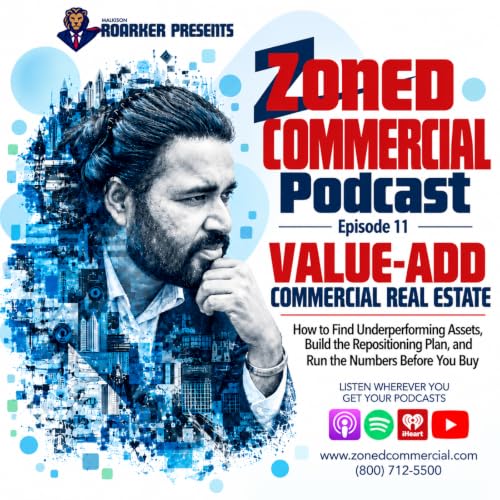
  • Value-Add Commercial Real Estate: How to Find Underperforming Assets, Build the Repositioning Plan, and Run the Numbers Before You Buy
    2026/10/18

    Welcome to Season 2 of Zoned Commercial, the official podcast of Malkison Company.

    We’re starting the new season by going deeper into one of the most talked-about—and often misunderstood—strategies in commercial real estate: value-add investing. A true value-add opportunity isn’t simply a building that needs new paint or landscaping. It’s an underperforming asset where an investor can identify a fixable problem, execute a specific plan, increase Net Operating Income (NOI), and ultimately create additional property value. ZonedCommercial_EP11_ScriptZonedCommercial_EP11_Script

    In this episode, Roy Malkison breaks down the four major types of value-add opportunities: leasing plays, management plays, physical renovation plays, and full repositioning plays—and explains how the risk, capital requirements, timeline, and execution strategy differ for each. ZonedCommercial_EP11_Script ZonedCommercial_EP11_Script

    In this episode, you’ll learn:

    • What value-add commercial real estate actually means—and what it doesn’t
    • The four types of value-add strategies
    • How to identify genuinely underperforming commercial properties
    • Where value-add opportunities can be found, including off-market outreach, broker relationships, distressed situations, and overlooked on-market properties
    • How to determine whether a property's problems are fixable or structural
    • How to build a complete repositioning plan
    • How to establish current performance versus realistic stabilized performance
    • How to budget for renovations, tenant improvements, leasing commissions, carrying costs, and contingencies
    • How to perform a before-and-after financial analysis
    • Why your cost basis per square foot matters
    • How bridge financing and repositioning holdbacks can work in value-add transactions
    • How investors can potentially exit through a refinance or sale
    • Five warning signs that a supposed value-add opportunity may actually be a money pitZonedCommercial_EP11_Script ZonedCommercial_EP11_Script

    The episode also walks through a hypothetical 20,000-square-foot retail center to demonstrate how an investor can compare current NOI with projected stabilized NOI, incorporate repositioning costs, calculate total cost basis, estimate stabilized value, and determine whether enough margin exists to justify the execution risk. ZonedCommercial_EP11_Script

    One of the most important lessons: underperformance alone does not create a value-add opportunity.

    The key question is why the property is underperforming. Poor management, below-market rents, deferred maintenance, or a solvable vacancy problem may create an opportunity. Structural obsolescence, a deteriorating location, or permanently weakened demand can be very different problems. ZonedCommercial_EP11_Script

    Before you buy the “potential,” make sure the numbers support the plan.

    Hosted by Roy Malkison Malkison Company Real Estate • Loans • Insurance • Business Brokerage (972) 918-5500 | malkison.com ZonedCommercial_EP11_Script

    Zoned Commercial — The Official Podcast of Malkison Company

    続きを読む 一部表示
    31 分
  • Commercial Real Estate Market Cycles: How to Read the Market, When to Buy, When to Hold, and When to Sell
    2026/10/18

    Commercial real estate markets move in cycles—but successful investors know that understanding where you are in the cycle can be just as important as choosing the right property.

    In Episode 10 of Zoned Commercial, Roy Malkison breaks down the four phases of the commercial real estate market cycle: Recovery, Expansion, Hypersupply, and Recession. More importantly, he explains how investors can recognize the signals that may indicate when it’s time to buy, hold, reduce risk, or prepare for the next opportunity. ZonedCommercial_EP10_Script

    You’ll learn how to evaluate five important market indicators: vacancy and absorption, rental-rate trends, the construction pipeline, capital-market conditions, and transaction volume and cap-rate trends. ZonedCommercial_EP10_Script

    Roy also explains why there is no single “commercial real estate market.” Office, retail, industrial, and multifamily can each be in different stages of the cycle at the same time, which makes local market and asset-class analysis critical before making an investment decision. ZonedCommercial_EP10_Script

    In this episode, we cover:

    • The four phases of the commercial real estate cycle
    • How to identify Recovery, Expansion, Hypersupply, and Recession
    • The market indicators investors should monitor
    • How office, retail, industrial, and multifamily behave differently
    • When the cycle may favor buying, holding, selling, or reducing risk
    • Why construction pipelines and effective rents matter
    • How interest rates and lending conditions affect CRE values
    • Five costly mistakes investors make when they ignore market cycles
    • How to position a commercial real estate portfolio for changing conditions
    • Why patience at the top and courage at the bottom can matter to long-term investors ZonedCommercial_EP10_Script

    This is also the Season One finale of Zoned Commercial. Across the first ten episodes, we’ve covered commercial real estate fundamentals, term sheets, due diligence, property management, commercial insurance, leases, deal analysis, financing, 1031 exchanges, and now market cycles. ZonedCommercial_EP10_Script

    Hosted by Roy Malkison Malkison Company Real Estate • Loans • Insurance • Business Brokerage Phone: (972) 918-5500 Website: malkison.com ZonedCommercial_EP10_Script

    Zoned Commercial — The Official Podcast of Malkison Company

    This podcast is for educational and informational purposes and should not be considered legal, tax, investment, or financial advice. Real estate investments involve risk. Consult the appropriate licensed professionals regarding your individual situation.

    続きを読む 一部表示
    27 分
  • Sell Commercial Property Without Paying Capital Gains Tax Now? How a 1031 Exchange Works
    2026/09/26

    Thinking about selling a commercial property with a large gain? Before you sell, you need to understand the 1031 Exchange.

    A properly structured 1031 exchange can allow a commercial real estate investor to defer capital gains taxes by reinvesting the proceeds from one investment property into another qualifying like-kind property—keeping more equity working in the next deal. But the rules are strict, the deadlines are unforgiving, and one procedural mistake can cause the exchange to fail. In Episode 9 of Zoned Commercial, I break down the 1031 Exchange from beginning to end—in practical, plain English. I am Roy Malkison — licensed realtor, loan officer, insurance agent, and business broker. Founder of Malkison Company.

    In this episode we cover:

    — What a 1031 Exchange actually is and how tax deferral works

    — The critical 45-day identification deadline

    — The 180-day closing deadline and why both clocks run at the same time

    — The Three-Property Rule, 200% Rule, and 95% Rule

    — What qualifies as like-kind property

    — How you can exchange one type of commercial property for another

    — Why you need a Qualified Intermediary (QI) and why you should never touch the sale proceeds

    — What cash boot and mortgage boot are and how they can trigger taxes

    — How a Reverse 1031 Exchange works

    — How Delaware Statutory Trusts (DSTs) can be used in a 1031 strategy

    — The five costly 1031 mistakes that can turn a tax-deferred transaction into an unexpected tax bill.

    The biggest takeaway: A 1031 Exchange is not simply about “avoiding taxes.” It is a strategy for deferring taxes and keeping more of your equity invested as you move from one commercial real estate investment to the next. ⚠️ IMPORTANT DISCLAIMER I am not a tax attorney or CPA. This episode is for educational purposes only. Every 1031 exchange should be structured with a qualified intermediary and reviewed with a qualified CPA and commercial real estate attorney.

    📞 WORK WITH ROY MALKISON Real Estate · Loans · Insurance · Business Brokerage

    📱 (972) 918-5500 🌐 malkison.com

    🔔 Subscribe to Zoned Commercial — new episodes every week. Real Numbers. Real Strategy. The Information Professionals Actually Use.

    #1031Exchange #CommercialRealEstate #CapitalGainsTax #RealEstateInvesting #CREInvesting #CommercialProperty #TaxStrategy #RealEstateTax #ZonedCommercial #MalkisonCompany #RoyMalkison #CommercialRealEstateInvesting #InvestmentProperty #RealEstatePodcast

    続きを読む 一部表示
    26 分