エピソード

  • Analysts of the Vibe
    2026/10/19
    Dear Show Notes Readers, It's decorative gourd season, motherfuckers! Fall has finally arrived in Houston, and Sean has taken the opportunity to accumulate a frankly unreasonable number of pumpkins and decorative gourds. Dan has returned from Telluride, where the fall colors were spectacular and the first snow has already fallen. All is right with the world. Or is it? This week, we're attempting to answer that question by doing what we do best: applying an entirely unnecessary level of analysis to the general mood of humanity. Sean has been experimenting with OpenAI's new persistent AI agents, including his latest digital assistant, Number Two. After spending months trying to cobble together something similar using Notion, Codex, and various AI tools, he's discovering the joys of watching a multibillion-dollar technology company casually release the thing he was trying to build. But when does AI stop being an entertaining toy and start becoming something genuinely useful? Dan makes the case that the biggest opportunity might not be building elaborate applications or autonomous coding agents. It might simply be dealing with the hundreds of emails, subscription renewals, calendar invitations, and administrative headaches that modern life throws at us. From there, we get into AI vendor lock-in, why Google should probably be better at email, and whether the future of communication is just a bunch of AI agents talking to one another while humans go about their lives. Then we turn our attention to the economy. Kyla Scanlon has introduced us to the wonderfully appropriate term shrugflation: that feeling when prices keep rising, the world keeps getting more expensive, and everyone collectively shrugs because what else are you going to do? We discuss inflation expectations, the limitations of the Federal Reserve, energy costs, the AI infrastructure boom, and the strange ways economic psychology can become economic reality. Which brings us to the central question of the episode: What exactly are the vibes? We're not entirely sure. Sean's assessment is that the economy is neither particularly good nor particularly bad. It's a complicated mixture of conflicting signals, irrational exuberance, anxiety, and uncertainty. In other words, the vibe is MEH. And wouldn't you know it? Our very own Unqualified Advice Vibe Index agrees. We also discuss Rory Sutherland and the importance of psychology, whether a flying car that's actually falling gracefully counts as flying, Apple's latest hardware, and the increasingly complicated relationship between AI and personal privacy. Are we approaching another fundamental shift in computing, comparable to the transition from local machines to the cloud? Probably. Should we be concerned about handing our personal information to increasingly capable AI agents? Absolutely. Should that stop us from experimenting, learning, and building things? We don't think so. Resistance may be futile, but understanding what you're getting into is still a pretty good idea. Until next time, go build something. — Sean & Dan A Podcast for a More Reasonable Tomorrow. Tools & Platforms Mentioned ChatGPT dots (OpenAI's always-on personal agent)CodexMeta MuseGemini and Google's Gemini 4 "Argon"OpenClaw, Hermes, Grok Bot (Dan's agent lineage)NotionGmailThe Vibe Index (our sentiment page) Companies Discussed OpenAI, Meta, Google, Waymo, Anthropic, Apple, Tesla, SpaceX, Amazon (AWS), Oracle, Ivanhoe Mines, The Wall Street Journal, the Federal Reserve, the CIA, My First Million, Ogilvy, the Financial Times Links & References The Unqualified Advice Vibe Index — Our own attempt to quantify the collective mood using six market signals. At recording time, it stood at 58/100: thoroughly MEH. It's Decorative Gourd Season, Motherfuckers — Colin Nissan — McSweeney's Internet Tendency. A seasonal masterpiece and required reading for anyone who appreciates the finer points of autumn decorating.Kyla Scanlon — Economic commentary exploring the relationship between economic fundamentals, consumer psychology, and the collective mood. Rory Sutherland — Dan discusses Sutherland's appearance on My First Million and his fascinating approach to behavioral economics and psychology.Kyla Scanlon: The Shrugflation Triangle Decrypt: everything OpenAI announced at DevDay 2026, including dots Forbes: why Russian sanctions relief would do little for US fuel prices Washington Examiner: Warsh raises rates and says the Fed will "stay in our lane" DCD: Oracle trucks in gas to power its Utah and Texas data centers Khaleej Times: the Tesla Roadster demo at SpaceX's McGregor site The Next Web: iPhone Duo preorders sell out, shipping slips to JanuaryDan's Substack, the Prometheus Dispatch Unqualified Fact-Check 🔍 We said some things. Here's how we did. 🟢 = Nailed it | 🟡 = Close enough | 🔴 = Whiffed it 🟡 Dots, the global agent Sean described dots as an always-on agent you can call on the phone, linked to his machines, ...
    続きを読む 一部表示
    44 分
  • Agency All the Way Down
    2026/10/05
    Programming Note: Off next week for fall break. We'll miss you! What happens when AI makes building an idea almost free? This week we introduce two projects born directly out of last week's podcast: Sean's Vibe Index, an attempt to quantify market and social sentiment from volatility, credit, meme stocks, prediction markets and Reddit; and Catsup Bot, our deeply unqualified experiment in buying the laggard of the Magnificent Seven. But the bots lead somewhere bigger. If AI can dramatically reduce the effort required to act on an idea, does it make us smarter? Or do we just stop thinking? We talk about agency, cognitive abundance, the surprisingly small share of households paying for AI, the changing value of white-collar management, what an undergraduate education should actually teach, signs of consumer stress, household leverage, and a future where AI agents may disrupt the advertising-driven internet by shopping for us. Plus: the Degeneracy Ratio, reinventing the associate's degree, whether "meh" is bullish, and why sometimes you need to touch grass and make a pizza. Find the Vibe Index and Ketchup Bot under Numbers at unqualifiedadvicepodcast.com. Cheers, Sean & Dan Tools & Platforms Mentioned The Vibe Index (our new page on the site)The Ketchup Bot (our paper-trading Mag 7 bot)Bright Data (Reddit scraping API)Reddit: r/wallstreetbets, r/stocks, r/investingPolymarket, Kalshi (prediction markets)FRED (St. Louis Fed economic data)ChatGPT, Muse, Grok Bot, Instinct (personal AI agents)The X API Companies Discussed Anthropic, OpenAI, Google, Meta, xAI, Instinct, Reddit, X, Bright Data, Andreessen Horowitz (a16z), Jane Street, ARK Invest, Polymarket, Kalshi, Robinhood, Coinbase, GameStop, AMC, Palantir, Tesla, SpaceX, the Magnificent 7, LVMH, DoorDash, Instacart, Amazon, Walmart, Shopify, Sonos, Bose, The Wall Street Journal, Stratechery, 3Fourteen Research, O'Shaughnessy Ventures Links & References The Vibe Index: our new market-sentiment pageThe Ketchup Bot: the paper-traded most-hated Mag 7Sheel Mohnot on X: the original "most hated" Mag 7 trading botRobert Shiller's online data (the CAPE dataset)a16z on X: "98% of US households aren't paying for AI yet"BLS: The Employment Situation, September 2026New York Fed: Household Debt and Credit Report, Q2 2026FRED: household debt service payments as a percent of disposable incomeTechCrunch: viral AI agent Instinct raises a $1B Series C at a $10B valuationO'Shaughnessy Ventures: The Great Reshuffle beginsDan's Substack, the Prometheus Dispatch Unqualified Fact-Check 🔍 We said some things. Here's how we did. 🟢 = Nailed it | 🟡 = Close enough | 🔴 = Whiffed it 🟢 The Vibe Index says meh Sean said that as of October 1st, Friday, the index sat at "meh." The site reads 56, squarely in Meh, as of October 1. October 1 was a Thursday, but the vibes don't care what day it is. 🟡 A 2.1% credit spread Sean called the gap between HYG (junk bonds) and IEF (Treasuries) "a two point one percent spread." It's actually how far HYG has beaten IEF over the past quarter, a relative return rather than a yield spread. Sean first called it elevated, then corrected himself to "actually pretty good," and the correction is right: it sits at the 68th percentile of the last three years. 🟡 Shiller CAPE at 41 Sean said the Shiller P/E was "around 41" yesterday, that it reached "42, 43" in 2000, and that it's historically "in the twenties." The current read is right: 41.4 at Friday's close. The dot-com peak was a bit higher, at 44.2 in December 1999. The long-run average is about 17, so the twenties only describe recent decades. Shiller does publish his data, but as a monthly series, not "every day." The daily figures come from sites that recompute it. Robert Shiller of Yale ✓. 🟢 Anthropic is about to IPO Sean said Anthropic is "about to IPO." Anthropic confidentially filed a draft S-1 on June 1, 2026, and recent reporting has the float landing in October or November at a valuation of $2 trillion or more. About to, indeed. 🟢 What the vibes said next Sean rattled off the index's track record. Doomscrolling happened on only 6 days and the market was up a month later 100% of the time. Meh was up 76% of the time, by about 2.5%. Memes All the Way Down lasted about 20 days and was up about half the time. Nervous was up 54%. The S&P is "typically up 69%." Every number matches the site (Meh averaged +2.2% with a +2.7% median). The 69% matches the base rate inside the index's own window, which is a little higher than the long-run norm. 🟡 Bright Data, five bucks a month Sean said Bright Data gave him 5,000 free Reddit calls a month and that "five bucks a month" would buy a lot more. The free tier is real: 5,000 requests a month, no card required. There's no $5 plan, though. Past the free tier it's pay-as-you-go at $1.50 per thousand requests, so five bucks buys you about 3,300 more calls. 🟢 The Ketchup Bot is up 200 bucks Sean said the bot ranks the Mag 7 on 3-, 6- and ...
    続きを読む 一部表示
    53 分
  • Where Are the Humans?
    2026/09/28
    Dear show notes readers, This week we accidentally spend most of an hour asking the same question in several completely different ways: Where are the humans? We start with personal AI agents and what happens when they begin doing more of our searching, shopping, comparing, emailing, and general internet busywork for us. Agents don't care about advertisements. Humans do. So if more of the utilitarian internet gets handed over to machines, where does human attention actually go — and which companies are positioned to monetize it? That leads us through Amazon vs. Walmart, Google vs. Meta, the economics of third-party sellers, YouTube advertising, and Dan making a sufficiently convincing case about Meta that Sean reluctantly changes his mind in real time. From there, we get increasingly agentic. Dan has been experimenting with TinCan, an open-source project that lets his various AI tools talk to one another, bringing us another step closer to the strange future where you don't manage individual AI applications so much as sit above an entire synthetic executive team and tell everyone what needs to happen. Then Sean shows up with a copy of Kurt Vonnegut's Galápagos. Obviously. Sean has been spending an unreasonable amount of time turning his Tomes and Tunes record collection into a walkable 3D record store. There is no business model. There is no obvious problem being solved. It may, in fact, be completely pointless. Dan thinks asking why he's doing it is the wrong question. Just do things. That leads us to Vonnegut's blue-footed boobies, their bizarre courtship dance, and a surprisingly difficult question about AI and creativity: when does something stop being made by AI and start being made with AI? Maybe the distinction isn't quality. Maybe it's intent. An AI-generated bus advertisement doesn't need a soul. It has a job. But art is different. Art can be exploratory, purposeless, weird, and valuable precisely because somebody wanted to make the thing. We argue about AI watermarking, ballpoint pens that can suddenly write their own sentences, and whether today's obsession with separating "human" creation from "AI" creation can survive once the tools become ubiquitous. Or, as Dan puts it: eventually it becomes water. Finally, Sean unveils the first version of Sean's Manufacturing Index, an attempt to track whether the physical buildout happening across the American economy is beginning to show up in manufacturing labor markets. Manufacturing employment hasn't exploded, but manufacturing wage growth is currently running ahead of broader wage growth. Sean thinks labor churn, tariff-driven manufacturing-network changes, data centers, power infrastructure, switchgear, cooling systems, and other physical investment may be setting up an interesting labor-market inflection point. Which brings us, strangely enough, back to the original question. If AI makes certain kinds of digital labor abundant while the physical economy needs more electricians, technicians, builders, engineers, operators, and manufacturing workers... Where are the humans? We close by deciding that markets are memes all the way down, contemplating a Vibe Index, discovering an absurdly simple Mag 7 trading strategy, and wisely deciding to take the rest of that conversation off air. Probably for the best. — Sean & Dan Books Discussed Galápagos by Kurt VonnegutUnknown Market Wizards by Jack D. Schwager Shows/Films Discussed The Mighty BooshCitizen Kane (and our pitch for a Christopher Nolan remake about Zuckerberg) Tools & Platforms Mentioned Muse (Meta's personal agent)TinCan / Agent Tincan (Matt Van Horn's open-source agent relay)Claude, ChatGPT / Codex, Gemini, GrokOpenClaw, Hermes (open personal-agent frameworks)Alexa (Amazon's shopping assistant)Sean's Manufacturing Index (our new SMI page)Sean's Tomes and Tunes (the 3D record store) Companies Discussed Meta, Google/Alphabet, YouTube, Amazon, AWS, Walmart, OpenAI, Anthropic, xAI, Oracle, Nike, Celsius, Coca-Cola, Budweiser, Miller Lite, Dove, Deckers, Skechers, Weber, June, Aalo Atomics, Jane Street, Colossus Links & References Sean's Tomes and Tunes: the 3D record storeSean's Manufacturing Index: the new SMI pageGeekWire: Amazon blocks Meta's Muse AI assistant in a new standoff over agentic shoppingBenzinga: Muse adds shopping with Walmart, Sephora and Best Buy (Meta Connect, Sep 23)Colossus: "Mark," Jeremy Stern's profile of Mark ZuckerbergStratechery: Ben Thompson interviews Colossus EIC Jeremy Stern about the profileAgent Tincan: let your AI agents ask each other for helpSheel Mohnot on X: the "most hated" Mag 7 trading botMarketplace Pulse: Amazon is regaining first-party unit shareDan's Substack, the Prometheus Dispatch Unqualified Fact-Check 🔍 We said some things. Here's how we did. 🟢 = Nailed it | 🟡 = Close enough | 🔴 = Whiffed it 🟢 Meta released Muse Dan said Facebook just released Muse, its closed, just-works personal agent. It launched September 8 and hit #1 on ...
    続きを読む 一部表示
    55 分
  • The Chicken Salad Index
    2026/09/21
    Dear Show Notes Readers, This episode begins with Halloween costumes and ends with copper on the Moon. Somehow, it makes sense. Dan's kids have reached the age where putting on a costume doesn't mean pretending to be something. For a little while, you simply are that thing. A dinosaur. Elsa. Whatever you've decided to become. That gets us thinking about the costumes adults wear, the stories we tell ourselves, and the enormous difference between saying "I'm not good at this" and "I'm not good at this yet." Because almost everything worth doing requires reps. That includes making economic predictions, where we take a moment this week to admit that we whiffed—hard—on a few. We revisit the Strait of Hormuz, fertilizer, rice, inflation, energy markets, and our increasingly mediocre prediction tracker before Sean and Dan simultaneously remember that the Kelly Criterion exists. From there we discuss the Chicken Salad Index, America's looming college demographic problem, whether degrees should somehow be priced according to their economic value, and why markets are so damn difficult to centrally organize. Trade, as Sean eventually observes, finds a way. That turns out to be a useful lens for AI, too. Should the frontier labs slow down? Can they? What happens when their breakthroughs diffuse around the world? Is China inventing the future, implementing it, democratizing it—or some mixture of all three? Then Dan makes perhaps the best defense of auto racing Sean has ever heard: the racetrack is a laboratory. It's where engineers get to ask, "Can we do it?" Which naturally sends us to the Moon. Why are we going back? Water. Minerals. Science. Capability. And all of the technologies we'll have to invent along the way. That brings us back to Earth, where electrification requires staggering quantities of copper, mining requires moving staggering quantities of rock, regulations require staggering quantities of paperwork, and physics remains stubbornly unwilling to negotiate. Maybe material science changes the equation. Maybe AI helps. Maybe we learn to use less copper, substitute other materials, recycle more efficiently, or build things in ways we haven't imagined yet. We aren't good at all of that yet. So we keep taking reps. Put on the costume of someone who can figure it out. Go build something. Books Discussed Mistborn by Brandon Sanderson — the king in white, and the reason I think about a fantasy novel on the plant floorThe Stormlight Archive by Brandon Sanderson — currently on book two. There are more than I said there wereThe Kingkiller Chronicle by Patrick Rothfuss — two brilliant books, one promised trilogy, and nineteen years of nothingMaterial World by Ed Conway — where I got the scale of the Atacama pit, and the second episode in a row Conway has done heavy lifting for us Tools & Platforms Mentioned Baker Hughes rig count · Bloomberg Odd Lots · Costco · Spirit Halloween Companies Discussed Ivanhoe Mines · Baker Hughes · BYD · Tesla · Porsche · GM / Chevrolet · Ford · Ram · Anthropic · OpenAI · University of Colorado Boulder · Purdue University · BloomTech Links & References The Chicken Salad Index — Dan demanded it on air, so here it is: the whole index, the modeled cost stack, and every price I have receipts forRobert Friedland on Odd Lots, "The World's Monumental Shortage of Copper" — published the day before we recorded. Go listen to it; I clearly should haveOur predictions tracker — every call we've made, scored, including the ones we got wrong this weekBaker Hughes rig count — published weekly since 1944, and the number the whole industry actually usesBLS Consumer Price Index, August 2026 — released two days before we recorded; the headline and core figures we argue overPurdue's "Back a Boiler" — the income share agreement I promised to look up on air Unqualified Fact-Check 🔍 We said some things. Here's how we did. 🟢 = Nailed it | 🟡 = Close enough | 🔴 = Whiffed it 🟢 The headline and the core Dan said "the three point four percent headline number, if you just strip it down to core, is closer to two." August CPI, released two days before we recorded: headline +3.4% year over year — exactly right — and core at +2.4%, the lowest core reading since March 2021. "Closer to two" than to three-four, comfortably. Recalled cold, two days after the print. 🟢 Heating oil up fifty-three percent Dan, off the top of his head: "Heating oil is up like fifty three percent." The CPI fuel oil index rose 52.0% over the twelve months to August 2026, the largest energy component in the report. One point off. Show-off. 🟢 Oil crossed a hundred again, and it never sticks Sean said we'd gotten above $100 a barrel recently and that historically it doesn't last. Brent broke $100 on September 9 and sat around $105.82 on the 11th. And the "short-lived" read holds up: before this year, the only time in the last decade oil held above $100 was 2022 — roughly six ...
    続きを読む 一部表示
    1 時間 9 分
  • The Demographics of Midtopia
    2026/09/14
    Notes From a Man Who Did Not Shave Dear Show Notes Readers, If demographics are destiny, what happens when some of the participants in the economy aren't actually people? That's where we start this week. Population decline has traditionally meant fewer workers, less economic activity, less surplus, and—if history is any guide—a greater chance that people start fighting over a shrinking pie. But history never had millions of AI agents doing useful work, making decisions, building businesses, and creating economic output. So we try to figure out whether that changes the equation. We talk about the Black Death and the Renaissance that came out of it. Is it actually getting rougher, or are we simply old enough to notice now? We stumble our way home to a better economic indicator than GDP: how things feel at the kitchen table. Then we ask the obvious next question. If agents really do become economically productive, who captures the surplus? Do we eventually tax agent-generated income differently from human labor? Can we use some of that productivity to give actual humans a better floor without deliberately kneecapping the technology creating it? Then we move to more practical matters. I've been moving my own agent between AI providers. So naturally we discuss sexy AI voices, revisit Her, and debate whether the ability to tell a genuinely funny joke might actually be a better test of AGI than most benchmarks. Dan thinks scientific discovery gets there first. Eventually we land on the bricklayer. Maybe AI doesn't replace the person who loves laying brick. Maybe it handles the website, follows up with customers, collects reviews, answers emails, manages the marketing, and does all the digital nonsense the bricklayer never wanted to do in the first place. That future sounds a lot more interesting than either utopia or dystopia. Midtopia, perhaps. Go build something. Cheers, Sean "You get older and you realize everyone's making it up, even the people that are in charge of it." Books Discussed Factfulness by Hans Rosling — the four income levels, and why things getting better is exactly what made families smallerRich Dad Poor Dad by Robert Kiyosaki — invoked strictly as the patron saint of predicting the next crash, foreverInfluence by Robert Cialdini — the one I couldn't retrieve on air. It's the "click, whirr" material, and yes, it's exactly about inverting the laziness Shows/Films Discussed Her (2013, dir. Spike Jonze) — due for a rewatch, and it will not feel the same30 Rock — I was reaching for a joke that turns out not to exist. See the fact-checkLost — collateral damage in a conversation about what's in the box Tools & Platforms Mentioned OpenAI Codex — the coding product, and the reason my agent has a new home this weekGPT-6 Astra — OpenAI's September releaseClaude / Anthropic — where the agent used to liveAnki — spaced repetition, aspirationally Companies Discussed Anthropic · OpenAI · Google · Meta · Amazon · BYD · Denver Botanic Gardens · The Comedy Cellar Links & References Greg Brockman on Stratechery — Ben Thompson's Sept 4 interview, the one Dan is half-remembering. Brockman: "somewhere in there, I think we're going to cross most people's AGI threshold"Gapminder's income levels — Rosling's four levels, with the actual dollar-per-day thresholdsEpoch AI on revenue per employee — the numbers behind my "look at that number" argumentAlliance for Lifetime Income, "Peak 65" — the boomer retirement figure I mangled, in its correct unitsCharlie Munger, "How to Guarantee a Life of Misery" (1986) — the source of "invert, always invert," which Munger got from Jacobi Unqualified Fact-Check 🔍 We said some things. Here's how we did. 🟢 = Nailed it | 🟡 = Close enough | 🔴 = Whiffed it 🟢 The Black Death handed the peasants leverage Dan said the plague "allowed the peasants to rise up, basically." Correct, and the receipts are unusually good: the plague killed 30–40% of England's population, and within two years the Crown passed the Ordinance of Labourers (1349) and then the Statute of Labourers (1351) capping wages at pre-plague 1346 levels — a law you only write if employers are being forced to bid up pay. One honest wrinkle: real wages didn't actually jump for about thirty years, and the 1381 Peasants' Revolt was crushed. But the long arc is exactly as Dan described it. 🟢 Rosling's levels, recalled under pressure Sean said Factfulness has "four or five different stages of wealth" and that America is "ninety nine percent in level four." It's four — under $2/day, $2–8, $8–32, and over $32 — and he hedged on the number anyway. Gapminder doesn't publish a US figure, but Level 4 starts at about $11,700 a year per person, which is below the US poverty line for a single adult. So essentially all of it. Both halves stand. 🟢 Brockman really did say that, and Dan really did listen to it Dan recalled an interview with OpenAI's co-founder on Ben ...
    続きを読む 一部表示
    46 分
  • Artificial Laziness
    2026/09/08
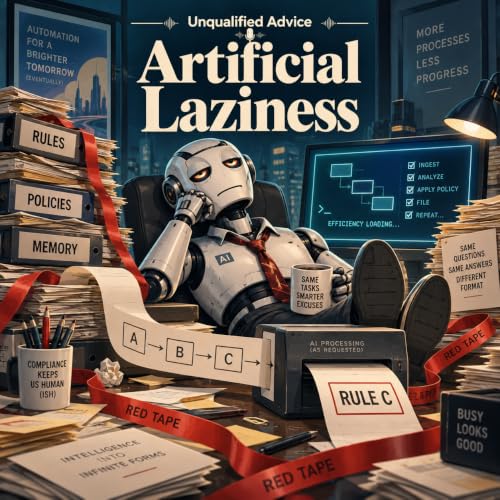
    Hello dear show notes readers! Dan started with a question about AI agents: how do you stop a thing that keeps writing down its own rules from going rigid? He was picturing a government. I was picturing red tape, and the policy documents I'd spent the week wrestling with. In the end, you wind up with the rule is C, and nobody remembers that C only ever followed from A and B — so when A changes, things downstream don't adapt quickly. Dan's answer: build deterministically, break the process into the smallest steps you can, and layer intelligence into only the one narrow place that actually needs judgment. It sounds a lot like training an employee, no? The middle of the episode is a boat. Ed Conway — whose Material World was my favorite book of its year — published a post the morning we recorded asking whether we've hit peak ship, and I brought it in as settled fact. Reader, I should have read to the end. The fact-checkers have notes. What survives the correction is the more interesting question anyway: what happens to a system when the curve that's been quietly fighting inflation on your behalf for forty years finally flattens out? That took us to Houthis, chokepoints, insurance actuaries, and my favorite tangent of the year — why shipping fortunes are shadowy in a way tech fortunes structurally cannot be. A Silicon Valley billionaire has one cash cow. A shipping magnate has Panama, Greece, and Angola. Then Dan announces a business. He's launching Polyiota — polyiota.com, as promised on air — consulting on AI transformation for exactly the kind of company that will never buy itself a software team. There is no such thing as ready, so you put the rivets in the airplane while it's already flying. His field report from his early efforts with his own team gives us a glimpse into the adoption headaches he hopes to help others avoid: the blinking cursor effect. The fix isn't just more intelligence. We end up somewhere I didn't see coming: not why not, but where's next. Cheap land moved technology west a century ago, and Dan's argument is that the underrated story of the next decade isn't AI at all — it's people moving again. Great Lakes. College towns. Columbia, Missouri. Then four million boomers a year start retiring, Dan does the arithmetic live and out loud with predictably mixed results, and we close on what the millennials will do with the inheritance. My guess was tattoos and beard oil. Dan, for the record, has neither. Go build something this week. Cheers, Sean Books Discussed Material World by Ed Conway — my favorite book of its year, on the raw materials that make modern life possible. If you only take one thing from it, make it how few places on Earth certain links in the silicon supply chain actually exist.Trade World by Ed Conway — the follow-up I said I was looking forward to. It came out four days after we recorded, built around bread, cloth, and cars. Tools & Platforms Mentioned Claude · Codex · Gemini · Grok · Cursor · OpenRouter · Zapier · Slack · X · YouTube · Substack Companies Discussed Anthropic · OpenAI · Google · xAI · SpaceX · Anysphere (Cursor) · Amazon · Sky News · NPR / Planet Money · Bloomberg / Odd Lots · University of Alabama · Purdue University · University of Missouri · Denver International Airport · Polyiota — Dan's new AI transformation and strategy practice Links & References Are We Approaching Peak Ship? (Ed Conway, Substack, Aug 30) — the post the middle of the episode is built on. Published the morning we recorded. Read past the setup; the ending is not where I left it.Polyiota — Dan's new practice. As promised on air.SycEval: Evaluating LLM Sycophancy (Fanous et al., Stanford, arXiv) — the study behind the "who caves when you push back" numbers.Planet Money Makes a T-Shirt (NPR, 2013) — the series I was describing, and the origin of the squirrel on my shirt.The Twitter recommendation algorithm — heavy ranker weights (GitHub) — the actual published numbers Dan was working from memory.How I AI — Claire Vo's show, correctly spelled.Peak 65: 4.1 million Americans turn 65 each year through 2027 (Alliance for Lifetime Income) — the real shape of the number I quoted.100 Years of U.S. Consumer Spending (BLS, PDF) — where my ninety-percent claim goes to die.China dominates the shipbuilding industry (CSIS) — the correct version of the stat that flabbergasted me. Unqualified Fact-Check 🔍 We said some things. Here's how we did. 🟢 = Nailed it | 🟡 = Close enough | 🔴 = Whiffed it 🟢 Material World is about six raw materials Sean hedged at "six or seven" and landed on the right one. It's six — sand, salt, iron, copper, oil, lithium — and the US subtitle says so on the cover. 🟢 The new book really is called Trade World Sean: "he's coming out with a new book, which I'm excited about, called Trade World." Correct, and better timed than he knew: Trade World: The Ties That Bound Our Past and Could Unravel ...
    続きを読む 一部表示
    1 時間
  • Our Submissions to the Library of Alexandria.
    2026/08/31
    The Horse Hello dear show notes readers! On this week's episode I tell Dan about something that had been haunting me. The events in the Strait of Hormuz feel eerily similar to a story captured 2,800 years ago. I had just seen Nolan's version of The Odyssey and been left with the feeling that Hormuz feels a lot like a modern-day Troy. A trade civilization built on a handful of honor rules. A horse rolled up to the gates. Somebody breaks the one rule that made the whole thing work, and everything that comes after comes through that gap. Dan's answer, which I'm still chewing on: "this sounds like post-World War Two." We came back to Troy twice more. It ends the way it always ends. Rome cleans up. That's the back half of a conversation that starts somewhere much drier. Dan opened by asking what on earth is going on with the Fed and the Treasury, and I did the responsible thing and pretended nothing was happening — thirty-year rates only back at 2007 levels, one arm of the government telling markets to speak freely and the other quietly buying bonds so they don't speak too freely. Then Dan said the quiet part out loud in the best line of the episode: Warsh says let the market speak, and Bessent says not that loudly. There are charts, an argument about whether what Bessent did counts as QE, and a detour on why a thirty-year mortgage is priced off the ten-year note — which I sent straight to the fact-checkers, because I was guessing. Then it turns into a build episode, and Dan makes an argument about agents I haven't been able to shake: you start a new conversation, and the thing knows everything until it knows nothing. It has to be born into existence every time. Which, he points out, is also us — we just happen to run about eighty years, and none of us can checkpoint our context either. That leads to his digital Library of Alexandria, my record store you can walk into on the internet, his rebuild of the whole investment process at Kabu, and the saddest sentence in modern software: all I've got is this little blinking cursor. We close on whether "artificial" is doing any work in "artificial intelligence," and whether a person is allowed to hold two contradictory ideas at once. Reader, we are. Go build something and contradict yourself. Cheers, Sean Books Discussed The Myth of America's Decline by Josef Joffe — Dan's find, on the pile, not yet read.When Reason Goes on Holiday by Neven Sesardić — arrived on Dan's doorstep the day before we recorded, still unopened.The Odyssey and The Iliad by Homer — the spine of the first half.The Republic by Plato — cited, correctly in spirit, on the permanence of nobody wanting to fix the hard thing. Also Discussed Watched / listened: The Odyssey (2026) · Tetragrammaton with Rick Rubin (the Tyler Cowen episode) · Odd Lots · Forward Guidance Tools, platforms, companies: Notion · GitHub · Discogs · Audible · Claude, Codex, Grok · Number One, Boosby, Tara, Saul and Fable (the named agents on both ends of the call) · US Treasury · Federal Reserve · Anthropic · OpenAI · xAI · Kabu Links & References Treasury doubles debt buybacks (CNBC, Aug 19) — the announcement the first act is built on.30-year Treasury tops 5.33%, a 19-year high (CNBC) — the "levels we haven't seen since '07" number.Warsh's July 29 press conference — full transcript (Federal Reserve, PDF) — the actual "play the ball, not the referee" remarks.The typical US homeowner now stays put about 12 years (Redfin) — the number that beat both our guesses. Unqualified Fact-Check 🔍 We said some things. Here's how we did. 🟢 = Nailed it | 🟡 = Close enough | 🔴 = Whiffed it 🟢 The 30-year really is back at 2007 levels Sean called it above 5.3%, at levels unseen since '07. It touched 5.33% on August 17–18 — a 19-year high, the highest since 2007. Correct to the decimal, from memory, in the first two minutes. 🟢 The buyback, and the date Sean put it at "middle of the week, August nineteenth." Treasury announced it August 19, raising the maximum operation size to at least $4 billion from $2 billion across 10–30 year maturities. One nuance: the 19th was the announcement. Buying starts September 9. 🟢 Yellen did it first Treasury relaunched its buyback program in May 2024, the first since the early 2000s. This is the load-bearing beam under Dan's "both sides are implicated," which was the whole point of the segment. 🟢 Two book titles, recalled cold, both exact Dan apologized for his pronunciation twice and then got both titles and both authors right. Word for word. 🟢 The Tetragrammaton episode really was last week The Tyler Cowen episode went up August 19 — four days before we recorded. 🟡 "Isn't this QE executed by Treasury?" — "Yes, sir." Buybacks are funded by issuing other debt, mostly bills, so no new money enters the system — a duration swap, closer to Operation Twist. Only the Fed can create reserves. Where we're right, and it's the part that ...
    続きを読む 一部表示
    59 分
  • Roll Your Own Problems
    2026/08/24
    The 7:30 PM Tuesday Problem Hello dear show notes readers! This one starts with a website. I spent a good chunk of the weekend finishing the rebuild of Howard Home Realty — Lindsay Howard's brokerage — and it went live the morning we recorded. Twenty to twenty-five hours all in, about ninety-five percent of it alongside an AI tool. Dan, being Dan, immediately turned my little side project into a tip that's going to change how I work: go extend your Claude Code transcript retention before the thing quietly auto-deletes, then mine all of it into a repeatable playbook for the next time. Audit trail first, tooling second. From there we get to the meat. Dan fired a software vendor this week and he's building the replacement himself. So we've both got a build project going, and we spend a while circling the same caution from opposite ends. It is a genuinely great moment to roll your own solutions, and you want to be very careful about rolling your own problems. Otherwise, on some Tuesday at 7:30 PM the thing breaks, it's yours, and there's nobody else to call. Then Dan asks me whether AI is a deflationary technology, and I fumble it live. I'm leaving the fumbling in, because I think I talk myself into his answer over about three minutes and that's more useful than if I'd just nodded along. He gets there in one sentence — you get more for less, period — and the carve-out he adds forty minutes later is the part I've been chewing on since: deflationary everywhere except the one place all the money is currently going. The back half turns to a soft jobs print, a read on the new Fed chair with the politics stripped out, and Dan asking the question of the episode: what is actually inside the manufacturing number? If Meta is out there training electricians and plumbers to build data centers, is manufacturing coming back in a shape our statistics structurally cannot see? He handed that one to Claude on the record, and the answer is in the fact-check below. I'll spoil this much — his instinct was right and his follow-up guess was not, which is a very Dan way to go two-for-one. We land somewhere I keep circling back to, which is that a thing can be the best outcome in the long run and genuinely painful in the short one, and that being honest about is the best way to face it. Cheers, Sean Go out, build something this week. Tools & Platforms Mentioned Claude / Claude Code — the ninety-five percent of the Howard Home Realty buildCowork — including the mobile release that obsoleted a handful of tools I'd built to do the same jobClaude Tag — Dan's been using it in one of his businesses, and it's the jumping-off point for the lock-in conversationClaude Fable — token appetite, orchestration, and hashtag skill issueCodex — Dan's on-the-go workhorse, and also the thing building UIs nobody asked forGitHub Copilot — my underwhelming work experience with itBuzz — Jack Dorsey's agent-native group chatworkgroove.ai — work governance and auditability across humans and agentsHQ — shared-context layer across coding agentsSquarespace — the before pictureGoogle Search Console / Google Analytics / Google Cloud — everything Squarespace was quietly doing for meIDX / MLS — the real-estate listing plumbing that was broken on the old siteEpic Systems — Dan's example of why healthcare AI is a slower storyX / Twitter bookmarks — Dan's over-stuffed information surface, and the raw material for his ingestion engine Companies Discussed Anthropic · OpenAI · Microsoft · Meta · Block · Google · Squarespace · Epic Systems · Goldman Sachs · Morgan Stanley · workgroove.ai · HQ · Howard Home Realty Links & References Howard Home Realty — Lindsay Howard's brokerage, live as of the morning we recorded. This is the cross-link I promised her on air.The before-and-after case study — on our own hosts page, if you want to see what twenty-five hours actually bought.Meta: America's Workforce Academy — the electrician-and-plumber training program Dan was describing, announced two months before we recorded.BLS Employment Situation — the July report, released two days before this conversation, and the reason Dan opened with "bad job numbers."FOMC press conference transcript, July 29, 2026 — Warsh in his own words, including the AI-capex-is-raising-prices line that undercuts our read of him.Claude Code data usage and retention — the cleanupPeriodDays setting behind Dan's tip. Default is 30 days; zero disables cleanup entirely.Introducing Claude Tag — what Dan's been testing.Jack Dorsey's Buzz — the Slack-killer with agents as first-class citizens.workgroove.ai and HQ — the two tools Dan named for making human-and-agent work legible.Philippine Statistics Authority, April 2026 labor force survey — where my eleven percent went to die.Why K-12 enrollment is declining — the demographic story under the elementary school closures. Unqualified Fact-Check 🔍 We said some things. Here's how we did. 🟢 =...
    続きを読む 一部表示
    49 分