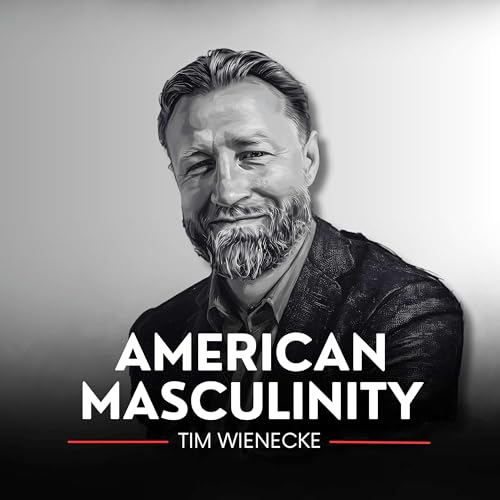
『The American Masculinity Podcast』のカバーアート

The American Masculinity Podcast

The American Masculinity Podcast

著者: Timothy Wienecke MA LPC LAC
無料で聴く

このコンテンツについて

Want to become a better man? American Masculinity is a self improvement for men podcast helping you master personal development, men's mental health, and leadership.

Hosted by Timothy Wienecke, licensed psychotherapist, Air Force veteran, and award-winning men's advocate. Each episode delivers expert insight and practical tools for men's self improvement.

Whether you're navigating fatherhood, building confidence in relationships, or working on personal growth, you'll find grounded conversations on masculinity, trauma recovery, growth mindset, and what it means to show up as a better partner, father, and leader.

No yelling. No clichés. Just thoughtful motivation rooted in psychology and real-world experience. Perfect for men seeking mental fitness, self-discipline, and meaningful life skills.

New episodes drop weekly with actionable advice on men's wellness, stress management, and becoming a better man. Subscribe now and join thousands of men committed to personal development and positive change.


© 2025 The American Masculinity Podcast
心理学 心理学・心の健康 衛生・健康的な生活
エピソード
  • How to Develop Real Empathy in 30 Days (Professor and Therapist Explains)
    2025/12/02

    Send us a text

    Most men are told to “listen better,” but almost nobody teaches the actual skills. In this episode, therapist and professor Tim Wienecke breaks empathy down into a practical, trainable system you can improve in 30 days. No personality shift required—just simple tools that help you communicate clearly, stay grounded in tough moments, and understand what people actually need from you.

    Tim teaches the same framework he uses with counseling students: a 30-day daily drill that improves emotional recognition, grounding skills to keep you out of fixer mode, and a three-level reflective listening method that makes conversations easier and more productive. You’ll also learn the one question that prevents most difficult conversations from blowing up, plus how to apply these skills in romantic partnerships, leadership, and parenting.

    Whether you want to connect better with your partner, lead more effectively at work, or simply be the man people feel safe opening up to, this episode gives you a complete step-by-step system you can start using today.

    What You’ll Learn

    • The 30-day stranger exercise that builds emotional accuracy
    • Why the Eyes Test is a helpful baseline for empathy
    • How the Emotion Wheel expands emotional vocabulary
    • Grounding techniques that help you stay present
    • The three types of reflections: simple, dual-sided, and summary
    • The question that keeps conversations from going sideways
    • How empathy shows up differently in parenting, leadership, and relationships

    Chapters

    00:00 Why Empathy Is a Trainable Skill
    00:50 The Eyes Test and Your Baseline
    02:10 The 30-Day Stranger Exercise
    03:10 Using the Emotion Wheel
    04:00 Skill 1: Grounding So You Stop Fixing
    06:40 Skill 2: Reflective Listening (Simple → Dual → Summary)
    12:00 Skill 3: “Am I Helping or Listening?”
    15:10 Applying the Skills: Kids, Leadership, and Partnerships

    Tools Mentioned

    Reading the Mind in the Eyes Test - https://socialintelligence.labinthewild.org/mite/

    Emotion Wheel (vocabulary expansion tool)- https://feelingswheel.com/

    Recommended Reading

    How to Win Friends and Influence People — Dale Carnegie
    If I Understood You, Would I Have This Look on My Face? — Alan Alda
    Motivational Interviewing (3rd ed.) — Miller and Rollnick

    Get them from delivered by your local bookstore:

    https://bookshop.org/lists/amp-32-empathy-and-communication-reading-list

    Full Fact Check and Show Notes: www.americanmasculnity.com/amp32-skilled-empathy

    📊 Research Notes:
    The 36-item Reading the Mind in the Eyes Test measures emotion recognition accuracy. Studies show empathic accuracy and reflective listening improve with deliberate practice.
    John Gottman's research finds 69% of relationship conflicts are "perpetual"—the goal

    Shop local bookshops with bookshop.org
    Bookshop.org is a non-profit that helps local bookstores deliver books directly to you by mail.

    Disclaimer: This post contains affiliate links. If you make a purchase, I may receive a commission at no extra cost to you.

    The American Masculinity Podcast™ is hosted by Timothy Wienecke — licensed psychotherapist, Air Force veteran, and men’s advocate.
    Real conversations about masculinity, mental health, growth, and how men can show up better — as partners, leaders, and friends.
    We focus on grounded tools, not yelling or clichés. If you have questions or want a tool for something you're wrestling with, leave a comment or send a message — your feedback shapes what we build next.
    Note: While this doesn’t replace therapy, it might help you notice something worth exploring.

    続きを読む 一部表示
    21 分
  • MeToo's Impact on Men - A Conversation About Accountability and Shame (MeToo Part 3)
    2025/11/26

    Send us a text

    What happens to men’s mental health after #MeToo—once the headlines fade and you’re left with shame, confusion, and a culture you didn’t choose but still live in?

    In this final part of the Men and #MeToo series, licensed therapist and veteran Tim Wienecke sits down with advocate Michael Brasher for an unhurried conversation about the “water” men were raised in: intergenerational violence, confusing sexual scripts, status pressure, and the stories that keep “good guys” from seeing the harm they cause.

    Together they unpack why so many men feel attacked or shut down when they hear terms like #MeToo, “rape culture,” or “toxic masculinity”—and how those reactions are often about fear, shame, and status threat, not about being hopelessly broken. They also talk about young men’s dating anxiety, the mentorship gap, and what it takes to build a version of masculinity that is both strong and deeply safe for others.

    The episode ends with something rare: an explicit on-air fact-check. Tim revisits several overstatements from the conversation and corrects them using current research on sexual assault, harassment, unwanted consensual sex, and male survivors—modeling how men can be emotionally honest and factually precise at the same time.

    In this episode, you’ll learn:

    • How intergenerational violence and family secrecy shape men’s addictions, relationships, and blind spots
    • Why the “good men vs. bad men” story blocks accountability and repair
    • What the latest data say about sexual assault, harassment, and unwanted consensual sex for both women and men
    • How shame, empathy, and self-kindness interact when men try to face their own harm-doing
    • Why status threat feels like a physical reaction in men’s bodies—and how to ride it instead of exploding or shutting down

    Parts 1 and 2 of this series give you practical tools:

    • Part 1: What to do when you’re accused
    • Part 2: How men can support survivors without walking on eggshells

    This conversation (Part 3) gives you the cultural context and emotional landscape those tools sit inside.

    🔗 Full fact-check, references, and show notes:
    www.EmpoweredChangeCE.com/american-masculinity

    The American Masculinity Podcast™ is hosted by Timothy Wienecke — licensed psychotherapist, Air Force veteran, and men’s advocate.
    Real conversations about masculinity, mental health, growth, and how men can show up better — as partners, leaders, and friends.
    We focus on grounded tools, not yelling or clichés. If you have questions or want a tool for something you're wrestling with, leave a comment or send a message — your feedback shapes what we build next.
    Note: While this doesn’t replace therapy, it might help you notice something worth exploring.

    続きを読む 一部表示
    1 時間 1 分
  • How Men Can Actually Support MeToo - A Therapist's Guide
    2025/11/18

    Send us a text

    Most men want to support survivors—but freeze when it matters. This guide teaches the three phases men need to show up with safety and presence.

    Many men believe in the MeToo movement but freeze when it’s time to actually show up. In Part 2 of the Men and MeToo series, therapist and veteran Tim Wienecke outlines a modern masculine framework for supporting survivors—focusing on emotional regulation, relational skill, and community presence.

    PHASE 1 — Support Yourself (01:20–07:30)
    Learn to regulate anger, fear, and protectiveness when someone discloses harm. Address your own shame, past behavior, and cultural conditioning before trying to hold someone else’s story.

    PHASE 2 — Support Your People (07:30–32:00)
    Master listening without interrogating. Explore the Continuum of Harm, the 10-Level Boundary Scale, and simple scripts for showing up without making things worse.

    PHASE 3 — Support Your Community (32:00–45:30)
    Move beyond online performance into real-world action. Learn how to enter survivor-led spaces, when men should lead (and when we shouldn’t), and what healthy masculine presence looks like.

    Chapters:
    00:00 – Why Men Freeze Up
    00:50 – Survivor Statistics
    01:20 – Phase 1: Managing Your First Reactions
    03:40 – Responding Without Blame
    05:40 – Looking Honestly at Your Past
    07:30 – Phase 2: You Can’t Do This Alone
    11:00 – Building Your Support Circle
    17:00 – The Continuum of Harm
    22:00 – The 10-Level Boundary Scale
    31:00 – Recap
    32:00 – Phase 3: Taking This Work Into the World
    33:30 – Why Online Outrage Fails
    36:20 – Real-World Support
    38:00 – Walking Into Spaces That Don’t Belong to You
    40:20 – When Men Should Lead
    44:00 – Strengthening Community
    45:30 – Closing

    This is practical masculinity that repairs. If it resonates, share it with men who want to do better.

    Series & Resources:
    • Part 1: What To Do When You’re Accused
    • Guide: How to Walk Into Spaces That Don’t Belong to You – https://americanmasculinity.gumroad.com/l/xvcnj

    • How to Build a Men’s Group That Holds You Accountable

    Key Facts:
    • 1 in 4 men, 1 in 2 women, and even higher rates among trans/non-binary adults experience sexual violence (CDC 2023; NSVRC 2024).
    • Very few cases result in conviction due to evidentiary limits—not because survivors are lying.
    • Questioning or interrogating survivors increases self-blame and isolation (Ullman & Peter-Hagene 2014).

    Full fact-check and citations: www.americanmasculinity.com

    What support do you need as you try to show up better for survivors in your life?
    Your story might help another man take his first step.

    The American Masculinity Podcast™ is hosted by Timothy Wienecke — licensed psychotherapist, Air Force veteran, and men’s advocate.
    Real conversations about masculinity, mental health, growth, and how men can show up better — as partners, leaders, and friends.
    We focus on grounded tools, not yelling or clichés. If you have questions or want a tool for something you're wrestling with, leave a comment or send a message — your feedback shapes what we build next.
    Note: While this doesn’t replace therapy, it might help you notice something worth exploring.

    続きを読む 一部表示
    46 分
まだレビューはありません