エピソード

  • PRAVER 2.0: The Comeback | 1% Survival & a Second Life
    2026/09/19

    39 hours. 9 days. 1% survival. And somehow, the story continued.


    This episode of The Listening Commons is especially close to my heart.


    Praver Awal is not simply our guest. He is a friend—and I have witnessed parts of a journey that, at times, felt nothing short of a miracle.


    But Praver 2.0 is not only a story about surviving a medical crisis. It is about what comes after survival.


    How do you rebuild when life has changed completely? What happens to fear, identity, relationships and purpose when you have come so close to losing everything? And what does a second chance ask of the person who receives it?


    In this deeply personal conversation, Praver Awal joins Scott Douglas Jacobsen and Dr. Aninda Sidhana to speak about the fight for life, the family that stood beside him, recovery, resilience, gratitude—and learning to stand again.


    Because sometimes recovery isn't about returning to the person you were.


    Sometimes you become 2.0.


    Declared Dead. Reborn Bold.

    PRAVER 2.0 — The Comeback.


    And for this story, perhaps there could be no better ending:


    Picture abhi baaki hai, mere dost. ❤️


    🎙️ The Listening Commons

    Real People. Real Conversations. A Kinder World.

    続きを読む 一部表示
    25 分
  • Decoding Suicide: Why Human Connection Beats the Algorithm Every Time
    2026/09/12


    Can artificial intelligence save a life in a mental health crisis, or does the true antidote to despair lie in human connection?


    In this episode of the listening commons Scott Douglas Jacobsen sits down with Dr. Aninda Sidhana—Indian psychiatrist, psychosexual-medicine specialist, educator, and global mental health advocate—to explore the evolving science, cultural landscape, and systemic realities of suicide prevention.

    Dr. Sidhana's work focuses on dignity-centered care, women's mental health, trauma-informed systems, and psychosocial wellbeing. Together, they move past surface-level awareness to examine why severe crises occur, how cultural belief systems shape vulnerability, and why responsible technology must be paired with genuine human empathy.

    What We Discuss in This Episode:

    * Forensic Insights & Psychological Autopsy: Unpacking shared delusional disorders (folie en famille), the Burari case, and how faith-healing practices and untreated depression intersect.

    * The Gender Paradox & Stigma Reduction: Analyzing suicide demographics, the lethal means gap, and why anonymous crisis lines are finally opening doors for male vulnerability.

    * Means Restriction & Systemic Prevention: Evidence-based public health interventions—from pesticide regulation to physical infrastructure safeguards—that interrupt impulsive crisis points.

    * Media Ethics & the Papageno Effect: Preventing copycat contagion (the Werther effect) by prioritizing stories of recovery, survival, and accessible community support.

    * Clinician-Led AI Alignment & Social Media: The psychological toll of algorithmic comparison, the risks of synthetic companionship, and why AI triage tools must be clinician-guided and rooted in referral rather than pseudo-therapy.

    * Building Lifelong Resilience: How childhood emotional regulation, healthy coping mechanisms, and strong cultural connectedness serve as foundational protective shields.


    Crisis Support Resources:

    If you or someone you care about is struggling with depression, distress, or thoughts of self-harm, please reach out for help immediately. Support is confidential, free, and available around the clock. Contact your local crisis helpline, mental health facility, or healthcare professional. You do not have to carry this alone.


    続きを読む 一部表示
    27 分
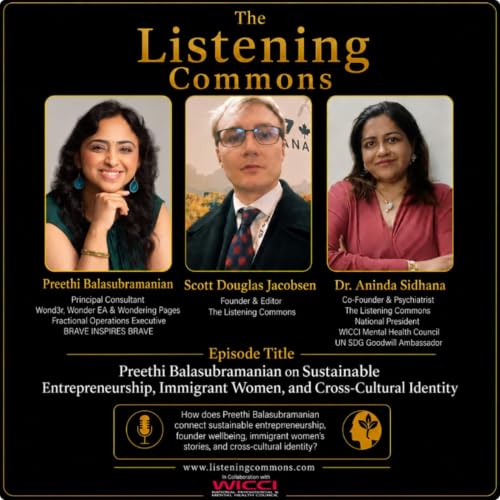
  • Preethi Balasubramanian on Sustainable Entrepreneurship, Immigrant Women, and Cross
    2026/09/08

    How does Preethi Balasubramanian connect sustainable entrepreneurship, founder wellbeing, immigrant women’s stories, and cross-cultural identity?


    Preethi Balasubramanian is a Toronto-based operations strategist, entrepreneur, author, and founder of Wonder EA and Wondering Pages. With more than 15 years of international experience, she helps founders build sustainable systems, reduce operational dependence, and avoid burnout. She is the author of The Ease Equation, writes children’s books rooted in Indian mythology and values, and curates Voices Across Borders, an anthology preserving immigrant women’s stories of identity, belonging, resilience, migration, and becoming across contemporary communities.


    In this interview, Scott Douglas Jacobsen and Dr. Aninda Sidhana with Preethi Balasubramanian discuss founder pressure, perfectionism, mental load, and the systems needed for sustainable entrepreneurship. They examine women’s experiences of business, immigration, motherhood, and cultural identity, including raising children between Indian and Canadian cultures. Balasubramanian also explains the purpose of Voices Across Borders, the shared and diverse experiences of immigrant women, culturally rooted children’s storytelling, resilience, self-care, support networks, and changing definitions of personal success in contemporary life.

    続きを読む 一部表示
    28 分
  • Dr.Nimesh G Desai on mental health ,human rights and humanity
    2026/09/05

    Dr. Nimesh G. Desai on Mental Health, Psychiatry, Human Rights, and Society


    How does Dr. Nimesh G. Desai understand the relationship Siddhanath reflects on listening, prevention, non-judgmentalitygical science, and society?


    Dr. Nimesh G. Desai is an Indian psychiatrist and public mental health specialist with more than four decades of clinical, academic, institutional, and policy experience. Formerly Director of the Institute of Human Behaviour and Allied Sciences in Delhi, he has worked at NIMHANS and AIIMS. His career has included contributions to mental health services, psychiatric education, substance-use policy, human rights, multidisciplinary care, and debates concerning biological, social, and cultural approaches to psychiatry.


    In this interview, Scott Douglas Jacobsen, Dr. Nimesh G. Desai, and Dr. Aninda Sidhana discuss mental health as a medical, social, cultural, and humanistic concern. They examine psychiatric diagnosis, biological research, biomarkers, psychopharmacology, multidisciplinary care, human rights, cultural differences, and the risks of over-psychiatrization. Desai emphasizes care, humility in science, diagnostic restraint, and integrating biological and psychosocial perspectives, while Siddhanath reflects on listening, prevention, non-judgmentality, and humane treatment.

    続きを読む 一部表示
    51 分
  • Dr. Kersi Chavda on Suicide Prevention, Mental Health, AI, and Media Ethics
    2026/09/03

    Dr. Kersi Chavda on Suicide Prevention, Mental Health, AI, and Media Ethics


    Dr. Kersi Chavda is a senior Mumbai psychiatrist with more than 35 years of clinical, academic, and advocacy experience. He serves as a consultant psychiatrist at P. D. Hinduja National Hospital, Hinduja Healthcare, and Sir H. N. Reliance Foundation Hospital. A past president of the Bombay Psychiatric Society, he has led Indian Psychiatric Society task forces on school psychiatry and LGBTQ+ mental health and contributed to work on autism, learning disabilities, and ethical psychiatric practice.

    In this interview, Scott Douglas Jacobsen and Dr. Kersi Chavda examine suicide as a psychiatric and public-health challenge in India. They discuss adolescent academic pressure, depression, bipolar disorder, schizophrenia, substance misuse, family support, bereavement, and media contagion. Chavda outlines prevention through direct questioning, confidentiality, professional treatment, follow-up, and safer environments. They also consider toxic workplaces, AI chatbots and psychiatric avatars, corporate responsibility, legal accountability, and warning signs requiring prompt professional intervention in contemporary clinical practice.

    続きを読む 一部表示
    35 分
  • Vibhu Kashyap on Filmmaking, Mental Health, Responsible Media, and the Power of Storytelling
    2026/08/31

    Vibhu Kashyap: From Asur to Dial 1975 — Cinema, Mental Health & the Power of Storytelling

    What happens when cinema meets psychology—and a story becomes more than entertainment?

    In this episode of The Listening Commons, filmmaker, writer, creative strategist and entertainment executive Vibhu Kashyap joins psychiatrist Dr. Aninda Sidhana and journalist Scott Douglas Jacobsen for a conversation about the extraordinary power—and responsibility—of storytelling.

    With a career spanning film, television, advertising, streaming and digital media, and more than 150 commercials alongside projects including Asur, Dor, Iqbal, NRI Wives, Dial 1975 and Watering the Grassroots, Kashyap reflects on his journey from Allahabad to Mumbai and what years inside the entertainment industry have taught him about creativity, resilience, character and human behaviour.

    The conversation goes behind the frame to explore how stories enter the mind: why audiences identify with certain characters, how cinema can challenge—or reinforce—mental-health stigma, and where creative freedom meets responsible representation. It also examines the pressures behind the glamour of the entertainment industry, people management, the influence of media on young audiences, and the challenge of portraying individuals and communities without reducing them to stereotypes.

    At its heart lies a larger question:

    Can a story change the way we see another human being?

    From Asur to Dial 1975, this is a conversation about the stories we create, the stories we consume—and the stories that quietly shape who we become.

    Featuring: Vibhu Kashyap

    Hosts: Dr. Aninda Sidhana & Scott Douglas Jacobsen

    The Listening Commons

    Global Conversations. Deeper Listening. Shared Humanity.

    続きを読む 一部表示
    30 分
  • Patricia Elias on Women, Peace & Security: UN Leadership, Resolution 1325 and No Peace Without Women
    2026/08/26

    How can women move from being disproportionately affected by conflict to becoming central architects of peace?


    Patricia Elias is a French-Lebanese international lawyer, senior gender expert and humanitarian, with extensive experience in governance, rule of law, gender equality, and women’s political participation and leadership. A former UN Women Senior Advisor for the Arab States, she has worked across humanitarian and international policy settings and is the founder of Avenir Liban. Her advocacy now includes No Peace Without Women and G100 Government and Ministerial Advocacy for lasting peace.


    In this episode of The Listening Commons, Scott Douglas Jacobsen and Patricia Elias explore women’s indispensable role in peacebuilding, diplomacy, political leadership and post-conflict reconstruction.

    Drawing on her UN Women experience and international advocacy, Elias examines what it takes to translate UN Security Council Resolution 1325 from international commitment into meaningful implementation.

    The conversation addresses gender-based violence in conflict, the situation of women and girls in Afghanistan, civic education, the role of faith communities, women’s political participation, institutional reform within the United Nations, and why sustainable peace requires women not merely to be protected, but to have meaningful participation in shaping decisions.

    The central question: Can peace truly be durable when women are absent from the tables where peace is negotiated?

    続きを読む 一部表示
    47 分
  • Decriminalising Minds: Rewriting Mental Health Law With Pride and Empathy | Dr. Kersi Chavda
    2026/08/25

    How do you rewrite the rules of a society with pride and empathy? We often think of mental health as a private journey, but true recovery requires a foundation of public policy. Today on The Listening Commons, we are looking at the legal architecture of care.

    ​We are joined by veteran psychiatrist Dr. Kersi Chavda, who has spent the last forty years at the forefront of India's mental health revolution—from structuring the first government accommodations for learning disabilities to providing the medical advocacy that helped the Supreme Court decriminalize homosexuality. This is a conversation about the intersection of human rights, medical ethics, and systemic change.

    ​ABOUT OUR GUEST

    Dr. Kersi Chavda is a Mumbai-based consultant psychiatrist at P. D. Hinduja National Hospital and a past president of the Bombay Psychiatric Society. He has worked extensively in child and adolescent mental health, school psychiatry, learning disabilities, professional ethics, and LGBTQ+ mental health. Chavda previously chaired Indian Psychiatric Society task forces on school psychiatry and LGBTQ+ issues and served on Maharashtra’s government panel developing educational concessions for students with learning disabilities across Maharashtra's education system.

    ​ABOUT OUR HOST

    Scott Douglas Jacobsen is a journalist, interviewer, and the founder of In-Sight Publishing. As the Editor-in-Chief of In-Sight: Independent Interview-Based Journal, he has conducted extensive interviews with global experts across medicine, academia, and public policy. He is a frequent contributor to international media outlets including The Good Men Project and International Policy Digest, focusing on complex global challenges, human rights, and social change.

    ​IN THIS EPISODE, WE EXPLORE:

    ​The transformation of psychiatry in India, from intense stigma to greater public awareness

    ​The medical advocacy and timeline behind LGBTQ+ decriminalization

    ​The systemic development of learning-disability accommodations

    ​The hidden realities of psychiatric emergencies, burnout, and physician mental health

    ​Modern challenges: child and adolescent pressures, social media, and addiction

    ​The ongoing push for insurance reform and the rights of patients and families

    ​Persistent taboos surrounding psychiatric medication during pregnancy and marriage, and how law and culture shape clinical practice

    ​Join us for a masterclass in how clinical expertise can drive monumental shifts in human rights.

    ​Listen, follow, and share to support global conversations on the human mind.

    続きを読む 一部表示
    32 分