• AI Governance in Trading: FIX's Regulatory Recommendations for Singapore
    2026/04/09
    Rarely does a single consultation reveal just how unprepared an industry is for a technology, and that is exactly what happened when FIX engaged Singapore's Monetary Authority on AI regulation in trading.

    Jim Kay, FIX's executive director, joins host Ajay Shamdasani to break down ten key recommendations submitted to Singapore's Monetary Authority. The conversation covers everything from defining AI specifically within trading contexts to managing large language models inside algorithms. What makes this discussion particularly striking is how Kay frames generative AI as fundamentally different from traditional trading controls, not just in complexity but in kind.

    The core tension throughout the episode is this: financial firms have long-standing governance frameworks for algorithmic trading, yet public LLMs introduce third-party technology companies that operate entirely outside the traditional financial ecosystem.

    Can compliance professionals really govern systems they do not fully understand technically? Kay argues yes, drawing a direct parallel to algorithmic trading oversight where knowing what questions to ask matters more than reading code.

    Interestingly, the episode also tackles the serious talent shortage in this space, noting that professionals combining AI expertise with financial risk management are exceptionally rare. (Bloomberg's cross-domain training model gets a mention as a potential blueprint.)

    If you want to understand where AI governance in financial services is actually heading, this conversation is essential listening.

    Our Guest

    Jim Kay

    Jim has worked in the financial industry for 25 years, mostly in equities electronic trading, market structure and regulatory implementation. He has been involved in FIX in various capacities over most of this period, having served as GSC co-chair for eight years, a director for five and as co-chair of various working groups.


    Our Host

    Ajay Shamdasani

    Ajay Shamdasani is a veteran writer, editor and researcher based in Hong Kong. He holds an AB in history and government from Ripon College, JD and MIPCT degrees from the University of New Hampshire Franklin Pierce Law School, and an LLM in financial regulation from the Illinois Institute of Technology’s Chicago-Kent College of Law.

    His 15-year long career as a financial and legal journalist began as deputy editor of A Plus magazine – the journal of the Hong Kong Institute of Certified Public Accountants. From there, he assumed the helm of Macau Business magazine as its editor-in-chief, and later, joined Asialaw magazine as its deputy editor.

    More recently, he spent close to seven years as a senior correspondent with Thomson Reuters’ subscription-based trade-wire service Regulatory Intelligence/Compliance Complete (previously called Complinet) in Hong Kong. While there, he covered regulatory developments in that city, as well as Singapore, India and South Korea.
    続きを読む 一部表示
    29 分
  • Bridging the Compliance Gap: How Mid-Market Firms Access Enterprise Legal Expertise on a Lean Budget.
    2026/03/11
    In this episode, Ajay Shamdasani sits down with Kris Daswani, partner at Hong Kong law firm DCLO, to discuss how Mid-Market financial firms can navigate heavy regulatory burdens without a "big bank" budget. Drawing on her senior experience at institutions like Citi and J.P. Morgan, Kris explains that while Mid-Market firms face the same compliance obligations as global giants, they often lack the infrastructure to manage them. She advocates for a fractional legal model that integrates legal, compliance, and risk functions under one senior expert, providing institutional grade expertise that is both agile and cost effective.The conversation highlights why the traditional law firm hierarchy where clients often pay to train junior associates is being replaced by more efficient, partner-led services. Kris emphasises that while large firms remain essential for high-stakes transactions where brand reputation is paramount, fractional models offer the necessary elasticity for routine operational compliance. The key takeaway is that firms no longer have to choose between high-level expertise and practical guidance; by matching proportional expertise to actual needs, Mid-Market firms can ensure quick turnarounds and regulatory safety without financial strain.

    Our Guest

    Kris Daswani

    Our Host

    Ajay Shamdasani

    Ajay Shamdasani is a veteran writer, editor and researcher based in Hong Kong. He holds an AB in history and government from Ripon College, JD and MIPCT degrees from the University of New Hampshire Franklin Pierce Law School, and an LLM in financial regulation from the Illinois Institute of Technology’s Chicago-Kent College of Law.

    His 15-year long career as a financial and legal journalist began as deputy editor of A Plus magazine – the journal of the Hong Kong Institute of Certified Public Accountants. From there, he assumed the helm of Macau Business magazine as its editor-in-chief, and later, joined Asialaw magazine as its deputy editor.

    More recently, he spent close to seven years as a senior correspondent with Thomson Reuters’ subscription-based trade-wire service Regulatory Intelligence/Compliance Complete (previously called Complinet) in Hong Kong. While there, he covered regulatory developments in that city, as well as Singapore, India and South Korea.
    続きを読む 一部表示
    16 分
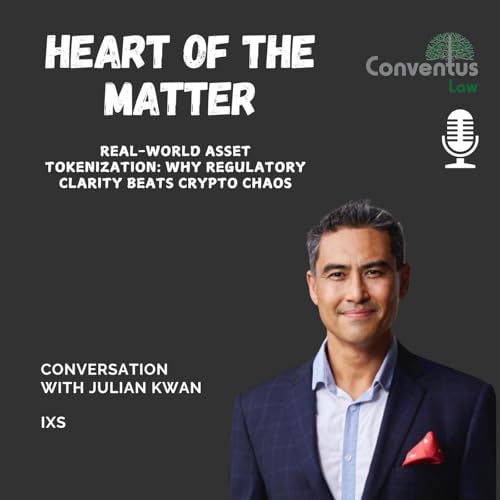
  • Real-World Asset Tokenization: Why Regulatory Clarity Beats Crypto Chaos
    2026/01/12
    Real-world asset tokenization isn't what most people think it is. Julian Kwan, head of IX Swap and Investax, cuts through the noise to explain what RWA actually means and why it matters for your portfolio. Surprisingly, RWA tokens aren't just blockchain native crypto. They're tokenized versions of traditional capital market instruments: equities, treasuries, debts. Most importantly, most RWA tokens are securities, which means regulatory compliance isn't optional. Kwan breaks down the four distinct RWA categories that issuers and investors need to understand: stablecoins, securities, utility tokens of RWA platforms, and commodities like tokenized gold. The conversation takes an unexpected turn into global regulatory competition. Because cryptocurrencies exist entirely on-chain and belong to no particular country, regulators are now competing for crypto startups. (Abu Dhabi's strategy with Binance proves this point brilliantly.) Singapore initially lost talent to Hong Kong, then quickly adapted. The UAE has become increasingly attractive, while the US dramatically reversed its stance under the Trump administration, passing the Genius Act for stablecoin regulation.What does this mean for you? Tokenized dollars now comprise nearly 100% of stablecoins worldwide, serving billions in underbanked regions. Drawing parallels to Bitcoin's seventeen year journey to an ETF, Kwan emphasizes that self education is essential this financial transformation is happening now, creating opportunities for early participants willing to engage actively.

    Our Guest

    Julian Kwan

    Julian is a 7-time founder and a recognized global authority in real-world asset (RWA)tokenization and Bitcoin-native yield infrastructure. He is the CEO of IXS, the InstitutionalExchange Settlement Layer, providing licensed blockchain and tokenization infrastructure for thecompliant, large-scale adoption of institutional tokenized RWA, and the CEO of InvestaX, aSingapore MAS-licensed issuance platform enabling institutional fixed income RWA.Julian has founded companies across blockchain, real estate, proptech, and fintech, and is afounding member of UnionChain an L2 chain for RWAs (25M+ verified users). He is also an earlymover in Bitcoin staking architecture, launching BTC Real Yields, the first compliant real worldyields for BTC investors.He has spoken at over 250+ conferences globally on the convergence of Web3, capital markets,and regulatory innovation. Born in Sydney, he holds degrees in Real Estate Development andMandarin, and continues to design systems that unlock capital flows into tokenized assets acrossborders without compromising compliance.

    Our Host

    Ajay Shamdasani

    Ajay Shamdasani is a veteran writer, editor and researcher based in Hong Kong. He holds an AB in history and government from Ripon College, JD and MIPCT degrees from the University of New Hampshire Franklin Pierce Law School, and an LLM in financial regulation from the Illinois Institute of Technology’s Chicago-Kent College of Law.

    His 15-year long career as a financial and legal journalist began as deputy editor of A Plus magazine – the journal of the Hong Kong Institute of Certified Public Accountants. From there, he assumed the helm of Macau Business magazine as its editor-in-chief, and later, joined Asialaw magazine as its deputy editor.

    More recently, he spent close to seven years as a senior correspondent with Thomson Reuters’ subscription-based trade-wire service Regulatory Intelligence/Compliance Complete (previously called Complinet) in Hong Kong. While there, he covered regulatory developments in that city, as well as Singapore, India and South Korea.
    続きを読む 一部表示
    25 分
  • Vietnam's Crypto Revolution: What the New 2026 Regulations Mean for You
    2025/11/21
    In this episode, host Ajay Shamsani interviews fintech and blockchain lawyer Philip Ziter to dissect the seismic shift in Vietnam's cryptocurrency policy. Effective January 1, 2026, the new Law on Digital Technology Industry moves the nation from regulatory ambiguity to a framework of comprehensive control. This landmark legislation introduces a deliberately restrictive environment for crypto exchanges, demanding a $400M minimum capital, strict domestic ownership requirements, and mandatory Vietnamese dong settlement. With only five licenses to be issued over five years, the barriers to entry are steep. Despite these stringent compliance challenges including AML and cybersecurity demands Vietnam remains a significant crypto player, boasting 21 million adult users and transaction volumes exceeding $100 billion. This framework signals genuine government commitment but raises key questions about the future: will regulators be able to keep pace with the technology, and will institutional investment replace the country's prevalent retail enthusiasm?

    Our Guest

    Philip Ziter

    Prior to joining Russin & Vecchi, Philip worked in Vietnam as an attorney at a top tier regional law firm and later with a commercial firm involved in blockchain.Philip advises on corporate and transactional matters, and on financing arrangements.Philip has been legal advisor to a handful of startup companies. He is knowledgeable in the fintech, blockchain, and e-commerce industries in Vietnam, Hong Kong, Singapore, and the US.Philip has also worked with manufacturers, pharmaceutical companies, and other entities in cross-border transactions.He advises on inbound investments involving corporate finance, manufacturing, technology, intellectual property, and mergers and acquisitions.

    Our Host

    Ajay Shamdasani

    Ajay Shamdasani is a veteran writer, editor and researcher based in Hong Kong. He holds an AB in history and government from Ripon College, JD and MIPCT degrees from the University of New Hampshire Franklin Pierce Law School, and an LLM in financial regulation from the Illinois Institute of Technology’s Chicago-Kent College of Law.

    His 15-year long career as a financial and legal journalist began as deputy editor of A Plus magazine – the journal of the Hong Kong Institute of Certified Public Accountants. From there, he assumed the helm of Macau Business magazine as its editor-in-chief, and later, joined Asialaw magazine as its deputy editor.

    More recently, he spent close to seven years as a senior correspondent with Thomson Reuters’ subscription-based trade-wire service Regulatory Intelligence/Compliance Complete (previously called Complinet) in Hong Kong. While there, he covered regulatory developments in that city, as well as Singapore, India and South Korea.
    続きを読む 一部表示
    31 分
  • Monetising Claims: Third Party Funding in Arbitration and Insolvency
    2025/10/16
    In this episode, Ajay Shandasani and guest John Y.C. Lee discussed how third-party funding is transforming legal departments by turning them into strategic value generators. The discussion highlighted how this non-recourse funding allows companies to monetize claims, transfer litigation risk to funders, and preserve capital for their core business. Lee explained that funders act as sophisticated investors, rigorously vetting cases for strong merits and enforceable awards, and are not just focused on ROI. He also emphasized the importance of carefully drafted funding agreements to avoid conflicts and maintain client control over the dispute.

    Our Guest

    John Y.C. Lee

    John is a solicitor admitted in Hong Kong and England & Wales, independent arbitrator and accredited mediator. He is a graduate of London University and has about 25 years of legal practice experience including as past partner and head of dispute resolution group of a major law firm. His main areas of practice are commercial arbitration, litigation, risk management, advisory and related areas. He has handled commercial and civil cases including investment claims, company / shareholder disputes, construction claims, insolvency cases, competition law matters, intellectual property claims, land related disputes etc.

    He is also a fellow of the Chartered Institute of Arbitrators and the Hong Kong Institute of Arbitrators. He serves as a risk management education tutor (part-time appointment of the Law Society of Hong Kong), Editorial Board member of the Solicitors’ Guide to Professional Conduct, a member of the Law Society Arbitration Committee and the Arbitration Panel, and a member of the Law Society Risk Management Education Accreditation Sub-Committee. He was appointed on the DOJ Working Group on ORFSA Checklists.

    Our Host

    Ajay Shamdasani

    Ajay Shamdasani is a veteran writer, editor and researcher based in Hong Kong. He holds an AB in history and government from Ripon College, JD and MIPCT degrees from the University of New Hampshire Franklin Pierce Law School, and an LLM in financial regulation from the Illinois Institute of Technology’s Chicago-Kent College of Law.

    His 15-year long career as a financial and legal journalist began as deputy editor of A Plus magazine – the journal of the Hong Kong Institute of Certified Public Accountants. From there, he assumed the helm of Macau Business magazine as its editor-in-chief, and later, joined Asialaw magazine as its deputy editor.

    More recently, he spent close to seven years as a senior correspondent with Thomson Reuters’ subscription-based trade-wire service Regulatory Intelligence/Compliance Complete (previously called Complinet) in Hong Kong. While there, he covered regulatory developments in that city, as well as Singapore, India and South Korea.
    続きを読む 一部表示
    38 分
  • Clear Legacies: Succession Trusts, Wills and Elder Law in Hong Kong
    2025/09/15
    In this episode, we tackle the critical topic of estate planning in Hong Kong. Guest Angela Wang, a leading expert in the field, joins us to discuss why it's crucial to plan for your family's future now, not later. We explore various tools, from simple wills and enduring powers of attorney to complex family trusts. Angela shares powerful, real-life examples of how family disputes over inheritance can tear families apart, emphasizing the need for clear, updated documentation. Don't wait until it's too late, tune in to learn how to secure your family's legacy and ensure your wishes are honored.

    Our Guest

    Angela Wang

    Angela is a graduate from the National University of Singapore and has practised with major international law firms in Singapore, Australia and Hong Kong. Angela regularly advises major international clients including Fortune 500 companies on a wide range of corporate matters including the takeover of listed companies, IPOs, substantial asset restructuring, capital fund raising, cross border private equity transactions and structured financing in Hong Kong China and South East Asia. She also acts for China state owned enterprises and Chinese domestic companies and entrepreneurs in their various investments overseas.

    Angela is a regular speaker at legal conferences for corporate counsel and business chambers in Hong Kong, Singapore and China.

    Our Host

    Ajay Shamdasani

    Ajay Shamdasani is a veteran writer, editor and researcher based in Hong Kong. He holds an AB in history and government from Ripon College, JD and MIPCT degrees from the University of New Hampshire Franklin Pierce Law School, and an LLM in financial regulation from the Illinois Institute of Technology’s Chicago-Kent College of Law.

    His 15-year long career as a financial and legal journalist began as deputy editor of A Plus magazine – the journal of the Hong Kong Institute of Certified Public Accountants. From there, he assumed the helm of Macau Business magazine as its editor-in-chief, and later, joined Asialaw magazine as its deputy editor.

    More recently, he spent close to seven years as a senior correspondent with Thomson Reuters’ subscription-based trade-wire service Regulatory Intelligence/Compliance Complete (previously called Complinet) in Hong Kong. While there, he covered regulatory developments in that city, as well as Singapore, India and South Korea.
    続きを読む 一部表示
    23 分
  • From Singapore to Hong Kong: A Legal Pioneer's 30-Year Journey
    2025/06/20
    Episode Summary: Angela Wang – 30 Years in Hong Kong LawThis episode features Angela Wang, a Singapore-trained lawyer who made the bold decision to establish her own boutique law firm in Hong Kong back in 1995. Now celebrating its 30th anniversary, her firm stands as a testament to her vision for independence and her sharp understanding of Hong Kong's dynamic legal landscape.Angela shares how she skillfully navigated through multiple global financial crises while building a thriving cross-border practice, particularly benefiting from China's market opening. She offers unique insights by contrasting Hong Kong's entrepreneurial spirit with Singapore's more structured environment, shedding light on what truly sets Hong Kong's legal market apart.The episode delves into how her firm focused on mid-sized transactions, her strategies for adapting to Hong Kong's challenging business culture, and her resilience in surviving various economic downturns since 1995. She also touches on leveraging opportunities within China's evolving market and her thoughtful approach to balancing AI integration with traditional legal practice. It's an inspiring story of determination, adaptability, and a genuine passion for law, leading to three decades of remarkable success in one of Asia's most vibrant legal hubs.

    Our Guest

    Angela Wang

    Angela is a graduate from the National University of Singapore and has practised with major international law firms in Singapore, Australia and Hong Kong. Angela regularly advises major international clients including Fortune 500 companies on a wide range of corporate matters including the takeover of listed companies, IPOs, substantial asset restructuring, capital fund raising, cross border private equity transactions and structured financing in Hong Kong China and South East Asia. She also acts for China state owned enterprises and Chinese domestic companies and entrepreneurs in their various investments overseas.

    Angela is a regular speaker at legal conferences for corporate counsel and business chambers in Hong Kong, Singapore and China.

    Our Host

    Ajay Shamdasani

    Ajay Shamdasani is a veteran writer, editor and researcher based in Hong Kong. He holds an AB in history and government from Ripon College, JD and MIPCT degrees from the University of New Hampshire Franklin Pierce Law School, and an LLM in financial regulation from the Illinois Institute of Technology’s Chicago-Kent College of Law.

    His 15-year long career as a financial and legal journalist began as deputy editor of A Plus magazine – the journal of the Hong Kong Institute of Certified Public Accountants. From there, he assumed the helm of Macau Business magazine as its editor-in-chief, and later, joined Asialaw magazine as its deputy editor.

    More recently, he spent close to seven years as a senior correspondent with Thomson Reuters’ subscription-based trade-wire service Regulatory Intelligence/Compliance Complete (previously called Complinet) in Hong Kong. While there, he covered regulatory developments in that city, as well as Singapore, India and South Korea.
    続きを読む 一部表示
    53 分
  • Strategic Legal: Turning Costs into Growth for VC-Backed Firms
    2025/06/11
    Are legal costs a burden or a strategic investment for your venture capital-backed company? In this episode of "Heart of the Matter," we chat with David Cameron of David Cameron Law Office about fundamentally transforming your view of legal representation. David explains why lawyers are now essential for VC-backed firms scaling rapidly and navigating complex capital tables. We discuss why innovative boutique law firms with fixed-fee models are often the perfect fit for their unique needs. You'll also learn how legal compliance can be a powerful strategic advantage that builds trust, especially in fast-moving sectors like fintech and AI. This conversation will challenge you to see legal spending as a genuine strategic investment that boosts growth and relationships. Ultimately, it's about seeing your legal counsel as true strategic partners in your VC-backed business's future.

    Our Guest

    David Cameron

    David is a dual-qualified Hong Kong solicitor and New York attorney who has been advising on corporate matters and financial transactions across Asia, based out of Hong Kong, for over 16 years. David has worked for Linklaters and Allen & Overy in addition to, most recently, being a Partner at Dorsey & Whitney. ​


    ​​David has a proven track-record of helping clients with enthusiasm and an entrepreneurial approach. This has resulted in multiple first-ever transactions and initiatives that have led to first-ever national rankings and various international awards. David is consistently ranked globally by institutions such as IFLR1000 and also ranked regionally by institutions such as IBLJ's Top 100 International A-List. ​David holds three graduate degrees, a JD, an MBA and an MA, from the University of Pennsylvania and a BA from Georgetown University.​


    Our Host

    Ajay Shamdasani

    Ajay Shamdasani is a veteran writer, editor and researcher based in Hong Kong. He holds an AB in history and government from Ripon College, JD and MIPCT degrees from the University of New Hampshire Franklin Pierce Law School, and an LLM in financial regulation from the Illinois Institute of Technology’s Chicago-Kent College of Law.

    His 15-year long career as a financial and legal journalist began as deputy editor of A Plus magazine – the journal of the Hong Kong Institute of Certified Public Accountants. From there, he assumed the helm of Macau Business magazine as its editor-in-chief, and later, joined Asialaw magazine as its deputy editor.

    More recently, he spent close to seven years as a senior correspondent with Thomson Reuters’ subscription-based trade-wire service Regulatory Intelligence/Compliance Complete (previously called Complinet) in Hong Kong. While there, he covered regulatory developments in that city, as well as Singapore, India and South Korea.
    続きを読む 一部表示
    37 分