エピソード

  • How to Save Marine Wildlife One Choice at a Time with Dr. AA Yaptinchay
    2026/07/27

    What role does marine wildlife play in keeping our oceans and communities healthy? In this episode of Good and Green, Chit Juan speaks with Dr. AA Yaptinchay, marine wildlife conservationist and Founder of the Marine Wildlife Watch of the Philippines, about protecting threatened species such as whale sharks, marine turtles, dugongs, dolphins, and sharks. They discuss how responsible marine tourism, stronger public awareness, and science-based conservation can protect biodiversity while creating sustainable livelihoods for coastal communities. Dr. AA also shares practical ways everyone can help, from respecting wildlife in their natural habitats to reducing plastic waste and supporting responsible tourism.


    GUEST BIO:

    AA Yaptinchay, DVM, MSc is a marine wildlife conservationist with more than 30 years of experience protecting some of the Philippines' most threatened marine species, including whale sharks, dugongs, marine turtles, dolphins, and sharks. A pioneer in responsible marine wildlife tourism, his work helped secure legal protection for whale sharks in the Philippines and has influenced national policies on marine conservation. He is the Founder and Executive Director of the Marine Wildlife Watch of the Philippines (MWWP) and continues to champion science-based conservation, wildlife rescue, and sustainable tourism.


    WHAT YOU’LL LEARN:

    • Why marine wildlife is vital to healthy ocean ecosystems.
    • How responsible tourism can support marine conservation.
    • The biggest threats facing the Philippines' marine wildlife.
    • Why awareness is key to protecting endangered marine species.
    • Simple actions everyone can take to help protect our oceans.


    QUOTES:

    • The Philippines is in the center of marine biodiversity globally. —Dr. AA Yaptinchay
    • Conservation-wise, the Philippines now has more marine protected areas. —Dr. AA Yaptinchay
    • I would go for allowing marine wildlife to be in their natural habitat in the most natural way without any disturbance. —Dr. AA Yaptinchay
    • When you enter the home of the marine species, it is their home. We need to respect these animals and their habitat. —Dr. AA Yaptinchay
    • Remove any form of threat. Hunting is a threat. Plastic pollution is a threat. Coastal development is a threat. —Dr. AA Yaptinchay


    LINKS or RESOURCES MENTIONED:

    Connect with Dr. AA Yaptinchay:

    • Marine Wildlife Watch of the Philippines on Facebook
    • Marine Wildlife Watch of the Philippines on Instagram


    Listen, rate, and subscribe!

    • Subscribe to the Good and Green Podcast on Apple Podcasts and Spotify
    • Follow Chit Juan on Instagram and Facebook, and LinkedIn
    • Subscribe to EchoNews on LinkedIn.

    Purchase Brew: Cafe, Coffee. Kape at Echostore.ph.

    For more information about Brew: Cafe, Coffee, Kape, visit the Food Writers Association of the Philippine Facebook Group.

    続きを読む 一部表示
    28 分
  • Episode 55: The Living Classroom That Inspires Better Learning with Sara Soliven-De Guzman
    2026/07/13

    What if the best classroom was found in nature? In this episode of Good and Green, Chit Juan sits down with Sara Francesca Soliven-De Guzman, President of O.B. Montessori Center and steward of Preziosa Farms, to share how a school campsite evolved into a 16-hectare destination for experiential learning, regenerative agriculture, and environmental stewardship. Sara explains how hands-on experiences—from harvesting vegetables and caring for animals to planting native trees—help children and families develop a deeper appreciation for nature while inspiring future generations to live more sustainably.


    GUEST BIO:

    Sara Francesca Soliven-De Guzman is the President of O.B. Montessori Center and the steward of Preziosa Farms, a 16-hectare educational farm in Alfonso, Cavite. Building on her mother Dr. Preciosa Soliven's vision, she has transformed the farm into a destination for experiential learning, regenerative agriculture, and environmental stewardship. Through camping programs, farm experiences, native tree conservation, and sustainable design, Sara continues to inspire children, families, and communities to develop a deeper appreciation for nature and responsible living.


    WHAT YOU’LL LEARN:

    • How Preziosa Farms grew from a school campsite into an educational farm.
    • Why hands-on experiences help children connect with nature.
    • How regenerative agriculture and native tree conservation support sustainability.
    • Designing a farm that balances education, hospitality, and environmental stewardship.
    • Simple ways families can reconnect with nature and inspire future environmental advocates.


    QUOTES:

    • In my family, we don't do things just abruptly. —Sara Soliven-De Guzman
    • You don't just cut the trees. They are like elements. They also have life. —Sara Soliven-De Guzman
    • I would advocate for parents to start bringing their kids to farms or rural areas around the country. —Sara Soliven-De Guzman
    • We're happy because we're able to inspire people and share what we know, what we can do to teach them more about nature. —Sara Soliven-De Guzman
    • We have a total of 5,000 kilos of vegetables harvested each year. —Sara Soliven-De Guzman
    • Be inspired by experiencing nature. We need to activate our wonder and awe towards loving Mother Earth. —Sara Soliven-De Guzman


    LINKS or RESOURCES MENTIONED:

    Connect with Sara Soliven-De Guzman:

    • Preziosa Farms on IG
    • Preziosa Farms on FB
    • Preziosa Farms Website


    Listen, rate, and subscribe!

    • Subscribe to the Good and Green Podcast on Apple Podcasts and Spotify
    • Follow Chit Juan on Instagram and Facebook, and LinkedIn
    • Subscribe to EchoNews on LinkedIn.

    Purchase Brew: Cafe, Coffee. Kape at Echostore.ph.

    For more information about Brew: Cafe, Coffee, Kape, visit the Food Writers Association of the Philippine Facebook Group.

    続きを読む 一部表示
    33 分
  • Episode 54: How A Curious Mind Built a Successful Organic Farm with Raffy Dacones
    2026/06/29

    Great farming doesn't begin with the harvest. It begins with healthy soil. In this episode of Good and Green, Chit Juan sits down with Raphael "Raffy" Dacones, Chief Farming Officer of Teraoka Farm, to share his journey from studying architecture and working in Japan to becoming one of the country's leading advocates for organic farming. What started as curiosity grew into a thriving farm that now supplies premium organic produce to some of Metro Manila's top restaurants.

    Raffy shares the lessons he learned through years of trial and error, from finding the right market and diversifying crops to building a farm school, mentoring future farmers, and creating stronger partnerships with chefs. He also explains why healthy soil, regenerative agriculture, and continuous learning are essential to building farms that are both productive and sustainable for generations to come.


    GUEST BIO:

    Raphael "Raffy" Dacones is the Chief Farming Officer of Teraoka Farm, an organic farm in Mangatarem, Pangasinan. Under his leadership, the farm has become a national benchmark for sustainable agriculture, supplying premium organic produce to many of Metro Manila's leading restaurants. He also consults on farm development and leads Soil Studio, integrating agriculture, landscape design, and sustainability to create greener, more resilient spaces.


    WHAT YOU’LL LEARN:

    • How curiosity led Raffy from architecture to organic farming.
    • Building a successful organic farm through trial, error, and persistence.
    • Finding the right market for premium organic produce.
    • Growing farmers through education, partnerships, and farm immersion.
    • Why healthy soil is the foundation of sustainable agriculture.


    QUOTES:

    • I've always liked getting my hands dirty. —Raffy Dacones
    • I was so determined to start a farm, but I never had that give up attitude despite it being very difficult at first. —Raffy Dacones
    • I like being challenged. —Raffy Dacones
    • I've always believed a farm should have a track record of producing and selling commercially. —Raffy Dacones
    • Take care of your soil. Soil is the life of everything. —Raffy Dacones
    • Composting is the key. —Raffy Dacones


    LINKS or RESOURCES MENTIONED:

    Connect with Raffy Dacones:

    • Teraoka Farm on Instagram
    • Teraoka Farm on Facebook


    Listen, rate, and subscribe!

    • Subscribe to the Good and Green Podcast on Apple Podcasts and Spotify
    • Follow Chit Juan on Instagram and Facebook, and LinkedIn
    • Subscribe to EchoNews on LinkedIn.

    Purchase Brew: Cafe, Coffee. Kape at Echostore.ph.

    For more information about Brew: Cafe, Coffee, Kape, visit the Food Writers Association of the Philippine Facebook Group.

    続きを読む 一部表示
    27 分
  • Episode 52: Why Mindful Tourism Creates the Most Beautiful Impact with Jeannie Javelosa
    2026/06/01

    Sustainable tourism becomes more meaningful when it is rooted in community, culture, and care for the environment. In this episode of Good and Green, Chit Juan talks with Jeannie Javelosa about how Banahaw Circle Nature Retreat grew from a personal connection to Mount Banahaw into a thriving community-based tourism initiative in Dolores, Quezon. Jeannie shares how the retreat supports local farmers, guides, artisans, cooks, and micro-entrepreneurs while helping preserve the mountain’s cultural and spiritual heritage. From transforming old homes into upcycled spaces to developing local products and training community members in tourism and hospitality, this conversation highlights how small, thoughtful tourism initiatives can create meaningful impact while protecting nature and local identity.


    GUEST BIO:

    Jeannie Javelosa is a thought leader in culture, sustainability, and gender, as well as an award-winning artist, writer, entrepreneur, and social impact advocate. She co-founded ECHOstore Sustainable Lifestyle, which promotes green community products, Great Women, which supports indigenous textiles and women-led enterprises, and Banahaw Circle Nature Retreat, a Mabuhay-level homestay and wellness destination in Dolores, Quezon. A finalist for the Cartier Women’s Initiative Award and recipient of multiple ASEAN and women entrepreneurship awards, Jeannie continues to champion sustainable communities, cultural heritage, and inclusive enterprise development through her work across business, tourism, and the creative industries.


    WHAT YOU’LL LEARN:

    • How Jeannie’s lifelong connection to Mount Banahaw led to Banahaw Circle Nature Retreat.
    • Turning old homes and local resources into a sustainable community tourism destination.
    • Supporting local farmers, cooks, artisans, and micro-businesses through tourism.
    • Preserving Banahaw’s spiritual, cultural, and environmental heritage through storytelling.
    • Why community tourism can create meaningful and sustainable local livelihoods.


    QUOTES:

    • Anybody connected with meditation, energy healing, UFOs, psychics, all those weird, strange phenomena have always come to Banahaw. —Jeannie Javelosa
    • I think this, for me, was always the call of the mountain. —Jeannie Javelosa
    • We positioned Banahaw Circle as something more than just houses where you can stay. Because it's small, it's like your doorway to the whole mountain. —Jeannie Javelosa
    • What our role is here is to storytell what the mountain is about so people respect it more and understand it more. —Jeannie Javelosa
    • No matter how small you are, you make an impact when you begin to work with many, many smaller ones. —Jeannie Javelosa
    • There are so many beautiful spaces in the country. They don't need to be so curated. —Jeannie Javelosa


    LINKS or RESOURCES MENTIONED:

    Connect with Jeannie Javelosa:

    • Banahaw Circle Nature Retreat on Instagram
    • Banahaw Circle Nature Retreat on Facebook
    • Banahaw Circle Nature Retreat Website


    Listen, rate, and subscribe!

    • Subscribe to the Good and Green Podcast on Apple Podcasts and Spotify
    • Follow Chit Juan on Instagram and Facebook, and LinkedIn
    • Subscribe to EchoNews on LinkedIn.

    Purchase Brew: Cafe, Coffee. Kape at Echostore.ph.

    For more information about Brew: Cafe, Coffee, Kape, visit the Food Writers Association of the Philippine Facebook Group.

    続きを読む 一部表示
    28 分
  • Episode 51: Sustainability Education Is Changing Hospitality For The Better with Dr. Harold Bueno
    2026/05/18

    Sustainability is no longer just a trend in tourism and hospitality. It is becoming part of how future professionals think, work, and serve. In this episode of Good and Green, Chit Juan talks with Dr. Harold Bernardo Bueno, Dean of the Institute of Tourism and Hospitality Management at FEU Manila, about how sustainability, food systems, and education intersect in today’s tourism industry. Drawing from his roots in farming and his personal experiences hiking across the Philippines, Dr. Bueno shares why understanding local food systems, edible plants, and community traditions can deepen tourism experiences and even support survival skills. He also explains how hospitality education must balance high tech with high touch and high trust to remain relevant in an AI-driven world.


    GUEST BIO:

    Dr. Harold Bernardo Bueno is the Dean of the Institute of Tourism and Hospitality Management at Far Eastern University (FEU), Manila, and a strong advocate for sustainable food systems. A certified Sustainable Tourism Professional, he champions the integration of food, culture, and sustainability in tourism and hospitality education. With over a decade of leadership in higher education and international research collaborations, he advances initiatives that promote responsible consumption, local food heritage, and inclusive tourism development. Through his work with academic, industry, and global partners, Dr. Bueno continues to shape future professionals toward building resilient and sustainable food and tourism ecosystems.


    WHAT YOU’LL LEARN:

    • How Dr. Bueno’s farming roots shaped his passion for sustainable food systems and tourism.
    • Why hiking and foraging can deepen understanding of local ecology and culture.
    • The need to train tour guides about edible plants and survival knowledge along hiking trails.
    • How hospitality education is adapting to sustainability and changing industry demands.
    • Why modern hospitality requires a balance of high touch, high tech, and high trust.


    QUOTES:

    • It's nice to go to a place unknown to you and then discover traditions along the trail. —Dr. Harold Bueno
    • We should create more training for our tour guides because identifying all these edible plants and fruits along the trail is a form of survival. —Dr. Harold Bueno
    • The biggest challenge is to always make sure that our curriculum, the teaching and learning are always up-to-date. —Dr. Harold Bueno
    • Being a Dean is a powerful position. —Dr. Harold Bueno
    • Hospitality is all about making our guests feel at home and feel comfortable. —Dr. Harold Bueno
    •  We have to build trust with our guests. Sustainability can build that trust with our guests. —Dr. Harold Bueno


    LINKS or RESOURCES MENTIONED:

    Connect with Dr. Harold Bueno:

    • Dr. Harold Bueno on Instagram
    • Dr. Harold Bueno on Facebook
    • FEU Manila Institute of Tourism and Hotel Management


    Listen, rate, and subscribe!

    • Subscribe to the Good and Green Podcast on Apple Podcasts and Spotify
    • Follow Chit Juan on Instagram and Facebook, and LinkedIn
    • Subscribe to EchoNews on LinkedIn.

    Purchase Brew: Cafe, Coffee. Kape at Echostore.ph.

    For more information about Brew: Cafe, Coffee, Kape, visit the Food Writers Association of the Philippine Facebook Group.

    続きを読む 一部表示
    25 分
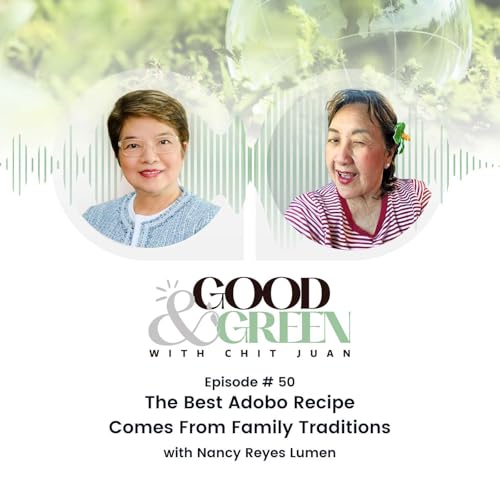
  • Episode 50: The Best Adobo Recipe Comes From Family Traditions with Nancy Reyes Lumen
    2026/05/04

    Filipino food is deeply rooted in family, tradition, and everyday life. In this episode of Good and Green, Chit Juan sits down with food advocate and author Nancy Reyes-Lumen, also known as the “Adobo Queen,” to explore why adobo continues to be one of the most powerful symbols of Filipino identity. As part of a multigenerational food family, Nancy shares how recipes are passed down, adapted, and preserved over time. From sourcing ingredients directly from local producers to practicing zero-waste habits long before they became trends, this conversation highlights how our food traditions are shaped by history, culture, and survival. Nancy also reminds us that there is no single “correct” version of adobo and that the beauty of Filipino food lies in its diversity and personal stories.


    GUEST BIO:

    Nancy Reyes-Lumen is a Filipino food advocate, researcher, writer, and culinary ambassador best known as the author of the best-selling The Adobo Book. A passionate champion of Filipino cuisine, she is widely recognized as the self-proclaimed “Adobo Queen” for her mission to elevate adobo as a signature Filipino dish for global audiences. She has also written several other cookbooks, co-hosts the Adobo Connections segment of Our Awesome Planet, and teaches Filipino and Asian cooking classes as a chef instructor for Cozymeal USA. Based in Houston, Texas, Nancy continues to promote Filipino food heritage both in the Philippines and abroad.


    WHAT YOU’LL LEARN:

    • Why adobo is considered a strong symbol of Filipino identity and culture.
    • The role of family traditions in shaping and preserving Filipino recipes.
    • Why there is no single “correct” version of adobo.
    • How sourcing from local producers and artisans was practiced even in earlier generations.
    • Traditional Filipino practices such as fermentation and zero-waste cooking.


    QUOTES:

    • I'm just a good collector of adobo recipes and stories. —Nancy Reyes Lumen
    • The 4th and 5th generations are bringing in new taste, new ways, new techniques, but we still want to instill some of our Lola's ways. —Nancy Reyes Lumen
    • One of the healthy ways of having food is fermentation. —Nancy Reyes Lumen
    • You can standardize adobo for a global recipe, only if you use branded. Branded vinegar, branded soy sauce, branded everything. —Nancy Reyes Lumen
    • Alisin na natin ang "lang". —Nancy Reyes Lumen


    LINKS or RESOURCES MENTIONED:

    Connect with Nancy Reyes Lumen:

    • Nancy Reyes Lumen on Instagram
    • Nancy Reyes Lumen on Facebook
    • The Adobo Book by Nancy Reyes Lumen and Reynaldo Gamboa Alejandro


    Listen, rate, and subscribe!

    • Subscribe to the Good and Green Podcast on Apple Podcasts and Spotify
    • Follow Chit Juan on Instagram and Facebook, and LinkedIn
    • Subscribe to EchoNews on LinkedIn.

    Purchase Brew: Cafe, Coffee. Kape at Echostore.ph.

    For more information about Brew: Cafe, Coffee, Kape, visit the Food Writers Association of the Philippine Facebook Group.

    続きを読む 一部表示
    28 分
  • Episode 49: The Big Reasons Filipino Food Research Matters Today with Ige Ramos
    2026/04/20

    As Good and Green continues its celebration of Filipino Food Month, this second special episode goes deeper into the stories behind what we eat. Chit Juan sits down with independent food scholar and book designer Ige Ramos to explore how decades of fieldwork, writing, and cultural research shaped his understanding of Filipino foodways. Their conversation touches on ethical food writing, the value of traveling and listening deeply, how data can help shape better food policies, and why Filipino food should never be boxed into one “correct” definition. This episode is a thoughtful reminder that preserving our food heritage starts with curiosity, respect, and a willingness to look beyond the plate.


    GUEST BIO:

    Ige Ramos is an independent food scholar and book designer. For more than three decades, he dedicated his life to studying Filipino foodways, founding a practical knowledge laboratory and a platform for publishing and conducting independent research on edible design, food studies, and comparative gastronomy. His books examine how geography, technology, ingredients, and demographic shifts influence Filipino cuisine, taste, and flavor. He created gastronomy and cultural diplomacy training modules for the Departments of Foreign Affairs and Tourism, as well as reviewed food-related laws and public policies. He also created the framework for the Iloilo UNESCO Creative City for Gastronomy.


    WHAT YOU’LL LEARN:

    • How Ige’s journey from museum work and book design led him into Filipino food scholarship
    • Why Filipino food must be studied through culture, history, anthropology, and fieldwork
    • The ethics of food writing, from asking permission to protecting communities and sources
    • How food research can go beyond storytelling and help shape policy and systems change
    • Why Filipino food cannot be reduced to one “authentic” version


    QUOTES:

    • We always look at things in a broader perspective, in a broader sense that the Philippines did not exist in a vacuum. —Ige Ramos
    • Influences are not one way. It's two-way or multiple ways. What you bring in, it goes out. —Ige Ramos
    • There's a fine line between promotions and review criticism. —Ige Ramos
    • Hunger is real. There are certain food preferences available because of convenience, of need, of hunger. —Ige Ramos
    • Data is data is data. —Ige Ramos
    • Eat Filipino food not for the history because we don't know what is authentic. Eat Filipino food not for the culture because we're not exotic enough. Eat Filipino food because what you know about it is wrong. —Ige Ramos


    LINKS or RESOURCES MENTIONED:

    Connect with Ige Ramos:

    • Ige Ramos on Instagram
    • Ige Ramos on Facebook
    • Book: Lasa ng Republika 2: Bukambibig by Ige Ramos


    Listen, rate, and subscribe!

    • Subscribe to the Good and Green Podcast on Apple Podcasts and Spotify
    • Follow Chit Juan on Instagram and Facebook, and LinkedIn
    • Subscribe to EchoNews on LinkedIn.

    Purchase Brew: Cafe, Coffee. Kape at Echostore.ph.

    For more information about Brew: Cafe, Coffee, Kape, visit the Food Writers Association of the Philippine Facebook Group.

    続きを読む 一部表示
    30 分