エピソード

  • Overlap Is Not Duplication: Making Space for Emerging OT Practice informed by Occupational Science
    2026/09/06
    I wrote this piece in response to some discourse I was tagged in around OT’s role in sports medicine and supporting high performance athletes.The reflection is specifically in response to this three-part LinkedIn series:Part 1: What OT Adds to Sports MedicineRead the original post on LinkedInPart 2: Collaboration and Professional RolesRead the original post on LinkedInPart 3: Advocacy, Scope, and the FutureRead the original post on LinkedInMuch of the discourse in the comments was centered on concerns of overlap with athletic trainers and presumptions that what OT is offering would be essentially duplicative and disrespectful to more traditionally prominent members of the sports medicine ecosystem.I had to modify my response on LinkedIn to match their character limit, so I thought I would publish the full response here. It covers content that feels relevant to much of the endless discourse that is largely driven by shorthand misinformation, presumptions, and various insecurities that get stirred when our focus is on eliminating rather than expanding possibilities for care and innovation.Why occupational science literacy mattersA big part of why I am a proponent of increased occupational science literacy for OTPs worldwide is to encourage us to use our own distinct lens and concepts when communicating about the innovations, roots, and foundations of our practice so we can get out of this trap of being reduced to limited paradigms and understandings of other professions in bad faith.First, we tend to be undermined for possibly not having the same competencies as another discipline or profession. Then, when we reveal that we do have the same competencies, or we catch up, we are framed as essentially duplicative or redundant and not unique.This is why communicating about our identity and skills from our own foundations and core terminology, including our cosmological, philosophical, epistemic, and emerging practice developments, on our own terms, alongside the formal policy developments that have shaped our practice from the beginning, is so important.Especially if we do so with pride in our unique integrative foundations rather than shame or presumed incompetence, very often this pattern is deeply rooted in the internalization of structural sexism and misogyny as it relates to female-dominated health care professions and integrated care approaches overall.OTPs need to start recognizing that when we are met with such suspicion and accusation, it can actually be a sign of our strength and competence as a threat rather than a sign of our own incompetence or need to prove or defend ourselves where we typically already currently belong.We keep de-skilling each otherIt’s so interesting how often in this type of discourse we default to pigeonholing and limiting all skilled providers to the bare minimum of responsibilities in institutional settings.For example, often between OT and PT the discourse can reduce both professions down to upper extremity versus lower extremity, even though we all know both disciplines in the real world are full-body therapists.With the discourse around athletic trainers, it seems like we’re reducing all professions to the most basic elements of those responsibilities, rather than exploring nuanced conversations about strengths, weaknesses, opportunities, gaps, and intersections that could lead to more comprehensive care.Unlike competitive athletics, health and human services are not competitive sports.When providers compete, our clients are always the ones who lose out on comprehensive care.I also think this pattern of discourse has consequences beyond any single profession. When we continually reduce skilled professions to their bare foundations and then treat overlap at that level as evidence of duplication, we can inadvertently create conditions that discourage innovation and advancement across health and human services.The bare foundations are the floor of professional capacity, not necessarily the ceiling.If we treat the floor as the ceiling, then every advancement into an emerging specialty, every new application of foundational knowledge, and every development in professional reasoning has to first defend itself against the existence of something another profession already does.That creates a very different condition for professional development than asking what becomes possible when skilled professionals build beyond their foundations.Overlap is not duplicationOverlap between providers is not new and never has been new. It’s actually essential to communication and efficiency for there to be essential overlap.One profession having a specific body area or modality in their scope does not mean that it is somehow unlawful or an automatic restriction or duplication for another provider to be skilled and competent in those areas. It simply means more than one profession has core competencies to perform a specific function.It means there are options rather than a basis for ...
    続きを読む 一部表示
    34 分
  • Integrating Creativity and Spirituality in Occupational Therapy: Embracing Arts, Science, and Ancestral Wisdom with Libby Lamb OT, Poet, and Creativity & Spirituality Coach
    2026/08/31
    Here is a voice-over of the article for those who prefer audioHi everyone! I’m thrilled to share this episode with you today. If you’ve been following this podcast since it started in 2023, you might know it grew out of my doctoral capstone project during my time in the University of Utah’s Post-Professional Clinical Doctorate program from 2019 to 2023. This journey unfolded during the challenges of the COVID-19 pandemic, which highlighted the global impact that devaluing public health initiatives has had on collective on health and well-being, and made deeply evident the barriers and costs to humanity created by maintaining dynamics of scientific elitism, and the lack of accessible frameworks for translating impactful health interventions and knowledge from the academy to the field, especially frameworks informed by disability and occupational justice.After navigating two stalled capstone projects due to pandemic-related challenges, I shifted my focus to creating resources for field clinicians to develop occupational science literacy for direct practice. Over three years, I poured my heart and all my spare time into building a fully virtual introduction to occupational science, using innovative online learning tools and best practices in adult education. If you’re curious, you can explore this project at engage.evolvelivingnetwork.com, and just by subscribing to this Substack, you can get free access to the OS 101 guide, which includes a glossary of all foundational occupational science terminology. My journey back into occupational therapy higher education began after feeling disillusioned during my first two years of clinical and school-based practice as a travel therapist. I was searching for a space where I could thrive using holistic approaches that integrated mental and physical health. Initially, I hoped to work in pediatric and school-based settings, but I quickly encountered policy limitations that narrowed the focus of occupational therapy to handwriting and fine motor skills. This was disheartening, especially since my master’s research centered on executive dysfunction supports for adolescents and assistive technology in schools, areas that were largely controversial for occupational therapists in traditional settings at the time.These challenges revealed deeper issues within the field, including limited access to occupational science developments and foundational frameworks like the “Occupational Therapy Practice Framework Fourth Edition.” I realized through my my more in-depth study that these barriers were tied directly to historical inequities, such as structural sexism in higher education and healthcare leadership sourcing all the way back to the 1500s. This understanding fueled my passion for creative problem-solving and building community around these issues. I have a free training in the evolved living collaborative skool community on how Occupational Science is integrated with the Occupational Therapy Practice Framework Fourth Edition for anyone who is looking to get caught up on out latest practice guidence updates. After graduating, I launched this podcast to raise awareness about Occupational Science and my capstone course. Later, I collaborated on a textbook chapter proposal for the “Occupational Therapy Without Borders” third edition, exploring innovative ways to circulate knowledge beyond traditional academic institutions. While the chapter ultimately missed the publication deadline, the experience taught me valuable lessons about resilience and navigating academic challenges.Since then, however, I have been challenged in relation to this podcast by writer’s block, perfectionism, shame around missing the deadline, and a lack of direction without the structure of a prompt, deadline, or institutional affiliation to prove the value of my work to or rebel against. I’ve been on a personal journey of healing and rediscovery, exploring the roots of occupational therapy in the moral treatment and arts and crafts movements, and deepening my understanding of decolonial healthcare frameworks. This has included honoring the wisdom of indigenous and folk healers whose contributions have often been suppressed or commodified by modern healthcare systems. To support my own recovery, I created a podcast and community called “Rewilding the Mythic Self,” where I’ve been reconnecting with creativity, spirituality, and interdisciplinary collaboration outside of formal institutions. Over time, however, I have come to realize that fracturing out these parts of myself wasn’t really possible and was actually disconnecting me from the type of integrative work I am passionate about reviving in Occupational Therapy practice throughout the world and thank goodness I am not alone in this mission! One of the most transformative moments in this journey recently has been discovering the work of Libby Lamb an occupational therapist and poet (Author of the Acacia Project) based ...
    続きを読む 一部表示
    1 時間 19 分
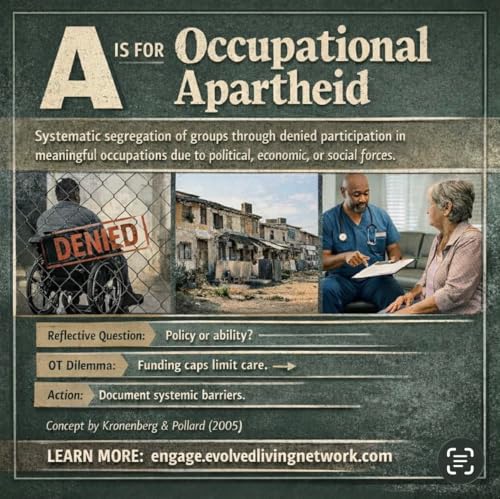
  • Clinical Reflections on Occupational Apartheid: Ethics, Policy, and Systems Change in Occupational Therapy
    2026/03/17
    Why this Occupational Science series mattersIf you are an occupational therapy practitioner in the United States, chances are you are already using occupational science.You just might not have been given the words for it yet.That gap is part of why I created this Occupational Science Alphabet Series, a public learning series designed to make occupational science more accessible and more visible in everyday life and traditional practice settings.This first composite series begins with A for Occupational Apartheid.Recording Timestamps:00:00 “Occupational Apartheid Analysis”06:01 “Occupational Apartheid Challenges”16:11 “Systemic Barriers in OT”18:04 “Enhancing Accessibility through Advocacy”25:20 “Defining Occupational Apartheid”33:06 “Occupation and Systemic Inequality”39:23 “Advocating Equity in OT Practice”45:04 “Occupational Therapy for Healing”48:04 “Advancing Occupational Justice”54:55 “Occupational Ethics Evolution”58:50 “Occupational Apartheid Ethics”01:03:58 “Justice and Veracity”01:10:17 Healthcare Bias and Scientific Integrity01:15:59 “Addressing Maternal Health Disparities”The phrase can feel intense at first.It should.Because it names something real.It gives language to the ways people are systematically denied access to meaningful participation in everyday life, not simply because of individual impairment or diagnosis, but because of how social, economic, political, and cultural systems are organized.And that matters deeply for occupational therapy.Because when we only look at barriers inside individual bodies, we miss the wider context shaping participation.We miss the insurance policy.The school policy.The zoning code.The inaccessible architecture.The transportation gap.The labor condition.The funding cap.Occupational science helps us see those patterns clearly.And once we can see them, we can respond more ethically and more effectively.The Secret of OccupationOne of the most powerful insights of occupational science is that occupation always transcends the individual.Yes, participation includes personal capacity, motivation, and health status.But occupation is also shaped by:environmentculturepolicyhistoryeconomicssocial relationshipsWhen occupational therapists work with clients, we are rarely working with bodies alone.We are working with people in systems.Occupational science simply gives us a language to describe those systems more clearly.Why Occupational Apartheid MattersThe concept of occupational apartheid helps us name situations where social systems restrict access to meaningful participation in everyday life.Frank Kronenberg describes occupational apartheid as:“systematically enacted negations of humanity that divide and subjugate collectives of people to the benefit of some at the expense of others.”(Kronenberg, 2018) These restrictions can occur through intersecting social mechanisms such as:racismclassismsexismableismxenophobiaeconomic inequalityThese forces shape who has access to resources that sustain dignified living.They shape who can participate fully in everyday life.And they show up in everyday occupational therapy practice more often than we might initially realize.When Systems Become HabitOne of the most profound insights connected to occupational apartheid comes from the concept of occupational consciousness, developed by Elelwani Ramugondo.Occupational consciousness invites us to examine how systems of power become embedded in everyday activity.Because the truth is:Systems do not reproduce themselves automatically.They reproduce themselves through what people do every day.Policies become habits.Beliefs become routines.Social hierarchies become normalized through everyday actions.Over time, these patterns become so familiar that they operate below the level of conscious awareness.This is where occupation becomes incredibly important.Occupation is the point where ideas turn into action.And when those actions become automated habits, they can quietly reproduce systems of inequality, even after the laws that created them have been formally abolished.When Systems End but Patterns PersistHistory shows us that oppressive systems rarely disappear completely when policies change.Segregation in the United States was formally dismantled decades ago.Apartheid in South Africa was officially abolished in the 1990s.And yet racial disparities, inequities in access to housing, healthcare, education, and safety persist in both societies today.Why?Because systems do not only exist in policy.They exist in everyday occupations.They exist in patterns of:where people livewho receives serviceswho gets referred to carewhose needs are believedwho feels welcome in public spaceswho has access to transportation, education, and healthcareThese patterns often persist through habits and assumptions that operate subconsciously.Occupational consciousness asks us to notice those patterns.Occupational apartheid helps us name their structural ...
    続きを読む 一部表示
    1 時間 18 分
  • Global Conversations: Cross-Discipline Collaboration in Epidemiology, Occupational Science, Disability, and AI with Emmanuel Ampomah Boadi
    2026/03/09
    Evolved Living Podcast with Dr. Josie Jarvis OT Global Conversations: Cross-Discipline Collaboration in Epidemiology, Occupational Science, Disability, and AIwith Emmanuel Ampomah Boadi---Episode OverviewIn this episode of the Evolved Living Podcast, Dr. Josie Jarvis welcomes Emmanuel Ampomah Boadi, a Ghana-based researcher working at the intersection of occupational science, epidemiology, biostatistics, rehabilitation, and disability studies. Their thoughtful, wide-ranging conversation explores how participation in daily life is shaped by social, structural, and systemic forces far beyond individual clinical encounters.Dr. Josie Jarvis opens the episode by reflecting on her diverse clinical background, spanning home health, schools, memory care, and acute and orthopedic rehabilitation. Her journey—deepened by doctoral work amid the COVID-19 pandemic—led her to occupational science as a discipline uniquely equipped to investigate barriers to participation at the population (not just individual) level.--- Key Topics Discussed- What is Epidemiology? Emmanuel Ampomah Boadi grounds the discussion by defining epidemiology: the study of how health, disease, and disability are distributed across populations, and the factors influencing those outcomes. He emphasizes that "it is the backbone of public health," using stories from Ghana and references to public health icons like John Snow and John Graunt to illustrate epidemiology’s roots in mapping, measurement, and understanding the interplay between environment and human behavior.- Bridging Disability Studies and Occupational Science Emmanuel Ampomah Boadi describes how his academic journey—spanning disability/rehabilitation studies and biostatistics—inspired him to explore the overlap between occupational science and population health. He highlights the importance of looking not only at medical conditions but also at social and environmental context, power imbalances, and race—reminding us that “everybody has some form of disability” and that “there is nothing like normal.”- The Role of Data and AI The conversation explores the need to “quantify” our observations to strengthen advocacy. Emmanuel Ampomah Boadi sees artificial intelligence as an assistive technology—valuable, but ultimately limited. He urges clinicians and researchers to retain the clarity and accountability of human interpretation, using AI as a support rather than a replacement for nuanced judgment.- Ethics, Equity, and Systemic Barriers The episode doesn’t shy away from difficult truths. They discuss well-known ethical breaches in research history (Tuskegee Syphilis Study, Nuremberg Code violations) and highlight how, without active attention to equity and ethics, scientific progress can deepen injustice. Dr. Josie Jarvis and Emmanuel Ampomah Boadi both reflect on their lived experiences of systemic inequity—from global vaccine access to the design of research and public health interventions.- Cultural Humility and Community Engagement Emmanuel Ampomah Boadi shares a poignant research anecdote from Ghana: an infrastructure project failed because outsiders did not consult the community, ultimately building a water borehole atop a sacred space. The lesson: knowledge translation is only possible with true cultural humility and partnership, not top-down assumptions.---Concepts ExplainedOccupational Science: A discipline that examines human participation (“occupation”) in everyday life, considering both individual and system-level factors—policy, environment, economics, and history—that enable or restrict engagement.Epidemiology & Biostatistics in Rehab: Not just tools for infectious disease, epidemiology provides frameworks for understanding disability, health disparities, and the structural determinants of participation. Biostatistics helps quantify these patterns and decipher root causes, moving advocacy from anecdote to evidence.Occupational Apartheid & Social Models of Disability: The episode contextualizes “occupational apartheid”—a situation where social, economic, or policy barriers systematically exclude groups from meaningful participation in everyday life. Emmanuel Ampomah Boadi distinguishes between the medical, social, and biopsychosocial (ICF) models of disability, urging listeners to see how “systemic barriers” create or intensify disability.---Practical Wisdom for Listeners- Integration is Key: Solutions come from teamwork—integrating medical science, social science, community wisdom, and policy. “You need to involve the community—what you believe to be the best solution may not fit their real needs.” - You Belong in Science: Dr. Josie Jarvis and Emmanuel Ampomah Boadi both stress that occupational science and health advocacy are not reserved for those with doctorates or prestigious affiliations. Efforts—however imperfect—matter. - Share and Connect: The conversation encourages clinicians, students, and community members ...
    続きを読む 一部表示
    1 時間
  • 🌿 Beyond the Hierarchy: Rethinking Evidence in Occupational Therapy
    2025/10/27
    When I first learned about evidence-based practice, I remember staring at that glossy triangle, the research hierarchy pyramid, with meta-analyses gleaming at the top like sacred scripture.It was comforting at first. Finally, a clear map of what counts as truth.But once I entered practice, that tidy hierarchy started to crumble under the weight of real people’s lives.Human beings aren’t controlled variables, and occupation doesn’t fit neatly into double-blind trials.The Trouble with the Old PyramidThe traditional Evidence-Based Practice (EBP) pyramid was built for biomedical and pharmaceutical research, where the goal is to test isolated variables across large populations (Duke University Medical Center Library, n.d.).That works beautifully when you’re measuring how a medication lowers blood pressure.But occupation is not a pill… it’s a process.It’s meaning, context, motivation, and environment woven together.In OT, our “data set” is often one person at a time, a life lived in context.Trying to flatten that into a universal protocol often means losing what makes our work effective and human.The Tomlin & Borgetto Research Pyramid: A Model That Fits Our FieldIn 2011, George S. Tomlin and Brandon Borgetto published Research Pyramid: A New Evidence-Based Practice Model for Occupational Therapy in The American Journal of Occupational Therapy (Tomlin & Borgetto, 2011).They didn’t just redraw the pyramid, they reimagined what evidence could look like.Their four-sided model includes:* Descriptive research: defining and observing occupational phenomena (the foundation).* Experimental research: asking causal questions under controlled conditions.* Outcome research: measuring effectiveness and impact in practice settings.* Qualitative research: exploring lived experience, culture, and meaning.Each side contributes uniquely to a full picture of occupational reality.Rather than stacking these methods into a hierarchy, Tomlin and Borgetto framed them as mutually reinforcing, like the faces of a pyramid that meet at the top…where evidence becomes practice.“Rather than ranking designs by hierarchy, the research pyramid encourages practitioners to evaluate rigor based on the type of question being asked.”- Tomlin & Borgetto (2011, p. 190)Why This Matters in PracticeIn home health, I’ve seen firsthand how rigid hierarchies undervalue the evidence that actually drives change.An RCT can tell me which exercise statistically improves shoulder flexion …but not whether my client can now garden with her grandchildren, or return to painting without pain.Occupational therapy lives where biology meets biography.To serve people well, we need research frameworks that make room for both.The Critiques That Strengthen UsScholars such as Whiteford and Wright-St Clair (2004) argue that the old hierarchy often silences the very forms of knowledge that make OT powerful- narrative, context, creativity.When we measure success only by quantitative control, we risk missing the human story.Occupational science reminds us that people are meaning-making beings.Our science must be capable of holding that complexity.How I Apply the Tomlin & Borgetto Pyramid* For mechanical reliability, I turn to experimental studies.* For real-world effectiveness, I consult outcome research.* For understanding experience, I value qualitative inquiry.* And at the root of it all, I rely on descriptive studies to ground my reasoning.Each approach has a place.Evidence becomes less about hierarchy and more about harmony, a dynamic ecosystem of knowing.Reclaiming Evidence as a Living PracticeEmbracing this model isn’t about lowering standards; it’s about broadening the lens.It validates community programs, arts-based methods, trauma-informed care, and culturally grounded interventions that might never fit into traditional RCTs.When we expand what counts as evidence, we expand what’s possible: for our clients, our profession, and the world we’re helping to rebuild.🌿 Learn More: Foundations of Occupational Science for U.S.-Based OTPsIf this conversation sparks something in you, the urge to better understand why occupational therapy feels different from other disciplines and how to ground that difference in research and policy… I invite you to join me inside Foundations of Occupational Science for U.S.-Based OTPs.This self-paced capstone learning experience bridges theory and practice, guiding practitioners and students to:* Decode the real meaning and application of the Tomlin & Borgetto Research Pyramid.* Integrate occupational science concepts into documentation, advocacy, and program design.* Reclaim OT’s creative and psychosocial roots while navigating contemporary U.S. systems.* Build confidence in articulating the full scope of practice, in language policymakers, payers, and interdisciplinary teams understand.You can explore the course and all current offerings here:👉 engage.evolvedlivingnetwork.comTogether, we’re ...
    続きを読む 一部表示
    13 分
  • Reclaiming the Roots of Care: Witches, Midwives, Nurses, and the Occupational Therapy Lineage
    2025/10/26
    I have been thinking a lot about the history of care and what becomes possible when we take the time to remember the people and practices that came before our modern healthcare systems.That was the focus of a recent book circle and art-making session inside the Evolved Living Collaborative, where we explored Witches, Midwives, and Nurses by Barbara Ehrenreich and Deirdre English through an occupational therapy and occupational science lens.The live gathering has already happened, but the recording and classroom materials are now available inside the community so you can explore the conversation at your own pace.This is one of those topics that I think deserves more than a single conversation.A Forgotten Lineage of OccupationLong before occupational therapy became a profession, people were using everyday occupations to care for themselves, their families, and their communities.Growing food, preparing remedies, weaving, sewing, making pottery, caring for children, attending births, preparing meals, and gathering around shared work were not necessarily separated into the categories we use today to describe healthcare, leisure, productivity, or self-care. They were simply part of living.These occupations helped people survive, connect with one another, pass knowledge between generations, and create meaning within their communities.Witches, Midwives, and Nurses gives us an opportunity to look at what happened when many of these community-based traditions of care came into conflict with increasingly professionalized and institutionalized systems of medicine.Women healers and midwives were not simply forgotten as modern medicine developed. Their knowledge and authority were challenged, restricted, and displaced in ways that were deeply connected to gender, class, and institutional power.That history raises questions that still feel relevant today.Who gets recognized as a legitimate knowledge holder? Whose knowledge becomes evidence? Who gets paid for care? What happens to forms of care that do not fit neatly into professional or institutional structures?These are not just historical questions.So What Does This Have to Do With Occupational Therapy?For me, this is where the conversation becomes especially interesting.Occupational therapy emerged alongside movements that recognized the therapeutic potential of meaningful activity, including the moral treatment movement and the arts and crafts movement.There was an understanding that doing matters. Making matters. Connection matters. The environments in which we live matter.Human beings are not simply bodies carrying diagnoses. We are people living through occupations, relationships, communities, environments, routines, and meaning.And yet, within modern healthcare, many of the things that make occupational therapy distinctive can become difficult to see.Our craft-based roots can become secondary to productivity metrics. Relational work can become difficult to quantify. Psychosocial and community-based occupations can be pushed aside when healthcare systems prioritize what is easiest to measure.Sometimes I think we have become so accustomed to explaining occupational therapy through the language of the medical system that we forget how unusual some of our roots actually are.That is one of the questions I wanted to create space for in this classroom session.What might happen if we became more familiar with the histories of care, craft, community knowledge, and everyday occupation that existed before our profession had a name?Why Revisit This Now?This feels particularly important at a time when so many people are experiencing burnout and disconnection from the systems that are supposed to support health.Clinicians are being asked to do more with less. Communities are struggling with access to care. Insurance structures can make meaningful services difficult to obtain. Healthcare workers are navigating staffing shortages, productivity expectations, and systems that do not always leave much room for relationship or creativity.At the same time, people continue to care for one another outside of formal institutions.People cook for their neighbors. They grow gardens. They make art together. They share skills and knowledge. They create mutual aid networks. They teach one another traditional practices. They gather around tables and find ways to make life a little more livable.None of this replaces regulated healthcare when regulated healthcare is needed.But I think it is worth paying attention to the fact that people have always created ways of caring for one another, particularly when formal systems have not been able to meet every need.Occupational therapy has an interesting place within this conversation because occupation connects individual health with the environments, relationships, communities, and everyday activities that make up a person’s actual life.What We Explored TogetherIn the 90-minute classroom session, we used Witches, Midwives, and Nurses as a ...
    続きを読む 一部表示
    5 分
  • Building Our Own Tables: A Response to “The Seat at the Table Fallacy”
    2025/10/26
    Last week I reacted live to a powerful post shared by Bill Wong in our community. The article in question — “Occupational Therapy and the ‘Seat at the Table’ Fallacy” by ABC Therapeutics — suggests that the push for higher credentials in OT (e.g., mandatory OTD) has been mis-directed:“A degree doesn’t grant influence. Credentials open doors, but they don’t dictate what happens once you step through them … A ‘seat at the table’ means very little if the table itself was built by someone else.” ABC TherapeuticsIt’s a critique worth hearing. But it’s also an invitation—not to retreat—but to re-vision how we approach our profession.The core tensionThe article argues:* Many OTD programs replicate existing content under new credentials, without generating genuine contribution. ABC Therapeutics* Visibility campaigns (hashtags, social media posts) risk being “toothless” when they lack scalable frameworks or evidence. ABC Therapeutics* We have long sought a seat at others’ tables rather than designing our own tables.You’ll hear echoes of that critique in my video: I reflected on how OT education, biomechanics-dominated models, and reimbursement systems have siloed us—and how that matters for people with disabilities, for social justice, and for innovation.My take: Let’s build AND sit1. Building our own tablesYes—the article is right: credentials alone don’t guarantee influence. But I take that as a call to action. We need to:* Design models where OT is not just invited, but indispensable (policy, systems, community, creative arts)* Co-create the future with interdisciplinary, cross-cultural, and justice-oriented partners* Use our degrees (OTD or otherwise) to contribute—not just credential-inflate2. Recognizing the invisible tables people actually builtOT’s lineage includes folks who built their own tables: moral treatment movement, arts & crafts interventions, community-based rehabilitation, disability justice activism. In my video I referenced how we’re responding to human rights crises, climate, trans / disability access barriers—these aren’t “outside” OT—they’re core.3. Expanding practice beyond the “biomechanical king of the castle”The article critiques that OTD programs default to clever “hobbie” capstones (“OT in football”, hashtag activism) without rigor or depth. My sympathy to the students who poured their hearts and best work in to their first major OT project. Perhaps some encouragement and support for the potential of their future work is also in order. I can’t tell how much more difficult contributing to the advancement of one’s field without the support or encouragement or belief in possibilities from one’s elders also want to offer what depth and rigor can also look like:* Confronting systems of oppression (transphobia in toileting access, disability justice, policy literacy)* Measuring participation, identity, belonging—not just ROM, strength, task time* Using community arts, folk craft, cross-generation dialogue as legitimate knowledge translation pathwaysWhy this matters—especially now* People with disabilities face occupational deprivation, systemic barriers, and need OT thinking that goes beyond physical rehab.* The U.S. health-human services system is stressed; OT’s value-add includes bridging discipline silos, addressing context, and enabling participation.* New generations (Gen Z, Gen Alpha) bring fresh epistemologies. If we insist on “sit at the table”, we risk boxing their potential. My mantra: “Make room for the next table-builders.”An invitation to youIf you resonate with any of these questions:* How might OT design a new table rather than merely trying to sit at one?* What kind of praxis (not just theory) can we commit to that spans social justice, policy literacy, community arts, and cross-cultural collaboration?* Can we mentor and co-create with newer cohorts, rather than gate-keep?Then join me. Let’s build Evolved Living OT/OS Collaborative as a space for these conversations and creations.ReferenceABC Therapeutics. (2025, October 17). Occupational Therapy and the ‘Seat at the Table’ Fallacy. Retrieved from https://abctherapeutics.blogspot.com/2025/10/occupational-therapy-and-seat-and-table.html This is a public episode. If you would like to discuss this with other subscribers or get access to bonus episodes, visit josiejarvisot.substack.com
    続きを読む 一部表示
    16 分
  • 🌿 The Power of Cross-Cultural & Intergenerational Engagement with Occupational Science
    2025/10/26
    Listen to the full episode → 🎧 Multigenerational Panel on Delayed Exposure to Occupational Science and Its Impact on OT Practice🌎 Reclaiming Our Collective VoiceWhen I think about the roots of occupational therapy and occupational science, I often imagine our profession as having lived under a kind of conservatorship — not unlike the cultural story of Britney Spears.For much of our history, OT in the United States was positioned under the American Medical Association, functioning almost like a dependent discipline. We began as “technicians” and “aides” before evolving into a profession with associate, bachelor’s, master’s, and now doctoral degrees.While this growth advanced professional credibility, it also created hierarchies and access barriers that have distanced many from the relational, creative, and community-driven roots of our work.That is why cross-cultural and intergenerational engagement with occupational science is so vital — it reconnects us to the shared experiment that science was always meant to be: interdisciplinary, context-sensitive, and liberatory.🪶 Why Occupational Science Needs Many VoicesOccupational science, in its truest expression, was designed to be:“An infinitely flexible and transparent experiment for discovering the meaning of doing, being, becoming, and belonging across contexts.”Globally, the field has diversified through multiple lenses:* Australia & New Zealand → Scholars such as Anne Wilcock, Gail Whiteford, and Claire Hocking have emphasized occupation as a determinant of health, linking individual activity to public-health systems and policy.* North America (University of Southern California) → The lineage of Elizabeth Yerxa, Mary Reilly, and later Gary Kielhofner rooted occupational science in clinical practice, volition, and systems of meaning.* Canada & Europe → Emerging work now centers occupational justice, sanctioned occupations, and community transformation.Each regional thread offers a unique epistemology — a way of producing and translating knowledge about what it means to live a meaningful life through occupation.🧵 The Panel: Four Generations, Shared PurposeThis Evolved Living Podcast episode brings together four occupational therapists from different generations — spanning Baby Boomer to Gen Z — to explore how exposure to occupational science transformed their thinking and practice.🎙 Panelists* Dr. Susan Burwash (Baby Boomer) – LinkedIn | Portfolio | @subu_ot* Dissertation: Doing Occupation: A Narrative Inquiry into Occupational Therapists’ Stories of Occupation-Based Practice* Dr. Karen Dwire (Generation X) – LinkedIn* Capstone: Pets Alleviating Loneliness in Seniors (PALS) – An adjunct OT program addressing isolation in older adults.* Dr. Josie Jarvis (Millennial) – Host of the Evolved Living Podcast and founder of the Evolved Living Collective.* Anna Braunizer, Reg. OT (BC) (Gen Z / late Millennial) – LinkedIn* Referenced article: Silences around Occupations Framed as Unhealthy, Illegal, and Deviant (Kiepek et al., 2018, Journal of Occupational Science).🌍 What We LearnedAcross generations and borders — U.S. and Canada — similar patterns emerged:* Home Health & Community Mental Health share more overlap than we think.Dr. Karen Dwire’s U.S. home-health practice mirrors Anna Braunizer’s work in Canada’s community-mental-health model.* Occupational Science Vocabulary gives us a shared lens for inter-professional collaboration.* Exposure to Global OS Frameworks empowers clinicians to separate professional identity from restrictive payer systems.“OT exists in an incredibly vulnerable position if we do not allow ourselves to build an identity separate from the systems we work in.” — Josie Jarvis💫 Why Intergenerational Literacy MattersWhen Baby Boomers, Gen Xers, Millennials, and Gen Z clinicians share dialogue, something shifts.We begin to see our own epistemological inheritance — and the blind spots that come with it.This is not about defining what OT is or isn’t in rigid terms.It’s about softening the limbic reflex that says “it’s either this or that.”Occupational science literacy helps us see possibility again — not through hierarchy, but through shared curiosity.🩺 From Systems to SovereigntyOne of the key takeaways from this panel is that understanding occupational science allows us to separate:* Policy systems (which define what’s reimbursed)* Professional identity (which defines what’s possible)Occupational therapy is always a negotiation between these two worlds. But when we ground ourselves in science — not just service codes — we begin to reclaim creative sovereignty and advocacy capacity within the system itself.As Dr. Jarvis noted:“Science is meant to be transparent and adaptable. When it becomes proprietary, it loses its soul.”🌏 Building Bridges Across BordersThis conversation also highlights the importance of global collaboration.The...
    続きを読む 一部表示
    10 分