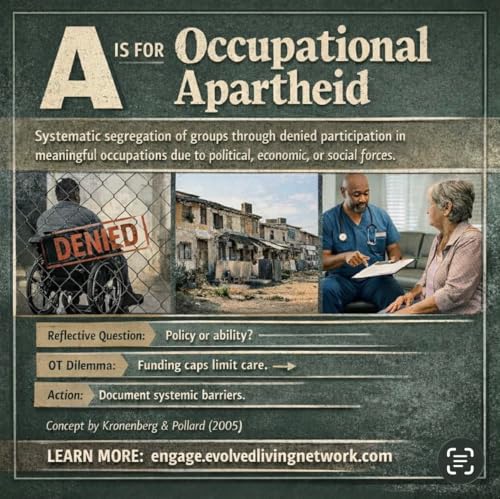
『Clinical Reflections on Occupational Apartheid: Ethics, Policy, and Systems Change in Occupational Therapy』のカバーアート

Clinical Reflections on Occupational Apartheid: Ethics, Policy, and Systems Change in Occupational Therapy

Clinical Reflections on Occupational Apartheid: Ethics, Policy, and Systems Change in Occupational Therapy

無料で聴く

ポッドキャストの詳細を見る

概要

Why this Occupational Science series mattersIf you are an occupational therapy practitioner in the United States, chances are you are already using occupational science.You just might not have been given the words for it yet.That gap is part of why I created this Occupational Science Alphabet Series — a public learning series designed to make occupational science more accessible and more visible in everyday life and traditional practice settings.This first composite series begins with A for Occupational Apartheid.Recording Timestamps:00:00 “Occupational Apartheid Analysis”06:01 “Occupational Apartheid Challenges”16:11 “Systemic Barriers in OT”18:04 “Enhancing Accessibility through Advocacy”25:20 “Defining Occupational Apartheid”33:06 “Occupation and Systemic Inequality”39:23 “Advocating Equity in OT Practice”45:04 “Occupational Therapy for Healing”48:04 “Advancing Occupational Justice”54:55 “Occupational Ethics Evolution”58:50 “Occupational Apartheid Ethics”01:03:58 “Justice and Veracity”01:10:17 Healthcare Bias and Scientific Integrity01:15:59 “Addressing Maternal Health Disparities”The phrase can feel intense at first.It should.Because it names something real.It gives language to the ways people are systematically denied access to meaningful participation in everyday life — not simply because of individual impairment or diagnosis, but because of how social, economic, political, and cultural systems are organized.And that matters deeply for occupational therapy.Because when we only look at barriers inside individual bodies, we miss the wider context shaping participation.We miss the insurance policy.The school policy.The zoning code.The inaccessible architecture.The transportation gap.The labor condition.The funding cap.Occupational science helps us see those patterns clearly.And once we can see them, we can respond more ethically and more effectively.The Secret of OccupationOne of the most powerful insights of occupational science is that occupation always transcends the individual.Yes — participation includes personal capacity, motivation, and health status.But occupation is also shaped by:environmentculturepolicyhistoryeconomicssocial relationshipsWhen occupational therapists work with clients, we are rarely working with bodies alone.We are working with people in systems.Occupational science simply gives us a language to describe those systems more clearly.Why Occupational Apartheid MattersThe concept of occupational apartheid helps us name situations where social systems restrict access to meaningful participation in everyday life.Frank Kronenberg describes occupational apartheid as:“systematically enacted negations of humanity that divide and subjugate collectives of people to the benefit of some at the expense of others.”(Kronenberg, 2018) These restrictions can occur through intersecting social mechanisms such as:racismclassismsexismableismxenophobiaeconomic inequalityThese forces shape who has access to resources that sustain dignified living.They shape who can participate fully in everyday life.And they show up in everyday occupational therapy practice more often than we might initially realize.When Systems Become HabitOne of the most profound insights connected to occupational apartheid comes from the concept of occupational consciousness, developed by Elelwani Ramugondo.Occupational consciousness invites us to examine how systems of power become embedded in everyday activity.Because the truth is:Systems do not reproduce themselves automatically.They reproduce themselves through what people do every day.Policies become habits.Beliefs become routines.Social hierarchies become normalized through everyday actions.Over time, these patterns become so familiar that they operate below the level of conscious awareness.This is where occupation becomes incredibly important.Occupation is the point where ideas turn into action.And when those actions become automated habits, they can quietly reproduce systems of inequality — even after the laws that created them have been formally abolished.When Systems End but Patterns PersistHistory shows us that oppressive systems rarely disappear completely when policies change.Segregation in the United States was formally dismantled decades ago.Apartheid in South Africa was officially abolished in the 1990s.And yet racial disparities, inequities in access to housing, healthcare, education, and safety persist in both societies today.Why?Because systems do not only exist in policy.They exist in everyday occupations.They exist in patterns of:where people livewho receives serviceswho gets referred to carewhose needs are believedwho feels welcome in public spaceswho has access to transportation, education, and healthcareThese patterns often persist through habits and assumptions that operate subconsciously.Occupational consciousness asks us to notice those patterns.Occupational apartheid helps us name their ...
まだレビューはありません