『Evolved Living Podcast』のカバーアート

Evolved Living Podcast

Evolved Living Podcast

著者: Dr. Josie Jarvis OT
無料で聴く

概要

🎙️ The Evolved Living Podcast with Dr. Josie Jarvis, PP-OTD, MA-OTR/L, BA, BS Hosted by occupational therapist, occupational scientist, and open citizen science advocate Dr. Josie Jarvis, The Evolved Living Podcast explores how we can bridge art, science, and wisdom to co-create more liberatory, ecological, and collaborative systems of care. Each episode invites critical yet compassionate dialogue across disciplines—connecting practitioners, educators, researchers, and community members who are working toward holistic, trauma-informed, and life-affirming change. Together, we translate occupational science into real-world practice and collective wellbeing through honest, inclusive, and transformative conversations.

josiejarvisot.substack.comDr. Josie Jarvis OT
生物科学 社会科学 科学
エピソード
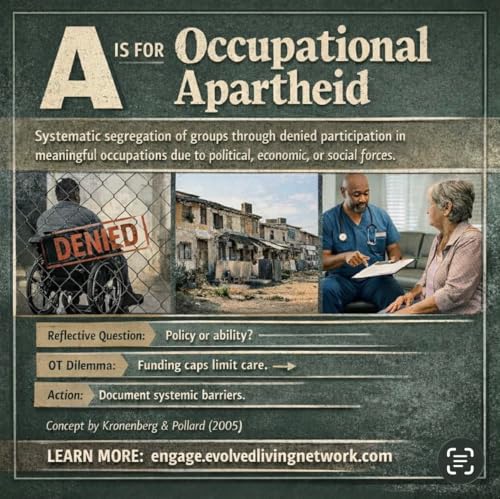
  • Clinical Reflections on Occupational Apartheid: Ethics, Policy, and Systems Change in Occupational Therapy
    2026/03/17
    Why this Occupational Science series mattersIf you are an occupational therapy practitioner in the United States, chances are you are already using occupational science.You just might not have been given the words for it yet.That gap is part of why I created this Occupational Science Alphabet Series — a public learning series designed to make occupational science more accessible and more visible in everyday life and traditional practice settings.This first composite series begins with A for Occupational Apartheid.Recording Timestamps:00:00 “Occupational Apartheid Analysis”06:01 “Occupational Apartheid Challenges”16:11 “Systemic Barriers in OT”18:04 “Enhancing Accessibility through Advocacy”25:20 “Defining Occupational Apartheid”33:06 “Occupation and Systemic Inequality”39:23 “Advocating Equity in OT Practice”45:04 “Occupational Therapy for Healing”48:04 “Advancing Occupational Justice”54:55 “Occupational Ethics Evolution”58:50 “Occupational Apartheid Ethics”01:03:58 “Justice and Veracity”01:10:17 Healthcare Bias and Scientific Integrity01:15:59 “Addressing Maternal Health Disparities”The phrase can feel intense at first.It should.Because it names something real.It gives language to the ways people are systematically denied access to meaningful participation in everyday life — not simply because of individual impairment or diagnosis, but because of how social, economic, political, and cultural systems are organized.And that matters deeply for occupational therapy.Because when we only look at barriers inside individual bodies, we miss the wider context shaping participation.We miss the insurance policy.The school policy.The zoning code.The inaccessible architecture.The transportation gap.The labor condition.The funding cap.Occupational science helps us see those patterns clearly.And once we can see them, we can respond more ethically and more effectively.The Secret of OccupationOne of the most powerful insights of occupational science is that occupation always transcends the individual.Yes — participation includes personal capacity, motivation, and health status.But occupation is also shaped by:environmentculturepolicyhistoryeconomicssocial relationshipsWhen occupational therapists work with clients, we are rarely working with bodies alone.We are working with people in systems.Occupational science simply gives us a language to describe those systems more clearly.Why Occupational Apartheid MattersThe concept of occupational apartheid helps us name situations where social systems restrict access to meaningful participation in everyday life.Frank Kronenberg describes occupational apartheid as:“systematically enacted negations of humanity that divide and subjugate collectives of people to the benefit of some at the expense of others.”(Kronenberg, 2018) These restrictions can occur through intersecting social mechanisms such as:racismclassismsexismableismxenophobiaeconomic inequalityThese forces shape who has access to resources that sustain dignified living.They shape who can participate fully in everyday life.And they show up in everyday occupational therapy practice more often than we might initially realize.When Systems Become HabitOne of the most profound insights connected to occupational apartheid comes from the concept of occupational consciousness, developed by Elelwani Ramugondo.Occupational consciousness invites us to examine how systems of power become embedded in everyday activity.Because the truth is:Systems do not reproduce themselves automatically.They reproduce themselves through what people do every day.Policies become habits.Beliefs become routines.Social hierarchies become normalized through everyday actions.Over time, these patterns become so familiar that they operate below the level of conscious awareness.This is where occupation becomes incredibly important.Occupation is the point where ideas turn into action.And when those actions become automated habits, they can quietly reproduce systems of inequality — even after the laws that created them have been formally abolished.When Systems End but Patterns PersistHistory shows us that oppressive systems rarely disappear completely when policies change.Segregation in the United States was formally dismantled decades ago.Apartheid in South Africa was officially abolished in the 1990s.And yet racial disparities, inequities in access to housing, healthcare, education, and safety persist in both societies today.Why?Because systems do not only exist in policy.They exist in everyday occupations.They exist in patterns of:where people livewho receives serviceswho gets referred to carewhose needs are believedwho feels welcome in public spaceswho has access to transportation, education, and healthcareThese patterns often persist through habits and assumptions that operate subconsciously.Occupational consciousness asks us to notice those patterns.Occupational apartheid helps us name their ...
    続きを読む 一部表示
    1 時間 18 分
  • Global Conversations: Cross-Discipline Collaboration in Epidemiology, Occupational Science, Disability, and AI with Emmanuel Ampomah Boadi
    2026/03/09
    Evolved Living Podcast with Dr. Josie Jarvis OT Global Conversations: Cross-Discipline Collaboration in Epidemiology, Occupational Science, Disability, and AIwith Emmanuel Ampomah Boadi---Episode OverviewIn this episode of the Evolved Living Podcast, Dr. Josie Jarvis welcomes Emmanuel Ampomah Boadi, a Ghana-based researcher working at the intersection of occupational science, epidemiology, biostatistics, rehabilitation, and disability studies. Their thoughtful, wide-ranging conversation explores how participation in daily life is shaped by social, structural, and systemic forces far beyond individual clinical encounters.Dr. Josie Jarvis opens the episode by reflecting on her diverse clinical background, spanning home health, schools, memory care, and acute and orthopedic rehabilitation. Her journey—deepened by doctoral work amid the COVID-19 pandemic—led her to occupational science as a discipline uniquely equipped to investigate barriers to participation at the population (not just individual) level.--- Key Topics Discussed- What is Epidemiology? Emmanuel Ampomah Boadi grounds the discussion by defining epidemiology: the study of how health, disease, and disability are distributed across populations, and the factors influencing those outcomes. He emphasizes that "it is the backbone of public health," using stories from Ghana and references to public health icons like John Snow and John Graunt to illustrate epidemiology’s roots in mapping, measurement, and understanding the interplay between environment and human behavior.- Bridging Disability Studies and Occupational Science Emmanuel Ampomah Boadi describes how his academic journey—spanning disability/rehabilitation studies and biostatistics—inspired him to explore the overlap between occupational science and population health. He highlights the importance of looking not only at medical conditions but also at social and environmental context, power imbalances, and race—reminding us that “everybody has some form of disability” and that “there is nothing like normal.”- The Role of Data and AI The conversation explores the need to “quantify” our observations to strengthen advocacy. Emmanuel Ampomah Boadi sees artificial intelligence as an assistive technology—valuable, but ultimately limited. He urges clinicians and researchers to retain the clarity and accountability of human interpretation, using AI as a support rather than a replacement for nuanced judgment.- Ethics, Equity, and Systemic Barriers The episode doesn’t shy away from difficult truths. They discuss well-known ethical breaches in research history (Tuskegee Syphilis Study, Nuremberg Code violations) and highlight how, without active attention to equity and ethics, scientific progress can deepen injustice. Dr. Josie Jarvis and Emmanuel Ampomah Boadi both reflect on their lived experiences of systemic inequity—from global vaccine access to the design of research and public health interventions.- Cultural Humility and Community Engagement Emmanuel Ampomah Boadi shares a poignant research anecdote from Ghana: an infrastructure project failed because outsiders did not consult the community, ultimately building a water borehole atop a sacred space. The lesson: knowledge translation is only possible with true cultural humility and partnership, not top-down assumptions.---Concepts ExplainedOccupational Science: A discipline that examines human participation (“occupation”) in everyday life, considering both individual and system-level factors—policy, environment, economics, and history—that enable or restrict engagement.Epidemiology & Biostatistics in Rehab: Not just tools for infectious disease, epidemiology provides frameworks for understanding disability, health disparities, and the structural determinants of participation. Biostatistics helps quantify these patterns and decipher root causes, moving advocacy from anecdote to evidence.Occupational Apartheid & Social Models of Disability: The episode contextualizes “occupational apartheid”—a situation where social, economic, or policy barriers systematically exclude groups from meaningful participation in everyday life. Emmanuel Ampomah Boadi distinguishes between the medical, social, and biopsychosocial (ICF) models of disability, urging listeners to see how “systemic barriers” create or intensify disability.---Practical Wisdom for Listeners- Integration is Key: Solutions come from teamwork—integrating medical science, social science, community wisdom, and policy. “You need to involve the community—what you believe to be the best solution may not fit their real needs.” - You Belong in Science: Dr. Josie Jarvis and Emmanuel Ampomah Boadi both stress that occupational science and health advocacy are not reserved for those with doctorates or prestigious affiliations. Efforts—however imperfect—matter. - Share and Connect: The conversation encourages clinicians, students, and community members ...
    続きを読む 一部表示
    1 時間
  • 🌿 Beyond the Hierarchy: Rethinking Evidence in Occupational Therapy
    2025/10/27
    When I first learned about evidence-based practice, I remember staring at that glossy triangle — the research hierarchy pyramid — with meta-analyses gleaming at the top like sacred scripture.It was comforting at first. Finally, a clear map of what counts as truth.But once I entered practice, that tidy hierarchy started to crumble under the weight of real people’s lives.Human beings aren’t controlled variables, and occupation doesn’t fit neatly into double-blind trials.The Trouble with the Old PyramidThe traditional Evidence-Based Practice (EBP) pyramid was built for biomedical and pharmaceutical research, where the goal is to test isolated variables across large populations (Duke University Medical Center Library, n.d.).That works beautifully when you’re measuring how a medication lowers blood pressure.But occupation is not a pill — it’s a process.It’s meaning, context, motivation, and environment woven together.In OT, our “data set” is often one person at a time — a life lived in context.Trying to flatten that into a universal protocol often means losing what makes our work effective and human.The Tomlin & Borgetto Research Pyramid: A Model That Fits Our FieldIn 2011, George S. Tomlin and Brandon Borgetto published Research Pyramid: A New Evidence-Based Practice Model for Occupational Therapy in The American Journal of Occupational Therapy (Tomlin & Borgetto, 2011).They didn’t just redraw the pyramid — they reimagined what evidence could look like.Their four-sided model includes:* Descriptive research — defining and observing occupational phenomena (the foundation).* Experimental research — asking causal questions under controlled conditions.* Outcome research — measuring effectiveness and impact in practice settings.* Qualitative research — exploring lived experience, culture, and meaning.Each side contributes uniquely to a full picture of occupational reality.Rather than stacking these methods into a hierarchy, Tomlin and Borgetto framed them as mutually reinforcing, like the faces of a pyramid that meet at the top — where evidence becomes practice.“Rather than ranking designs by hierarchy, the research pyramid encourages practitioners to evaluate rigor based on the type of question being asked.”— Tomlin & Borgetto (2011, p. 190)Why This Matters in PracticeIn home health, I’ve seen firsthand how rigid hierarchies undervalue the evidence that actually drives change.An RCT can tell me which exercise statistically improves shoulder flexion — but not whether my client can now garden with her grandchildren, or return to painting without pain.Occupational therapy lives where biology meets biography.To serve people well, we need research frameworks that make room for both.The Critiques That Strengthen UsScholars such as Gallew (2016) argue that the old hierarchy often silences the very forms of knowledge that make OT powerful — narrative, context, creativity.When we measure success only by quantitative control, we risk missing the human story.Occupational science reminds us that people are meaning-making beings.Our science must be capable of holding that complexity.How I Apply the Tomlin & Borgetto Pyramid* For mechanical reliability, I turn to experimental studies.* For real-world effectiveness, I consult outcome research.* For understanding experience, I value qualitative inquiry.* And at the root of it all, I rely on descriptive studies to ground my reasoning.Each approach has a place.Evidence becomes less about hierarchy and more about harmony — a dynamic ecosystem of knowing.Reclaiming Evidence as a Living PracticeEmbracing this model isn’t about lowering standards; it’s about broadening the lens.It validates community programs, arts-based methods, trauma-informed care, and culturally grounded interventions that might never fit into traditional RCTs.When we expand what counts as evidence, we expand what’s possible — for our clients, our profession, and the world we’re helping to rebuild.🌿 Learn More: Foundations of Occupational Science for U.S.-Based OTPsIf this conversation sparks something in you — the urge to better understand why occupational therapy feels different from other disciplines and how to ground that difference in research and policy — I invite you to join me inside Foundations of Occupational Science for U.S.-Based OTPs.This self-paced capstone learning experience bridges theory and practice, guiding practitioners and students to:* Decode the real meaning and application of the Tomlin & Borgetto Research Pyramid.* Integrate occupational science concepts into documentation, advocacy, and program design.* Reclaim OT’s creative and psychosocial roots while navigating contemporary U.S. systems.* Build confidence in articulating the full scope of practice — in language policymakers, payers, and interdisciplinary teams understand.You can explore the course and all current offerings here:👉 ...
    続きを読む 一部表示
    13 分
まだレビューはありません