• Dark Sayings, p. 65
    2026/11/13

    Each Word a Universe: Turning Bones, Not Stones. A daily word of Scripture, heard across the three scrolls of Abraham.

    A method stated plainly: attend to how things function, not to the categories their names imply.

    You imagine that things differ from each other based on their nature as opposed to how they work. You don’t look at how things operate in the world. You don’t think or analyze. You are led to believe that there is a fundamental difference between two things because of the words people use to deceive you.

    Marc Philip Boulos, Dark Sayings: Diary of an American Priest (OCABS Press, 2023), p. 65

    Opening music: Oriental Style Song, oud and darbuka, by Surprising_Media (Pixabay).

    The quotation is from Marc Philip Boulos; it is read by the digital voice Fāṭima.

    The digital voice Fāṭima (فَاطِمَة) is named in honor of the learned women of al-Andalus, particularly Fāṭima bint Yaḥyā al-Maghāmī, Fāṭima al-Sharrāṭ, and Fāṭima bint al-Muthannā, whose legacies embody the Andalusian traditions of scriptural scholarship, jurisprudence, education, and wisdom.

    続きを読む 一部表示
    1 分
  • Rise, Andalus, p. 77 · n-ḥ-m
    2026/11/12

    Each Word a Universe: Turning Bones, Not Stones. A daily word of Scripture, heard across the three scrolls of Abraham.

    Listen for one function heard across three scrolls: the Greek verb of comfort set against the Hebrew and Arabic root of regret and self-consolation.

    The Greek παρακαλέω (parakaleo) encompasses encouragement, exhortation, and comfort, corresponding to the Hebrew root נ־ח־ם (nun-ḥet-mem), which signifies regret, sorrow, and self-consolation. The Arabic cognate ن-ح-م (nūn-ḥāʾ-mīm) maintains parallel semantic usage, indicating the cross-linguistic stability of this triliteral root within the Abrahamic tradition.

    Marc Philip Boulos, Rise, Andalus: The Fall of Imperial Harlotry (OCABS Press, 2025), p. 77

    The root: נ-ח-ם · παρακαλέω · ن-ح-م (n-ḥ-m)

    Opening music: Oriental Style Song, oud and darbuka, by Surprising_Media (Pixabay).

    The quotation is from Marc Philip Boulos; it is read by the digital voice Fāṭima.

    The digital voice Fāṭima (فَاطِمَة) is named in honor of the learned women of al-Andalus, particularly Fāṭima bint Yaḥyā al-Maghāmī, Fāṭima al-Sharrāṭ, and Fāṭima bint al-Muthannā, whose legacies embody the Andalusian traditions of scriptural scholarship, jurisprudence, education, and wisdom.

    続きを読む 一部表示
    1 分
  • Seen and Unseen, p. 55 · gh-f-r
    2026/11/11

    Each Word a Universe: Turning Bones, Not Stones. A daily word of Scripture, heard across the three scrolls of Abraham.

    A name itself becomes a function, heard the same way in Arabic liturgy and in the Greek of the Gospels.

    This verse brings the full functionality together. To release guilt through remission of sin. The name itself preaches maghfirah (مَغْفِرَة), remission. Those who hear the liturgy in Arabic recognize this: li-maghfirat al-khaṭāyā (لِمَغْفِرَةِ الْخَطَایَا), the remission of sins. That is why the offering of the gifts is for the remission of sins. This is what nūḥ preaches, and it functions in Qurʾan 71:10 exactly as it does in the Gospels: aphiemi: release, remission, non-settlement.

    Marc Philip Boulos, Seen and Unseen: The Earth as the Ground of Testing (OCABS Press, 2026), p. 55

    The root: ἀφίημι · غ-ف-ر (gh-f-r)

    Heard in: Sūrat Nūḥ 71:10

    Opening music: Oriental Style Song, oud and darbuka, by Surprising_Media (Pixabay).

    The quotation is from Marc Philip Boulos; it is read by the digital voice Fāṭima.

    The digital voice Fāṭima (فَاطِمَة) is named in honor of the learned women of al-Andalus, particularly Fāṭima bint Yaḥyā al-Maghāmī, Fāṭima al-Sharrāṭ, and Fāṭima bint al-Muthannā, whose legacies embody the Andalusian traditions of scriptural scholarship, jurisprudence, education, and wisdom.

    続きを読む 一部表示
    1 分
  • Man of Letters, p. 104 · ʿ-l-h / ʿ-l-w
    2026/11/10

    Each Word a Universe: Turning Bones, Not Stones. A daily word of Scripture, heard across the three scrolls of Abraham.

    A priest's name is traced through its Hebrew and Arabic twin roots of ascent, and through the Arabic grammar of weak letters that turn a name toward exaltation.

    The priest’s name, ʿEli, is the skeleton of ascent, ע-ל-ה (ʿayin-lamed-he), whose Arabic twin is ع-ل-و (ʿayn-lām-wāw). Its third radical is a ḥarf ʿilla (حَرْف عِل َّة), a letter of weakness, and under taṣrīf ( تَصْرِیف)—the turning of the letters—the weak letters turn until the name says ʿaliyy (عَلِيّ), the exalted one. But there is only one who is exalted in the high places.

    Marc Philip Boulos, Man of Letters (OCABS Press, 2026), p. 104

    The root: ע-ל-ה · ع-ل-و (ʿ-l-h / ʿ-l-w)

    Opening music: Oriental Style Song, oud and darbuka, by Surprising_Media (Pixabay).

    The quotation is from Marc Philip Boulos; it is read by the digital voice Fāṭima.

    The digital voice Fāṭima (فَاطِمَة) is named in honor of the learned women of al-Andalus, particularly Fāṭima bint Yaḥyā al-Maghāmī, Fāṭima al-Sharrāṭ, and Fāṭima bint al-Muthannā, whose legacies embody the Andalusian traditions of scriptural scholarship, jurisprudence, education, and wisdom.

    続きを読む 一部表示
    1 分
  • Torah to the Gentiles, p. 58
    2026/11/09

    Each Word a Universe: Turning Bones, Not Stones. A daily word of Scripture, heard across the three scrolls of Abraham.

    On hearing rather than seeing: a deity with no image, a word carried rather than a figure beheld.

    Paul’s observation, “that he was not known by sight” (1:22), and was “only heard” in Judea (1:23), emphasizes this association, since those searching the empty tomb find nothing but a word from the angel; a deity with no effigy (Luke 24:7–8; Mark 16:6–7).

    Marc Philip Boulos, Torah to the Gentiles: St. Paul's Letter to the Galatians (OCABS Press, 2014), p. 58

    Opening music: Oriental Style Song, oud and darbuka, by Surprising_Media (Pixabay).

    The quotation is from Marc Philip Boulos; it is read by the digital voice Fāṭima.

    The digital voice Fāṭima (فَاطِمَة) is named in honor of the learned women of al-Andalus, particularly Fāṭima bint Yaḥyā al-Maghāmī, Fāṭima al-Sharrāṭ, and Fāṭima bint al-Muthannā, whose legacies embody the Andalusian traditions of scriptural scholarship, jurisprudence, education, and wisdom.

    続きを読む 一部表示
    1 分
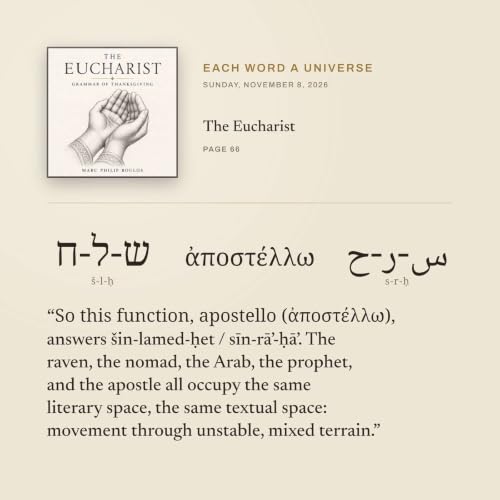
  • The Eucharist, p. 66 · š-l-ḥ / s-r-ḥ
    2026/11/08

    Each Word a Universe: Turning Bones, Not Stones. A daily word of Scripture, heard across the three scrolls of Abraham.

    A single function of release is heard across Hebrew and Arabic, binding the raven of the flood to the prophet and the apostle.

    So this function, apostello (ἀποστέλλω), answers ש-ל-ח (šin-lamed-ḥet) / س-ر-ح (sīn-rāʾ-ḥāʾ). The raven, the nomad, the Arab, the prophet, and the apostle all occupy the same literary space, the same textual space: movement through unstable, mixed terrain.

    Marc Philip Boulos, The Eucharist: A Grammar of Thanksgiving (OCABS Press, 2026), p. 66

    The root: ש-ל-ח · ἀποστέλλω · س-ر-ح (š-l-ḥ / s-r-ḥ)

    Opening music: Oriental Style Song, oud and darbuka, by Surprising_Media (Pixabay).

    The quotation is from Marc Philip Boulos; it is read by the digital voice Fāṭima.

    The digital voice Fāṭima (فَاطِمَة) is named in honor of the learned women of al-Andalus, particularly Fāṭima bint Yaḥyā al-Maghāmī, Fāṭima al-Sharrāṭ, and Fāṭima bint al-Muthannā, whose legacies embody the Andalusian traditions of scriptural scholarship, jurisprudence, education, and wisdom.

    続きを読む 一部表示
    1 分
  • Dark Sayings, p. 58
    2026/11/07

    Each Word a Universe: Turning Bones, Not Stones. A daily word of Scripture, heard across the three scrolls of Abraham.

    A plain statement of what Scripture is for: not flattery of the human race but its indictment.

    Scripture is a critique of the human race. It was not written for us but rather addressed to us, against us, for the sake of God’s creation. We are the problem in the story. It was not written to fix or reform us but to keep us in check, for our sake, yes, but more importantly, for the well-being of all of God’s creation, of which, in the story, we are but an insignificant part.

    Marc Philip Boulos, Dark Sayings: Diary of an American Priest (OCABS Press, 2023), p. 58

    Opening music: Oriental Style Song, oud and darbuka, by Surprising_Media (Pixabay).

    The quotation is from Marc Philip Boulos; it is read by the digital voice Fāṭima.

    The digital voice Fāṭima (فَاطِمَة) is named in honor of the learned women of al-Andalus, particularly Fāṭima bint Yaḥyā al-Maghāmī, Fāṭima al-Sharrāṭ, and Fāṭima bint al-Muthannā, whose legacies embody the Andalusian traditions of scriptural scholarship, jurisprudence, education, and wisdom.

    続きを読む 一部表示
    1 分
  • Rise, Andalus, p. 39 · ḥ-r-b
    2026/11/06

    Each Word a Universe: Turning Bones, Not Stones. A daily word of Scripture, heard across the three scrolls of Abraham.

    The same three consonants name both a mountain of lawgiving and the act of desolation, the root turning toward opposite ends.

    Significantly, this triliteral root also designates Mount Ḥoreb, the site of divine lawgiving. The same linguistic function that describes destruction and desolation also names the location where God establishes his covenant. This connection cannot be coincidental. It represents the fundamental tension between divine and human systems of order. The same triliteral appears as both the site where divine law is given and the agent of God’s judgment against human rebellion.

    Marc Philip Boulos, Rise, Andalus: The Fall of Imperial Harlotry (OCABS Press, 2025), p. 39

    The root: ח-ר-ב (ḥ-r-b)

    Opening music: Oriental Style Song, oud and darbuka, by Surprising_Media (Pixabay).

    The quotation is from Marc Philip Boulos; it is read by the digital voice Fāṭima.

    The digital voice Fāṭima (فَاطِمَة) is named in honor of the learned women of al-Andalus, particularly Fāṭima bint Yaḥyā al-Maghāmī, Fāṭima al-Sharrāṭ, and Fāṭima bint al-Muthannā, whose legacies embody the Andalusian traditions of scriptural scholarship, jurisprudence, education, and wisdom.

    続きを読む 一部表示
    1 分