

The Eucharist, p. 66 · š-l-ḥ / s-r-ḥ
カートのアイテムが多すぎます
カートに追加できませんでした。
ウィッシュリストに追加できませんでした。
ほしい物リストの削除に失敗しました。
ポッドキャストのフォローに失敗しました
ポッドキャストのフォロー解除に失敗しました

The Eucharist, p. 66 · š-l-ḥ / s-r-ḥ
-
ナレーター:
-
著者:
Each Word a Universe: Turning Bones, Not Stones. A daily word of Scripture, heard across the three scrolls of Abraham.
A single function of release is heard across Hebrew and Arabic, binding the raven of the flood to the prophet and the apostle.
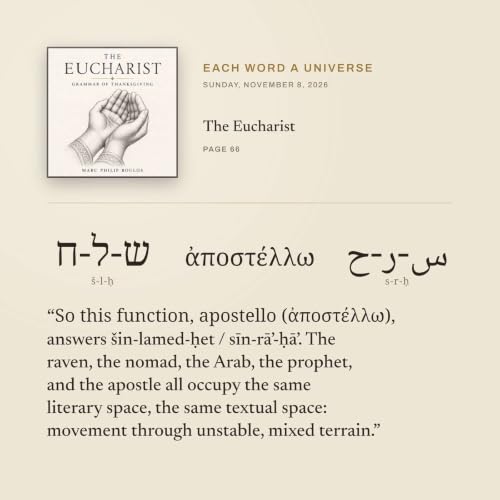
So this function, apostello (ἀποστέλλω), answers ש-ל-ח (šin-lamed-ḥet) / س-ر-ح (sīn-rāʾ-ḥāʾ). The raven, the nomad, the Arab, the prophet, and the apostle all occupy the same literary space, the same textual space: movement through unstable, mixed terrain.
Marc Philip Boulos, The Eucharist: A Grammar of Thanksgiving (OCABS Press, 2026), p. 66
The root: ש-ל-ח · ἀποστέλλω · س-ر-ح (š-l-ḥ / s-r-ḥ)
Opening music: Oriental Style Song, oud and darbuka, by Surprising_Media (Pixabay).
The quotation is from Marc Philip Boulos; it is read by the digital voice Fāṭima.
The digital voice Fāṭima (فَاطِمَة) is named in honor of the learned women of al-Andalus, particularly Fāṭima bint Yaḥyā al-Maghāmī, Fāṭima al-Sharrāṭ, and Fāṭima bint al-Muthannā, whose legacies embody the Andalusian traditions of scriptural scholarship, jurisprudence, education, and wisdom.