• The Abundant Mindset in an Age of Abundant Intelligence | Book 201 Deep Dive
    2026/09/12

    A 46-minute deep dive into Di Tran's Book 201, The Abundant Mindset in an Age of Abundant Intelligence. This episode explores a practical truth for the AI era: intelligence is abundant, but applied discipline, service, consistency, and real work are still rare.


    Inside this conversation: why degree anxiety is fading, why execution matters more than credentials, how builders turn knowledge into proof, and how companies are born by solving real human problems close to home.


    Generated as a NotebookLM podcast overview from Di Tran's book manuscript and prepared for the Di Tran University: Humanized Learning & Life Lessons Podcast.


    By Di Tran / Di Tran University / The College of Humanization.

    続きを読む 一部表示
    47 分
  • DEAL: What Is a Good Business Deal? | Di Tran’s 200th Book
    2026/09/08

    What makes a deal good—for you, for the other person, and for the people who live with its consequences?

    Explore DEAL, Di Tran’s 200th book, from Di Tran University — The College of Humanization. Through reflections on business, relationships, money, products, and service, discover how clear commitments and thoughtful value exchange can help us build trust and honor human dignity.

    At its heart is a practical framework:
    D — Define the exchange.
    E — Examine the evidence.
    A — Allocate risk and reward.
    L — Leave people with dignity.

    For entrepreneurs, educators, leaders, and anyone learning to make better agreements and keep meaningful promises.

    A milestone made possible through the contributions of the Di Tran University team, human editors, and AI tools supporting the writing and editing process.

    Explore the book: DEAL on Amazon

    https://www.amazon.com/dp/B0HJ66H5NQ

    続きを読む 一部表示
    21 分
  • Career Credit Score: Build Your Beauty Reputation Before You Graduate | Louisville Beauty Academy
    2026/08/28

    What if your beauty career could begin before the day you receive your license?

    In this Louisville Beauty Academy podcast episode, we explore Career Credit Score: How Documented Action Becomes the New Professional Reputation by Di Tran—a practical framework for students who want to build a stronger professional foundation while they are still in beauty school.

    This is not a shortcut. It is not glamour. It is not about pretending to be successful online.

    It is 100% effort, action, discipline, and documentation.

    At Louisville Beauty Academy, students can choose to participate in an optional Career Credit Score framework supported by significant incentives through our super-discount system. The purpose is to recognize students who voluntarily put extra effort into building the habits, portfolio, professional presence, and documented record that can help support long-term career success.

    Students may choose to document and develop:

    • Their professional growth and skill development

    • A portfolio of real student work

    • Consistent attendance, preparation, and responsibility

    • Sanitation, client care, and professional conduct

    • Communication and customer-service skills

    • Community service and positive contribution

    • A professional online presence and future client awareness

    • A record of effort that helps show who they are becoming as professionals

    The goal is simple: students should not have to start from zero after they become licensed.

    Imagine graduating with your required education completed, your license earned, your work documented, your portfolio growing, your reputation forming, and future clients already aware of your journey.

    That is what documented action can create.

    Important clarification: Louisville Beauty Academy’s Career Credit Score is an optional, non-financial professional-development framework. It is not a FICO score, consumer-credit score, credit report, state-board score, licensing guarantee, job guarantee, income guarantee, or promise of clients. All students remain responsible for meeting applicable education, examination, licensing, and legal requirements.

    Louisville Beauty Academy is proud to advance a student-centered model of beauty education that combines technical preparation with transparency, workforce readiness, professional documentation, ethical career development, and long-term student success.

    📘 Explore the book:
    Kindle: https://www.amazon.com/dp/B0GSCF198V
    Paperback: https://www.amazon.com/dp/B0GSJK8GQ1

    📚 Di Tran University Research & Book Library:
    https://ditranuniversity.com/research-books-subscribe/

    🌐 Louisville Beauty Academy:
    https://louisvillebeautyacademy.net/

    #LouisvilleBeautyAcademy #CareerCreditScore #BeautySchool #CosmetologyEducation #BeautyCareer #ProfessionalReputation #StudentSuccess #CareerReadiness #DiTran

    続きを読む 一部表示
    20 分
  • Knowledge Is No Longer the Moat: PhDs, AI & the Implementation Economy Spotify Description
    2026/08/27

    What happens to expertise when artificial intelligence can retrieve, summarize, translate, and organize advanced knowledge in seconds?

    In this flagship Research & Podcast Series 2026, the Di Tran University—The College of Humanization Research Team investigates doctoral credentialism, PhD career outcomes, academic labor, skills-based hiring, artificial intelligence, and the changing meaning of human expertise.

    The evidence challenges both extremes. PhD holders are not one monolithic class, and the data does not support the blanket claim that most doctorates never leave school or perform applied work. Many science, engineering, and health doctorate holders work outside education, while other disciplines remain more concentrated within academic systems. At the same time, a credential alone does not prove that someone can verify information, exercise judgment, implement a solution, produce measurable results, or accept responsibility for an outcome.

    AI has not made expertise obsolete. It has made information retrieval, first-draft production, and knowledgeable-sounding language less scarce. That shift raises the value of what remains deeply human: verification, judgment, embodied experience, ethical execution, accountability, trust, and measurable human impact.

    This series introduces the DTU Knowledge-to-Value Framework:

    Access → Comprehension → Verification → Judgment → Implementation → Outcome → Accountability and Humanization

    Knowledge remains the foundation—but it is no longer the finish line.

    The new moat is verified implementation and accountable human value.

    続きを読む 一部表示
    18 分
  • Do Not Absorb with Di Tran
    2026/08/26

    Do Not Absorb is a practical podcast for people who care deeply but refuse to be ruled by every mood, accusation, urgency, or emotional atmosphere around them.

    Hosted by entrepreneur and educator Di Tran, this series explores emotional discipline, healthy boundaries, communication, leadership, family, work, money, and the daily practice of turning pressure into value.

    Each episode offers clear tools to help you:

    • Read the room without absorbing the room

    • Respond instead of react

    • Set boundaries without becoming cold

    • Use silence with purpose

    • Speak in ways that create understanding

    • Respect human emotion without letting emotion become the ruler

    • Turn repeated frustration into systems, agreements, and better action

    For parents, spouses, students, workers, teachers, leaders, founders, and builders, Do Not Absorb is a reminder that compassion does not require emotional captivity.

    Care deeply.
    Govern your response.
    Turn pressure into value.

    続きを読む 一部表示
    21 分
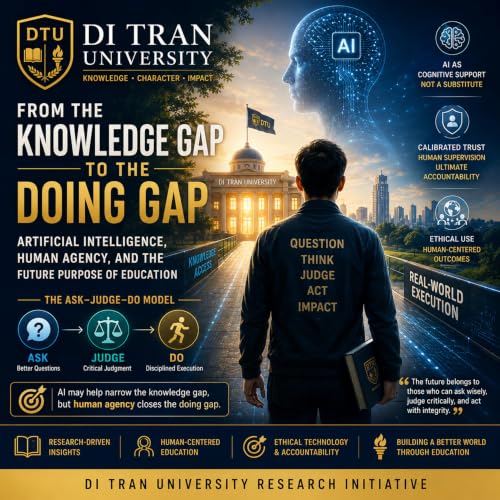
  • From the Knowledge Gap to the Doing Gap: AI, Human Agency & the Future of Education
    2026/08/19

    Artificial intelligence can place information, tutoring, translation, drafting, and strategic planning within reach—but access to answers is not the same as learning, judgment, competence, or action.

    In this Di Tran University Research Initiative feature, we examine why the future of education must move beyond information delivery and toward human formation: asking better questions, recognizing limits, verifying information, judging ethically, and executing with discipline in the real world.

    The research introduces the ASK–JUDGE–DO Model, a human-centered framework for using AI responsibly while preserving human supervision, professional accountability, critical thinking, and real-world execution. It also explores calibrated trust, automation bias, cognitive overreliance, the intention–behavior gap, and the essential role of educators, mentors, skilled professionals, and community.

    AI may help narrow the knowledge gap—but responsible human agency, critical judgment, and disciplined execution are what close the doing gap.

    Di Tran University — Knowledge. Character. Impact.

    続きを読む 一部表示
    23 分
  • When Is a Beauty School Truly a School? Ethical Clinics, Student Labor, and the Future of Cosmetology Education
    2026/08/18

    What separates a legitimate student clinic from a business model that may rely too heavily on unpaid student labor?

    In this 2026 NABA Research & Podcast Series episode, we examine the legal, ethical, and economic foundations of cosmetology education in the United States. The discussion explores the federal Fair Labor Standards Act’s “primary beneficiary” framework; the difference between supervised, competency-based clinical education and non-educational operational work; consumer transparency for live models; instructor oversight; mannequin-based alternatives; state licensing rules; accreditation uncertainty; and the growing need for affordable, student-first beauty education.

    Using Kentucky as a detailed case study, this episode also explains why documented learning objectives, meaningful instructor supervision, clear clinic disclosures, sanitation, safety, and non-retaliation protections are central to a sustainable beauty-school model.

    Topics include:

    • The FLSA primary-beneficiary test for vocational students

    • Benjamin v. B&H Education, Velarde v. GW GJ, and Eberline v. Douglas J. Holdings

    • When clinic activities support education—and when operational tasks may create risk

    • Student rights, live-model transparency, and informed consent

    • Kentucky cosmetology education and clinic requirements

    • Mannequin alternatives and competency-based progression

    • NACCAS, Title IV, student debt, and accountability pressures

    • A practical compliance framework for ethical beauty education

    This episode is for beauty-school owners, instructors, students, salon professionals, policymakers, regulators, workforce leaders, and advocates working to build a safer, more transparent, affordable, and educationally rigorous future for cosmetology, esthetics, nail technology, barbering, and wellness education.

    続きを読む 一部表示
    23 分
  • Students Before Gatekeepers: Federal Workforce Education, Student Choice, and Accountability
    2026/08/11

    Who should control the future of workforce education: institutional gatekeepers or verified students with real choice?

    This policy research report examines federal workforce education, accreditation, Title IV aid, WIOA reporting burdens, tuition inflation, fraud safeguards, and outcome-based accountability. It explores a balanced national question: whether state-licensed occupational programs can expand affordable student access while protecting learners and taxpayers through verified progress, licensure outcomes, and rigorous anti-fraud controls.

    Published by NABA for public education and civic discussion. Research, analysis, and drafting by the Di Tran University Research Team.

    This episode is educational and informational only. It is not legal, financial, or policy advice, and it does not endorse any political party, public official, agency, accreditor, institution, or proposed legislation.

    続きを読む 一部表示
    25 分