

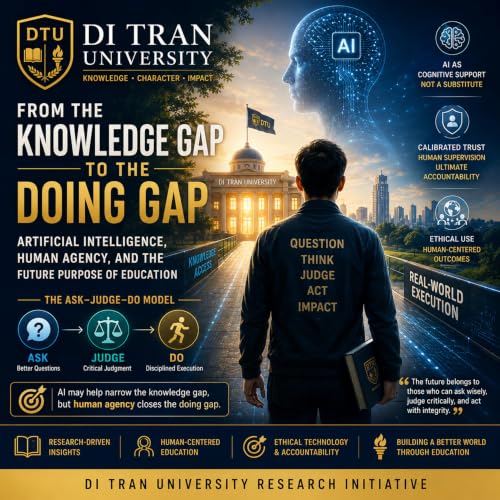
From the Knowledge Gap to the Doing Gap: AI, Human Agency & the Future of Education
カートのアイテムが多すぎます
カートに追加できませんでした。
ウィッシュリストに追加できませんでした。
ほしい物リストの削除に失敗しました。
ポッドキャストのフォローに失敗しました
ポッドキャストのフォロー解除に失敗しました

From the Knowledge Gap to the Doing Gap: AI, Human Agency & the Future of Education
-
ナレーター:
-
著者:
Artificial intelligence can place information, tutoring, translation, drafting, and strategic planning within reach—but access to answers is not the same as learning, judgment, competence, or action.
In this Di Tran University Research Initiative feature, we examine why the future of education must move beyond information delivery and toward human formation: asking better questions, recognizing limits, verifying information, judging ethically, and executing with discipline in the real world.
The research introduces the ASK–JUDGE–DO Model, a human-centered framework for using AI responsibly while preserving human supervision, professional accountability, critical thinking, and real-world execution. It also explores calibrated trust, automation bias, cognitive overreliance, the intention–behavior gap, and the essential role of educators, mentors, skilled professionals, and community.
AI may help narrow the knowledge gap—but responsible human agency, critical judgment, and disciplined execution are what close the doing gap.
Di Tran University — Knowledge. Character. Impact.