エピソード

  • A Legacy Written by Compassion
    2026/07/10

    Guests: Erin Cunningham and Pat Gerig

    This deeply moving tribute episode highlights the life and legacy of Martha Vergara a nurse whose quiet power, unshakeable dignity, and boundless compassion left a mark that time simply cannot erase.

    Host Misty Burgett is joined by two remarkable nurses who had the privilege of walking alongside Martha at a Long-Term Acute Care (LTAC) Hospital in Fort Wayne, Indiana. Pat Gerig is a recently retired RN whose 48-year nursing career took her from LPN to wound care specialist a journey she credits, in part, to Martha's steady influence. Erin Cunningham has been a practicing nurse since 1994 and found her professional home in hospital case management, where Martha's mentorship helped shape the clinician and person she is today. Together, these three voices paint a portrait of a woman who embodied what it truly means to Care Beyond the Chart.

    The conversation opens with a powerful question: what single word comes to mind when you think of Martha? Pat answers without hesitation, "Dignity." Erin offers, "Professionalism." From there, the episode unfolds into a rich exploration of how Martha led through the consistent, intentional way she showed up for every person around her. Whether she was stepping into a chaotic clinical situation with calmness, mentoring a new nurse without a trace of condescension, or navigating a difficult conversation with a grieving family, Martha's presence was described as a salve or something that soothed, steadied, and restored.

    One of the most unforgettable stories shared in this episode involves a homeless man Martha discovered sheltering on a closed hospital floor during a cold winter night. Rather than immediately alerting security, Martha first ordered him a meal tray and gave him supplies to clean up, choosing to see a human being in need before she saw a liability. This story, and others like it, reveal a nurse who was deeply tuned in to the social determinants of health long before the phrase became part of mainstream clinical conversation.

    The episode also dives into Martha's exceptional gift for handling conflict and difficult conversations. Even when patients, families, or physicians were emotionally volatile, Martha would listen quietly, allow space for the storm to pass, and then ask with calm simplicity, "Okay, so now what do you want to do?" Misty shares how this taught her one of nursing's most important lessons: that the anger directed at a nurse often has nothing to do with the nurse at all. It's about grief, fear, and loss finding their closest target. Martha's ability to hold that space with grace, without internalizing the pain or becoming defensive, was a masterclass in emotional intelligence and patient-centered care.

    But Martha was far more than her clinical wisdom. This episode is also filled with laughter, and beautifully so. Listeners will hear about the prank involving a mannequin that sent Martha running and shouting in Spanish, only to dissolve into laughter once she realized what was really happening. They'll smile at the "Hot Pockets" incident, in which batteries and loose change in Martha's pocket created a small fire, and Martha responded with characteristic cool, even offering to write up an incident report. Listeners will absolutely delight in the Grand Rapids adventure involving a conference, homemade wine, a casino, and a driver who called himself "Big Daddy," all while Martha watched from the background, eyes wide and skeptical. These moments and others remind us that Martha was a full, vibrant, compassionate nurse.

    続きを読む 一部表示
    39 分
  • Lost in Translation: The Human Side of Nursing Care
    2026/06/19

    Guest: Tracy Espinoza

    When a Patient Can't Read Their Own Language — A Nursing Story That Changed Everything.

    What if the biggest barrier to your patient's care had nothing to do with their diagnosis? One nursing student's clinical day uncovered something that a 10-day hospital stay had completely missed — and it's a lesson every healthcare provider needs to hear.

    Tracy Espinoza, a nursing student and certified medical assistant, walked into a clinical shift and ended up caring for two non-English-speaking patients. What she discovered wasn't just a language barrier — it was layers of invisible fear, undetected illiteracy, and silent suffering. One patient was quietly guarding his abdomen in pain, yet reporting low pain scores. Why? He was uninsured and terrified that every medication meant another bill he couldn't pay. Another patient had been handed Spanish-language consent forms for an entire hospitalization — but no one had ever asked if he could read them.

    "I let the nurse know, hey, our patient hasn't even reviewed this. He doesn't know how to read. And they're like, 'Oh, it's in Spanish.' I go, 'I know it's in Spanish, but he doesn't know how to read.' Even in his own language."

    This is what happens when we assume that providing information in someone's language is the same as ensuring they understand it. Health literacy and language are not the same thing — and our patients deserve better than assumptions. Real care means asking deeper questions, sitting with discomfort, and never taking a nod for an answer.

    Nursing is both a science and an art. The science keeps patients safe. The art keeps them human. Let's commit to practicing both.

    続きを読む 一部表示
    44 分
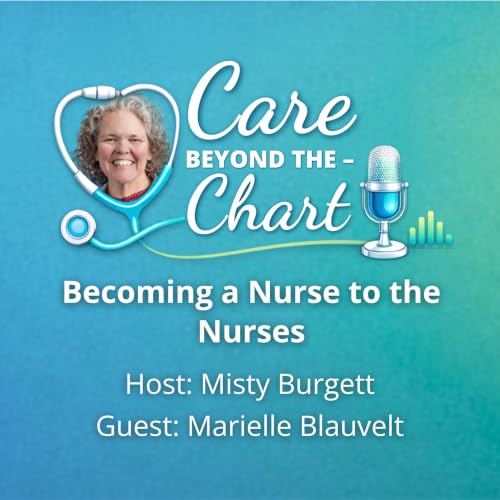
  • Becoming a Nurse to the Nurses
    2026/06/06

    Guest: Marielle Blauvelt, Chief Nursing Officer (CNO) at the Orthopedic Hospital of Lutheran (Fort Wayne, Indiana)

    In this inaugural episode of Care Beyond the Chart: Strength Behind the Scrubs, host Misty Burgett sits down with Becker's Hospital Review's newly named "CNO to Know", Marielle Blauvelt. Together, they pull back the curtain on the hidden emotional realities of healthcare. From the culture shock of transitioning from a rural farm upbringing to an inner-city county hospital, to the harrowing reality of workplace violence, Marielle shares how she redefined her executive leadership role as being a "nurse to the nurses." This raw conversation dives deep into the structural burdens that break healthcare workers' hearts, the sacred responsibility of protecting clinical staff, and why the future of medicine relies entirely on preserving the delicate balance between the art and science of patient care.

    10 Key Takeaways

    1. The "Nurse to the Nurses" Leadership Philosophy: Effective healthcare executives must view their primary role as removing operational roadblocks and providing frontline clinicians with the tools, safety, and training necessary to optimize patient outcomes.
    2. The Tension Between Art and Science: Modern nursing requires an equal integration of the scientific task (clinical data, technical mastery) and the humanistic art (preserving dignity, active listening, and emotional presence).
    3. Administrative Overload Drives Burnout: Healthcare systems continually add documentation requirements and regulatory tasks to a nurse's plate for safety compliance without implementing structural efficiencies to subtract existing burdens.
    4. Zero Tolerance for Workplace Violence: There is an urgent, necessary cultural shift occurring across healthcare systems away from treating patient-on-staff physical and verbal abuse as "part of the job."
    5. Advocacy Mandates Accountability: Protecting staff from physical assault or systemic exploitation requires leaders who prioritize employee safety over institutional public relations, including seeking legal remedies when necessary.
    6. Outlasting Toxic Hospital Cultures: Clinicians navigating punitive, fault-finding institutional environments can find a temporary sense of purpose by acting as defensive buffers to protect their peers and subordinates from toxic management.
    7. The Compounding Cost of "Invisible Work": The most impactful elements of therapeutic nursing—such as holding a hand or restoring a patient’s identity—are unquantifiable actions that cannot be tracked within an electronic medical record.
    8. The Flaw of Fragmented Patient Care: A major failure of the modern American medical system is its extreme navigation complexity; patients frequently get lost in the care continuum unless they have an insider advocate within their family.
    9. Patient Expertise and Active Listening: True clinical advocacy requires healthcare providers to slow down and listen to patients, recognizing that individuals are the ultimate experts on their own lived physical conditions.
    10. A Resilient Future Generation: Despite the profound trauma inflicted on the medical infrastructure by global pandemics, the high intellect and curiosity of incoming nursing school graduates remain the definitive anchor for long-term industry recovery.
    続きを読む 一部表示
    31 分