• Joe Yaffe, COO at Cowboy Space, on Whether Data Centers in Space Are Cheaper
    2026/08/18

    Part 2 of 2. Part 1 is here: https://betweentwocoos.com/65

    In part 1, Joe Yaffe explained how an orbital data center works. This time, the question is
    whether it works as a business.

    In this episode, Joe and Michael discuss:

    • Why Cowboy Space measures itself in cost per GPU hour, not cents per kilowatt hour
    • Why a lot of new space companies are run by technologists who aren't asking if it's a business
    • What has to go right to raise the billions this needs beyond the first $365 million
    • Why the perfect rocket engine is designed to sit on the balance point of failure
    • How being your own only customer changes what a failed launch costs you
    • Six-year chip life, and why you stop caring that you can't reach them
    • The seven-year wait for a data center in Northern Virginia
    • Which agencies regulate an orbital data center, including the FDA
    • Why hiring, not physics, sits at the top of his list
    • The December 2028 launch date the whole company runs against

    About Joe:
    Joe Yaffe is COO and chief legal officer at Cowboy Space, which is building data centers
    that run in orbit. He spent 31 years practicing law in Silicon Valley, fifteen of them at
    Latham & Watkins and the rest at Skadden, where he was managing partner of the Palo Alto
    office. He studied ancient Greek in college.

    Connect with Joe:

    • LinkedIn: https://www.linkedin.com/in/josephyaffe/

    Connect with Michael:

    • LinkedIn: https://www.linkedin.com/in/michael-koenig514
    • Building Helm: https://helmapp.ai

    Subscribe to Between Two COOs:

    • Apple Podcasts: https://podcasts.apple.com/us/podcast/between-two-coos-with-michael-koenig/id1596195041
    • Spotify: https://open.spotify.com/show/4OQY2oizo3rWUlwhmtdpSi
    • Newsletter: https://betweentwocoos.com
    続きを読む 一部表示
    36 分
  • Joe Yaffe (Cowboy Space): From Big Law to Orbit, Part 1 of 2
    2026/08/11

    Part 1 of 2. Part 2 drops later this week.

    Joe Yaffe had climbed as high as the ladder goes. Fifteen years at Latham & Watkins,
    then Skadden, managing partner of the Palo Alto office, 31 years advising founders and
    CEOs. By his own account, his idea of a midlife crisis was moving from one mega law firm
    to another. Then Baiju Bhatt stepped away from Robinhood, Joe asked what was next, and
    the answer was space lasers.

    In this episode, Joe and Michael discuss:

    • Why switching law firms counted as a midlife crisis, and what that says about risk
    • The three traits Joe saw in every successful founder across 31 years of client work
    • The easy button for a lawyer, and why he calls it second grade lawyering
    • One way doors and two way doors, with a real one from Cowboy Space
    • Getting to an undergraduate understanding of rocket science in about a year
    • How data centers in space actually work, explained without an engineering degree
    • Why the second stage of the rocket becomes both the data center and the radiator
    • Why none of it breaks the laws of physics

    About Joe:
    Joe Yaffe is COO and chief legal officer at Cowboy Space, which is building data centers
    that run in orbit. He spent 31 years practising law in Silicon Valley, fifteen of them at
    Latham & Watkins and the rest at Skadden, where he was managing partner of the Palo Alto
    office. He studied ancient Greek in college.

    Chapters
    00:00 Cold open
    01:11 Introduction
    02:27 Thirty-one years, and a very small midlife crisis
    04:03 Meeting Baiju Bhatt
    05:13 "I thought I would die at my desk"
    05:31 Space lasers
    06:34 "If you do it, I'll come join you"
    07:32 What twenty years beside founders teaches you
    09:13 The eight billion people rule
    11:46 Second grade lawyering
    13:26 Tapping the brakes and hitting the accelerator
    14:33 One way doors and two way doors
    17:14 "Be careful with the rations"
    18:13 Zero to rocket science in a year
    19:45 "I'm the liberal arts guy in the room"
    22:03 Acronyms, and blowing a fastball by you
    23:27 Advice for anyone standing at the fork
    26:37 The best advice he got before he jumped
    29:29 How Cowboy Space works, explained for the rest of us
    31:05 Asimov wrote about this in the 1940s
    35:27 Turning the second stage into the data center
    36:30 The radiator epiphany
    37:50 Cheaper than Earth, or it's a science project
    39:29 Why they're building their own rocket
    43:54 Chips, cooling, and NVIDIA
    45:54 "We're not breaking any laws of physics"
    47:50 Four companies at once
    50:37 Nuclear reactors on the moon

    Resources mentioned:

    • Cowboy Space: https://cowboyspace.com
    • I, Robot by Isaac Asimov, which collects "Reason", the 1941 short story on beaming power
      from orbit: https://www.amazon.com/dp/055338256X

    Connect with Joe:

    • LinkedIn: https://www.linkedin.com/in/josephyaffe/

    Connect with Michael:

    • LinkedIn: https://www.linkedin.com/in/michael-koenig514
    • Building Helm: https://helmapp.ai

    Subscribe to Between Two COOs:

    • Apple Podcasts: https://podcasts.apple.com/us/podcast/between-two-coos-with-michael-koenig/id1596195041
    • Spotify: https://open.spotify.com/show/4OQY2oizo3rWUlwhmtdpSi
    • Newsletter: https://betweentwocoos.com
    続きを読む 一部表示
    53 分
  • Riikka Söderlund, Katana COO, on Why AI Won't Know Your Product Exists
    2026/07/29
    Riikka Söderlund is the chief operating officer at Katana Cloud Inventory, a Finland-based platform that helps small product businesses run inventory, manufacturing, and multi-channel sales. She and host Michael Koenig discuss how AI search is affecting product discovery, why an out-of-stock product is invisible to an AI chat, and why she thinks marketing is an underused path to the COO seat. Along the way: six-week sprints instead of quarters, why Katana opened its API while SAP closed theirs, and the brand that discovered it had been selling at a loss. Why marketing is an underrated path to the COO seat, and what narrative building does for an operator that sales training does notThe six-week sprint, why four weeks is too short and eight is too long, and how she bridges the gap between a key result and an actual plan of executionProduct metadata as the new SEO, and why an out-of-stock product does not get surfaced by AI search at allThe Shopify earnings-call number: AI referral traffic to Shopify stores grew 13-fold quarter over quarterWhy Katana opened its API to any AI the customer chooses while SAP closed theirs, and why she frames that as a values choice about who owns inventory dataThe brand that did not know its cost of goods sold was negative, and the one that found $40,000 of inventory it had misplaced Riikka Söderlund is the chief operating officer at Katana Cloud Inventory, where she runs the commercial side of the business. She spent two decades in marketing, starting in Helsinki ad agencies, then a decade in consumer marketing, before joining Katana as VP of marketing and later CMO. She studied communications, and she credits narrative building as the skill that carried across from marketing into operations. Katana serves merchants in over 70 countries, with more than $3 billion in gross merchandise value flowing through the platform. Chapters 0:00 Cold open1:04 Introducing Riikka Söderlund and Katana2:12 From Helsinki PR to Vogue and Oprah3:55 Why old-era marketing skills became rare6:05 What COOs should learn from marketers7:24 Storytelling, listening, and internal communication10:37 Founder gravitas versus learned operator skill11:53 Training to be a COO before the title14:15 Running Katana day to day15:22 Goal setting and the six-week sprint19:16 Physical goods, SAP, and the market gap25:01 The golden era of creativity and branding30:35 Product metadata is the new SEO33:44 AI search and the internet economy36:33 Opening the API while SAP closed theirs38:06 Training for product management42:02 The brand that didn't know it was losing money43:43 Harry Potter and the invisible inventory Mentioned in this episode Katana Cloud Inventory: https://katanamrp.comShopify: https://www.shopify.comSAP: https://www.sap.comSalesforce: https://www.salesforce.comGong: https://www.gong.ioLovable: https://lovable.devClaude Code: https://claude.com/product/claude-codeCannes Lions: https://www.canneslions.com Connect with Riikka LinkedIn: https://www.linkedin.com/in/riikkasoderlund/Katana Cloud Inventory: https://katanamrp.com Connect with Michael LinkedIn: https://www.linkedin.com/in/michael-koenig514Building Helm: https://helmapp.ai Subscribe to Between Two COOs Apple Podcasts: https://podcasts.apple.com/us/podcast/between-two-coos-with-michael-koenig/id1596195041Spotify: https://open.spotify.com/show/4OQY2oizo3rWUlwhmtdpSiNewsletter: https://betweentwocoos.com
    続きを読む 一部表示
    45 分
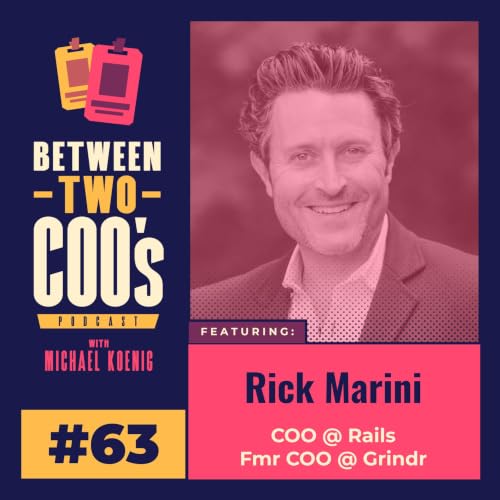
  • Rick Marini on the Day-One Speech That Turned Grindr Around
    2026/07/21
    Rick Marini, co-founder of Rails and former COO of Grindr, joins Between Two COOs to explain why he would rather be a great COO than a good CEO. He and host Michael Koenig cover the CFIUS-forced sale that put Grindr in play, the day-one culture reset that ended two and a half years later in a $2 billion New York Stock Exchange debut, the three-months-of-cash pivot that saved Tickle in the dot-com crash, and how he evaluates moats now that AI lets anyone stand up a company in a weekend. Why he says he is a good CEO but a great COO, and the honest question behind it: where do you add the most value?The vision gap: great CEOs see ten years out, he sees two, and the COO executesBuying Grindr for roughly $600 million after CFIUS forced the Chinese owner to sellThe day-one speech: equity for everyone, transparency, and earning a burned-out team's trustFight or flight at Tickle: the PhD-validated IQ test that turned three months of cash into the fastest-growing site on the internetMoats in the AI era: network effects plus a product people will pull out a credit card for Rick Marini has founded and operated consumer technology companies for 26 years. He co-founded Tickle in 1999, founded and led BranchOut to 800 million profiles and $49 million raised, and served as COO of Grindr from its 2020 acquisition through its $2 billion NYSE debut. He has been an angel investor in 60 companies, 15 of them unicorns, started Protocol Ventures, the first crypto fund of funds, and is now co-founder of Rails, a crypto perpetuals exchange. Read more and explore related coverage at betweentwocoos.com/rick-marini-good-ceo-vs-great-coo. (update if slug changes) Chapters 00:00 Good CEO, great COO00:31 Introducing Rick Marini02:00 Where do I add the most value?03:59 The realization and what got better08:11 The $600 million Grindr acquisition11:00 Day one: earning a broken team's trust12:49 The $2 billion IPO callback15:17 CFIUS, TikTok, and forced sales17:37 Tickle and three months of cash21:31 Fight or flight: the IQ test24:23 What repeats: team, TAM, differentiation26:51 Moats in the AI era29:47 Grizzled vets vs rookie founders31:49 Crypto, Rails, and perps34:29 Waymos, AI, and what's next Mentioned in this episode GrindrRails (confirm link before publish; press coverage cites Rails.xyz but the landing page is sparse)Protocol VenturesWaymo Connect Rick Marini on LinkedIn: https://www.linkedin.com/in/rickmarini (confirm before publish)Rick Marini on X: https://x.com/rmariniMichael Koenig on LinkedIn: https://www.linkedin.com/in/michael-koenig514Building Helm: https://helmapp.ai Subscribe to Between Two COOs Apple Podcasts: https://podcasts.apple.com/us/podcast/between-two-coos-with-michael-koenig/id1596195041Spotify: https://open.spotify.com/show/4OQY2oizo3rWUlwhmtdpSi
    続きを読む 一部表示
    38 分
  • Zapier CEO Wade Foster on Why AI Is a People Problem, Not a Tech Problem
    2026/07/15

    Michael Koenig talks with Wade Foster, co-founder and CEO of Zapier, about running the company for 14 years without a CEO safety net and without ever naming a COO. Wade explains why he thinks hiring a chief operating officer from outside a company is a coin flip, why Zapier put AI transformation inside the chief people officer role instead of naming a dedicated AI executive, and why he believes AI adoption is fundamentally an organizational and people problem rather than a technology problem. The conversation covers Zapier's “code red” response to GPT-4, the pricing decision that traded short-term revenue for long-term customer trust, and what changed in Wade's own leadership style over 14 years in the same seat.

    • Why Zapier has never had a COO and why Wade calls external executive hiring a coin flip
    • Why AI sits inside the chief people officer's role at Zapier instead of a dedicated AI leader
    • The 2023 “code red” triggered by the jump from GPT-3.5 to GPT-4
    • How Zapier decides when a workflow needs deterministic software versus AI judgment
    • Why Zapier delayed its mid-market and enterprise push, and what that delay cost
    • Advice for non-tech companies on building an AI adoption mindset without a hackathon culture

    Wade Foster co-founded Zapier and serves as its CEO. Zapier is a workflow automation platform that connects thousands of software tools and now powers billions of automated actions each month. Under Wade's leadership, Zapier grew to roughly 850 employees and a multi-billion dollar valuation while raising only a small seed round after Y Combinator.

    Read the full episode page at Between Two COOs: Wade Foster on why AI adoption is a people problem.

    Mentioned in this episode

    • Zapier — https://zapier.com
    • Acquired podcast — https://www.acquired.fm
    • Y Combinator — https://www.ycombinator.com
    • Claude Code — https://claude.com/product/claude-code
    • Zapier MCP — https://zapier.com/mcp
    • EVE Online — https://www.eveonline.com
    • The Hard Thing About Hard Things — https://a16z.com/books/the-hard-thing-about-hard-things/
    • The High Growth Handbook — https://press.stripe.com/high-growth-handbook
    続きを読む 一部表示
    51 分
  • Zulema Quintans, COO of Noda, on Why Your OKRs Don't Get Done
    2026/07/02

    Zulema Quintans runs operations at an energy company, and she has a clear theory about why goals fail. This is a conversation about making OKRs actually work, and how AI is changing the operator's job.

    In this episode, Zulema and Michael discuss:

    - Why most OKRs never get done, and the one link that fixes it

    - Running OKRs as an operating system, not a quarterly ritual

    - Aiming for 70 percent completion, and the Federer mindset behind it

    - Being directive without micromanaging

    - The $200 billion commercial buildings spend on energy, and how much is wasted

    - How Noda connects to legacy buildings and cleans messy data

    - Automated demand management, and the knob that quietly saves energy

    - Why AI makes this a golden age for operators

    - Where the human still has to stay in the loop

    Chapters

    00:00 Cold open: the energy waste problem

    01:05 Meet Zulema and Noda

    01:45 From Juilliard ballet to COO

    03:30 Holding focus and flexibility

    06:01 Why OKRs fail, and the 70% rule

    08:41 Top-down meets bottom-up OKRs

    13:09 Making OKRs the operating system

    15:55 Inside Noda: climate tech for buildings

    19:19 Turning messy building data usable

    20:39 The modular path to automation

    22:50 AI cuts onboarding from weeks to hours

    24:50 The Buildings IoT acquisition

    25:46 AI, the COO role, and human judgment

    32:09 The five-year view for buildings

    34:42 A warehouse full of sensors

    About Zulema:

    Zulema Quintans is the chief operating officer of Noda, an energy and building intelligence platform for commercial real estate, where she leads product, operations, and customer success. Before Noda she held leadership roles at Arcadia, American Express, and Bain & Company. She began her career as a professional ballet dancer trained at Juilliard.

    Resources mentioned:

    - Roger Federer, 2024 Dartmouth commencement address: https://www.youtube.com/watch?v=pqWUuYTcG-o

    Connect with Zulema:

    - LinkedIn: https://www.linkedin.com/in/zulema-quintans-36152223/

    - Noda: https://noda.ai

    Connect with Michael:

    - LinkedIn: https://www.linkedin.com/in/michael-koenig514

    - Building Helm: https://helmapp.ai

    Subscribe to Between Two COOs:

    - Apple Podcasts: https://podcasts.apple.com/us/podcast/between-two-coos/id1635533318

    - Spotify: https://open.spotify.com/show/2NjVgGm6mqLPEbJUvHnHEH

    - Newsletter: https://betweentwocoos.com
    - Episode Website: https://betweentwocoos.com/zulema-quintans-noda-ai-okrs-energy

    続きを読む 一部表示
    38 分
  • Peter Rojas, New Products at Mozilla, on Why Ideas Don't Decide Success
    2026/06/16

    Watch on YouTube.
    Peter Rojas has built new things at almost every scale there is, and he planted the seed for this show years ago in an email to Michael.

    In this episode, Peter and Michael discuss:

    • How building new products inside a big company differs from a startup, and why you have to invest ahead of traction
    • Why corporate product development is a harder numbers game than a venture portfolio
    • AI, vibe coding, and the Mozilla Pioneers program for widening the top of the funnel
    • Why incumbents keep losing the next technology wave
    • Why coordination breaks down at scale, and the clarity that fixes it

    About Peter: Peter Rojas co-founded Gizmodo and Engadget, two publications that changed how people understand technology. He has been an operator and investor across AOL, Meta, and BetaWorks, where he was a founder and VC. Today he leads new product development at Mozilla and runs Mozilla Pioneers.

    00:00 Cold open

    01:46 The email that started the show

    03:33 Startup vs building inside a company

    06:57 The corporate product numbers game

    11:03 Vibe coding and Mozilla Pioneers

    15:13 When a trusted brand is the advantage

    18:04 Why incumbents lose the next wave

    21:58 Meta's metaverse bet vs AI

    25:44 If I were running Meta

    29:02 Was the VR bet a failure

    30:27 Why coordination breaks at scale

    35:07 Fear, focus, and the CEO filter

    38:56 How Mozilla runs on KPIs

    40:30 The founder who hid his idea

    46:33 Where to find Peter

    Resources mentioned:

    • Mozilla Pioneers: https://newproducts.mozilla.org/mozilla-pioneers/
    • WordPress: https://wordpress.org
    • Lovable: https://lovable.dev
    • Replit: https://replit.com
    • Claude Code: https://www.anthropic.com/claude-code
    • Rec Room: https://recroom.com

    Connect with Peter:

    • LinkedIn: https://www.linkedin.com/in/peterrojas/

    Connect with Michael:

    • LinkedIn: https://www.linkedin.com/in/michael-koenig514
    • Building Helm: https://helmapp.ai

    Subscribe to Between Two COOs:

    • Apple Podcasts: https://podcasts.apple.com/us/podcast/between-two-coos/id1635533318
    • Spotify: https://open.spotify.com/show/2NjVgGm6mqLPEbJUvHnHEH
    • Newsletter: https://betweentwocoos.com
    • Watch on YouTube.
    続きを読む 一部表示
    46 分
  • AI Agents Need Logins Too: Identity, Security, and the Future of AI | Greg Keller, CTO, JumpCloud
    2026/03/05

    Get 90 days of Fellow free at Fellow.ai/coo

    In this episode, Michael Koenig speaks with Greg Keller, co-founder and CTO of JumpCloud, about identity access management and why it’s becoming one of the most important operational systems in the age of AI.


    Greg explains how traditional identity systems were designed for office-based companies running Microsoft infrastructure and why that model broke as companies moved to SaaS, cloud infrastructure, and remote work.


    The discussion then turns to the next big shift: the rise of AI agents and synthetic identities inside organizations.


    As companies deploy more AI tools, the number of machine identities may soon outnumber human employees. Managing what those systems can access will become a critical security and operational challenge.

    Topics Covered

    What a CTO actually does

    Greg explains the different types of CTO roles and how technology leaders help companies anticipate where the market is headed.

    Identity Access Management explained simply

    IAM answers three core questions inside every company:

    Who are you?

    What can you access?

    How is that access managed?

    Why the old IT model broke

    Traditional identity systems were built for on-premise offices and Microsoft infrastructure. Modern companies now operate across:

    SaaS applications

    cloud infrastructure

    remote work environments

    multiple operating systems

    How JumpCloud approaches identity

    JumpCloud was built to manage identity across devices, applications, and infrastructure regardless of platform.

    Where Okta fits in the ecosystem

    Okta helped modernize browser-based authentication through Single Sign-On, while JumpCloud focuses on broader identity infrastructure.

    AI, Security, and Synthetic Identities

    Why COOs should push AI adoption

    Greg argues AI adoption is no longer optional. Companies must encourage teams to improve productivity and efficiency using AI.

    The rise of synthetic identities

    AI agents, bots, APIs, and service accounts are becoming new actors inside companies that require identity governance.

    Bots may soon outnumber employees

    Organizations will soon manage more machine identities than human ones.

    AI as a potential insider threat

    AI systems can become security risks if they are granted excessive permissions or misinterpret policies.

    The API key governance problem

    Many AI integrations rely on API keys, which are often poorly managed and can create hidden security risks.

    Key Takeaway

    As companies adopt AI, identity access management becomes the control layer that determines what both humans and machines are allowed to do inside the organization.
    The companies that manage identity well will move faster and operate more securely.

    Links:

    Michael on LinkedIn: https://linkedin.com/in/michael-koenig514

    Greg on LinkedIn: https://www.linkedin.com/in/gregorykeller/

    JumpCloud: https://jumpcloud.com/

    Between Two COO’s: https://betweentwocoos.com

    Episode Link: https://betweentwocoos.com/ai-agents-identity-access-greg-keller

    続きを読む 一部表示
    32 分