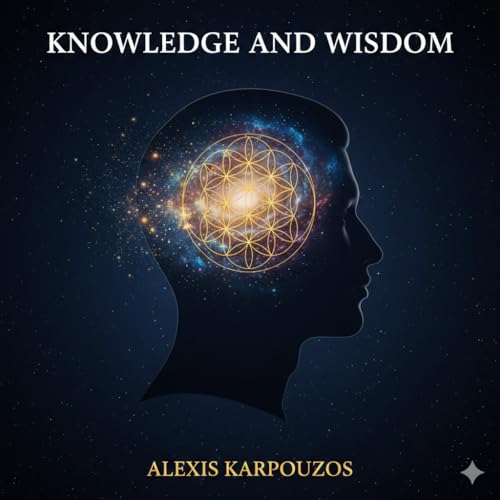
KNOWLEDGE — WISDOM: ALEXIS KARPOUZOS From the earliest myths and Pre-Socratic cosmologies to the science of modernity, humanity has sought to understand, classify, and explain the world. Knowledge refers to the process of understanding phenomena. Wisdom, by contrast, concerns the understanding of the meaning behind those phenomena. Knowledge is analytical, wisdom is synthetic; knowledge separates, wisdom unites. The philosophical question posed is: can human beings transform knowledge into wisdom? That is, can one move from the science of the real to the consciousness of Being? 1. Knowledge as the Logic of Distinction In Platonic philosophy, knowledge (episteme) is contrasted with mere doxa (opinion). In the Republic (VI, 509d), Plato places knowledge within a hierarchy culminating in the noesis of the Good—the pure vision of truth. Aristotle, in his Metaphysics, attributes to knowledge the character of causal understanding: "all men by nature desire to know." Knowledge is, therefore, an exit from ignorance and an appropriation of the world through reason. 2. Knowledge as Power and Limitation With the Enlightenment and Modernity, knowledge is transformed into a means of power. Francis Bacon declares that "Knowledge is Power," founding the spirit of the scientific age. However, as Martin Heidegger showed in The Question Concerning Technology (1954), this identification of knowledge with power leads to an anthropocentric oblivion of Being, where the world becomes a mere standing reserve (Bestand) for use. Knowledge, severed from wisdom, ceases to reveal and begins to control. Consequently, knowledge moves within linear and causal time; it is the product of analysis, logic, and method. Yet, as Heraclitus would argue, "much learning does not teach understanding"—the accumulation of information does not necessarily lead to prudence. Reason (Logos) must be connected to the xynon—the common meaning of the Whole—to be transformed into wisdom. 3. Wisdom as Insight and Participation in the Whole Wisdom, unlike knowledge, is an experience of unity. Heraclitus views wisdom as the understanding of the Logos of the world—the unity within the conflict of opposites: "all things are one." Plotinus, in the Enneads, describes wisdom as the return of the soul to the One, where the intellect falls silent and thought is transformed into vision (theoria). Wisdom is, therefore, meta-logical; it does not negate reason but transcends it. Like Nietzsche in Thus Spoke Zarathustra, wisdom is not the result of syllogism, but a tragic acceptance of the unity of life and death. 4. Wisdom in Eastern Traditions In Taoist and Buddhist thought, wisdom (prajñā) is identified with non-duality: the experience that subject and object, visible and invisible, are but manifestations of the same whole. Lao Tzu writes: "The wise man knows without knowing, acts without acting" (Tao Te Ching, ch. 2). This non-adversarial stance toward the world is close to the spirit of Karpouzos, who links wisdom with empathy for the Whole, with the awareness that existence is not isolated but participatory. 5. The Dialectical Relationship of Knowledge and Wisdom Knowledge and wisdom, rather than being opposed, constitute two dialectical stages of human consciousness. Hegel, in the Phenomenology of Spirit (1807), describes the process of transmuting knowledge through sublation (Aufhebung), where the particular is synthesized into the universal. Knowledge is the thesis—the stage of distinction; wisdom is the sublation—the transcendence of distinction toward unity. Man is not called to reject knowledge, but to complete it within wisdom. Karpouzos, in his work The Cosmology of Consciousness, writes: "Wisdom is not the negation of knowledge; it is its liberation from the prison of the anthropocentric ego." This means that wisdom is the point where knowledge is transformed into self-knowledge—where the subject understands that the object of knowledge is not foreign, but a reflection of its own Being. 6. Knowledge and Wisdom in the Age of Technics The information age has highlighted the vast expansion of knowledge and, simultaneously, the lack of wisdom. Man knows almost everything about the world, but less and less about himself. Knowledge has become quantitative, not qualitative. Heidegger speaks of the "state of the oblivion of Being"; Karpouzos would say that modern man suffers from metaphysical anesthesia. The world is treated as a given object, not as a sacred mystery. The solution, therefore, lies not in the rejection of knowledge, but in its transmutation into wisdom—in the creation of a holistic/fragmentary consciousness that unites science with poetry, logic with dreams, reason with the heart. 7. Knowledge — Wisdom as a Unity of Logic and Intuition Knowledge — Wisdom constitutes an existential and epistemological axis of human evolution. Knowledge is the outward journey of the mind, wisdom is the inward return of the spirit. One ...
続きを読む
一部表示


 11 分
11 分 5 分
5 分 2026/04/125 分
 14 分
14 分 2026/02/135 分
 2026/02/1310 分
 5 分
5 分 6 分
6 分