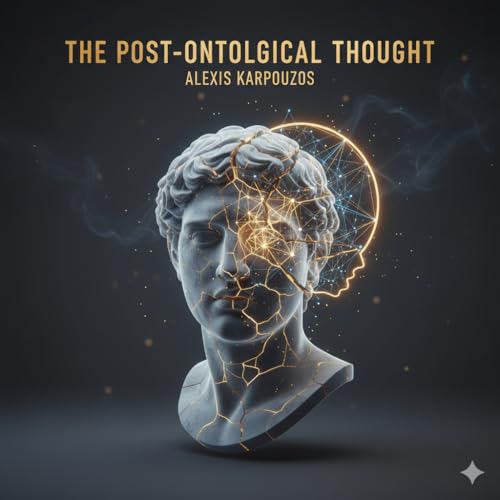
『THE POST - ONTOLOGICAL THOUGHT - ALEXIS KARPOUZOS』のカバーアート

THE POST - ONTOLOGICAL THOUGHT - ALEXIS KARPOUZOS

THE POST - ONTOLOGICAL THOUGHT - ALEXIS KARPOUZOS

無料で聴く

ポッドキャストの詳細を見る

概要

A Paradigm Shift in 21st Century Philosophy The Post-Ontological Thought of Alexis Karpouzos offers a groundbreaking re-examination of traditional metaphysics and philosophy. Emerging from a landscape where classical ontological inquiries often centered on the static nature of being, Karpouzos's thought departs significantly, proposing a fluid, dynamic approach to understanding existence. His work intertwines metaphysics with contemporary social sciences, challenging us to rethink the foundations of reality, presence, and consciousness. 1. Deconstructing Metaphysics Deconstructing metaphysics begins with questioning the fundamental assumptions that have long governed philosophical inquiry about being and existence. Karpouzos critically engages with classical ontological paradigms, emphasizing that metaphysics should no longer be seen as a static foundation but as a dynamic process intertwined with social and existential realities. Karpouzos replaces fixed essences with fluid, emergent processes. His methodology involves deconstructing Western binaries—such as being/non-being and reality/illusion—moving toward a "reconstructivism" focused on relationships and becoming. 2. Beyond Being: The Emphasis on Becoming At the heart of Karpouzos' philosophy lies a profound shift from "being" to "becoming." He advocates that existence is a continuous process rather than a fixed state. Philosophy, in this view, ceases to be an inquiry into what exists and becomes a study of how things emerge, transform, and connect within a web of interactions. 3. The Post-Ontological Turn The post-ontological turn signifies a movement away from conventional metaphysical absolutes towards fluidity, contingency, and relationality. Karpouzos rethinks fundamental concepts like essence, existence, and causality, proposing that these categories are constructs emerging from interconnected processes. This approach aligns with contemporary debates on complexity, chaos, and emergence. +2 4. Critique of Traditional Metaphysics Karpouzos critiques traditional metaphysics for its tendency to reduce existence to a static, essentialist framework. He highlights how these classical systems neglect the living, dynamic aspects of reality. This critique is also social and political, questioning how ontological assumptions shape power dynamics and societal structures. 5. Implications for Contemporary Debates The post-ontological perspective has profound implications for consciousness, identity, and social justice: Consciousness: Viewed as an emergent process shaped by social interaction and existential reality. Social Sciences: Fosters a nuanced analysis of power and inequality, aligning with Actor-Network Theory and relational sociology. 6. Key Concepts: Emergence, Relationality, and Processuality Central to this framework are three pillars: Emergence: New forms of organization or consciousness arising from complex interactions. Relationality: The shift from viewing entities as independent to understanding them as nodes in an intricate web. Processuality: The emphasis on ongoing change over fixed states. 7. Relevance in the 21st Century In an era of rapid technological and ecological transformation, Karpouzos's emphasis on interconnectedness provides tools to navigate climate change, social fragmentation, and information overload. It promotes a human-centered view where we are not isolated individuals but active participants co-creating the fabric of reality. 8. Comparative Philosophy While sharing affinities with Process Philosophy (Whitehead), Phenomenology, and Systems Theory, Karpouzos diverges through his integrative ambition. Unlike post-structuralism, he maintains a constructive ontology, advocating for active engagement in shaping reality through collective effort and dialogue. 9. Future Directions The evolution of post-ontological philosophy beckons for further interdisciplinary research, bridging: Physics: Quantum physics and the nature of reality. Neuroscience: The fluid nature of the mind. Indigenous Wisdom: Engaging with non-Western relational epistemologies. Conclusion The Post-Ontological Thought of Alexis Karpouzos represents a transformative shift, replacing static essentialism with a dynamic vision of reality. By rethinking the relationship between being and becoming, Karpouzos offers a philosophy that is not merely an abstract exercise but a participatory project—an active process of world-building for the 21st century.
まだレビューはありません