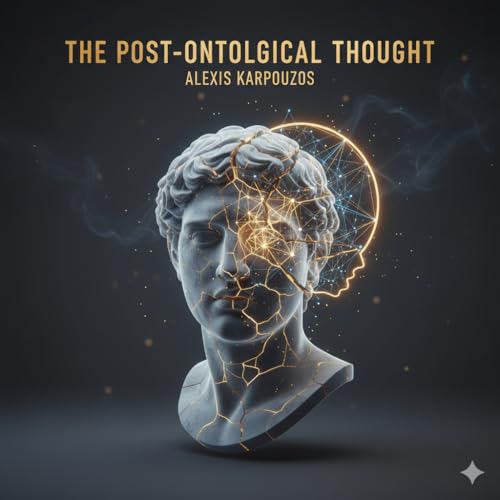
『alexis karpouzos's podcast』のカバーアート

alexis karpouzos's podcast

alexis karpouzos's podcast

著者: alexis karpouzos
無料で聴く

概要

Alexis karpouzos (Born, April 09, 1967 in Athens) is an Greek-born Philosopher, Spiritual Teacher and Author. Alexis karpouzos passionate engagement with tensions at the heart of creativity give strength to his call for an individual and collective evolutionary leap forward. Alexis karpouzos is the teacher of the essence of spiritual conscious evolution and its social contribution. The poetic thought of Alexis karpouzos is a expressions of soul's inner experiences, expression of universality. The inspiring visual images and the symbolic use of language offer a description of elevating experiences of consciousness, a glimpse of higher worlds. The philosophy of alexis karpouzos speak to the human experience from a universal perspective, trancending all religions, cultural and national boundaries. Using vivid images and a direct language that speaks to the heart, his philosophy evokes a sense of deep communication with the collective unconscious, a sense of connection to all the creatures of the world, compassion for others, admiration for the beauty of nature, reverence for all life, and an abiding faith in the invisible touch of world. Alexis karpouzos thoughts are often terse and paradoxical, challenging us to to break out of the box of limiting beliefs and see things from a new perspective. Above all, alexis karpouzos continually calls to us to wake up and exlpore the mysteries within our own selves, i.e the mysteries of universe.alexis karpouzos スピリチュアリティ 社会科学
エピソード
  • THE POST - ONTOLOGICAL THOUGHT - ALEXIS KARPOUZOS
    2026/02/13
    A Paradigm Shift in 21st Century Philosophy The Post-Ontological Thought of Alexis Karpouzos offers a groundbreaking re-examination of traditional metaphysics and philosophy. Emerging from a landscape where classical ontological inquiries often centered on the static nature of being, Karpouzos's thought departs significantly, proposing a fluid, dynamic approach to understanding existence. His work intertwines metaphysics with contemporary social sciences, challenging us to rethink the foundations of reality, presence, and consciousness. 1. Deconstructing Metaphysics Deconstructing metaphysics begins with questioning the fundamental assumptions that have long governed philosophical inquiry about being and existence. Karpouzos critically engages with classical ontological paradigms, emphasizing that metaphysics should no longer be seen as a static foundation but as a dynamic process intertwined with social and existential realities. Karpouzos replaces fixed essences with fluid, emergent processes. His methodology involves deconstructing Western binaries—such as being/non-being and reality/illusion—moving toward a "reconstructivism" focused on relationships and becoming. 2. Beyond Being: The Emphasis on Becoming At the heart of Karpouzos' philosophy lies a profound shift from "being" to "becoming." He advocates that existence is a continuous process rather than a fixed state. Philosophy, in this view, ceases to be an inquiry into what exists and becomes a study of how things emerge, transform, and connect within a web of interactions. 3. The Post-Ontological Turn The post-ontological turn signifies a movement away from conventional metaphysical absolutes towards fluidity, contingency, and relationality. Karpouzos rethinks fundamental concepts like essence, existence, and causality, proposing that these categories are constructs emerging from interconnected processes. This approach aligns with contemporary debates on complexity, chaos, and emergence. +2 4. Critique of Traditional Metaphysics Karpouzos critiques traditional metaphysics for its tendency to reduce existence to a static, essentialist framework. He highlights how these classical systems neglect the living, dynamic aspects of reality. This critique is also social and political, questioning how ontological assumptions shape power dynamics and societal structures. 5. Implications for Contemporary Debates The post-ontological perspective has profound implications for consciousness, identity, and social justice: Consciousness: Viewed as an emergent process shaped by social interaction and existential reality. Social Sciences: Fosters a nuanced analysis of power and inequality, aligning with Actor-Network Theory and relational sociology. 6. Key Concepts: Emergence, Relationality, and Processuality Central to this framework are three pillars: Emergence: New forms of organization or consciousness arising from complex interactions. Relationality: The shift from viewing entities as independent to understanding them as nodes in an intricate web. Processuality: The emphasis on ongoing change over fixed states. 7. Relevance in the 21st Century In an era of rapid technological and ecological transformation, Karpouzos's emphasis on interconnectedness provides tools to navigate climate change, social fragmentation, and information overload. It promotes a human-centered view where we are not isolated individuals but active participants co-creating the fabric of reality. 8. Comparative Philosophy While sharing affinities with Process Philosophy (Whitehead), Phenomenology, and Systems Theory, Karpouzos diverges through his integrative ambition. Unlike post-structuralism, he maintains a constructive ontology, advocating for active engagement in shaping reality through collective effort and dialogue. 9. Future Directions The evolution of post-ontological philosophy beckons for further interdisciplinary research, bridging: Physics: Quantum physics and the nature of reality. Neuroscience: The fluid nature of the mind. Indigenous Wisdom: Engaging with non-Western relational epistemologies. Conclusion The Post-Ontological Thought of Alexis Karpouzos represents a transformative shift, replacing static essentialism with a dynamic vision of reality. By rethinking the relationship between being and becoming, Karpouzos offers a philosophy that is not merely an abstract exercise but a participatory project—an active process of world-building for the 21st century.
    続きを読む 一部表示
    14 分
  • THE SPHERICAL SPACETIME -ALEXIS KARPOUZOS
    2026/02/13
    Spherical Spacetime: The Metaphysical Vision of Alexis Karpouzos Spherical Spacetime is one of the most profound and original concepts in the philosophy of Alexis Karpouzos. It does not refer to a mathematical or physical description like those found in the theory of relativity (e.g., a sphere-shaped curved spacetime), but rather to a metaphysical and holistic vision of the universe. It is a dynamic, transformative structure that unites space, time, consciousness, and "the void" into an eternal movement of creation and destruction. Core Characteristics of Spherical Spacetime Sphericity and Wholeness: The term "spherical" symbolizes the omni-centric and symmetrical nature of reality—there is no privileged center; instead, every point is the center. It is the sum-total of all perspectives: an invisible, fleeting center that relates and coordinates all differences, viewpoints, and experiences without flattening them. It ensures unity within multiplicity. Inseparability from the Void: Spherical spacetime is inseparable from absolute zero (the vacuum, the void). Nothing "exists" as a fixed constant—it is created and destroyed simultaneously. This means that existence is not permanent, but a continuous transformation emerging from the void and returning to it in a cycle of creation-destruction. Transformations and Indeterminacy: Its transformations are indeterminate and eternal. They do not follow a linear progression but a spiral movement. Within this spacetime, binary oppositions (e.g., Being/non-Being, light/dark, subject/object) are inscribed where they shift, negate one another, and coexist without contradiction, thanks to paradoxical logic. Connection to Consciousness and Evolution: Every human and living being is constituted by this spherical spacetime. It is the holistic unit of information connecting the microcosm (the atom) to the macrocosm (the universe). The evolution of consciousness occurs through the awareness of this spherical spacetime, where time is non-chronological and space is "atopic" (placeless). Relation to Other Concepts in Karpouzos' Thought Concept Relationship to Spherical Spacetime Relational Ontology Spherical spacetime is the ultimate web of relations—everything exists only through interdependence. Metaphysical Openness Openness arises because spacetime is indeterminate and constantly transforming. The Diagonal Path The path crosses "diagonally" through oppositions and inscribes them into this spherical structure. Paradoxical Logic The logic that embraces contradictions precisely because spherical spacetime incorporates them without conflict. Key Idea: Transcending Linearity Alexis Karpouzos proposes that spacetime is not linear, flat, or infinitely straight (as described by classical physics), but spherical, closed-and-simultaneously-open, omnitemporal, and non-local. In other words, time and space are not separate, independent dimensions, but form a spherical structure where past, present, and future coexist simultaneously in the Timeless state. 1. Omnitemporality All moments of time exist simultaneously. The past is not "lost," and the future is not "yet to come." They are all present at different points on the spherical surface of spacetime. The linear sense of time is merely an illusion of limited human perception. 2. Non-locality and Spherical Closure Just as a sphere has no "beginning" or "end" (if you travel straight around the Earth, you return to the same point), so it is with the universe: every point is simultaneously center and periphery. This connects directly to quantum non-locality (entanglement) and David Bohm's idea of the "holographic universe." 3. Timeless Time When consciousness is liberated from the linear narrative of the ego, it experiences spacetime as spherical: everything happens at once in an eternally present unity. 4. Spacetime as Consciousness Spherical spacetime is not just a physical structure—it is a structure of universal consciousness. Consciousness is not within spacetime; spacetime is a manifestation of consciousness. When human consciousness "awakens," it can experience this sphericity through deep meditative experience or poetic insight. 5. Transcending Causality In spherical spacetime, there is no strict "cause → effect" determinism in the linear sense. Events influence each other cyclically and simultaneously (akin to quantum phenomena where the future may influence the past—retrocausality). The Metaphor of the Horizon "Imagine you are standing on the surface of a vast sphere. Everywhere you look, the horizon curves and returns to you. Time is exactly like that: every moment is the horizon of the other. Your past looks at you from your future, and your future is already present within you." Spherical spacetime is the cosmological expression of the non-dual, holistic, and paradoxical reality proposed by Karpouzos: a universe where everything is simultaneously One and Many, present and boundless, closed and infinitely open.
    続きを読む 一部表示
    5 分
  • KNOWLEDGE AND WISDOM - ALEXIS KARPOUZOS
    2026/02/13
    KNOWLEDGE — WISDOM: ALEXIS KARPOUZOS From the earliest myths and Pre-Socratic cosmologies to the science of modernity, humanity has sought to understand, classify, and explain the world. Knowledge refers to the process of understanding phenomena. Wisdom, by contrast, concerns the understanding of the meaning behind those phenomena. Knowledge is analytical, wisdom is synthetic; knowledge separates, wisdom unites. The philosophical question posed is: can human beings transform knowledge into wisdom? That is, can one move from the science of the real to the consciousness of Being? 1. Knowledge as the Logic of Distinction In Platonic philosophy, knowledge (episteme) is contrasted with mere doxa (opinion). In the Republic (VI, 509d), Plato places knowledge within a hierarchy culminating in the noesis of the Good—the pure vision of truth. Aristotle, in his Metaphysics, attributes to knowledge the character of causal understanding: "all men by nature desire to know." Knowledge is, therefore, an exit from ignorance and an appropriation of the world through reason. 2. Knowledge as Power and Limitation With the Enlightenment and Modernity, knowledge is transformed into a means of power. Francis Bacon declares that "Knowledge is Power," founding the spirit of the scientific age. However, as Martin Heidegger showed in The Question Concerning Technology (1954), this identification of knowledge with power leads to an anthropocentric oblivion of Being, where the world becomes a mere standing reserve (Bestand) for use. Knowledge, severed from wisdom, ceases to reveal and begins to control. Consequently, knowledge moves within linear and causal time; it is the product of analysis, logic, and method. Yet, as Heraclitus would argue, "much learning does not teach understanding"—the accumulation of information does not necessarily lead to prudence. Reason (Logos) must be connected to the xynon—the common meaning of the Whole—to be transformed into wisdom. 3. Wisdom as Insight and Participation in the Whole Wisdom, unlike knowledge, is an experience of unity. Heraclitus views wisdom as the understanding of the Logos of the world—the unity within the conflict of opposites: "all things are one." Plotinus, in the Enneads, describes wisdom as the return of the soul to the One, where the intellect falls silent and thought is transformed into vision (theoria). Wisdom is, therefore, meta-logical; it does not negate reason but transcends it. Like Nietzsche in Thus Spoke Zarathustra, wisdom is not the result of syllogism, but a tragic acceptance of the unity of life and death. 4. Wisdom in Eastern Traditions In Taoist and Buddhist thought, wisdom (prajñā) is identified with non-duality: the experience that subject and object, visible and invisible, are but manifestations of the same whole. Lao Tzu writes: "The wise man knows without knowing, acts without acting" (Tao Te Ching, ch. 2). This non-adversarial stance toward the world is close to the spirit of Karpouzos, who links wisdom with empathy for the Whole, with the awareness that existence is not isolated but participatory. 5. The Dialectical Relationship of Knowledge and Wisdom Knowledge and wisdom, rather than being opposed, constitute two dialectical stages of human consciousness. Hegel, in the Phenomenology of Spirit (1807), describes the process of transmuting knowledge through sublation (Aufhebung), where the particular is synthesized into the universal. Knowledge is the thesis—the stage of distinction; wisdom is the sublation—the transcendence of distinction toward unity. Man is not called to reject knowledge, but to complete it within wisdom. Karpouzos, in his work The Cosmology of Consciousness, writes: "Wisdom is not the negation of knowledge; it is its liberation from the prison of the anthropocentric ego." This means that wisdom is the point where knowledge is transformed into self-knowledge—where the subject understands that the object of knowledge is not foreign, but a reflection of its own Being. 6. Knowledge and Wisdom in the Age of Technics The information age has highlighted the vast expansion of knowledge and, simultaneously, the lack of wisdom. Man knows almost everything about the world, but less and less about himself. Knowledge has become quantitative, not qualitative. Heidegger speaks of the "state of the oblivion of Being"; Karpouzos would say that modern man suffers from metaphysical anesthesia. The world is treated as a given object, not as a sacred mystery. The solution, therefore, lies not in the rejection of knowledge, but in its transmutation into wisdom—in the creation of a holistic/fragmentary consciousness that unites science with poetry, logic with dreams, reason with the heart. 7. Knowledge — Wisdom as a Unity of Logic and Intuition Knowledge — Wisdom constitutes an existential and epistemological axis of human evolution. Knowledge is the outward journey of the mind, wisdom is the inward return of the spirit. One ...
    続きを読む 一部表示
    10 分
まだレビューはありません