エピソード

  • Episode 339 - The Top 10 Things Consumers Can Do To Build Wealth in The Next Twelve Months
    2026/09/03

    Core message: Wealth is not built by one dramatic move. It is built by leading your money with intention, consistency, and a written plan.

    What if the next 12 months could become the strongest financial year of your life—not because you won the lottery, received an inheritance, or discovered a secret investment, but because you made ten intentional decisions and followed through?

    The truth is that most people do not need another get-rich-quick promise. They need a practical wealth-building system. Today, I am sharing ten moves that can help you strengthen your cash flow, reduce financial stress, invest more consistently, and increase your net worth during the next year.

    Stay with me, because at the end of this episode, I will give you a simple 12-month action plan you can begin today.

    Opening

    Welcome to Wealth Academy Podcast, where wealth is more than just money. I am your host, Paul Lawrence Vann, founder and president of Wealth Building Academy and known as The Leadership Catalyst.

    On this podcast, we talk about financial intelligence, leadership, personal growth, and the decisions that help people build a stronger life and a lasting legacy.

    Before we begin, remember that this episode is for educational purposes. It is not individualized investment, tax, or legal advice. Consider speaking with a qualified professional about your personal circumstances.

    Today's episode is titled, “The Top 10 Things Consumers Can Do to Build Wealth Over the Next 12 Months.”

    Notice that I said build wealth. Building is an active process. It requires a foundation, a blueprint, the right tools, and consistent work. Wealth is rarely created through one spectacular decision. It is usually created through ordinary decisions repeated long enough to produce extraordinary results.

    Here is my assessment: During the next 12 months, your greatest opportunities are not predicting the next hot stock or perfectly timing the economy. They are controlling what you can control—your spending, saving, debt, taxes, investing, income, protection, and behavior.

    Let us walk through ten practical moves.

    続きを読む 一部表示
    27 分
  • Episode 338 - America’s $40 Trillion Debt Problem: What It Means for Your Money and What You Can Do About It
    2026/09/02

    Welcome to Wealth Academy Podcast. I’m your host, Paul Lawrence Vann.

    Today, we're going to talk about a number so large that it can almost seem meaningless: nearly $40 trillion in U.S. national debt.

    Trillion.

    Not billion. Trillion.

    But here is the question I want you to think about:

    What does the national debt have to do with your mortgage, your credit cards, your retirement, your grocery bill, your investments, or your children’s financial future?

    More than you might think.

    This episode is not about Republicans versus Democrats. It is not about blaming one administration or another.

    This is about your money.

    Because Washington has its economy—but you have an economy too.

    I call it your personal economy.

    And while you may not be able to control what Congress spends, what the Federal Reserve does, where interest rates go, or how large the national debt becomes, you have much more control over your personal economy.

    Today, I'm going to explain what America's enormous national debt can mean for ordinary citizens—and then I'm going to give you practical steps for positioning yourself and your family to navigate an uncertain economy.

    Welcome to Wealth Academy Podcast, where we believe:

    Wealth is more than just money.

    Let's get started.


    1:30–4:00 | WHAT EXACTLY IS THE NATIONAL DEBT?

    First, let's simplify this.

    The national debt represents the accumulation of money the federal government has borrowed over time.

    When the federal government spends more money than it receives in revenue during a year, it runs a budget deficit.

    To finance that deficit, the government borrows.

    One year of borrowing gets added to previous years of borrowing.

    Over decades, those deficits accumulate into the national debt.

    Think about a household.

    Suppose a family earns $80,000 a year but consistently spends $95,000.

    The difference has to come from somewhere.

    Maybe they use credit cards.

    Maybe they borrow against their home.

    Maybe they take out personal loans.

    Eventually, the debt begins to accumulate.

    The United States government is obviously very different from a household. It issues its own currency, operates the world's largest economy, and can borrow by issuing Treasury securities.

    But one principle remains important:

    Borrowing has a cost.

    And that cost is interest.

    According to the Congressional Budget Office's 2026 projections, net federal interest costs are expected to exceed $1 trillion during 2026.

    Think about that.

    More than one trillion dollars going toward interest.

    That is money that cannot simultaneously be used for other national priorities.

    And this is where the national debt begins to connect with your personal economy.


    続きを読む 一部表示
    24 分
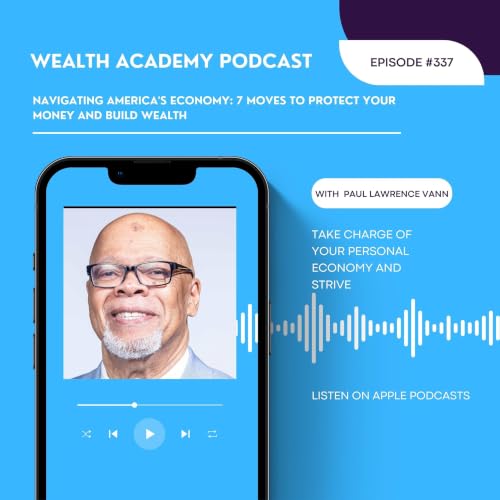
  • Episode 337 - Navigating America's Economy: 7 Moves to Protect Your Money and Build Wealth
    2026/09/01

    Help consumers understand what is happening in today's economy without becoming overwhelmed by the headlines—and provide practical actions they can take to manage expenses, reduce financial vulnerability, increase income, and continue building wealth.

    ________________________________________

    0:00–2:00 | Opening — Don't Let the Economy Control Your Financial Future

    Opening thought:


    Welcome to Wealth Academy Podcast. I'm your host, Paul Lawrence Vann, and as I always remind you, wealth is more than just money.


    Today I'm discussing something affecting virtually every household in America: the economy.

    You may be asking:


    • Why does my paycheck seem to buy less?

    • Why are groceries, gasoline, housing, insurance, and other necessities so expensive?

    • Should I save, invest, or pay down debt?

    • What happens if the economy slows?

    • How can I prepare my family financially?


    Here's the message I want you to remember:

    You cannot control the economy, but you can control how you respond to it.

    Economic uncertainty requires financial awareness, discipline, and action.

    Today, I gave you seven moves consumers can make to successfully navigate today's economy.


    Rate and review this episode on Apple Podcasts, provide a 5-Star rating, thank you: https://tinyurl.com/bdrwth6y

    ________________________________________

    続きを読む 一部表示
    24 分
  • Episode 336 - Lead Yourself to Wealth: The Discipline Before the Dollars
    2026/08/04

    In Episode 336 of the Wealth Academy Podcast, Paul Lawrence Vann delivers one of the most important wealth-building truths you will ever hear:

    Your wealth strategy will never outperform your self-leadership.

    Before you grow your portfolio…

    Before you build multiple streams of income…

    Before you achieve financial freedom…

    You must learn to lead yourself.

    In this powerful episode, Paul explains why discipline, emotional control, clarity of vision, and daily financial habits matter more than market timing, stock tips, or side hustles. Wealth is not first a money issue, it is a leadership issue.

    If you’ve ever struggled with consistency in saving, investing, or following through on financial goals, this episode will challenge you to examine the root cause, your personal leadership capacity.

    This is not about motivation.

    This is about mastery.

    Because wealth doesn’t respond to hype — it responds to disciplined behavior repeated over time.


    Why You Should Listen to This Episode


    • To understand why self-leadership is the foundation of financial success


    • To learn how emotional discipline impacts investment decisions


    • To discover how daily habits determine long-term wealth outcomes


    • To identify the behaviors that sabotage financial growth


    • To develop clarity around your written wealth vision


    • To strengthen your financial consistency during market uncertainty


    • To shift from reactive money management to intentional wealth strategy


    • To build a leadership-based approach to generational wealth


    • To stop drifting financially and start leading your financial future

    続きを読む 一部表示
    35 分
  • Episode 335: Seven Streams One Legacy: Why Multiple Incomes Are the Blueprint for Generational Wealth
    2026/08/04

    In Episode 335 of the Wealth Academy Podcast, Paul Lawrence Vann delivers a powerful and strategic message about one of the most important principles in modern wealth building:

    One stream of income creates survival.

    Multiple streams create legacy.

    In today’s economic climate, where layoffs, inflation, and market volatility are realities, relying on a single paycheck is no longer a wealth strategy. It’s a vulnerability.

    In this episode, Paul breaks down why building multiple income streams is essential for financial stability, freedom, and generational wealth. He explains how earned income alone rarely produces long-term prosperity and how wealth builders intentionally create asset-based, leveraged, and ownership-driven income streams.

    This is not about chasing side hustles randomly.

    This is about building structured, intentional, income-producing systems that outlive you.

    If you want to stop depending solely on employment and start building income that multiplies, compounds, and transfers to future generations — this episode provides the blueprint.

    Because wealth is not what you earn.

    It’s what you build.

    It’s what you own.

    It’s what you leave behind.


    What You’ll Learn in This Episode:


    • Why relying on one paycheck limits long-term wealth creation


    • The difference between earned income and leveraged income


    • How dividend stocks, real estate, and business ownership create sustainable cash flow


    • Why asset ownership is critical for generational wealth


    • How to identify additional income streams aligned with your skills


    • The importance of consistency when building passive income


    • Why lifestyle inflation can destroy wealth-building momentum


    • How to create a five-year multiple income strategy


    • The mindset shift required to move from employee thinking to ownership thinking

    続きを読む 一部表示
    26 分
  • Episode 334: Master the Mind, Multiply the Money: The Foundation of a Healthy Wealth Mindset
    2026/08/04

    In Episode 334 of the Wealth Academy Podcast, Paul Lawrence Vann — The Leadership Catalyst reveals the powerful truth most people overlook:

    Your bank account follows your belief system.

    Before you multiply money…

    You must master your mindset.

    In this transformational episode, Paul breaks down how your thoughts, habits, emotional discipline, and financial intentions directly shape your wealth outcomes. If you’ve ever wondered why some professionals earn six figures yet struggle financially while others steadily build wealth with clarity and confidence, this episode provides the answer.

    A healthy wealth mindset is not about chasing money.

    It’s about building discipline, strategy, and long-term financial maturity.

    Paul walks listeners through eight powerful questions that challenge you to evaluate your money beliefs, spending habits, emotional triggers, and investment behavior. He also shares the foundational pillars required to create sustainable financial freedom, not temporary financial success.

    What You’ll Learn in This Episode:


    • Why your mindset is the foundation of your financial success


    • How your early beliefs about money influence your current wealth habits


    • The difference between emotional spending and intentional investing


    • Why financial discipline matters more than income level


    • How to shift from a consumer mindset to an investor mindset


    • The role of written financial intentions in building long-term wealth


    • How to respond strategically — not emotionally — to financial setbacks


    • The three pillars required to build a healthy wealth mindset foundation


    • Why mastering your thoughts is the first step to multiplying your money

    続きを読む 一部表示
    30 分
  • Episode 333: Love Yourself Enough to Lead Yourself: The Wealth Blueprint
    2026/08/03

    Paul Lawrence Vann, The Leadership Catalyst delivers a powerful message on the connection between self-leadership and wealth building.


    February is known as the month of love, but it transcends the entire year. But what if the greatest act of love is leading yourself with discipline, clarity, and financial intention?


    In this transformative episode, Paul challenges listeners to examine whether they truly trust themselves with wealth. He breaks down the leadership behaviors that determine financial outcomes and explains why wealth is not about income; it is about identity, habits, and intentional living.


    If you’ve ever struggled with consistency in saving, investing, or following through on your financial goals, this episode provides the blueprint you need. You will learn how emotional discipline, written wealth vision, and daily leadership habits shape your long-term financial freedom.


    What You’ll Learn in This Episode:


    • Why self-leadership is the foundation of financial success

    • The behavioral habits that separate wealth builders from consumers

    • How to shift from emotional spending to intentional investing

    • The importance of writing your 2026 wealth vision

    • How discipline and delayed gratification accelerate compound growth

    • Why mindset maturity matters more than market timing

    続きを読む 一部表示
    32 分
  • Episode 332 - Your Philosophy on Wealth: The Beliefs That Shape Your Financial Destiny
    2026/02/02

    In This Episode, You’ll Learn:

    • Why everyone has a wealth philosophy—whether they realize it or not
    • How unconscious money beliefs sabotage financial progress
    • The connection between self-leadership and wealth creation
    • How to redefine wealth beyond income and net worth
    • Practical reflection questions to clarify your personal wealth philosophy

    Key Themes:

    • Mindset over mechanics
    • Leadership before money
    • Wealth as a long-term system, not a short-term event
    • Alignment between values, behavior, and legacy


    “Wealth is never just about dollars, it’s about decisions. And the most important decision you’ll ever make is who you choose to become on the journey.”

    Until next time, remember, lead yourself first, and wealth will follow.

    Discover more at: https://www.paulvannspeaks.com


    続きを読む 一部表示
    20 分