エピソード

  • The Missing Tiger Flight 739: The Military Mystery That Vanished Without a Trace
    2026/10/26

    Episode Description

    In March 1962, Flying Tiger Line Flight 739 disappeared over the western Pacific while transporting military personnel toward South Vietnam. Aboard the civilian-operated Lockheed Super Constellation were 93 American soldiers, three South Vietnamese military personnel, and 11 civilian crew members. No confirmed wreckage was recovered, and investigators could not establish what caused the loss.

    I reconstruct the flight’s final documented movements, examine the extraordinary sighting reported by the crew of the S.S. T. L. Lenzen, and separate evidence of a possible in-flight catastrophe from unproven explanations involving sabotage. I also examine ground-security concerns, the aircraft’s mechanical history, and a separate Flying Tiger accident at Adak that helped fuel suspicion—but was not established as part of a shared plot.

    At the center of this investigation is a distinction between what the record suggests and what it proves. The Civil Aeronautics Board considered destruction in flight likely, but its probable-cause finding remained undetermined. Behind that unresolved conclusion were families left without answers—and a decades-long struggle for remembrance.

    Chapters

    00:00 Cold Open

    00:43 Flight Profile & Passenger Manifest

    02:19 Tactical Context vs. Cause of Loss

    03:11 Chronology & Time Zones

    03:47 The Physical Evidence Gap

    04:56 Reconstructing the Final Flight Leg

    06:59 The Last Radio Transmission & Emergency Escalation

    08:48 The S.S. T. L. Lenzen Sighting

    11:21 The Massive Search Operation

    12:29 Sabotage Theories & Ground Security

    14:04 Mechanical History & The Adak Parallel

    15:57 Official CAB Findings

    16:45 Separating Known Facts From Speculation

    17:56 Human Cost & Letters Home

    19:01 Remembrance & The Fight for Recognition

    19:56 Conclusion

    ISSN: 3144-6477 Uncovered investigates – The Podcast


    Get full access to Uncovered Investigates at uncoveredinvestigates.substack.com/subscribe
    続きを読む 一部表示
    21 分
  • UI PRESENTS – Natalia Grace: When the System Changed the Child
    2026/09/28

    For years, the Natalia Grace story has been packaged as a sensational true-crime mystery—a bizarre narrative inviting public speculation and divided sides. In this episode, Kyle Fields strips away the media noise to examine the cold institutional realities of the case. Rather than focusing on lurid claims or entertainment, the episode investigates a critical legal question: How did government systems respond when a child with severe physical disabilities was legally reclassified as an adult, placed alone in an apartment, and effectively locked out of child-protection services?

    Key Discussion Points & Timeline

    1. The Facts of the Record

    * 2008–2010: Natalia, diagnosed with diastrophic dysplasia (a form of dwarfism), is adopted from a Ukrainian orphanage by a New Hampshire couple, then subsequently adopted in Indiana by Michael and Kristine Barnett in November 2010. Official adoption records consistently list her birth year as 2003.

    * The 2012 Re-Aging Petition: Between 2010 and 2012, the Barnetts raised concerns regarding Natalia’s behavior and age. In June 2012, they petitioned a Marion County probate court to change her birth year from 2003 to 1989—transforming an 8-year-old child into a 22-year-old adult on paper.

    * The Procedural Breakdown: The court granted the petition just 11 days later without an evidentiary hearing, without appointing a guardian ad litem to represent Natalia, without the Barnetts appearing in court, and while Natalia was hospitalized.

    2. The Bureaucratic Trap

    * Jurisdictional Lockout: Once the legal age change was finalized, child-welfare agencies lost jurisdiction. Child protection investigations were closed or dismissed because Natalia was judicially classified as an adult.

    * Independent Living and Relocation: The Barnetts placed Natalia into apartments (first in Hamilton County, later in Tippecanoe County in July 2013) with federal disability benefits ($733/month) and initial rent support, before moving to Canada with their biological children.

    * Adult Protective Services: Subsequent investigations by Adult Protective Services in late 2013 were closed without further action, leaving Natalia in a legal “no-man’s-land”—too old for child protection, yet entirely vulnerable as an independent adult.

    3. Legal Constraints and the Courts

    * The Limits of Criminal Prosecution: When criminal charges of neglect were brought against the Barnetts, prosecutors faced severe legal hurdles. Courts ruled that the state could not relitigate Natalia’s age due to collateral estoppel (the 2012 probate order stood as a binding legal determination). Furthermore, applicable statutes of limitations constrained the prosecution.

    * Delayed Safeguards: Later efforts by advocates, deputy prosecutors, and temporary guardians (such as Antwon and Cynthia Mans) to challenge the 2012 order ran into brick walls. A 2017 hearing acknowledged the original order was flawed and issued without notice, yet the probate court ultimately reaffirmed the 1989 birth year.

    4. Disability, Power, and Institutional Accountability

    * Weaponizing Disability: The episode critiques how Natalia’s diastrophic dysplasia was sensationalized and weaponized in the public square to infer age, capability, and motive, overshadowing her actual medical and support needs.

    * The Real Crisis: The core takeaway of the episode shifts the focus from tabloid drama to accountability. The true failure lies in how easily an irreversible legal decision was pushed through without independent advocacy, locking a vulnerable person out of the systems designed to protect them.

    Key Takeaways

    * Process Matters: A court order changing a birth year is not an administrative detail; it is a gatekeeper that completely alters a person’s legal rights, agency protections, and safety nets.

    * Systemic Blind Spots: When courts make rapid, unverified changes to legal status, child-welfare and adult-protection systems can become legally disabled from intervening when warning signs appear.

    * A Warning on Institutional Care: The case serves as a stark reminder of the dangers of institutional speed over due process, emphasizing that vulnerable individuals require independent representation before life-altering legal changes are enacted.


    Get full access to Uncovered Investigates at uncoveredinvestigates.substack.com/subscribe
    続きを読む 一部表示
    19 分
  • The Secrets of Pine Gap
    2026/09/22

    A remote intelligence base in Australia’s red desert has spent more than half a century operating behind a wall of secrecy. In the new episode of Uncovered Investigates, Kyle Fields examines Pine Gap—the joint U.S.-Australian facility near Alice Springs that may be one of the most consequential surveillance and military-intelligence hubs on Earth.

    Behind its white radomes, Pine Gap’s missions extend far beyond the Cold War listening post the public was originally told it would be. The facility controls signals-intelligence satellites, supports missile-launch detection, intercepts communications, and—according to reporting and leaked documents—helps geolocate phones and feed information into U.S. military targeting systems.

    This episode follows the documented questions surrounding Pine Gap’s role in drone warfare, its connection to intelligence sharing with Israel during the war in Gaza, and the profound sovereignty and accountability issues facing Australia. It also centers the Arrernte traditional owners whose sacred land hosts the facility—and the activists, researchers, and community members demanding answers.

    In this episode:

    * How Pine Gap began as a secret CIA operation disguised as “space research”

    * The satellite systems and global signals-intelligence missions run from Central Australia

    * The reported role of phone geolocation in U.S. drone targeting

    * What Snowden documents and expert testimony suggest about intelligence flows to Israel

    * Why critics argue Australia has little meaningful control over a base it co-hosts

    * The Arrernte land claim, the human cost of secrecy, and renewed protest at the gates

    Listen now to UI Presents: The Secrets of Pine Gap—Season 4, Episode 10 of Uncovered Investigates.

    The most dangerous thing about Pine Gap may not be what happens inside its gates. It may be how little the public is allowed to know about it.


    Get full access to Uncovered Investigates at uncoveredinvestigates.substack.com/subscribe
    続きを読む 一部表示
    19 分
  • The Clancy Case: Evidence, Illness, and the Questions in Between
    2026/09/15

    On January 24, 2023, Cora, Dawson, and Callan Clancy died inside their family’s Duxbury, Massachusetts, home. Their mother, Lindsey Clancy, survived an apparent suicide attempt and later faced criminal charges.

    The central issue in the case was never simply whether the children died, or whether Clancy caused their deaths. The legal question was more difficult: Was her mind so impaired by mental illness at that moment that she could not be held criminally responsible under Massachusetts law?

    In this episode, host Kyle Fields examines the collision of evidence, psychiatry, law, and public judgment surrounding a case that has prompted enormous grief and fierce disagreement.

    The episode explores:

    * The prosecution’s allegation that Clancy acted deliberately and with planning.

    * The defense’s argument that she suffered from severe postpartum psychiatric illness, including postpartum psychosis.

    * The crucial distinctions between postpartum depression, anxiety, intrusive thoughts, obsessive-compulsive symptoms, bipolar disorder, and postpartum psychosis.

    * Why an allegation of planning may be important evidence—but does not automatically settle a person’s psychiatric state.

    * Why a mental-health diagnosis, by itself, does not automatically resolve criminal responsibility.

    * The September 4, 2026 mistrial, after jurors could not reach a unanimous verdict following weeks of testimony and seven days of deliberations.

    This is not a prosecution brief. It is not a defense argument. And it is not an attempt to make an unimaginable tragedy emotionally simple.

    It is an effort to examine the available record carefully, identify what remains disputed, and resist the online impulse to reduce a complex case to a slogan.

    Three children remain at the center of this story. Cora, Dawson, and Callan Clancy were not abstractions in a legal or cultural debate. Their deaths demand seriousness, empathy, and intellectual honesty.

    The episode also carries an important message for parents experiencing mental-health crises: postpartum depression, anxiety, insomnia, intrusive thoughts, hopelessness, and suicidal thinking are reasons to seek help—not signs of moral failure. Postpartum psychosis is rare, severe, and a psychiatric emergency. No parent should feel forced to suffer in silence.

    Listen to “The Clancy Case: Evidence, Illness, and the Questions Between” now.

    Content note: This episode discusses the deaths of children, suicide, severe mental illness, postpartum depression, postpartum psychosis, and intrusive thoughts. It is factual and non-graphic, but some listeners may find the subject matter deeply upsetting.


    Get full access to Uncovered Investigates at uncoveredinvestigates.substack.com/subscribe
    続きを読む 一部表示
    20 分
  • UI PRESENTS: The Tree That Nearly Started a War
    2026/09/04

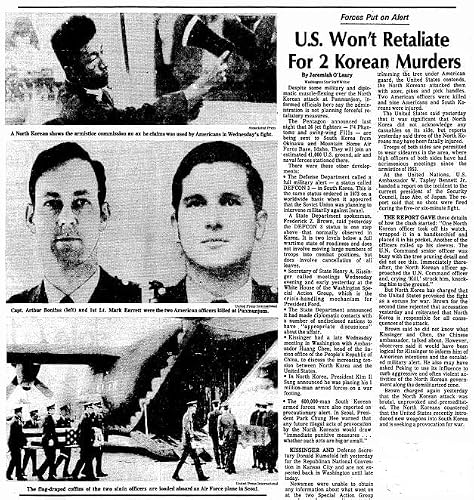
    In August 1976, two U.S. Army officers were murdered by North Korean guards in the Korean Demilitarized Zone while supervising a routine tree-trimming crew. What followed was Operation Paul Bunyan: an extraordinary display of coercive military force built around a pair of chainsaws. I break down how a poplar tree at the Bridge of No Return nearly triggered World War III—and how deterrence, restraint, and sheer presence prevented full-scale conflict.

    Episode Breakdown

    [Cold Open]

    The Murder in the DMZ: Two American officers killed in the most heavily armed border zone on Earth.

    The immediate geopolitical dilemma: Airstrikes vs. diplomacy vs. Operation Paul Bunyan.

    The 42-minute operation that centered an international crisis around a set of chainsaws.

    [Beginning] - The Spark at the Bridge of No Return

    Why sightlines in the Joint Security Area (JSA) meant the difference between life and death.

    August 18, 1976: The attack on Captain Arthur Bonifas and First Lieutenant Mark Barrett.

    The ideological excuse: North Korean claims over Kim Il-sung's "personally planted" tree.

    The dangerous gap between the Korean Armistice Agreement and actual peace.

    [Middle] - Overwhelming Force & Coercive Signaling

    Raising readiness to DEFCON 3 and managing the risk of runaway escalation.

    The military machine: Aircraft carriers, B-52 bombers, commandos, and heavy artillery on standby.

    Back-channel diplomacy: How U.S. outreach to Beijing and Moscow helped contain the crisis.

    August 21, 1976: 23 vehicles, 42 minutes, and a 20-foot stump left behind.

    [End] - The Logic of Deterrence

    How deterrence works when violence is visibly possible, but restrained.

    Permanently altering the JSA: Ending shared movement across the Military Demarcation Line.

    Remembering Captain Bonifas and Lieutenant Barrett beyond the spectacle of the response.

    Key Historical Takeaways

    Symbolism as Strategy: In an unresolved armistice zone, ordinary objects—checkpoints, flagpoles, sightlines, and trees—become high-stakes territorial markers.

    Calculated Deterrence: Operation Paul Bunyan succeeded not by firing first, but by demonstrating such absolute military readiness that North Korea chose to observe rather than interfere.

    Structural Aftermath: The incident permanently ended the practice of guards from both sides freely mixing within the Joint Security Area.

    Resources & Further Reading

    Command History: United Nations Command archives on the 1976 Ax Murder Incident.

    Memorial Information: Camp Bonifas and the DMZ memorial honoring CPT Arthur Bonifas and 1LT Mark Barrett.


    Get full access to Uncovered Investigates at uncoveredinvestigates.substack.com/subscribe
    続きを読む 一部表示
    20 分