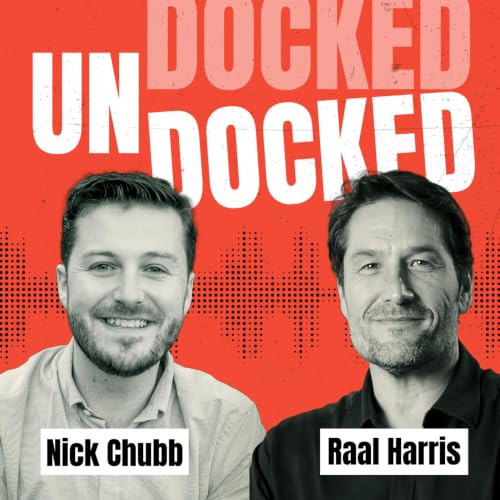
『UnDocked: The Maritime Transformation Show』のカバーアート

UnDocked: The Maritime Transformation Show

UnDocked: The Maritime Transformation Show

著者: Raal Harris and Nick Chubb
無料で聴く

概要

Undocked is a weekly podcast where Nick Chubb and Raal Harris explore what’s changing in maritime and technology. Through candid conversations and guest interviews, the show unpacks emerging trends, overlooked stories, and strategic insights, offering a fresh, unfiltered perspective on the evolving future of one of the world’s oldest industries.2026 Raal Harris and Nick Chubb
エピソード
  • Remembering a Champion of Seafarer Rights, Software Changes Class & Mission-led Funds
    2026/03/12

    This week on UnDocked, Nick and Raal examine escalating risks to shipping in the Gulf, the market forces driving record tanker rates, and the tension between profit and seafarer safety. They also pay tribute to industry leader David Dearsley, the first Secretary General of the International Maritime Employers’ Council and his legacy of transforming seafarer rights, welfare and as a key architect of the Maritime Labour Convention. The launch of the Korean Registry’s new software hub sparks a discussion class societies entering the software race. The duo discuss a new maritime venture investment fund with a timely purpose and wind up asking whether anti-acid tablets for the ocean is a geo-engineering step too far.


    Chapters

    00:00 – Opening and the week in maritime

    Conflict around the Gulf intensifies, with merchant ships hit and security risks rising.

    02:00 – Crew mobility disruption

    Flight disruptions and soaring travel costs complicate crew changes across Middle East hubs.

    04:00 – Seafarers’ perspective in the news

    Connectivity at sea is allowing seafarers to share frontline experiences during crises.

    07:00 – Tanker markets surge

    VLCC rates spike dramatically as geopolitical risk and supply constraints collide.

    12:00 – The economics of tanker deployment

    Why shipping supply is relatively fixed and how positioning vessels affects the market.

    15:00 – Tribute: David Dearsley

    Remembering the architect of key global seafarer welfare frameworks and the Maritime Labour Convention.

    30:00 – Class societies enter the software race

    The Korean Registry launches a new software hub, signalling deeper digital competition.

    43:00 – Maritime venture capital

    Mare Liberum’s new fund backs technologies supporting free trade and maritime security.

    53:00 – Climate experiments at sea

    Geoengineering ideas, ballast water lessons, and the unintended consequences of regulation.

    57:30 – Wrap-up

    This episode is supported by Fortec.

    In marine environments, power variability and efficiency are critical. Fortec’s N-Line panel-mount glass monitors are engineered for stability across diverse vessel setups, with 12V DC operation, galvanic isolation, and IEC 60945-compliant EMC filtering.

    DNV-approved and built for real-world reliability, Fortec helps shipowners deploy robust display systems for both new builds and retrofits.

    Explore the full range at fortec.uk

    続きを読む 一部表示
    58 分
  • Pilot Purgatory, Practical AI & Human Fears
    2025/08/28

    In this episode, Nick Chubb and Raal Harris dig into the findings of a new Thetius research report commissioned by Marcura, which shows that while 81% of maritime organisations are piloting AI, only 11% have policies in place, and just 23% are training their people. They debate whether AI deserves its own strategy or should simply sit inside a broader technology plan, with Nick introducing the Thetius ADAPT framework as a way for leaders to cut through the hype and move beyond “pilot purgatory.”

    They then turn to OrbitMI’s back-to-back acquisitions of Auqub and Galeforce, exploring why pairing agentic AI software with a traditional weather routing advisory business could be a smart hybrid play. The discussion unpacks how human expertise and automated platforms can coexist, and why trust and verification matter more in AI-driven systems than in traditional SaaS.

    A major cyberattack on Iran’s shipping industry prompts a conversation on satcom vulnerabilities, IT/OT segregation, and why drills and resilience testing need to become the norm. From there, Nick and Raal dive into the human side of maritime, discussing seafarer isolation in the digital age, the double-edged sword of connectivity, and the undervalued role of emotional intelligence in crew management and leadership.

    Looking ahead to London International Shipping Week, they share what’s on their agendas — from the Thetius Top 150 launch to panels on digitalisation, AI, and decarbonisation. They also highlight Marine Media Enterprises’ new Donate & Train initiative, blending e-learning with charitable giving.

    To wrap up, a light-hearted debate over Elon Musk’s latest venture — “Macro Hard,” an AI-driven challenger to Microsoft — sparks reflections on branding, competition, and whether the tech billionaire can really pull it off.

    Download the Thetius "Beyond the Hype" Report here.

    続きを読む 一部表示
    1 時間 1 分
  • Seafarer Abandonment, Industry Standards and a How-To for Start-ups Pondering 2026 Maritime Events
    2026/01/29

    In this episode, Raal and Nick turn to a sobering ITF report showing seafarer and vessel abandonment at its worst-ever levels. They unpack what abandonment actually means in practice, why Indian seafarers are disproportionately affected, and how ownership structures, sanctions, and flags of convenience leave crews with little protection or recourse.

    From there, the discussion broadens to transparency, data, and trust: why individual seafarers struggle to assess operator risk, how fragmented information limits accountability, and why even well-intentioned standards struggle to reach those most exposed. The conversation then pivots to the International Standards Organisation, illustrating how conformance standards quietly underpin global trade, from containers and currencies to unexpected examples like tea preparation.

    The episode closes with a pragmatic look at modern shipping realities: USB sticks still moving critical vessel data, the absence of shared operational standards, and practical advice on navigating the 2026 maritime events calendar, including how to minimise chance, maximise learning, and extract real value from industry gatherings.


    • 01:45 ITF data and the scale of seafarer abandonment
    • 14:50 Flags of convenience and structural incentives
    • 20:59 Why standards matter in global trade
    • 26:18 ISO standards, from containers to tea
    • 39:12 USB sticks, bay plans, and broken data exchange
    • 43:00 Maritime events calendar for 2026


    This episode is brought to you by Fortec. In a digital bridge environment, visibility is critical to safety and performance. Fortec’s N-Line maritime monitors are engineered for clarity across all lighting conditions, with DNV certification and global trust. Find out more here.

    続きを読む 一部表示
    56 分
まだレビューはありません