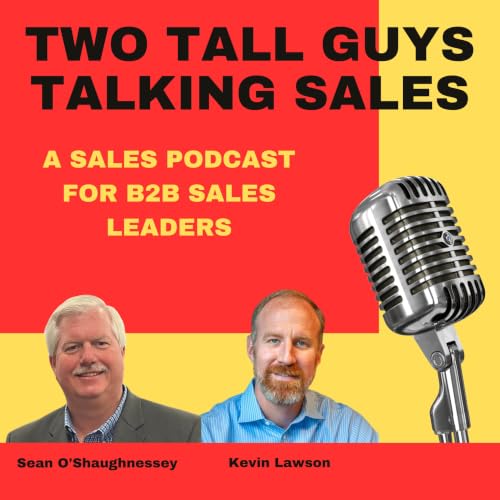
『Two Tall Guys Talking Sales』のカバーアート

Two Tall Guys Talking Sales

Two Tall Guys Talking Sales

著者: Kevin Lawson and Sean O'Shaughnessey
無料で聴く

今ならプレミアムプランが3カ月 月額99円

2026年5月12日まで。4か月目以降は月額1,500円で自動更新します。

概要

"Two Tall Guys Talking Sales," where Sean O'Shaughnessey and Kevin Lawson discuss a single sales topic. Kevin and Sean together have about 60 years of experience in professional selling. This podcast helps people in sales, sales leadership, and business leadership or company owners realize the maximum value of their company by improving their revenue generation capability. This podcast is designed to help those people enhance their companies' sales management practices, methodologies, processes, teams, and messaging. Sean O'Shaughnessey and Kevin Lawson are Fractional Vice Presidents of Sales. They operate their own companies separately but have partnered for this podcast to advise salespeople and SMB companies on successful strategies and methodologies. Kevin is the CEO of Lighthouse Sales Advisors. Lighthouse Sales Advisors is a sales leadership solution provider for small businesses. Lighthouse helps business owners navigate the potential pitfalls around sales growth, sales turnaround, or scaling up by leveraging sales acumen and decades of experience to build effective sales teams. https://www.lighthousesalesadvisors.com/ Sean is the CEO of New Sales Expert. He helps company owners realize the maximum value of their company by improving their revenue generation capability. He helps owners enhance their sales management, methodologies, processes, teams, and messaging.2024 マネジメント マネジメント・リーダーシップ 経済学
エピソード
  • Why Your Sales Team Has a Leads Problem—and How to Fix It
    2026/04/28
    For many sales teams, the leads problem is not really a leads problem. It is an ideal client profile problem, a value proposition problem, and a focus problem disguised as pipeline activity. In this episode of Two Tall Guys Talking Sales, Kevin Lawson and Sean O'Shaughnessey dig into the practical discipline of building a lead list that salespeople can actually use, one grounded in clear ICP definition, sharper Messaging, better Sales processes, and a more realistic understanding of market share. This is a direct, useful conversation for sales leaders, owners, and sellers who want better Revenue generation without wasting effort on prospects they were never built to win. Key Topics Discussed The three versions of a leads problem — 00:00 Kevin opens with a useful distinction: some companies have no leads, some have too many leads, and some have plenty of the wrong leads. Each problem requires a different sales management response, but all three point back to the same issue: the business has not clearly defined who it should pursue. Building an ideal client profile before building the list — 01:10 The episode makes a strong case for documenting the ideal client profile in practical, observable terms. Company size, revenue, locations, executive tenure, installed systems, and other demographic signals should inform the list before a seller starts calling. This is where Business acumen begins to separate disciplined Sales strategies from random prospecting. Using buying signals and psychographics to improve Value selling — 03:00 Kevin explains that the demographic definition is only part of the work. Sellers also need to understand why companies buy, what pressure they are trying to relieve, and what business outcomes matter to them. That is the bridge between raw data and meaningful Value selling. Learning from your five best customers — 07:44 Sean reframes ICP work around a deceptively simple question: which five customers were the most fun, easiest, fastest, and most valuable to sell? Those companies likely hold the clues to your best future market. Interview them, study them, and use what you learn from them to sharpen your Messaging. Shrinking the market to improve Sales success — 10:37 Sean challenges the common assumption that a bigger list is better. Most companies cannot sell to, serve, or fulfill every opportunity in their theoretical market. A focused list, built around realistic capacity and high-fit targets, can drive better Sales success than a bloated database full of distractions. Turning ICP, value proposition, and market share into Revenue management discipline — 13:31 Kevin closes by tying the episode back to the fundamentals: ideal client profile, unique value proposition, Messaging, market share, and the actual people who buy. Strong Revenue management starts when leaders stop treating all leads as equal and begin building repeatable systems around the customers they can serve best. Key Quotes "Every business has a leads problem. I don't care if you are wildly successful, really struggling, or somewhere in the middle." — Kevin Lawson, 00:13 "If you haven't written down in painstaking detail who you want to attract and sell to, carve out time to do your demographic definition." — Kevin Lawson, 01:45 "Who are the five companies that you sold to that were just fun to sell to? They got your product, your service, your capability, your offering immediately." — Sean O'Shaughnessey, 07:44 "You have more people to sell to than you can possibly imagine. You need to whittle your ideal client profile down." — Sean O'Shaughnessey, 10:12 "We have to find our sweet spot and then lean into it. That's how we make a successful year out of a leads problem." — Kevin Lawson, 14:17 Additional Resources Kevin references several data and research tools that can help sales teams define and build better lead lists, including: Data Axle through public library access Apollo KnowledgeNet Seamless ZoomInfo Crunchbase A Significant Actionable Item from this Podcast Identify your five best customers and interview them before building or expanding your next lead list. Do not start with a database. Start with reality. Look at the customers who bought quickly, understood your value, paid appropriately, were good to serve, and represented the kind of business you would gladly replicate. Then ask them deeper questions: how they make money, where they lose money, what pressures are changing in their market, what they value from vendors, and what would make your company more useful to them. That work will improve your ideal client profile, sharpen your value proposition, and give your salespeople better Messaging for future outreach. More importantly, it forces a decision: are you trying to sell to everyone, or are you building a focused market where your Sales processes can consistently generate Revenue? Summary This episode is a strong listen for any sales leader, owner, or seller who has ...
    続きを読む 一部表示
    18 分
  • With Great Pipeline Power Comes Great Responsibility: Fix Your Sales Forecast
    2026/04/21
    Two Tall Guys Talking Sales hosts Kevin Lawson and Sean O'Shaughnessey tackle one of the most overlooked drivers of sales success: forecast accuracy. This episode goes beyond the usual conversation about CRM hygiene and quota pressure to get to the real issue: salespeople and sales managers carry critical information that the rest of the company depends on for hiring, staffing, planning, and revenue generation. Sean and Kevin argue that forecasting is not administrative overhead. It is a direct reflection of discovery quality, business acumen, value selling, and the discipline of running strong sales processes. If you want sharper sales management, more credible messaging, and a more reliable path to revenue management, this conversation is worth your time. Key Topics Discussed Why forecasting is a leadership responsibility, not just a sales task (00:00) Sean opens with a memorable analogy: with great power comes great responsibility. Salespeople hold information no one else in the company has—what is likely to close, when it will close, what the buyer needs, and what revenue is actually coming. That knowledge creates an obligation to communicate with accuracy. How poor forecast data affects hiring, staffing, and company decisions (02:00) Kevin makes the stakes clear. Forecast data is not trapped inside the sales department. Executive teams use it to make staffing decisions, resource plans, and growth bets. When the data is weak, the business makes bad decisions. Why discovery is the foundation of accurate forecasting (05:00) Sean ties forecasting directly to discovery. If you do not ask tough questions early, you will eventually pay for it later in the sales cycle. Strong discovery clarifies the customer's business drivers, strengthens messaging, improves value selling, and makes forecast confidence more credible. Why sales strategies fail when pipeline discipline is weak (08:07) Kevin connects forecasting to pipeline reality. Leaders cannot force a number into existence simply because they want growth. If the top of the funnel, qualification discipline, and relationship development are not in place, the revenue generation target is a fantasy, not a strategy. Why customers buy outcomes, not features (09:21) Both hosts reinforce a central truth of value selling: buyers care much more about business impact than about technical specifications. The real issue is not the drill, but the hole—and even more than that, what the hole allows them to accomplish. How inaccurate forecasting damages real people and real businesses (13:13) Sean closes with a story from early in his career that shows the human cost of bad forecasting. A low forecast contributed to layoffs that, in hindsight, were unnecessary. It is a sharp reminder that revenue management is not theoretical. Accuracy matters. Key Quotes Sean O'Shaughnessey (00:00) "One of the wisest men in all of sales is a gentleman by the name of Stan Lee." Kevin Lawson (02:02) "The entire company is basing its hiring and staffing decisions on your data." Kevin Lawson (03:25) "You have to ask tough questions early." Sean O'Shaughnessey (07:46) "You document all that, and you tell your boss the truth. It's as simple as that." Kevin Lawson (11:20) "Put the date that the customer should buy based on the insight you've gleaned, not the date that you want them to buy." Sean O'Shaughnessey (12:00) "You don't sell the drill, you sell the hole, and more importantly than that, you sell what goes through the hole." Additional Resources B2B Sales Lab Sean references the B2B Sales Lab community as a place for sales professionals and sales managers to ask questions, refine their thinking, and improve their skills in areas such as forecasting, sales processes, and revenue generation. Chris Cocca on the importance of Discover Sean mentions episode 85 featuring Chris Cocca, particularly his point that discovery is the most important part of the sales process. https://sites.libsyn.com/458454/transforming-opportunities-chris-coccas-insights-on-perfecting-the-discovery-meeting A Significant Actionable Item from this Podcast Audit your current pipeline and rewrite the expected close date for every meaningful deal based on buyer evidence, not seller hope. That means looking at each opportunity and asking: What business issue is driving this purchase? Who has validated the urgency? What internal steps does the customer still need to complete? What evidence supports the date in CRM? This one habit sharpens sales management, improves forecast reliability, strengthens messaging, and forces better value selling. Most missed forecasts are not caused by bad luck. They are caused by untested assumptions that stayed in the pipeline too long. Summary This episode is a concise but serious discussion about forecasting, discovery, and the responsibility that comes with carrying the company's most important field intelligence. Sean and Kevin do not treat forecasting like a spreadsheet exercise. ...
    続きを読む 一部表示
    18 分
  • The Sales Meeting Prep Advantage: How Top Sellers Win Before the Call Starts
    2026/04/14
    This episode of Two Tall Guys Talking Sales gets after a basic truth that too many salespeople ignore: meeting prep is not administrative overhead, it is a competitive weapon. Kevin Lawson and Sean O'Shaughnessey break down why organized sellers create better first impressions, ask sharper questions, and build trust faster than competitors who show up improvising. The conversation moves from practical prospect research to the sales management discipline, then to how modern AI tools can reduce prep time without lowering quality. If you care about Sales success, stronger Messaging, and more consistent Revenue generation, this episode gives you a simple edge you can apply immediately. Key Topics Discussed Why meeting prep still separates serious sellers from average ones (00:00) Kevin opens with a frustration most professionals recognize instantly: the seller who accepted the meeting but clearly did not do the homework. The discussion makes the case that doing the simple things well is still one of the most reliable Sales strategies in B2B selling. How preparation signals respect, credibility, and Business acumen (01:00) Sean shares an early-career story about using a Wall Street Journal mention to walk into a customer meeting knowing more about the company's current situation than the contact did. The point is not cleverness. It is that informed preparation communicates seriousness and creates trust. What sellers should actually know before a prospect or customer meeting (03:10) Kevin lays out the practical standard: know the business model, know how the company creates value, understand the people involved, and have a working sales hypothesis. He also ties preparation back to documented ICPs, personas, value propositions, and the broader Sales processes that support effective prospecting. Using frameworks like PESTEL to improve Value selling conversations (06:19) The conversation moves beyond surface-level research into structured analysis. Kevin explains how frameworks such as PESTEL help a seller understand the customer's operating environment and bring relevant insight into the meeting, which is where real Value selling starts. How Google Alerts and AI can compress research time without lowering quality (07:25) Sean introduces Google Alerts as a low-friction way to stay current on target accounts and local developments. He then connects that to AI, showing how sellers can save prompts, generate company or industry briefings, and use tools like PESTEL analysis on demand before calls and meetings. Why current research matters more than favorite tools (12:00) Kevin closes by warning against relying on stale assumptions or outdated tooling. Platforms change. Commercial products evolve. What matters is staying current and using the available tools to support better Revenue management, stronger Messaging, and more informed customer conversations. Key Quotes Kevin Lawson (00:40): "Being ready for a meeting is so simple. It's often overlooked, and it's a huge opportunity to outshine your competition as a seller." Sean O'Shaughnessey (02:08): "He was so impressed that we knew his business and we knew what was going on about his company that until the last day that I knew him, he always mentioned it." Kevin Lawson (03:28): "Your ducks in a row means you know the business you're calling on, what they do, how they create value, how you can have your sales hypothesis, how you can create value for them." Sean O'Shaughnessey (11:19): "There is no excuse that you don't know today's announcement about your prospect when you walk in the door or pick up the phone to contact that prospect." Kevin Lawson (14:06): "Be current with your research. Be current with the commercially available products so that you can serve your prospects and customers well." Additional Resources Google Alerts Sean recommends Google Alerts as a simple, proven way to monitor prospect companies, industries, and geographic territories to stay relevant in conversations. PESTEL Framework Kevin references PESTEL as a useful framework for understanding the political, economic, social, technological, environmental, and legal factors affecting a customer's business. B2B Sales Lab B2B Sales Lab is a place where sales professionals and sales leaders can work through practical selling and sales management challenges in more depth. A Significant Actionable Item from this Podcast Open your calendar and identify all upcoming prospect meetings and prospecting blocks. Then make the first 15 minutes of each one non-negotiable research time. Use that window to review company news, confirm the contact's role and influence, revisit your ICP and persona fit, and build a working hypothesis about where you can create value. This is a small discipline, but it sharpens Messaging, improves call quality, and separates a seller who is merely active from one who is actually driving Sales success. Summary This episode is a sharp reminder that strong selling does not begin ...
    続きを読む 一部表示
    18 分
まだレビューはありません