エピソード

  • Are You Really Okay? Suicide Prevention & Human Connection with Lindsey Gray
    2026/09/23

    What do you say when someone you care about isn’t okay—and are you willing to truly listen to the answer?

    In this episode of Truth Be Told, Dave Thompson, CFI sits down with Lindsey Gray, a mental health professional and Suicide Prevention Training Manager with Wounded Warrior Project, for a powerful conversation about veteran mental health, suicide prevention, and human connection.

    Lindsey explores why veterans can face unique challenges around identity, purpose, belonging, and accessing care—and why the lessons from suicide prevention apply far beyond the veteran community. From the workplace to our closest relationships, they discuss how to recognize when someone may be struggling, ask difficult questions directly, avoid the instinct to immediately “fix” the problem, and create space for people to feel heard.

    The conversation also dives into what happens in the brain during a crisis, the importance of time and connection, and a simple but powerful reminder: you don’t need to have the perfect words to make a difference.

    Resources & Support

    If you or someone you know is struggling, help is available:

    • 988 Suicide & Crisis Lifeline: Call or text 988. Veterans can call 988 and press 1 for the Veterans Crisis Line.
    • Crisis Text Line: Text HOME to 741741.
    • Vets4Warriors: 24/7 confidential peer support for veterans and the military community at 855-838-8255.
    • Wounded Warrior Project: Veteran mental health, suicide prevention resources, and support.
    • The Trevor Project: Crisis support for LGBTQ+ young people at 1-866-488-7386 or text START to 678678.

    If someone is in immediate danger or experiencing a medical emergency, contact emergency services.

    About Truth Be Told

    Hosted by Dave Thompson, CEO of Wicklander-Zulawski & Associates (WZ), Truth Be Told explores the psychology and science behind better conversations—from investigative interviewing and difficult workplace discussions to leadership, human behavior, rapport, listening, and the moments when communication matters most.

    Wicklander-Zulawski provides science-based investigative interviewing and communication training to professionals across law enforcement, human resources, loss prevention, corporate investigations, and other industries.

    続きを読む 一部表示
    55 分
  • “I Would Never Confess”: The Truth About False Confessions with Robin Dahlberg
    2026/09/09

    Why would an innocent person confess to a crime they didn’t commit?

    It’s one of the most misunderstood questions in criminal justice—and the answer reveals important lessons about interrogation techniques, false confessions, wrongful convictions, and the way we search for the truth.

    In this episode of Truth Be Told, host Dave Thompson, CFI sits down with attorney, advocate, and photographer Robin Dahlberg, author of Breaking Point, a powerful project that takes readers inside the interrogation experiences of six exonerees who confessed to crimes they did not commit.

    Through the stories of Jeffrey Deskovic, Vanessa Gathers, Byron Halsey, Eddie Lowery, Christopher Ochoa, and Raymond Santana of the Exonerated Five, Dave and Robin explore how an investigation can go wrong long before a confession ever occurs—and why understanding the human experience inside the interrogation room matters for investigators, attorneys, and anyone interested in criminal justice reform.

    The conversation examines some of the most important questions surrounding modern interview and interrogation practices:

    • Why do innocent people falsely confess? • How can tunnel vision and confirmation bias influence an investigation? • What happens when investigators become convinced they have the right suspect? • How can maximization, minimization, threats, promises, and false-evidence tactics influence a suspect’s decisions? • Why is recording the entire interview and interrogation so important? • How can investigators obtain reliable information without relying on coercive or guilt-presumptive interrogation techniques? • What role do public defenders, expert witnesses, and unequal resources play in wrongful conviction cases? • And what can today’s investigators learn directly from people who experienced a wrongful interrogation and conviction?

    One particularly important theme is perspective. Dahlberg’s Breaking Point uses photography and the words of exonerees to put the audience in the other chair—to understand what an interrogation can feel like to the person being questioned. The goal isn’t to vilify investigators. It’s to recognize that investigators, suspects, victims, attorneys, and families are all human—and that reliable investigations require practices designed to protect the integrity of the evidence and the search for truth.

    Dave also connects these cases to the evolving science of investigative interviewing and the importance of continually challenging our own methods. Better interviewing isn’t simply about avoiding false confessions. It’s about

    obtaining information that is accurate, reliable, and capable of withstanding scrutiny.

    For law enforcement investigators, criminal justice professionals, attorneys, workplace investigators, forensic interviewers, and anyone interested in wrongful convictions or interrogation reform, this conversation offers an important look at what can happen when pressure, assumptions, and certainty replace curiosity.

    About Wicklander-Zulawski & Associates (WZ) Wicklander-Zulawski & Associates provides investigative interviewing and interrogation training focused on ethical, evidence-based and non-confrontational methods for obtaining reliable information. WZ training helps law enforcement, corporate investigators, human resources professionals, loss prevention teams, and other investigative professionals strengthen interviewing skills, recognize bias, build rapport, and conduct more effective investigations.

    If you’re searching for investigative interviewing training, interrogation training, false confession training, science-based interviewing techniques, rapport-based interviewing, or professional development for investigators, explore the training and educational resources available from Wicklander-Zulawski & Associates.

    続きを読む 一部表示
    54 分
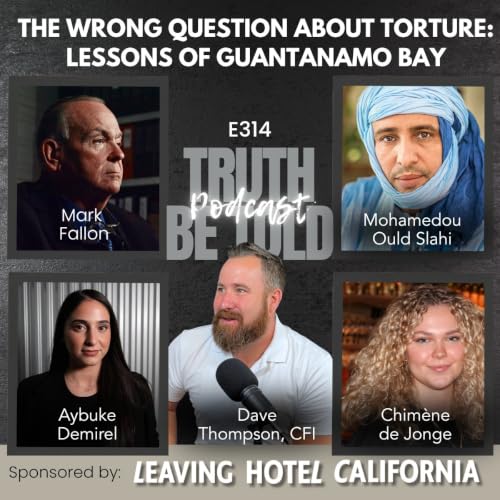
  • The Wrong Question About Torture: Lessons of Guantanamo Bay
    2026/08/26
    What happens when fear becomes policy—and the people labeled “the worst of the worst” are no longer treated as people? In this episode of the Truth Be Told Podcast, host Dave Thompson, CFI explores the powerful story behind the documentary Leaving Hotel California and the complicated legacy of Guantanamo Bay, post-9/11 interrogations, enhanced interrogation techniques, torture, and the human consequences of abandoning evidence-based investigative practices. Dave is joined by filmmakers Chimène de Jonge and Aybüke Demirel, former NCIS Special Agent Mark Fallon, and former Guantanamo detainee and Guantánamo Diary author Mohamedou Ould Slahi for a conversation about investigative interviewing, coercion, false information, cognitive bias, morality, forgiveness, and what happens when fear begins influencing the investigative process. Inside Leaving Hotel California Support the Documentary Here. The documentary Leaving Hotel California examines Guantanamo Bay through the experiences of the people who lived this history from dramatically different perspectives. Chimène and Aybüke explain how a journalism project driven by their interest in human rights evolved into a documentary focused not simply on what happened at Guantanamo, but on the people behind the history. Their reporting led them to former government officials, investigators, intelligence professionals, attorneys, and detainees as they attempted to understand what actually happened—and why. Mark Fallon: Fighting Torture From Inside the System Mark Fallon offers a rare perspective from inside the U.S. government's response to September 11. As a senior NCIS investigator involved in terrorism investigations after 9/11, Fallon describes watching interrogation practices evolve from legitimate investigative efforts toward coercive techniques and prisoner abuse. He discusses his attempts to challenge those practices, document what was happening, and warn government leadership about how history would ultimately judge the decisions being made. The conversation also examines SERE — Survival, Evasion, Resistance and Escape — training and the controversial decision to adapt techniques designed to help U.S. personnel resist abusive treatment for use in interrogations. Fallon explains the fundamental contradiction: techniques associated with increasing resistance and producing unreliable or false information were being adapted as methods for obtaining intelligence. For investigators, law enforcement professionals, HR investigators, intelligence professionals, and anyone interested in science-based investigative interviewing, the lesson extends well beyond Guantanamo: Pressure can produce compliance. That doesn't mean it produces reliable information. Mohamedou Ould Slahi: The Human Being Behind the Label Mohamedou brings the conversation from interrogation theory to lived experience. He describes his detention, interrogation, sleep deprivation, abuse, and the psychological impact of being treated not as an individual, but as part of a category of people presumed to be dangerous. But Mohamedou also challenges one of the most common debates surrounding enhanced interrogation: Why is the question whether torture works? What if the more important question is whether torture is morally acceptable in the first place? That distinction creates one of the most powerful moments of the episode and forces a broader conversation about ethics, investigative integrity, human rights, and what limits should exist even when investigators believe the stakes could not be higher. Investigative Bias, False Information & the Danger of Certainty The episode also explores how the fear and uncertainty following September 11 created conditions where confirmation bias, categorization, assumptions, and investigative tunnel vision could influence decision-making. Fallon describes investigators being tasked not only with identifying people responsible for terrorism, but also with investigating evidence that could exonerate detainees who should not have been at Guantanamo in the first place. It's a lesson that remains relevant to investigators today. When investigators become committed to a conclusion before fully developing the information, the interview can shift from an effort to discover what happened into an effort to confirm what we already believe happened. An Unexpected Friendship Perhaps the most powerful part of Leaving Hotel California isn't about interrogation at all. It's about the friendship that developed between Mark Fallon and Mohamedou Ould Slahi. Their relationship began through books, virtual conversations, and shared discussions about Guantanamo before the filmmakers ultimately captured their first meeting in person. Fallon describes what drew him to Mohamedou simply: his humanity. At the airport, Mohamedou greeted Mark with a sign inspired by the phrase displayed at Guantanamo, “Honor Bound to Defend Freedom.” Mohamedou's version carried a different ...
    続きを読む 一部表示
    1 時間 27 分
  • You’re Not Listening: The Communication Mistakes We All Make with Alex Perry
    2026/08/12

    Most communication problems aren't really about what happened.

    They're about what happens next.

    In this episode of Truth Be Told, Dave Thompson sits down with communication expert Alex Perry to explore why even well-intentioned people misunderstand each other — and what we can do differently.

    From difficult conversations and feedback to active listening, empathy, body language and leadership presence, Alex challenges some of the assumptions we've been taught about what “good communication” actually looks like.

    They explore why curiosity may be more valuable than certainty, why listening doesn't always mean fixing, how leaders can show empathy without lowering expectations, and why our desire to quickly reach an answer can prevent us from actually understanding the person in front of us.

    The conversation also tackles communication myths — including the often-cited 93/7 rule — and examines how the same principles apply across leadership, relationships, sales and investigative interviews.

    Because sometimes the most important question isn't, “What should I say next?”

    It's: “What am I missing?”

    Want to improve how you handle difficult conversations, workplace conflict, and high-stakes communication? Wicklander-Zulawski & Associates (WZ) provides evidence-based training for leaders, HR professionals, investigators, and organizations looking to strengthen communication, active listening, rapport, and decision-making. Explore WZ’s training and resources to build practical skills for navigating the conversations that matter most.

    続きを読む 一部表示
    1 時間 6 分
  • It’s not about the Dishes. The Psychology of Healthy Communication with Kristina Virro
    2026/07/29

    Can better communication save your relationship, strengthen your leadership, and improve your toughest conversations?

    In this episode of Truth Be Told, Dave Thompson, CFI sits down with licensed therapist Kristina Virro to explore the psychology behind effective communication, healthy relationships, emotional intelligence, and conflict resolution. Whether you're navigating a marriage, leading a team, conducting investigative interviews, or simply trying to become a better communicator, this conversation is packed with practical, research-backed insights.

    Together they discuss:

    • Why recurring arguments are rarely about the surface issue.
    • The communication habits that quietly damage relationships.
    • How curiosity outperforms assumptions in both personal and professional conversations.
    • The science behind the Gottmans' research and the predictors of relationship success.
    • Why defensiveness, criticism, and poor listening derail trust.
    • Communication strategies leaders can use to build stronger teams.
    • How couples, managers, investigators, and HR professionals can ask better questions and create psychological safety.
    • Practical tools—including Kristina's weekly relationship check-in—that improve connection before problems become crises.

    If you're interested in communication skills, emotional intelligence, leadership, couples therapy, active listening, conflict management, workplace communication, investigative interviewing, relationship advice, difficult conversations, psychology, or personal growth, this episode delivers actionable techniques you can begin using immediately.

    Whether you're a business leader, law enforcement professional, HR investigator, therapist, or someone simply looking to build healthier relationships, you'll leave this conversation with one powerful reminder:

    Replace assumptions with curiosity—and watch every conversation change

    Follow Kristina on Instagram!

    Follow Kristina on TikTok!

    Why This Matters

    While this conversation centers on relationships, its lessons extend far beyond couples therapy. Many of the same communication principles discussed in this episode—curiosity, active listening, emotional intelligence, and avoiding assumptions—are the same evidence-based skills taught by Wicklander-Zulawski for investigative interviewing, workplace investigations, leadership, and other difficult conversations.

    Whether you're leading a team, interviewing a witness, conducting an HR investigation, or working to strengthen a personal relationship, better conversations lead to better outcomes.

    続きを読む 一部表示
    59 分
  • Could One Conversation Save a Life? Beyond the Arrest with Keeley Knowles and Stuart Toogood
    2026/07/15

    What if the most effective way to prevent crime isn't another arrest—but another conversation?

    For nearly 30 years, Keeley Knowles lived with a severe heroin addiction, funding it as one of the United Kingdom's most prolific shoplifters. Stuart Toogood spent those same three decades serving as a police officer with West Midlands Police. By every measure, they should have remained on opposite sides of the law.

    Instead, they formed a partnership that helped save a life.

    In this powerful episode of Truth Be Told, host Dave Thompson sits down with Keeley and Stuart to explore the human side of addiction, retail theft, and policing. They discuss how the innovative Offender to Recovery program challenged traditional law enforcement approaches by addressing the root causes of repeat offending instead of simply making another arrest.

    Keeley shares her firsthand experience with addiction, organized retail theft, recovery, and rebuilding her life after believing she would never escape substance use. Stuart reflects on his policing career, why understanding addiction transformed the way he approached investigations, and how compassion, accountability, and evidence-based intervention can work together to reduce crime and change lives.

    Whether you're a police officer, detective, retail investigator, loss prevention professional, security leader, HR investigator, or simply someone interested in addiction recovery and criminal justice reform, this conversation offers practical insights that extend far beyond shoplifting.

    Truths:

    Prevention starts with understanding the person, not just the crime. Addressing the root causes of offending can reduce repeat crime more effectively than enforcement alone.

    Addiction doesn't discriminate. As Keeley shares, anyone can find themselves "two or three mistakes away" from addiction, making empathy and education essential for investigators, law enforcement, and the public.

    Compassion and accountability can coexist. Holding people accountable while treating them with dignity creates opportunities for recovery without compromising public safety.

    Effective policing is about more than making arrests. Stuart explains how helping people access recovery services prevented future crime and ultimately made communities safer.

    Human connection changes outcomes. One security officer's willingness to care—and one police officer's willingness to do something different—helped save Keeley's life.

    Retail theft is often a symptom of a deeper problem. Understanding the motivations behind organized retail theft and addiction can help investigators, retailers, and loss prevention professionals develop more effective prevention strategies.

    Second chances create lasting impact. Recovery isn't just about overcoming addiction—it's about rebuilding relationships, restoring purpose, and helping others find hope through lived experience.

    Wicklander-Zulawski & Associates and the International Association of Interviewers are proud supporters of the Truth Be Told podcast. Leaders in evidence-based investigative interviewing for law enforcement, loss prevention, human resources, compliance, security and audit professionals. Learn more here.

    This episode is also supported by our friends at ORIS Media, a publications, education and events company, serving the European retail loss prevention industry.

    続きを読む 一部表示
    57 分
  • The Danger of Thinking You're Right: Why Curiosity Beats Certainty with Brad Beeler
    2026/07/01

    How do experienced investigators end up on the wrong path—even when they're trying to do the right thing?

    In this episode of Truth Be Told, Dave Thompson, CFI sits down once again with retired U.S. Secret Service agent and author Brad Beeler for a conversation that challenges some of the biggest assumptions in investigations. We explore how gut instinct can become confirmation bias, why false confessions happen more often than many people realize, and how investigators can avoid unintentionally steering themselves toward the wrong conclusions.

    Brad shares powerful stories from his own career—including cases that changed the way he interviews forever—and introduces his mathematical model of criminal behavior, a practical framework for understanding motive beyond simply asking "Who had reason?"

    We also discuss the importance of perspective over perception, the role of empathy without agreement, and the science-backed interviewing principles that lead to better information and better outcomes.

    Whether you're in law enforcement, corporate investigations, HR, or simply interested in how people think and make decisions, this episode offers practical insights into improving communication, reducing bias, and finding the truth.

    At its core, it's really about how humans make decisions, how our biases shape what we believe, and how curiosity can help us get closer to the truth. That's a theme your audience consistently responds to, and it comes through naturally in this conversation.

    Check out more about Brad and his book "Tell Me Everything": Brad Beeler | Retired Secret Service Agent, Author, Keynote Speaker & Communication Expert

    BOOK | Brad Beeler

    Truths:

    • Why intuition is both an investigator's greatest asset and greatest liability.
    • How confirmation bias quietly shapes interviews and investigations.
    • What false confessions teach us about outdated interrogation tactics.
    • Brad Beeler's mathematical model for understanding criminal behavior.
    • Why perspective—not perception—is the key to effective interviewing.
    • Practical techniques for building rapport, reducing bias, and uncovering reliable information.
    • How investigators can challenge their own assumptions while improving case outcomes.

    Come see Brad speak at the International Association of Interviewers Elite Training Days Conference!

    続きを読む 一部表示
    57 分
  • Beyond Borders: The Universal Language of Trust with Chris Norris, CFI
    2026/06/11

    What happens when you spend more than two decades helping organizations communicate, investigate, and build trust across the globe?

    In this episode of Truth Be Told, Dave Thompson, CFI sits down with WZ Vice President of International, Chris Norris, CFI to explore what he's learned from working in more than 45 countries and traveling to over 80. From living in the UK to teaching investigators in Afghanistan, Korea, Brazil, and beyond, Chris shares the cultural lessons, communication mistakes, and relationship-building strategies that have shaped his career.

    The conversation dives into the surprising differences—and remarkable similarities—between people around the world. Chris discusses how curiosity, humility, and adaptability can help anyone build stronger relationships, whether they're leading an international team, conducting an interview, or simply connecting with people from different backgrounds. Along the way, he shares memorable stories about cultural misunderstandings, translating investigative training across languages, and why some of the most important communication lessons have nothing to do with words at all.

    Learn more about WZ's International presence!

    Truths:

    • People are more alike than different. Whether you're in London, Seoul, Kabul, or Chicago, the fundamental challenges of communication, trust, and information gathering remain remarkably consistent. Cultural differences matter, but human nature is universal.
    • Curiosity is a communication superpower. The most effective communicators don't assume—they ask. Chris shares how approaching new cultures with humility, patience, and a willingness to learn opens doors that expertise alone cannot.
    • Adaptation builds credibility. From language choices and email etiquette to dress and behavior, small adjustments can make a big difference in building rapport and trust across cultures. Adaptation isn't about changing who you are—it's about showing respect for the people you're trying to connect with.
    • Don't mistake difference for resistance. What looks like disengagement, disrespect, or reluctance in one culture may actually be a sign of respect in another. Effective communicators learn to challenge their assumptions before drawing conclusions.
    • Open-mindedness is the foundation of growth. Chris's message to every class is simple: "Be open-minded, and we'll learn something together." Whether you're leading a team, conducting an interview, or traveling abroad, growth begins when you're willing to see the world through someone else's perspective.

    続きを読む 一部表示
    1 時間 7 分