エピソード

  • Battle Buddy! Life improvement strategies for the surgeon who wants more … in 10 minutes – Episode 142
    2026/08/20

    Send us Fan Mail

    Pump the brakes on your week and take 10 minutes to make your life as a surgeon just a little better…

    Jeff welcomes to the podcast orthopedic surgeon, doctor of education, and retired 20 year Navy veteran, Dr. Marlene DeMaio.

    When you’re working as a physician, surgeon, or resident, you’re mostly focused on getting through the day and providing the best care possible. This often comes as the expense of your own wellbeing. Looking at your situation from an outside perspective, it can be easier to see the things that may be impacting performance and what needs to change.

    In the military, it’s commonplace to have a “battle buddy” - someone you trust implicitly in the most dire of situations. This is the type of person who is going to catch you before you even start falling. Whether you're a surgeon, physician, or resident, what if you had a “battle buddy” to help you through the good times and the bad?

    As physicians, it’s really difficult for us to be objective about ourselves. That’s why having a “battle buddy” is so important. We need someone who can see us in a way you cannot with explicit permission to tell us.

    What steps does Marlene suggest we do to implement this “battle buddy” system?

    • Step 1 - Find your “battle buddy.” This buddy doesn’t necessarily have to be a work colleague, but you need to trust them and have regular exposure to them.
    • Step 2 - Check in with yourself regularly. If something isn’t right, try to figure it out yourself and make a plan of action.
    • Step 3 - Lean on your buddy when you need to. If something is wrong and you can’t find a solution, lean on your buddy to find a path forward.


    Most importantly, PRACTICE the “battle buddy” system!


    BIO

    Marlene is an honors graduate of Brown University and Drexel School of Medicine. She completed her residency in orthopaedic surgery at Yale-New Haven Medical Center, followed by fellowship in orthopaedic sports medicine at Cincinnati Sports Medicine and Orthopaedic Center. Her 20 year career in the Navy included hospitals, ships, deployment overseas, and remote/telehealth. Marlene says it was a wonderful balance of sports medicine practice, research and education. She then served at the VA as a clinician, orthopaedic department chief, site GME coordinator, and assistant chief of surgery. She ended her federal career as a physician consultant at the VA Office of the Inspector General. In 2024, Drexel School of Education conferred an EdD to Dr. DeMaio for adult education and leadership. An author of peer-reviewed publications, book chapters and rehabilitation protocols, she also did award-winning research on body armor and knee kinematics. She has been on the editorial boards of the American Journal of Sports Medicine and Clinical Orthopaedics and Related Research and reviews for several journals. Dr. DeMaio is the current president of the Clinical Orthopaedic Society and a past president of the Ruth Jackson Orthopaedic Society and the Association of Bone and Joint Surgeons.


    Social Media:

    https://www.linkedin.com/in/marlene-demaio-b4727819/

    https://www.instagram.com/demaiomarlene/

    SurgeonMasters is a physician peer community dedicated to improving the personal and professional well-being of physicians.

    Join your colleagues online at SurgeonMasters.com for events, resources, and more.

    PRACTICE Your Best!

    続きを読む 一部表示
    9 分
  • Science of Physician Wellness! Life improvement strategies for the surgeon who wants more … in 10 minutes – Episode 141
    2026/07/30

    Send us Fan Mail

    Pump the brakes on your week and take 10 minutes to make your life as a surgeon just a little better…

    Jeff welcomes to the podcast Richard Boyatzis, PhD, Distinguished University Professor of Case Western Reserve University, and a Professor in the Departments of Organizational Behavior, Psychology, and Cognitive Science.

    As healthcare providers, we learn so much about helping patients, which is fantastic. However, we often don’t apply these things we learn to ourselves.

    Physicians and nurses study the autonomic nervous system but often do not apply it to themselves. The sympathetic nervous system helps you focus and problem solve, but it’s not good for your overall health. It raises your blood pressure, decreases your cognitive ability, and (perhaps worst of all) compromises your ability to pay attention to other people.

    We now have documentation that every time you activate the task positive network you suppress the default mode. When you’re in a helping field, you need both. You need to be able to sort things out and solve problems, but you also need to be able to communicate with people.

    It’s essential that healthcare professionals treat themselves. That doesn’t mean you have to cut back or shift fields. It may just mean you adjust the rhythm of your day.

    What steps does Richard suggest we do to manage chronic stress?

    • Step 1 - Engage Wellness. Richard offers science-backed ways to engage in wellness that don’t have to be an hour every single day.
    • Step 2 - Focus on Purpose. Goals are great, and focusing on purpose and our why is even better.
    • Step 3 - Build Relationships. Being playful and laughing with others is a fantastic way to support our well-being.


    Most importantly, PRACTICE wellness!


    BIO

    Richard E. Boyatzis is Distinguished University Professor of Case Western Reserve University, and a Professor in the Departments of Organizational Behavior, Psychology, and Cognitive Science. He has a BS in Aeronautics and Astronautics from MIT and Ph.D. in Social Psychology from Harvard. His more than 200 scholarly and 50 practitioner articles examine sustained, desired change, leadership, emotional intelligence, competency development, coaching, neuroscience and graduate education. He is ranked in the top 2% in PLOS Biology and the top .05% of all worldwide scientists by Scholar GPS, for 2023 - 2025. His Coursera MOOCs have over 1 ½ million visitors and enrolled from 215 countries. His 10 books include: the international best-seller, Primal Leadership with Daniel Goleman and Annie McKee; Helping People Change with Melvin Smith and Ellen Van Oosten; and the new The Science of Change: Discovering Sustained, Desired Change from Individuals to Organizations and Communities.


    Social Media:

    https://www.linkedin.com/in/richard-boyatzis-401822a/

    https://www.facebook.com/richard.boyatzis

    https://x.com/RBoyatzis

    https://www.instagram.com/RichardBoyatzis/

    https://scholar.google.com/citations?user=fRFAIpQAAAAJ

    SurgeonMasters is a physician peer community dedicated to improving the personal and professional well-being of physicians.

    Join your colleagues online at SurgeonMasters.com for events, resources, and more.

    PRACTICE Your Best!

    続きを読む 一部表示
    10 分
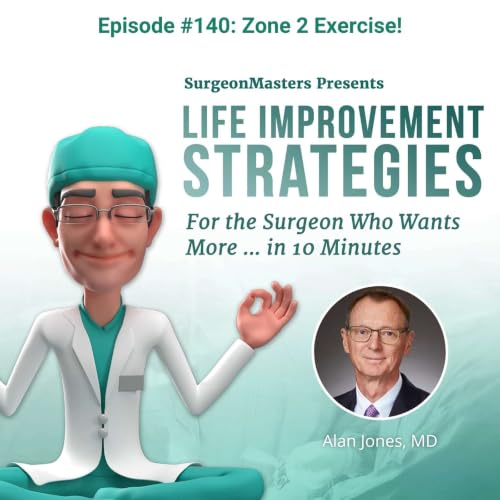
  • Zone 2 Exercise! Life improvement strategies for the surgeon who wants more … in 10 minutes – Episode 140
    2026/07/08

    Send us Fan Mail

    Pump the brakes on your week and take 10 minutes to make your life as a surgeon just a little better…

    Jeff welcomes orthopaedic surgeon and surgeon-wellness advocate Alan Jones, MD, to the podcast.

    Alan has been an avid runner for the last fifteen years, and typically runs one marathon per year. Recently, Alan has been training in Zone 2.

    If you’re unfamiliar, Zone 2 training involves working out at a relatively easy heart rate. This type of training provides a stimulus that often increases your fitness better than working out at a higher intensity.

    In addition, Zone 2 training also leaves you with more energy to do other things you love after the workout itself. As a result, it leads to an improved overall sense of well-being.

    This highlights an important mantra that we, as surgeons, often overlook: more is not always better.

    What steps does Alan suggest we take to try Zone 2 training?

    • Step 1 - Incorporate Zone 2 training into your fitness routine. Whether you prefer cycling, running, or utilizing other equipment, this training is adaptable.
    • Step 2 - Assess your physical and mental state before starting the workout, and reflect on how you feel afterward. You might discover that you have more energy than you did before the session, a notable contrast to the fatigue often following more strenuous exercise.
    • Step 3 - Maintain a balanced fitness regimen by keeping other forms of exercise in the mix. Consider Zone 2 training as one essential component of a comprehensive physical routine.


    Most importantly, PRACTICE Zone 2 exercise principles for well-being!


    BIO

    Alan L. Jones, MD is a board certified orthopaedic surgeon and a founding member of Orthopaedic Trauma Associates of North Texas. Dr. Jones is on the medical staff at Baylor University Medical Center at Dallas and serves as the medical director of orthopaedic trauma services. Dr. Jones specializes in articular fractures (bone breaks near major joints), injuries to the pelvis and acetabulum, and fracture non-union and mal-union. Dr. Jones received his medical degree at Baylor College of Medicine, Houston before completing an internship in surgery at the University of Texas Southwestern Medical School and affiliated hospitals in Dallas, where he also completed a residency in orthopaedic surgery. He is fellowship-trained in orthopaedic traumatology at the Shock Trauma Center/Maryland Institute for Emergency Medical Services Systems in Baltimore, Maryland.

    SurgeonMasters is a physician peer community dedicated to improving the personal and professional well-being of physicians.

    Join your colleagues online at SurgeonMasters.com for events, resources, and more.

    PRACTICE Your Best!

    続きを読む 一部表示
    8 分
  • Physician Needs Too! The SurgeonMasters Podcast
    2026/05/21

    Send us Fan Mail

    Pump the brakes on your week to make your life as a surgeon just a little better…

    Jeff welcomes to the podcast family physician and physician coach, Ken Dodge, MD.

    As physicians, most of our stress and frustration doesn't come from not knowing what to do. Rather, it comes from not knowing what we need. In medical terms, when you fail to identify a need, you miss the diagnosis. If we can identify these needs, it can go a long way to reducing stress in our day-to-day lives.

    When we say needs, we don't mean preferences or wants. Needs are core human drivers like rest, autonomy, a sense of meaning, connection, etc. When our needs aren't met, some type of suffering or adversity will occur.

    These needs constantly shape our behaviors, whether or not we're aware of them. Every decision we make is an attempt to meet a need. For example, if a physician stays late at work it may be that they have a need for approval.

    It’s important to distinguish between needs and strategies to deal with our needs (lest a strategy becomes a need). Think of needs as the diagnosis, whereas strategies are the treatment. Needs are static and non-negotiable, while strategies are flexible. A physician who has a need to be seen as competent, may employ a strategy of staying late and picking up additional shifts. That strategy may work for a time, but eventually it will lead to issues like burnout. That’s not because the initial need is wrong, but that the strategy is serving the need ineffectively.

    If we take the time to identify our needs, decisions become clearer and communication improves.

    What steps does Ken suggest we do to meet our needs?

    • Step 1 - Understand the difference between wants and needs. Before we can focus on meeting needs, we first need to know the difference between needs and wants.
    • Step 2 - Identify your specific needs. Instead of asking yourself “what should I do?” ask yourself “what do I need?”
    • Step 3 - Develop strategies to address those needs. This may take some time and tweaking. That’s OK!


    Most importantly, PRACTICE identifying and addressing your needs!


    BIO

    Dr. Ken Dodge is a retired family physician who devoted 42 years to patient care after earning his MD from Wright State University and completing residency in Dayton, Ohio. With an undergraduate background in psychology from The Ohio State University, he developed a lifelong interest in relationships, emotional health, and personal growth.

    Now retired from clinical practice as of June 2025, Ken coaches physicians, offering a compassionate, reflective space grounded in deep listening and respect for emotional and spiritual influences. He is passionate about helping physicians navigate challenges, reconnect with their inner wisdom, and cultivate greater balance and serenity.

    Ken is married, a father of three, and a grandfather of five. He enjoys hiking, biking, traveling, and reading.

    SurgeonMasters is a physician peer community dedicated to improving the personal and professional well-being of physicians.

    Join your colleagues online at SurgeonMasters.com for events, resources, and more.

    PRACTICE Your Best!

    続きを読む 一部表示
    19 分
  • Recognizing Feelings! Life improvement strategies for the surgeon who wants more … in 10 minutes – Episode 139
    2026/04/08

    Send us Fan Mail

    Pump the brakes on your week and take 10 minutes to make your life as a surgeon just a little better…

    Jeff welcomes physician coach and family physician, Ken Dodge, MD, to the podcast.

    As physicians, we like to think we’re governed almost exclusively by logic, but despite our best intentions, we are often driven by our emotions. Feelings are so important because they inform all of our decisions. When we try to ignore them, they don’t just go away.

    Chip Dodd, PhD, tells us there are a handful of core feelings that help us make sense of the world: sadness, anger, fear, shame, acceptance, guilt, loneliness, and pain.

    If we understand these feelings, communication moves from reactivity to intentionality. We can let go of our defensiveness and improve our teamwork.

    What steps does Ken recommend we take to turn these feelings into tools that can benefit us?

    • Step 1 - Don’t look at feelings as liabilities but as early warning signs.
    • Step 2 - Honor and value your emotions. Become aware of them.
    • Step 3 - Identify your personal emotions. Once you identify your emotions, utilize them.


    Most importantly, PRACTICE recognizing and honoring your feelings!


    BIO

    Dr. Ken Dodge is a retired family physician who devoted 42 years to patient care after earning his MD from Wright State University and completing residency in Dayton, Ohio. With an undergraduate background in psychology from The Ohio State University, he developed a lifelong interest in relationships, emotional health, and personal growth.

    Now retired from clinical practice as of June 2025, Ken coaches physicians, offering a compassionate, reflective space grounded in deep listening and respect for emotional and spiritual influences. He is passionate about helping physicians navigate challenges, reconnect with their inner wisdom, and cultivate greater balance and serenity.

    Ken is married, a father of three, and a grandfather of five. He enjoys hiking, biking, traveling, and reading.

    SurgeonMasters is a physician peer community dedicated to improving the personal and professional well-being of physicians.

    Join your colleagues online at SurgeonMasters.com for events, resources, and more.

    PRACTICE Your Best!

    続きを読む 一部表示
    8 分
  • Injury Prevention! Life improvement strategies for the surgeon who wants more … in 10 minutes – Episode 138
    2026/03/25

    Send us Fan Mail

    Pump the brakes on your week and take 10 minutes to make your life as a surgeon just a little better…

    Jeff welcomes to the podcast, exercise physiology LiverTransplant Program member, Gil Spitz.

    In many ways, physicians are like athletes. We're high performers always striving to be the best version of ourselves - often to our physical detriment.

    Many physicians do things that are generally healthy, but they may not be doing exercises that properly train them for the rigors of a career in medicine. Instead of moving as fast as possible at all times, we should focus on precise movements that create specific outcomes. We need to train for what we do on a daily basis.

    Just like you would see on a sports team, there are a variety of different positions that physicians play. For example, a open surgery requires a different set of training than laparoscopic surgery. Training for different situations is essential to prevent injuries..

    What steps does Gil suggest we do to prevent injuries?

    • Step 1 - Perform an honest physical check. How does your body feel? What hurts?
    • Step 2 - Work with an exercise physiologist or another qualified professional to create a personalized plan that helps you sustain your career longer.
    • Step 3 - Follow your plan with scheduled check-ins to evaluate what is working well and what you can improve.


    Most importantly, PRACTICE personal injury prevention!


    BIO:

    Originally a classical musician, Gil Spitz shifted his focus to ergonomics and preventative exercise to help musicians with repetitive motion injuries. He furthered his expertise with an MS in Exercise Physiology, researching optimized training for first responders.

    In 2019, he joined the Medical ICU team at Baylor/St. Luke’s Medical Center, developing and enacting exercise plans for medically compromised patients. Since 2021, he has been with the LiverTransplant Program, implementing a hospital-wide method for assessing transplant patients physical suitability, providing post-transplant follow-up, and developing a virtual pre-habilitation program to improve outcomes.

    During this time he has worked with the surgical staff helping them prevent musculoskeletal and repetitive motion injuries. Gil has worked with providers both on a 1-on-1 basis, addressing specific needs and issues as well as presenting the topic of OR ergonomics, inter- & intra-op preventative exercises to incoming resident cohorts during an annual bootcamp at Baylor College of Medicine.


    Social Media:

    LinkedIn - https://www.linkedin.com/in/gil-spitz-088346138/

    SurgeonMasters is a physician peer community dedicated to improving the personal and professional well-being of physicians.

    Join your colleagues online at SurgeonMasters.com for events, resources, and more.

    PRACTICE Your Best!

    続きを読む 一部表示
    10 分
  • Physician Needs! Life improvement strategies for the surgeon who wants more … in 10 minutes – Episode 137
    2026/03/11

    Send us Fan Mail

    Pump the brakes on your week and take 10 minutes to make your life as a surgeon just a little better…

    Jeff welcomes physician coach and family physician, Ken Dodge, MD, to the podcast.

    As physicians, we often struggle to identify our needs. In fact, we often don't know the value. It's easy for us to get disconnected from our feelings and lack self-awareness.

    If we understood our needs, it would make life much easier. We could set boundaries, be intentional, and have honest conversations. It's ironic because we spend all day telling patients what they need, yet we often don't know what we need ourselves.

    If we're aware of our needs at any moment, we can have less self-judgment. Emotions often signal what is happening in our world and give us clues. If you become angry, it may indicate you need respect, fairness, or protection. When you understand your needs, the emotions you experience make more sense. By honoring your needs, you send a message to yourself that you matter.

    What steps does Ken recommend we take to more effectively express our needs?

    • Step 1 - Be intentional in knowing your needs by practicing self-reflection and observation.
    • Step 2 - Ask yourself what you need right now that you wish someone would notice without you having to say anything.
    • Step 3 - Practice vulnerability by sharing your needs with someone you trust, such as a spouse or close friend.


    Most importantly, PRACTICE honoring and expressing your needs!


    BIO

    Dr. Ken Dodge is a retired family physician who devoted 42 years to patient care after earning his MD from Wright State University and completing residency in Dayton, Ohio. With an undergraduate background in psychology from The Ohio State University, he developed a lifelong interest in relationships, emotional health, and personal growth.

    Now retired from clinical practice as of June 2025, Ken coaches physicians, offering a compassionate, reflective space grounded in deep listening and respect for emotional and spiritual influences. He is passionate about helping physicians navigate challenges, reconnect with their inner wisdom, and cultivate greater balance and serenity.

    Ken is married, a father of three, and a grandfather of five. He enjoys hiking, biking, traveling, and reading.

    SurgeonMasters is a physician peer community dedicated to improving the personal and professional well-being of physicians.

    Join your colleagues online at SurgeonMasters.com for events, resources, and more.

    PRACTICE Your Best!

    続きを読む 一部表示
    10 分
  • Narrative Medicine! Life improvement strategies for the surgeon who wants more … in 10 minutes – Episode 136
    2026/02/18

    Send us Fan Mail

    Pump the brakes on your week and take 10 minutes to make your life as a surgeon just a little better…

    Jeff welcomes Richard A. Schaefer, MD, MPH, an orthopaedic surgeon at Johns Hopkins University, to the podcast.

    Richard is a big fan of the concept of narrative medicine. It’s an intentional, reflective practice of medicine in which you take what you’re experiencing and put it into narrative form.

    We use evidence-based medicine every day in practice. But narrative medicine is different. It’s about the importance of stories. Our own stories, as well as those of our colleagues and patients.

    Narrative medicine can help us be better listeners to our patients and colleagues. It can also help increase our empathy and prevent burnout.

    So what steps does Richard suggest we take to integrate a practice of narrative medicine?

    • Step 1 – Explore the Humanities in Medical Literature
      Many clinicians are unaware that academic journals often include sections dedicated to the humanities, the arts, and narrative medicine. Reading these pieces is an easy way to begin integrating reflective and humanistic perspectives into clinical practice.
    • Step 2 – Learn and Remember What Matters to Your Patients
      Make a deliberate effort to understand personal details meaningful to your patients, such as family members, hobbies, milestones, or concerns. Document and revisit these details at future visits. Small acknowledgments can significantly strengthen trust and rapport.
    • Step 3 – Incorporate Narrative into Patient Communication
      Use storytelling and attentive listening in clinical conversations. Invite patients to share their experiences, and frame explanations in ways that connect medical information to their personal stories.


    Most importantly, PRACTICE narrative medicine!


    BIO

    Richard A. Schaefer, MD, MPH is an orthopaedic surgeon at Johns Hopkins University in Baltimore, MD. He grew up in Buffalo, NY, after which he went to West Point followed by medical school at Tulane. He did his orthopaedic residency at the former Fitzsimons Army Medical Center in Colorado, and orthopaedic oncology fellowship at Mayo Clinic. Prior to joining Johns Hopkins, Dr. Schaefer served for over 30 years in the U.S. Army, retiring at the rank of colonel. He had a number of stateside and overseas assignments at military medical facilities, including two tours in Afghanistan. He received several military decorations and awards for his service, including the Bronze Star Medal and Combat Action Badge.

    In addition to his clinical practice at Johns Hopkins, Dr. Schaefer is a medical student advisor, providing longitudinal school and career advising to a cohort of students from their first day and throughout the 4 years until they graduate. He has a variety of outside interests including travel, art, and sports, and is a lifelong die-hard fan of the Buffalo Bills.


    Social Media:

    Closler

    LinkedIn - https://www.linkedin.com/company/closler/

    Instagram - https://www.instagram.com/closler

    Facebook - https://www.facebook.com/CLOSLER/

    YouTube - https://www.youtube.com/channel/UCL2CyImH8fICsHrf9YGxEwg

    X - https://twitter.com/CLOSLER

    Website - https://closler.org/


    SurgeonMasters is a physician peer community dedicated to improving the personal and professional well-being of physicians.

    Join your colleagues online at SurgeonMasters.com for events, resources, and more.

    PRACTICE Your Best!

    続きを読む 一部表示
    10 分