エピソード

  • 320: From Second-Guessing Every Mix To Finishing & Releasing Songs - Thomas Hauenstein
    2026/09/09

    🚀 Want our personal help with your studio or your next music project?

    If you want to finally finish songs and make them sound so good that you can't wait to share them with the world...

    👉 Book a free first coaching session with us:

    theselfrecordingband.com

    We’ll listen to your music, look at your current situation, create a custom plan for you and figure out if you're a good fit for our coaching inside The Self-Recording Syndicate.

    If you are, we can help you make records you're truly proud of and give you the skills and confidence to do it over and over again.

    --

    About this episode:

    What happens when you stop second-guessing every mix and start actually finishing and releasing your songs?

    That’s a big part of Thomas Hauenstein’s story.

    Thomas is a solo artist, songwriter, and longtime member of The Self-Recording Syndicate. He writes and produces his own music, plays multiple instruments, programs and records drums, mixes his songs, and also collaborates with other musicians.

    For a long time, one of his biggest challenges was simply not knowing whether what he had made was actually good enough.

    He could write songs.

    He could record them.

    But evaluating his own mixes, knowing what needed to change, and deciding when something was finished was much harder.

    In this episode, we talk about how that changed.

    Thomas shares how developing his ears, getting consistent feedback, and finishing more projects helped him build confidence and actually release music instead of leaving ideas unfinished on a hard drive.

    We also get into his very hands-on approach to recording:

    Creating fuzzy rock tones, programming realistic drums, experimenting with acoustic guitar mic setups, sampling his own drum kit, collaborating with other musicians, and learning when to let go of control.

    And underneath all of it is one idea Thomas comes back to:

    “It has to be heard by other people.”

    In this episode:

    • Going from uncertainty to actually releasing music
    • Why finishing songs matters so much (beyond the obvious)
    • Learning to trust your own ears
    • The value of outside feedback
    • Why chasing perfection can keep songs stuck forever
    • Producing both full rock arrangements and stripped-back acoustic songs
    • Making programmed drums feel more natural
    • Building unique guitar and bass tones
    • Thomas’s acoustic guitar recording setup
    • Using modeling microphones creatively
    • Sampling your own drum kit
    • Why unique sounds make productions more personal
    • Collaborating with other musicians
    • Learning to give up some creative control
    • The challenge of doing everything yourself
    • Managing expectations when music is not your full-time job


    If you have a hard drive full of unfinished songs and keep wondering whether your mixes are good enough, Thomas’s story will probably feel very familiar. And it might inspire you to finally take action.

    --

    If this episode helps you, we’d really appreciate it if you left a rating/review or shared it with another self-recording artist. It helps us reach more musicians like you, invite exciting guests and keep the podcast going.

    --

    For links to everything we've mentioned in this episode, as well as full show notes go to:

    theselfrecordingband.com/320


    Thomas Hauenstein:

    instagram.com/thomas_hauenstein (@thomas_hauenstein)

    --

    Send us Fan Mail

    If you have any questions, feedback, topic ideas or want to suggest a guest, email us at: podcast@theselfrecordingband.com

    続きを読む 一部表示
    1 時間 9 分
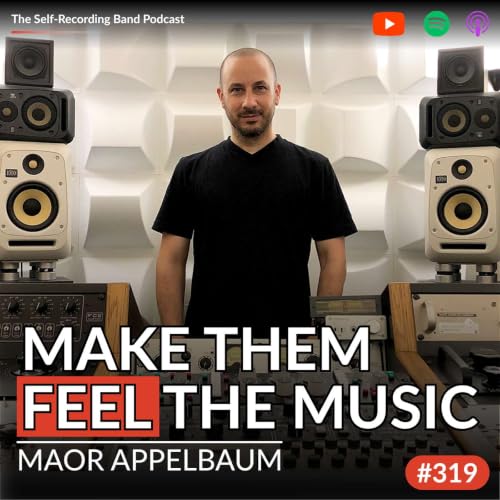
  • 319: What Mastering Actually Does To Your Music - Maor Appelbaum
    2026/08/26

    🚀 Want our personal help with your studio or your next music project?

    If you want to produce your songs in a way that gets the emotion across and makes your vision for the music come out of the speakers...

    👉 Book a free first coaching session with us:

    theselfrecordingband.com

    We’ll listen to your music, look at your current situation, create a custom plan for you and figure out if you're a good fit for our coaching inside The Self-Recording Syndicate.

    If you are, we can help you make records you're proud of and give you the skills and confidence to do it over and over again.

    --

    About this episode:

    What does mastering actually do to your music?

    It’s easy to think of mastering as the final technical step. Make it louder, maybe add some polish, export the final files, done.

    But for mastering engineer Maor Appelbaum, the job goes much deeper than that.

    Maor has worked with artists including Faith No More, Sepultura, Dream Theater, Yes, Meat Loaf, and many more. And in this episode, he explains mastering as a form of presentation: shaping the tone, focus, contrast, texture, dynamics, and overall feel of a finished mix so the listener connects with the music more deeply.

    We talk about why mastering isn’t just about loudness, why tiny changes can matter, how transient response changes emotional impact, when a mastering engineer should leave a mix alone, and why there is no universal mastering chain that works for every song.

    Maor also shares his thoughts on collaboration, AI mastering, hearing health, learning through mentorship, and why the human connection around music still matters so much.


    In this episode:

    • What mastering actually does to a finished mix
    • Why mastering is about presentation and emotional impact
    • How EQ, compression, limiting, saturation, and width change how music feels
    • Why tiny mastering moves can still matter
    • When more processing makes a master worse
    • Why there is no universal mastering chain
    • What artists should expect from a professional mastering engineer
    • Why mastering can reveal problems you missed in the mix
    • Whether you should mix into a limiter or mastering chain
    • The difference between a “loud mix” and a true mastering process
    • Why collaboration and outside perspective matter
    • How Maor developed his ears, taste and skills
    • Protecting your hearing as an engineer or musician
    • Maor’s perspective on AI mastering
    • Why keeping people involved in music matters for the future of art and the community around it

    If you’ve ever wondered what mastering really adds after the mix is finished, this conversation gives you a much deeper answer than “make it louder.”

    --

    If this episode helps you, we’d really appreciate it if you left a rating/review or shared it with another self-recording artist. It helps us reach more musicians like you, invite exciting guests and keep the podcast going.

    --

    For links to everything we've mentioned in this episode, as well as full show notes go to:

    theselfrecordingband.com/319


    Maor Appelbaum:

    maorappelbaum.com

    instagram.com/maorappelbaummastering

    --

    Send us Fan Mail

    If you have any questions, feedback, topic ideas or want to suggest a guest, email us at: podcast@theselfrecordingband.com

    続きを読む 一部表示
    1 時間 49 分
  • 318: What Artists Actually Need From A Modern Music Producer - Pablo Lopez Figueroa
    2026/08/19

    What do artists actually need from a modern music producer?

    Not just someone who can hit record, choose microphones, or make a mix sound polished.

    A great producer helps turn a rough idea into a finished record. And a huge part of that work happens before the final recording even starts.

    In this episode, we talk with Spanish producer, guitarist, songwriter, and engineer Pablo Lopez Figueroa about what modern production really looks like.

    Pablo works with artists across the entire process: songwriting, arrangement, pre-production, recording, performances, editing, mixing, mastering, and bringing in additional musicians when a song needs them.

    A big part of the conversation is about pre-production and why decisions about structure, tempo, key, dynamics, instrumentation, vocal melodies, and contrast often matter more than the plugins or gear you use later.

    We also get into collaboration, making faster creative decisions, keeping ego out of the production process, creating a studio environment where artists feel comfortable, and why working around other ambitious musicians can accelerate your growth dramatically.

    Pablo is a member of The Self-Recording Syndicate and also part of our Studio Growth Mastermind, where studio owners meet weekly to exchange ideas, solve problems, and grow their creative businesses together.

    In this episode:

    • What artists should actually expect from a modern producer
    • Why so much of a great record happens before you hit record
    • What good pre-production really includes
    • Building contrast into songs and arrangements
    • Why better production starts with better decisions
    • Helping artists turn rough demos into finished records
    • Why the producer’s ideas don’t always need to win
    • Working with bands and choosing a musical director
    • Avoiding endless revisions and creative indecision
    • Creating a studio environment where artists can do their best work
    • Why acoustics matter more than expensive monitors
    • Building a professional studio on a realistic budget
    • The value of community, accountability, and learning from your peers
    • Pablo and Manel’s journey from music students in Dublin to professional producers

    If you think a producer’s job starts when the red light comes on, this episode might change the way you look at the entire record-making process.

    --

    If this episode helps you, we’d really appreciate it if you left a rating/review or shared it with another self-recording artist. It helps us reach more musicians like you, invite exciting guests and keep the podcast going.

    --

    For links to everything we've mentioned in this episode, as well as full show notes go to:

    theselfrecordingband.com/318


    Pablo Lopez Figueroa:

    lacharcasound.com

    instagram.com/pablopezfi

    youtube.com/@pablopezfi


    --

    🚀 Want our personal help with your studio or your next music project?

    If you want to surround yourself with like-minded, ambitious artists and producers like Pablo and Manel...

    👉 Apply for coaching:

    theselfrecordingband.com/coaching

    You'll get our unlimited, personal guidance.

    Depending on what your goals are, we can help you make records you're proud of, or build and grow the studio business you've always wanted.

    We’ll listen to your music, look at your current situation, create a custom plan for you, and help you execute it step by step.

    --

    Send us Fan Mail

    If you have any questions, feedback, topic ideas or want to suggest a guest, email us at: podcast@theselfrecordingband.com

    続きを読む 一部表示
    1 時間 31 分
  • 317: Sounding Professional Doesn't Mean Generic, Boring, Or "Overproduced" - Domi Schreiber (MyKungFu)
    2026/08/12

    Can your music sound professional without becoming generic, boring, or overproduced?

    That tension is the main theme of this conversation with Domi Schreiber, the Swiss artist behind MyKungFu.

    Domi has a very specific artistic taste. He likes warm, organic, slightly imperfect productions with unusual textures, sparse arrangements, and a strong emotional identity. But for a long time, sounding different from other artists made him wonder whether his music simply wasn’t good enough.

    In this episode, we talk about the difference between sounding professional and sounding polished into sameness.


    Domi shares how he developed his own sonic identity, why he prefers character over perfection, and how learning the technical side of recording and mixing gave him more creative freedom instead of less.

    We also talk about unusual instruments and textures, working with real studio musicians, keeping imperfections that add emotion, building a live show that feels different from the studio recordings, and learning to promote your own music without handing everything over to someone else.


    In this episode:

    • Why professional doesn’t have to mean generic
    • The difference between polished and overproduced
    • Finding your own sonic identity
    • Why sounding different can feel uncomfortable
    • Keeping warmth and character in your productions
    • Knowing when imperfections make a song better - and when they make it worse
    • Why sparse arrangements can be more powerful
    • Using unusual sounds and non-traditional instruments
    • Learning the technical side without losing creativity
    • Working with other musicians while protecting your vision
    • Translating studio productions into interesting live performances
    • Why self-recording can give artists more freedom
    • Learning music promotion and advertising as an independent artist
    • Why finishing and releasing matters more than chasing perfection


    Domi was also a member of The Self-Recording Syndicate and worked with us through 1-on-1 coaching to improve his recording, mixing, and production skills while staying true to the sound he wanted to create.

    If you’ve ever worried that making your music sound more professional might also make it sound less like you, this episode is for you.

    --

    If this episode helps you, we’d really appreciate it if you left a rating/review or shared it with another self-recording artist. It helps us reach more musicians, invite exciting guests and keep the podcast going.

    --

    For links to everything we've mentioned in this episode, as well as full show notes go to:

    theselfrecordingband.com/317


    Domi / MyKungFu:

    mykungfumusic.com

    patreon.com/mykungfu

    MyKungFu on Spotify

    MyKungFu on Apple Music


    --

    🚀 Want our personal help with your next project?

    If you want feedback on your songs, your arrangements, your recordings, or your mixes…

    …followed by a clear plan to build your skills, confidence and turn your demos into finished releases...

    ...plus the professional guidance to implement it all:

    👉 Apply for coaching:

    theselfrecordingband.com/coaching

    We’ll listen to your music, create a custom plan for you, and help you execute it step by step.

    --

    Send us Fan Mail

    If you have any questions, feedback, topic ideas or want to suggest a guest, email us at: podcast@theselfrecordingband.com

    続きを読む 一部表示
    1 時間 34 分
  • 316: What Great Drummers Do Differently - Michi Dreilich
    2026/08/05

    What separates a good drummer from a great one?

    Most people would probably think it's timing, technique, or playing everything perfectly.

    But the biggest difference is:

    Great drummers make intentional choices. They understand how dynamics, tuning, feel, sound, and even small imperfections can change the emotion of a song.

    In this episode, we talk to professional session and touring drummer Michi Dreilich about what great drummers do differently and how musicians can create drum parts that truly serve the song.

    Michi spent ten years playing with Blackout Problems and now works as a touring drummer for different artists. He also teaches drums and records custom drum tracks remotely from his own studio, Container Drums. He was previously a member of The Self-Recording Syndicate and worked with us through 1-on-1 coaching to further develop his recording setup, workflow, and drum sounds.

    In this conversation, Michi explains why good drum performances are about much more than hitting the right drums at the right time. We discuss the balance between precision and feel, what a real drummer can add that programmed drums cannot, and how to make bold creative decisions without losing sight of the artist’s vision.

    We also listen to three versions of Manel’s song “Lágrimas de Sal”: The original phone demo, a full production demo with programmed drums, and the finished version featuring Michi’s live drums and Benedikt’s final mix.


    In this episode:

    • What great drummers do differently
    • Why every drum choice should serve the song
    • The difference between feel and sloppy playing
    • When imperfect timing makes a performance more exciting
    • How dynamics create emotion in drum tracks
    • How to program more realistic drums
    • What real drummers add that samples cannot
    • Balancing the artist’s ideas with a session drummer’s creativity
    • Choosing drums, cymbals, heads, tuning, and dampening
    • Getting great drum sounds in an imperfect room
    • Why room-mic placement can transform your recordings
    • Comping and editing professional drum performances
    • How Michi developed his remote recording studio
    • The evolution from phone demo to finished production


    Whether you play drums, program them, or record a drummer in your own studio, this episode will help you think more intentionally about the performance and sound your song actually needs.

    --

    If this episode helps you, we’d really appreciate it if you left a rating/review or shared it with another self-recording artist. It helps us reach more musicians, invite exciting guests and keep the podcast going.

    --

    For links to everything we've mentioned in this episode, as well as full show notes go to:

    theselfrecordingband.com/316

    Michi Dreilich:

    instagram.com/michidreilich

    instagram.com/containerdrums

    https://linktr.ee/michidreilich


    --

    🚀 Want our personal help with your next project?

    If you want feedback on your songs, your arrangements, your recordings, or your mixes…

    …followed by a clear plan to build your confidence and turn your demos into finished releases...

    ...plus the professional guidance to implement it all:

    👉 Apply for coaching:

    theselfrecordingband.com/coaching

    We’ll listen to your music, create a custom plan for you, and help you execute it step by step.

    And if you want to try what Manel did, let Michi add drums to your song and then send it to us to mix, we can do that, as well! Let's talk!

    --

    Send us Fan Mail

    If you have any questions, feedback, topic ideas or want to suggest a guest, email us at: podcast@theselfrecordingband.com

    続きを読む 一部表示
    1 時間 47 分
  • 315: Why Most Bands Never Finish Their Album - Fabian Valentini (Max im Parkhaus)
    2026/07/29

    Why do so many bands never finish their album?

    For German indie rock band Max im Parkhaus, it wasn’t a lack of ideas or inspiration.

    It wasn’t a lack of talent.

    It wasn’t even a lack of opportunities or budget.

    After two failed attempts with professional #1 producers, years of frustration, and almost giving up completely, guitarist and songwriter Fabian Valentini decided to take control of the process himself. The result was the band’s first album they were genuinely proud of.

    In this episode, Fabian shares what finally made the difference, why trusting yourself as a producer matters, and what he learned from spending years chasing the wrong version of success.

    We also talk about perfectionism, finishing creative work, balancing music with a full-time career, and what happened just one week after the album’s release.

    Along the way, we discuss:

    • Why most bands never finish their album
    • The biggest lessons from producing an album three times
    • How to build confidence as a self-recording artist
    • How Fabi built the skills to do it himself - and what he needed help with
    • What helped them rebuild trust in themselves and the process
    • The danger of perfectionism
    • Learning to trust your creative instincts
    • Self-producing while running a full-time business
    • Why sounding like yourself matters more than sounding commercial

    This is an episode about the hardest part of recording music: Finishing it.

    --

    If this episode helps you, we’d really appreciate it if you left a rating/review or shared it with another self-recording artist. It helps us reach more musicians, invite exciting guests and keep the podcast going.

    --

    For links to everything we've mentioned in this episode, as well as full show notes go to:

    theselfrecordingband.com/315

    Max im Parkhaus:

    Get the vinyl

    instagram.com/maximparkhaus

    Spotify

    TIDAL

    Apple Music

    Fabian's video agency:

    look-medien.de

    --

    🚀 Want our personal help with your next project?

    If you want feedback on your songs, your arrangements, your recordings, or your mixes…

    …followed by a clear plan to build your confidence and turn your demos into finished releases...

    ...plus the professional guidance to implement it all:

    👉 Apply for coaching:

    theselfrecordingband.com/coaching

    We’ll listen to your music, create a custom plan for you, and help you execute it step by step.

    And if you want to try what Fabi did and let us mix your self-recorded songs, we can do that, as well! Let's talk!

    --

    Send us Fan Mail

    If you have any questions, feedback, topic ideas or want to suggest a guest, email us at: podcast@theselfrecordingband.com

    続きを読む 一部表示
    1 時間 33 分
  • 314: Can Recording Studios Be Sustainable? Why Michael Buschka Is Building His Studio Differently.
    2026/07/22

    Can recording studios be sustainable?

    That’s the question we explore in this episode with Michael Buschka, a recording and mixing engineer from Germany who has built his studio around sustainability, conscious decision-making, and genuinely caring for the artists he works with.

    Michael shares how he applies sustainable principles to every part of his business. From renewable energy and second-hand gear to ethical merch, banking, and the online services he uses. But the conversation quickly expands beyond sustainability.

    We also talk about:

    • Creating a recording environment where artists feel safe to be vulnerable
    • Why rushing records almost always leads to disappointment
    • How to build a mixing workflow that keeps the creative process fun
    • Why finishing songs is one of the most important skills any producer can develop.
    • Why artists perform better when they feel comfortable
    • Why great templates improve creativity
    • The value of mentorship and feedback
    • Building a studio business around your values

    Whether you’re a self-recording artist or an aspiring producer, this episode is full of practical ideas for making better records—and building a creative career you’ll actually enjoy.

    --

    If this episode helps you, we’d really appreciate it if you left a rating/review or shared it with another self-recording artist. It helps us reach more musicians, invite exciting guests and keep the podcast going.

    --

    For links to everything we've mentioned in this episode, as well as full show notes go to:

    theselfrecordingband.com/314

    Michael Buschka:

    michaelbuschka.com

    instagram.com/michaelbuschka

    --

    🚀 Want our personal help applying this to your next project?

    If you want feedback on your songs, your arrangements, your recordings, or your mixes…

    …followed by a clear plan to build your confidence and turn your demos into finished releases...

    ...plus the professional guidance to implement it all:

    👉 Apply for coaching:

    theselfrecordingband.com/coaching

    We’ll listen to your music, create a custom plan for you, and help you execute it step by step.

    --

    Send us Fan Mail

    If you have any questions, feedback, topic ideas or want to suggest a guest, email us at: podcast@theselfrecordingband.com

    続きを読む 一部表示
    1 時間 27 分
  • 313: How Legendary Rock Records Are Made - Kyle Hoffmann (NRG Recording Studios)
    2026/07/16

    What separates good audio engineers and producers from great ones?

    In this episode, we sit down with Kyle Hoffmann, Chief Engineer at the legendary NRG Recording Studios in Los Angeles, to talk about the iconic NRG sound and the skills that matter most. Both in the studio and throughout your career.

    Kyle shares his journey from intern to Chief Engineer, what he learned at Berklee College of Music, and why mentorship, attitude and relationships have shaped his career far more than gear ever could.

    We also talk about:

    • Why attitude matters more than technical skill
    • The difference between producing and engineering
    • Building trust with artists in the studio
    • Learning from mentors instead of relying on tutorials
    • What aspiring engineers get wrong about professional studios
    • Whether audio school is worth it
    • Why legendary studios like NRG still matter
    • How to build a long-term career in audio

    This conversation is packed with practical lessons that go far beyond equipment and recording techniques.

    --

    If this episode helps you, we’d really appreciate it if you left a rating/review or shared it with another self-recording artist. It helps us reach more musicians, invite exciting guests and keep the podcast going.

    --

    For links to everything we've mentioned in this episode, as well as full show notes go to:

    theselfrecordingband.com/313

    NRG / Kyle:

    nrgrecording.com

    instagram.com/nrgrecording

    instagram.com/khoffmannmusic

    --

    🚀 Want our personal help applying this to your next project?

    If you want feedback on your songs, your arrangements, your recordings, or your mixes…

    …followed by a clear plan to build your confidence and turn your demos into finished releases...

    ...plus the professional guidance to implement it all:

    👉 Apply for coaching:

    theselfrecordingband.com/coaching

    We’ll listen to your music, create a custom plan for you, and help you execute it step by step.

    --

    Send us Fan Mail

    If you have any questions, feedback, topic ideas or want to suggest a guest, email us at: podcast@theselfrecordingband.com

    続きを読む 一部表示
    2 時間 1 分