エピソード

  • Michael Burry Sees a $3 Trillion AI Risk Wall Street May Be Missing
    2026/09/24
    Artificial intelligence could become one of the most important technologies in modern history.

    It could also produce one of the largest investment bubbles.

    In Episode 307 of The Secret War on Cash, Dean Heskin and Chris Agelastos of Swiss America Trading examine warnings from Michael Burry and Ray Dalio about the financial structure developing underneath the AI boom.

    Burry has raised concerns about roughly $3 trillion in commitments associated with major hyperscalers including Amazon, Alphabet, Microsoft, Meta and Oracle.

    Many of those commitments involve future leases, infrastructure projects, data centers and other spending that may not appear on corporate balance sheets in the same way as conventional debt.

    That creates a potentially important timing mismatch.

    AI technology can evolve dramatically within 12 to 18 months.

    Major data centers may require three to five years to plan and construct.

    Companies may therefore be committing enormous amounts of capital to infrastructure designed for a technology that can change significantly before the buildings are even completed.

    The conversation then turns to Ray Dalio.

    Dalio argues that AI may ultimately deliver enormous productivity gains while still producing a speculative bubble.

    Transformative technology does not automatically make every associated investment attractive at every valuation.

    The internet changed the world, but many dot-com companies still failed.

    AI could follow a similar path.

    The episode also explores the effect on workers and consumers if AI dramatically increases productivity while reducing employment in certain fields.

    Brought to you by Swiss America Trading.

    Get your complimentary Secret War on Cash Report:
    1-800-289-2646
    https://www.swissamerica.com/social


    続きを読む 一部表示
    8 分
  • The Dollar Is in 89% of FX Trades. So Why Is BRICS Moving Away From It?
    2026/09/22
    The U.S. dollar remains the dominant currency in global foreign-exchange markets.

    So why does de-dollarization continue to attract so much attention?

    In Episode 306 of The Secret War on Cash, Dean Heskin and Chris Agelastos of Swiss America Trading examine China’s upcoming role as BRICS chair in 2027 and what it could mean for efforts to increase local-currency trade among member countries.

    The conversation then turns to a headline declaring that the U.S. dollar accounts for approximately 89% of the global forex market.

    That statistic sounds overwhelming, but there is an important technical detail.

    A foreign-exchange transaction always contains two currencies.

    The Bank for International Settlements therefore counts the currency on each side of a trade. As a result, percentages for all currencies add up to roughly 200%, not 100%.

    The dollar was on one side of 89.2% of global FX trades in April 2025. The euro appeared on 28.9%, the Japanese yen on 16.8%, and the Chinese renminbi on 8.5%.

    Those figures confirm that the dollar remains deeply entrenched in the global financial system.

    But dollar dominance and de-dollarization can occur simultaneously.

    The dollar can remain the most important international currency while individual countries gradually increase local-currency settlement, build alternative payment systems or diversify portions of their reserves.

    The key question is not whether the dollar disappears overnight.

    It is whether its share of global finance gradually erodes over many years.

    Brought to you by Swiss America Trading.

    Get your complimentary Secret War on Cash Report:
    1-800-289-2646
    https://www.swissamerica.com/social


    続きを読む 一部表示
    10 分
  • Could AI Data Centers Send Your Natural Gas Bill Higher?
    2026/09/18
    Artificial intelligence may be digital, but the infrastructure powering it is very physical.

    In Episode 305 of The Secret War on Cash, Dean Heskin and Chris Agelastos of Swiss America Trading examine the enormous energy requirements behind America’s rapidly expanding AI data-center industry.

    The article discussed in the program forecasts that U.S. data centers could eventually consume extraordinary quantities of natural gas as companies build the computing infrastructure needed to train and operate advanced AI systems.

    Natural gas offers advantages because it is comparatively inexpensive and can provide reliable electricity generation.

    But increased demand creates another question.

    What happens to natural-gas prices when data centers begin consuming dramatically more fuel?

    Dean and Chris discuss the potential impact on ordinary consumers, including households that rely on natural gas for winter heating.

    The conversation then shifts from AI’s economic cost to its potential technological risk.

    President Donald Trump has publicly pushed back against calls for slowing AI development, emphasizing the importance of America maintaining its lead over China.

    Dean and Chris understand the strategic argument. If the United States deliberately slows development while international competitors continue advancing, America could surrender technological leadership in one of the most consequential technologies of the century.

    But the hosts also discuss warnings coming from technology leaders themselves.

    Executives and researchers at leading AI companies have acknowledged that capabilities are advancing rapidly and that safety, monitoring and alignment systems must continue improving alongside them.

    The issue is therefore not simply whether AI development should continue.

    The harder question is how quickly it should proceed, how it should be monitored and who should be responsible for making sure increasingly powerful systems remain under meaningful human control.

    Brought to you by Swiss America Trading.

    Get your complimentary Secret War on Cash Report:
    1-800-289-2646
    https://www.swissamerica.com/social


    続きを読む 一部表示
    11 分
  • The Fed’s Rate Hike Trap: Fight Inflation or Worsen the Debt?
    2026/09/16
    The Federal Reserve is confronting a problem with no obvious painless solution.
    In Episode 304 of The Secret War on Cash, Dean Heskin and Chris Agelastos of Swiss America Trading examine expectations for another Federal Reserve interest-rate increase and the conflicting economic pressures behind the decision.
    Higher interest rates are one of the traditional tools central banks use to slow inflation. By making borrowing more expensive, policymakers can reduce demand and potentially ease upward price pressure.
    But America’s current fiscal situation makes that strategy considerably more complicated.
    With an enormous national debt, higher rates can increase the federal government’s borrowing and debt-service costs. Consumers and businesses also feel the effects through mortgages, auto loans, credit and financing.
    The hosts discuss President Donald Trump’s opposition to higher rates and the possibility that Federal Reserve Chair Kevin Warsh could face some of the same political tension experienced by his predecessor, Jerome Powell.
    Energy creates another obstacle.
    Dean and Chris discuss oil above $100 per barrel and sharply elevated gasoline and diesel prices. Because diesel is essential to trucking and transportation, those fuel costs can spread throughout the supply chain.
    That raises a difficult question: how much can higher interest rates accomplish when part of the inflation problem is being driven by geopolitical conflict and energy shortages?
    Lowering or holding rates presents its own risk. Easier money can support economic activity, but it may also prolong or intensify inflation.
    The result is the monetary-policy catch-22 at the center of this episode:
    Raise rates, and debt becomes more expensive.
    Keep rates lower, and inflation may remain stronger.
    Dean and Chris close by discussing physical gold and silver as assets that have historically been used as part of an inflation and monetary-risk diversification strategy.
    Brought to you by Swiss America Trading.
    Get your complimentary Secret War on Cash Report:
    Call or text: 1-800-289-2646
    https://www.swissamerica.com/social


    続きを読む 一部表示
    10 分
  • You Don’t Drive Diesel. You’re Still Paying for It.
    2026/09/10
    You may never put diesel into your own vehicle, but you still depend on it for the goods and services you use every day.
    In Episode 303 of The Secret War on Cash, Dean Heskin and Chris Agelastos of Swiss America Trading examine rising gasoline and diesel prices and the wider economic consequences of higher energy costs.
    The hosts begin with fuel-price reports from Labor Day weekend and the continuing uncertainty surrounding the conflict involving Iran. They also discuss the Russia-Ukraine war, attacks on Russian refining infrastructure and the potential effects on diesel supply.
    Chris explains why diesel is especially important to school buses, trucking, farming, construction and the transportation of food and other consumer goods. When fuel costs rise, businesses may pass those expenses along to customers, reducing the amount of discretionary income households have available.
    The episode then turns to a Yahoo Finance article concerning the national debt and rising Treasury yields.
    Dean questions whether policymakers are taking the debt burden seriously enough, while Chris explains how higher debt can produce greater interest expense, larger deficits and additional borrowing. Investors may then demand higher yields, making the cycle more difficult to control.
    The conversation also addresses the debate over government spending, the challenges facing both political parties and why the hosts believe continued fiscal pressure can affect confidence in the U.S. dollar.
    Dean and Chris conclude by connecting those concerns with central-bank gold purchases and the importance of considering physical gold and silver as part of a diversified financial strategy.
    Brought to you by Swiss America Trading.
    Get your complimentary Secret War on Cash Report:
    Call or text 1-800-289-2646
    https://www.swissamerica.com/social


    続きを読む 一部表示
    11 分
  • Central Banks Are Trading Dollars for Gold. Why Isn’t America?
    2026/09/09
    Why are central banks continuing to buy physical gold while reducing their reliance on the U.S. dollar?
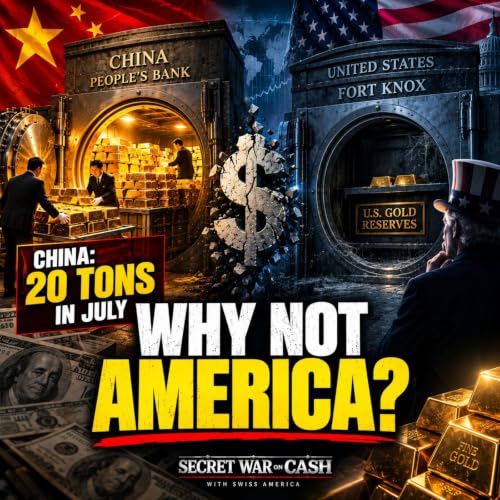
    In Episode 302 of The Secret War on Cash, Swiss America Trading’s Dean Heskin and Chris Agelastos examine reported central-bank gold purchases in July, including approximately 20 tons attributed to China out of 23 tons discussed in the program.
    The hosts connect that buying with a longer-term reserve-diversification trend. They discuss survey findings indicating that most central banks expect global gold reserves to increase, while a substantial majority expect the dollar’s share of reserves to decline.
    Dean and Chris also consider why the United States does not appear to be adding to its gold holdings at the same pace as other nations. That leads to the Fort Knox debate, the country’s enormous debt burden and the question of whether American monetary policy leaves room for additional gold accumulation.
    The conversation then turns to gold repatriation. Some countries are seeking to bring reserves stored abroad closer to home, citing security and geopolitical considerations. The hosts discuss what those decisions may indicate about changing perceptions of financial risk.
    In the second half, Dean and Chris examine the 1970s as a historical comparison for the current precious-metals market. They discuss how gold can rise even during periods of higher interest rates and how sudden price movements can make market timing difficult.
    Their conclusion is that physical gold and silver should be considered according to an investor’s objectives and need for diversification, rather than relying on a prediction of the exact market bottom.
    Brought to you by Swiss America Trading.
    Get your complimentary Secret War on Cash Report:
    Call or text 1-800-289-2646
    https://www.swissamerica.com/social

    続きを読む 一部表示
    11 分
  • Central Banks Just Bought $47 Billion in Gold. Why?
    2026/09/03
    Central banks continue buying gold, but the scale of the latest increase stands out.
    In this episode of The Secret War on Cash, Dean Heskin and Chris Agelastos discuss figures showing roughly $47 billion in central-bank gold purchases over a three-month period, following several years of strong institutional demand.
    Chris notes that central banks had often been purchasing around $10 billion per quarter, making the latest increase approximately five times larger.
    Why the jump?
    One explanation discussed in the episode is price.
    Gold had pulled back from a previous high near $5,500 into roughly the $4,000–$4,500 range. To long-term institutional buyers, Chris argues, that represented something similar to a 20% sale.
    The larger motivation may be even more important.
    Central banks have been reducing portions of their exposure to dollars and other fiat currencies while increasing their holdings of physical gold.
    Dean jokingly calls the process “de-fiatizing,” but the underlying idea is straightforward: move reserves into an asset that is tangible, globally recognized, and not simultaneously someone else’s debt obligation.
    Then the episode turns to a second record.
    U.S. broad money supply is discussed at approximately $23.2 trillion.
    Dean and Chris explain the basic inflationary concern. If the quantity of money grows faster than economic productivity and the availability of goods and services, additional dollars compete for the same output.
    Prices rise.
    The purchasing power of money already sitting in savings accounts declines.
    Chris connects this dynamic with several other trends discussed on recent episodes: federal debt, rising interest costs, Treasury-market pressure, and strong central-bank demand for physical metal.
    Individually, each factor can be supportive of precious metals.
    Together, he argues, they create substantial momentum behind gold and silver.
    Dean closes by noting that physical gold has served as a hedge for decades, but recent performance has also allowed that hedge to generate significant appreciation.
    That creates an unusual alignment: the same asset can potentially provide diversification while also participating in a strong market trend.
    Brought to you by Swiss America.
    Get your complimentary Secret War on Cash Report:
    Call or text: 1-800-289-2646
    Visit: https://www.swissamerica.com/social
    続きを読む 一部表示
    8 分
  • America Is Spending Nearly 20% of Its Revenue on Interest
    2026/09/01
    Episode 300 of The Secret War on Cash returns to the issue that has become increasingly difficult for Washington to avoid: debt.
    Dean Heskin and Chris Agelastos begin with an article stating that annual U.S. interest expense has reached its highest share of federal revenue since 1991.
    According to the figures discussed in the episode, interest costs are approaching 20% of federal revenue.
    Chris compares the situation with an individual earning $50,000 annually and losing a substantial share simply servicing credit-card interest without reducing the underlying balance.
    The comparison becomes more troubling when the hosts look back to 1991.
    Interest rates at that time were around 8%, while rates discussed today are closer to the low-5% range. Dean and Chris argue that if current borrowing costs rose toward those earlier levels, the federal government's interest burden could become substantially worse.
    They also note that the share of revenue devoted to interest has increased dramatically over the last several years.
    The second article in the episode introduces an even larger number.
    Gerald Celente is cited as arguing that total U.S. obligations may be closer to $126 trillion rather than the roughly $40 trillion conventional debt figure because the larger estimate includes future commitments such as Social Security and Medicare.
    The episode does not independently establish that $126 trillion figure, but uses the claim to illustrate the importance of looking beyond outstanding Treasury debt when assessing long-term fiscal obligations.
    That creates a difficult policy environment.
    Higher interest rates increase the cost of financing the debt. But keeping rates lower can weaken the dollar, contribute to inflationary pressure, and reduce confidence in dollar-denominated assets.
    Dean and Chris connect that dynamic with gold and silver.
    Their argument is straightforward: the more pressure debt places on monetary policy and the dollar, the stronger the case becomes for holding assets that do not depend on the government's ability to issue additional currency.
    Three hundred episodes into The Secret War on Cash, the story has changed in size, but not in direction.
    Debt grows.
    Interest grows with it.
    And the options become narrower.
    Brought to you by Swiss America.
    Get your complimentary Secret War on Cash Report:
    Call or text: 1-800-289-2646
    Visit: https://www.swissamerica.com/social
    続きを読む 一部表示
    6 分