

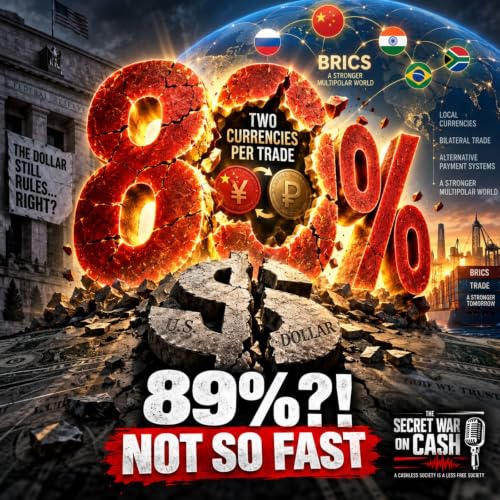
The Dollar Is in 89% of FX Trades. So Why Is BRICS Moving Away From It?
カートのアイテムが多すぎます
ご購入は五十タイトルがカートに入っている場合のみです。
カートに追加できませんでした。
しばらく経ってから再度お試しください。
ウィッシュリストに追加できませんでした。
しばらく経ってから再度お試しください。
ほしい物リストの削除に失敗しました。
しばらく経ってから再度お試しください。
ポッドキャストのフォローに失敗しました
ポッドキャストのフォロー解除に失敗しました

The Dollar Is in 89% of FX Trades. So Why Is BRICS Moving Away From It?
-
ナレーター:
-
著者:
So why does de-dollarization continue to attract so much attention?
In Episode 306 of The Secret War on Cash, Dean Heskin and Chris Agelastos of Swiss America Trading examine China’s upcoming role as BRICS chair in 2027 and what it could mean for efforts to increase local-currency trade among member countries.
The conversation then turns to a headline declaring that the U.S. dollar accounts for approximately 89% of the global forex market.
That statistic sounds overwhelming, but there is an important technical detail.
A foreign-exchange transaction always contains two currencies.
The Bank for International Settlements therefore counts the currency on each side of a trade. As a result, percentages for all currencies add up to roughly 200%, not 100%.
The dollar was on one side of 89.2% of global FX trades in April 2025. The euro appeared on 28.9%, the Japanese yen on 16.8%, and the Chinese renminbi on 8.5%.
Those figures confirm that the dollar remains deeply entrenched in the global financial system.
But dollar dominance and de-dollarization can occur simultaneously.
The dollar can remain the most important international currency while individual countries gradually increase local-currency settlement, build alternative payment systems or diversify portions of their reserves.
The key question is not whether the dollar disappears overnight.
It is whether its share of global finance gradually erodes over many years.
Brought to you by Swiss America Trading.
Get your complimentary Secret War on Cash Report:
1-800-289-2646
https://www.swissamerica.com/social
adbl_web_anon_alc_button_suppression_t1
まだレビューはありません