エピソード

  • From Overwhelm To Action With Karen Koepp
    2026/09/21
    In this episode, Michael Dargie sits down with Dr. Karen Koepp, a reinvention and IP strategist who splits her time between Los Angeles and the mountains of Utah. Karen helps people who have reached the end of a chapter, a layoff, a sold business, or a career upended by AI, figure out what comes next, and then actually bring it to life. Karen's own path was anything but tidy. She did everything right out of college, landing a management consulting role at a big four firm, only to find something missing. Burned out and travelling constantly, she switched jobs, then spent six years volunteering, taking self-assessments, and trying part-time work before a master's program brought her face to face with a thesis that nearly broke her. A single hour of structured feedback from a second advisor finally made it click, and she rewrote three chapters in an afternoon to graduate on time. A week later, a friend called in a panic, four hundred pages of unfinished manuscript, a smashed laptop, and a deadline closing in. Karen flew across the country, and over three days the two of them wrangled the mess into a complete draft. He graduated, and Karen realized there was a market for what she does. That was more than twenty years ago. The heart of the conversation is a quiet myth-buster: finding your direction is not the finish line. Karen argues that our purpose lives in our own stories, the moments we have come fully alive, and that clarity is only the first stage. The second is overwhelm, which she treats not as failure but as a predictable signpost. Her readiness retrofit diagnoses where people stall and designs systems around it, whether that means prosthetic systems for a would-be author who hates writing, developmental systems for genuine skill gaps, or reward systems when the work simply costs too much. Along the way, Karen makes the case that procrastination has been unfairly vilified, she wrote her thesis on it, calling it a wise feedback mechanism worth listening to. There are lighter turns too: a roller-skiing mishap that left her with a black eye and a ready-made metaphor, a childhood spent writing stories about her stuffed animals in Wisconsin, a love of Fiji, and a Bolivian village whose joy reframed everything she thought she wanted. Her advice for rebels in waiting: uncover your stories, expect the overwhelm, and build a new future through low-stakes reps. Episode Highlights [00:41,000] What Reinvention Really Means | Karen defines her work as a reinvention and IP strategist for people facing a layoff, a sale, or an AI-upended career.[01:34,000] The Secret Is in Your History | The key to what's next lives in the stories of when we've come fully alive.[02:55,000] Doing Everything Right | A big four consulting job looked perfect, but something was missing and burnout followed.[03:54,000] A Six-Year Search | Self-assessments, volunteering, and part-time work before a master's program changed things.[05:06,000] The Thesis That Nearly Broke Her | Two years of agony with no structure and feedback that simply said try again.[06:35,000] One Hour That Changed Everything | A second advisor's structured feedback made it click; she rewrote three chapters in an afternoon.[07:04,000] Rescuing a 400-Page Thesis | A smashed laptop and an unfinished manuscript became a three-day rescue mission.[08:02,000] Finding the Market | The clouds parted and Karen realized there was a market for what she does.[09:51,000] The Myth of Direction | Finding your direction is not the solution, and that's the big misunderstanding.[10:23,000] The Answer to How Is Yes | Karen references Peter Block and the idea that purpose is unique to each of us.[12:19,000] A Black Eye as Metaphor | A roller-skiing face plant becomes a fitting image for reinvention.[13:37,000] Mission Isn't Enough | Clarity is stage one; overwhelm is the natural second stage of any mission.[14:40,000] The Readiness Retrofit | Diagnosing where people stall and designing the systems to move through it.[15:09,000] Prosthetic Systems | If you hate writing, build a system that extracts your ideas without a keyboard.[16:35,000] Procrastination Is Wise | Karen's thesis argues procrastination is a useful feedback mechanism, not a flaw.[25:49,000] Advice for Rebels in Waiting | Uncover your stories, expect the overwhelm, and build through low-stakes reps. Links From This Episode Dr. Karen Koepp's website The Answer to How Is Yes by Peter Block Full show notes, transcript, and more: https://rebelrebelpodcast.com/episodes/from-overwhelm-to-action-with-karen-koepp
    続きを読む 一部表示
    29 分
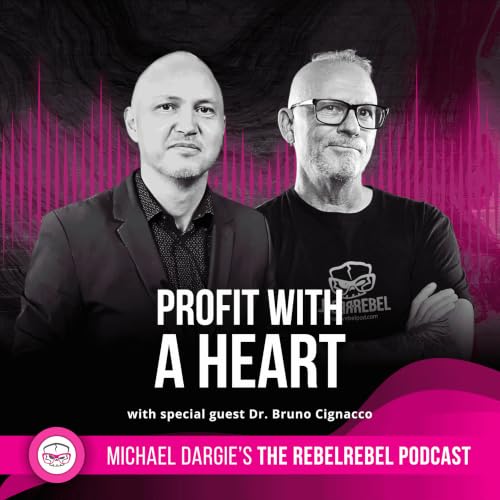
  • Bruno Cignacco and Profit With A Heart
    2026/09/19
    In this episode, Michael Dargie speaks with Dr. Bruno Roque Cignacco, a university professor, researcher, and author based on the outskirts of London. Bruno teaches at postgraduate level, runs a consultancy in international marketing and import-export, and has spent the last few years building a business unit that helps companies become both more profitable and more human. His book, The Art of Compassionate Business, now in a second edition, is the throughline of the conversation. Bruno traces his shift from traditional marketing to compassionate business back to a Harvard Business Review article, "The Human Moment at Work." It wasn't about strategy or tactics, but about building long-lasting relationships and connecting with people on an emotional level. That idea sent him into the research, where he found a body of science-based studies on compassion, generosity, gratitude, and forgiveness in business. His conclusion is simple and firm: the building brick of any business is the human being, a meta resource that generates every other resource. The pair land quickly on a shared belief. Michael frames it as P2P, person to person, no matter whether the label says B2B or B2C. Bruno backs it with research: give customers two near-identical products and they stay loyal to the company that treats them as a person rather than a number in a database. Care for people and they reciprocate; treat them harshly and customers withdraw, employees disengage, and communities push back. Bruno's favourite part of the work is watching resistant companies change their minds. Show a business the research on autonomy, delegation, and psychologically safe workplaces, and the coin drops. He points to Patagonia as an exemplar, a company that calls the planet its shareholder, uses organic cotton, and runs childcare on site at no cost to employees. A loving, supportive workplace, he notes, tends to produce higher satisfaction, lower absenteeism, and a healthier bottom line. The conversation widens into travel, cultural sensitivity, and learning. Bruno reads several books a week, believing that many leaders are readers, and that learning keeps him humble. He dreams of two unhurried weeks in Egypt. He picks Spiderman and Batman as childhood favourites, and, half Italian and Argentinian, he settles the coffee-or-tea question firmly on the side of tea. To the show's rebels in waiting, Bruno offers one word: immersion. Fear is the biggest obstacle in any endeavour, and you are the obstacle, so get out of your own way. Start small, gather advice, gain confidence step by step, like easing into the shallow end of a pool before the deep. Scientists call the feeling self-efficacy; Bruno calls it the quiet certainty that you can do this. Episode Highlights [00:43,000] Home on the outskirts of London | Bruno introduces himself from Watford, a short hop from London, where he has lived for over 17 years.[01:11,000] Professor, researcher, consultant | Three decades of teaching and consulting in international marketing, plus a new unit on compassionate business.[02:19,000] Why the traditional model falls short | Focusing only on profit and closing deals ignores the human side of long-lasting relationships.[03:37,000] The article that changed everything | A Harvard Business Review piece, "The Human Moment at Work," pointed Bruno toward compassion research.[05:31,000] The human being as meta resource | Not tech or money, but people generate business models, products, and services, everything else.[06:55,000] Two identical products, one loyal customer | Given a choice, customers stay with the company that personalizes and humanizes its approach.[08:33,000] When the coin drops | Bruno's favourite moment is watching resistant companies see the research and change their minds.[09:38,000] Micromanagement backfires | Treat employees like naughty children and they disengage; autonomy and trust do the opposite.[11:32,000] Patagonia: the planet as shareholder | Organic cotton and on-site childcare show a company caring for people and the environment wholeheartedly.[13:31,000] The loving workplace study | Psychologically safe workplaces see higher satisfaction, lower absenteeism, and a better bottom line.[16:01,000] Cultural sensitivity | Bruno travels to learn, respecting other cultures and imagining the world through their lens.[22:12,000] Egypt on the bucket list | Two unhurried weeks among the pyramids is Bruno's plan for next year, done deeply, not superficially.[23:01,000] Readers are leaders | Several books a week keep Bruno humble and learning, like Buffett and Gates who read constantly.[26:34,000] The tea verdict | Half Italian and Argentinian, and 17 years in England, Bruno lands firmly on tea.[27:13,000] Advice for rebels: immersion | Start small, gain confidence gradually, and get out of your own way; fear is the real obstacle.[30:01,000] Where to find Bruno | The Art of Compassionate Business, his website, and LinkedIn, where he posts articles ...
    続きを読む 一部表示
    30 分
  • Care Before You Cure with Mark Gillilan
    2026/09/14
    In this episode, Michael Dargie sits down with Mark Gillilan, founder of Kyoto Botanicals, a botanical wellness company built on hemp-derived, THC-free CBD and, as of recently, functional mushrooms. Mark never set out to work in cannabis. A self-described introvert and former wildlife biologist, he grew up in Dallas riding his bike into the woods and wandering creeks from sunup to sundown, turning over rocks and catching anything that moved. That childhood love of nature became a biology degree, years of fieldwork, and eventually a career in consumer packaged goods marketing at companies like Nestle. The turn toward botanicals came out of the blue. An old boss recruited him to Charlotte's Web, the brand that helped create the whole CBD category alongside Charlotte Figi and the original patient families. Mark had real reservations. He had never been a cannabis guy and carried the same negative perception of weed that a lot of people did. But from week one he was hooked. Seeing firsthand how the plant changed people's lives was eye-opening, and he decided to dedicate himself to growing awareness and acceptance for it. Along the way the two get into the science and the soul of the work. Mark explains terpenes, the chemical defence mechanism plants use to fend off bugs and animals, and how those same compounds carry health and wellness benefits for us. He makes the case for a shift from treating illness to baseline maintenance and prevention, from curing ourselves down the road to caring for ourselves day to day. The conversation is honest about the founder's life too. Mark describes the roller coaster nobody warned him about: highs like no other high, and lows that can drop you to rock bottom in a heartbeat. His way through it is the same thing that has grounded him since childhood, getting outside, walking the dog, sitting in the sun for three minutes to reset. The heart of the episode is Mark's decision to stop hiding. For years he ran Kyoto Botanicals by the rigid marketing playbook he had learned, suppressing the nagging feeling that his real differentiator was himself, his voice, and why he cared. A few months ago he finally turned the camera on, forced himself through thirty days of YouTube videos, rewrote his own blog posts, and redesigned his homepage around a simple question: what do I want people to feel when they meet me and the brand? His advice to rebels in waiting is disarmingly simple. Don't hide yourself. That's the reason what you're doing matters, and eventually why it will matter to the world. You may not reach a hundred million people, but you'll reach a hundred thousand of the right ones. Woven through it all are camping trips with his kids, a love of baking bread, a hard-won lesson about giving yourself grace, and a book recommendation that reframes how we see the world entirely. Episode Highlights [00:57,000] Meet Kyoto Botanicals | Mark introduces himself as founder of Kyoto Botanicals, a botanical wellness company focused on THC-free, broad-spectrum hemp CBD, recently expanded into functional mushrooms.[01:50,000] Why 'Botanicals' | He explains the name was deliberate, always meant to reach beyond one plant into the many plants that support our wellbeing.[02:10,000] Terpenes 101 | Terpenes give wine its full body and show up across the pepper family. Mark, a former wildlife biologist, breaks down what they actually are.[02:39,000] A Plant's Defence | Terpenes are the plant's chemical defence mechanism against bugs and animals, and many of them are beneficial for human health.[04:47,000] The Cottonmouth Bite | At about ten, Mark picked up a baby water moccasin that bit him. Luckily it was a dry bite, and he still has the fang scars to prove it.[06:39,000] Recruited To Charlotte's Web | An old boss pulled him into Charlotte's Web, the company that helped create the CBD category. Mark had serious reservations about working in cannabis.[07:38,000] Hooked From Week One | Meeting Charlotte Figi and the original families, and seeing the plant change lives firsthand, turned his skepticism into a calling.[09:03,000] Care, Don't Just Cure | Mark argues for a shift from treating illness to daily wellness and prevention, and senses that culture is finally starting to change.[10:15,000] The Founder Roller Coaster | Nobody warned him about the highs and lows: euphoria one moment, the terror of feeling like a failure the next, sometimes within the same day.[12:19,000] How He Resets | Getting outside is his regulator. A walk, a run, or even three minutes in the sun helps him catch himself sliding too far up or down.[19:13,000] A Little More Grace | Asked what he wishes the world knew, Mark lands on giving ourselves and each other more grace, a lesson he's trying to model for his kids.[25:02,000] An Immense World | Mark recommends Ed Yong's book on how animals sense the world differently, a humbling read that ties back to his message about grace and patience.[27:48,000] Advice To Rebels In Waiting...
    続きを読む 一部表示
    33 分
  • The Journey Is The Goal with Manuel Prinz
    2026/08/13
    In this episode, Michael Dargie sits down with Manuel Prinz, a co-founder of the AI e-commerce startup Keep Converting, calling in from a sunny Friday in California. Manuel spends his days between product management, opening new markets, and pointing cutting-edge AI at the sort of thorny problems that keep e-commerce brands up at night. But the conversation quickly leaves the boardroom and heads somewhere more interesting: how a kid from rural Germany ended up building companies half a world away. Manuel grew up near Stuttgart, in the shadow of Mercedes-Benz, Porsche, and Bosch, where becoming an engineer for a car manufacturer was less a dream than a default. A hands-on internship, all tooling and hard labour, quietly closed that door. He pivoted to business and economics, and there he found a one-sided exchange with UC Santa Barbara buried at the bottom of his university's agenda, so overlooked that nobody had used it in years. He drilled down, made contact, and made it happen. Landing in California was, in his words, all explosions and fireworks. The polished SUVs at the airport, the investment banker, skateboarder, and homeless person sharing a single block in San Francisco's financial district. For someone raised where everyone lived the same levelled, middle-class life, watching people chase their own individual dreams cracked something open. He wanted in. That curiosity turned into a career. Manuel joined an early payments startup, Paymentwall, an early answer to what Stripe would become, and helped grow it across nearly every continent. He reckons he's now been to more than a hundred countries. He talks warmly about Vietnam, a Hanoi office, and a local chef who served the team fish soup at eight in the morning, and about the balut he bravely tried on a beach in the Philippines. Woven through the travel stories is a quiet philosophy. Manuel shares his move for any new city: get the rundown from a talkative taxi driver, then find a local bar that first night and go with the flow. He talks about needing two or three days to settle before a holiday actually feels like one, because sitting still makes him anxious. And he lands on the thing he wishes the world knew, that the journey is the goal, that there's no end state where complete happiness finally arrives. For the rebels in waiting, the ones stuck between wanting and doing, Manuel's advice is plain: if an idea won't leave your head, even when you try to talk yourself out of it, that persistence is a signal. Get a solid read on it, then go. You might run into a wall. It happens. His own motto sits underneath all of it: never stop running. It's a warm, funny, well-travelled conversation about daring to chase the thing you can't stop thinking about. Episode Highlights [01:16,000] No two days the same | Manuel describes life as a co-founder of an AI e-commerce startup, splitting his days between product, new markets, and hard problems.[02:12,000] Out of stealth | He reveals the company name, Keep Converting, launching after a stretch in stealth mode.[02:54,000] A Stuttgart childhood | Growing up near Mercedes, Porsche, and Bosch, where becoming an engineer felt like the default future.[04:23,000] The internship that redirected him | A hands-on tooling internship shows him mechanical engineering isn't his path, and quietly opens a new one.[05:22,000] The hidden exchange | He unearths a forgotten UC Santa Barbara exchange buried in his university's agenda and makes it happen.[07:16,000] First taste of Silicon Valley | Roommates pull him to San Francisco, where he sees tech and the Valley for the first time.[07:57,000] Fireworks off the plane | Polished SUVs at the airport and a city block holding an investment banker, a skateboarder, and a homeless person at once.[10:09,000] What gets him up | His favourite part of the work: talking to other founders and brands to see what's left and right.[10:58,000] A hundred countries | Joining Paymentwall put him on the front line of global growth, and passport stamps in more than a hundred countries.[12:24,000] Vietnam and the fish soup | A Hanoi office, a chef at the market by 5am, and being served unforgettable fish soup at eight in the morning.[16:22,000] The landing playbook | His move for any new city: a long taxi ride for the rundown, then a local bar that first night.[19:24,000] The bravest bite | The craziest thing he's done, trying balut on a beach in the Philippines, and feeling great after.[24:12,000] Can't sit still | Doing nothing makes him anxious; it takes two or three days before a holiday actually feels like one.[27:09,000] The journey is the goal | The one thing he wishes the world knew: there's no end state, so embrace the working-toward.[30:08,000] For the rebels in waiting | If an idea won't leave your head, that's a signal. Get a solid read, then just go for it.[32:59,000] Never stop running | Manuel shares his personal motto and where to connect with him afterward. Links From This Episode ...
    続きを読む 一部表示
    35 分
  • Find Your Fire Again with Susie deVille
    2026/07/21
    In this episode, Michael Dargie welcomes Susie deVille — entrepreneur, coach, artist, and self-described "concrete chiseler in chief" — who joins from a mountain plateau at 4,118 feet in Highlands, North Carolina. Susie works with entrepreneurs, creators, and visionary leaders who feel stuck and riddled with self-doubt, helping them reconnect with their innate creativity and unlock who they truly are. Her own path took a while to reveal itself. She studied anthropology, moved to Boston and then overseas for a career in publishing at HarperCollins, launched two nonprofits that are still running today, and became a real estate broker in 2001. It was during her master's studies that a class introduced her to the design firm IDEO, and, as she puts it, the top of her head came off. From that moment, all she wanted to do was understand innovation and creativity. That curiosity became a lifeline. When the markets crashed, Susie's finances, her marriage, and her health all went "poof" at once — a stretch she calls her nuclear winter. Her instinct was to work harder, which only pulled her deeper into the quicksand. So she rebuilt everything from the studs up, leaning on a simple but radical idea borrowed from Paulo Coelho: inspiration means breathing in. Most of us, she says, have gold-medalled the exhale — the doing, the burning out, the gerbil wheel — while forgetting to take anything back in. The conversation wanders happily from there. Susie explains her "creative circadian rhythm" and why she writes at three in the morning, when she can "take dictation from the divine." She shares the morning practices that bring her home to herself: Julia Cameron's morning pages, movement, inspired reading, and the one her clients resist most — making something with your hands, whether it's a quick sketch or a vat of gumbo. She and Michael also detour into Paris, flânerie, joie de vivre, and a plate of beef cheeks at Le Procope so good the entire waitstaff once gave her a round of applause. Underneath the fun is a serious message about energy over productivity. We're brilliant at solving for time and discipline, Susie argues, and terrible at noticing the hidden energy loads behind every bold move, hard conversation, and new boundary. Heal and optimize your energy first, and the grand voyage becomes possible. For the rebels in waiting, Susie offers a Joseph Campbell-flavoured reframe: the real work isn't the launch, it's the dragon of your becoming — your ability to tolerate uncertainty and keep going. Take good care of your energy and health, inspire yourself, keep a journal, and remember that your authentic, aligned self is the ultimate champion in any arena. Episode Highlights [00:44,000] What Susie Does | Helping stuck entrepreneurs and creators reconnect with their innate creativity.[01:30,000] The Winding Path | Anthropology, publishing at HarperCollins, two nonprofits, and real estate.[02:56,000] The Top of Her Head Comes Off | A grad-school class introduces her to IDEO and lights the fuse.[04:03,000] Nuclear Winter | The crash takes her finances, marriage, and health all at once.[05:00,000] Learning to Inhale | Inspiration means breathing in — not just the endless exhale.[07:33,000] Not the Artistic One | Why she believed she "missed the art genes" — and why that's false.[09:00,000] Cracking the Concrete | Sketching, watercolour, and mixed media start to reveal the authentic her.[10:20,000] Concrete Chiseler in Chief | An archaeological dig of the self that's energizing and fun.[11:38,000] Why Paris | Feeling instantly at home, joie de vivre, and artfully designed days.[16:11,000] Getting Lost on Purpose | The French idea of the flâneur and surrendering to serendipity.[18:32,000] The Art of Doing Nothing | Energy over productivity, and the hidden loads we never notice.[21:28,000] Creative Circadian Rhythm | Finding the hours when your best thinking actually shows up.[23:00,000] Morning Practices | Morning pages, movement, inspired learning, and making something.[27:51,000] Beef Cheeks at Le Procope | The Paris dish that earned her a standing ovation.[31:25,000] Advice for Rebels in Waiting | The dragon of your becoming and tolerating uncertainty. Links From This Episode Susie deVille — Innovation & Creativity Institute (with free toolkit)Buoyant: The Entrepreneur's Guide to Becoming Wildly Successful, Creative, and Free by Susie deVilleIDEO — design and innovation firmThe Alchemist by Paulo CoelhoMorning Pages / The Artist's Way by Julia CameronLe Procope — the oldest cafe in ParisFondation Louis Vuitton — Gerhard Richter exhibition Full show notes, transcript, and more: https://rebelrebelpodcast.com/episodes/find-your-fire-again
    続きを読む 一部表示
    36 分
  • Writing Through The Darkness with Corey Croft
    2026/02/26
    "Let the ego shrivel up and die on the vine."

    In this episode, Michael Dargie sits down with Vancouver-based independent author and publisher Corey Croft for a candid conversation about writing, depression, ego, and the strange compulsion to finish terrible books.

    This episode is sponsored by my new book BRANDJITSU, helping you find, shape, and share your story with the world.

    Corey shares how his path to becoming a novelist began not with ambition, but with anxiety. During a difficult stretch marked by depression, he realized he always had "time" to write — he just wasn't using it. A community writing challenge to produce 1,000 words a day became the catalyst. What began as an experiment turned into a therapeutic practice, and eventually into a serious body of work. Writing, for Corey, became a way to confront inner chaos and shape it into narrative.

    The conversation moves from craft to philosophy. Corey speaks openly about ego — how it quietly sabotages artists — and the importance of humility when pursuing creative work. He reflects on literary influences like Dostoevsky's Crime and Punishment, the discipline he learned from Stephen King's On Writing, and why he treats writing like a job rather than waiting for inspiration to strike.

    There's humour woven throughout: from his refusal to abandon a bad novel (no matter how painful), to his thoughts on dog-earing book pages, to his suspicion of overly optimized, AI-driven culture. Beneath the jokes is a deeper concern about authenticity — about becoming too polished, too homogenous, too disconnected from the rough edges that make people human.

    At its heart, this conversation is about staying real. Corey talks about diminishing the "mask" we wear in public life and striving to align who we are on the outside with who we are internally. For creative rebels and entrepreneurs alike, it's a reminder that art isn't about perfection — it's about honesty.

    Audere est facere. To dare is to do. And sometimes, to write.

    PULL QUOTES

    "You always have time. You just have to make it." — Corey Croft

    "Let the ego shrivel up and die on the vine." — Corey Croft

    "The freaks make up the world." — Corey Croft

    "I love broken spines." — Michael Dargie

    "If you're not your honest and true self, how are people ever going to fall in love with you?" — Corey Croft

    EPISODE HIGHLIGHTS

    [01:22,000] Independent Publisher | Corey explains why he created Fly Pelican Press and chose the indie route.

    [05:35,000] Writing as Therapy | A 1,000-words-a-day challenge becomes a turning point during depression.

    [09:45,000] Dostoevsky on a Megabus | The book that changed Corey's life: Crime and Punishment.

    [10:26,000] Writing Like a Job | Lessons from Stephen King's On Writing and treating creativity with discipline.

    [13:02,000] Writing Across Gender | Why Corey avoids writing female leads — and the authenticity dilemma.

    [17:52,000] You Always Have Time | The myth of "when I have time" gets dismantled.

    [23:32,000] Homogeneity and AI | Concerns about optimization and losing human imperfection.

    [28:34,000] The Completion Compulsion | Corey refuses to abandon bad books — no matter how awful.

    [32:30,000] Rebels in Waiting | Advice for aspiring artists: diminish the ego and embrace rejection.

    [38:05,000] Reduce the Mask | Authenticity as a lifelong practice.

    LINKS FROM EPISODE
    • Corey Croft Author Website (https://coreycroftauthor.com)

    • Corey Croft on Instagram (https://instagram.com/coreycroftauthor)

    • Crime and Punishment by Fyodor Dostoevsky (https://www.goodreads.com/book/show/7144.Crime_and_Punishment)

    • On Writing by Stephen King (https://www.goodreads.com/book/show/10569.On_Writing)

    • Henry Miller (https://www.goodreads.com/author/show/147.Henry_Miller)

    • Edinburgh, Scotland (https://www.visitscotland.com/places-to-go/edinburgh)

    About the Host of The RebelRebel

    Learn more about Michael Dargie, his book on branding, and cool tools he built at https://MichaelDargie.com

    続きを読む 一部表示
    38 分
  • Mr. Incredible's Business Case for Boldness with Robert Schmidt
    2026/02/17
    "Awesome hides on the other side of fear."

    In this episode, Michael Dargie talks with Robert Schmidt—brand strategist, educator, and senior skydiving instructor based in Calgary, Alberta. Robert runs a national brand strategy firm called Box, where he helps organizations figure out who they are, what they stand for, and how to connect with the people that matter most.

    This episode is sponsored by my new book BRANDJITSU, helping you find, shape, and share your story with the world.

    Robert's superpower? Helping brands be something for someone—not everything to everyone. He shares the importance of finding your unique point of view, creating internal alignment, and building brand from the inside out. With clients across Canada and team members as far away as Beirut, Robert's work is as global as it is grounded.

    They talk about how COVID reshaped his business, why teaching adult learners lights him up, and how skydiving became both a metaphor and a mindset. With over 1,000 jumps under his belt—including future plans to jump over the pyramids of Giza—Robert explains why fear is often the final gate before true awesomeness.

    They also cover his upcoming book about why brand deserves a permanent seat in the boardroom, and the 700% ROI some of his clients have seen from brand investments.

    His advice to rebels in waiting? Be awesome. Make the choice, take the leap, and be something for someone—not everything to everyone.

    Quoteable Quotes

    "Awesome hides on the other side of fear."
    "Be something for someone, not everything to everyone."
    "You can't climb a mountain all at once. But you can take the next step."
    "Your brand should have a seat at the boardroom table."
    "If you're not choosing awesome, what are you choosing?"

    Episode Highlights

    What He Actually Does | Brand strategy, storytelling, and adult education
    Remote Before It Was Cool | Selling the office and going national
    Skydiving Instructor | 1,000+ jumps and a love of wingsuits
    Future Plans | Jumping over the pyramids of Giza from a C-130
    Teaching Style | Creating "aha" moments for grown-ups
    From Science to Strategy | His path from microbiology to marketing
    The Book | Arguing for brand at the boardroom table
    People First | Why human connection matters more than ever
    The Restaurant Test | Ask them what they would eat
    Hot Enough to Break Your Nose | A taco story for the ages
    Advice to Rebels | Choose awesome. Be real. Take the leap.

    Links From Episode

    We Are Box Website (https://wearerebox.com)
    Robert on LinkedIn (https://www.linkedin.com/in/brandingstrategist/)
    Robert on Facebook (https://www.facebook.com/robert.schmidt.7374)

    About the Host of The RebelRebel

    Learn more about Michael Dargie, his book on branding, and cool tools he built at https://MichaelDargie.com

    続きを読む 一部表示
    34 分
  • The Biker's Voice Goes Global with India Hayes
    2026/02/16

    In this episode, Michael Dargie talks with India Hayes, founder of Bikers Hangout—a grassroots global movement for motorcycle riders. Broadcasting from Warrington, England, India shares how her idea to connect riders around the world began in a hospital while recovering from pneumonia. Frustrated by the lack of an international biker network, she started a Facebook group. That seed grew into Bikers Hangout, a multimedia platform complete with its own radio station, live shows, club directory, and growing global partnerships.

    India opens up about riding through personal health struggles, including kidney failure and spinal issues, and how building Bikers Hangout gave her focus and something to live for. From her first illegally rebuilt TS125 to launching shows across the UK, US, and beyond, India's journey is powered by persistence and love for the biking community.

    She also talks about the importance of giving back, connecting small service businesses to riders, and using the platform to support organizations like Blood Bikes. With plans to tour more, build out the global club directory, and collaborate with TV hosts and major cargo networks, India shows what's possible when you follow your calling—even if the road is bumpy.

    Her advice to rebels in waiting? Be patient, be relentless, and get out into the world. "You have one life, and that life is soon gone. So just do it. Give it 100%."

    Quoteable Quotes

    "You have one life, and that life is soon gone. So just do it. Give it 100%."
    "There wasn't a global bikers platform—so I built one."
    "It's quite an emotional connection you have with a motorcycle… you are at one."
    "Sometimes you've got to stop and show them how it's done."
    "Every day is a new day. I've got stuff to do."

    Episode Highlights

    The First Ride | Rebuilding a bike from boxes at 13
    From Facebook to Global | How Bikers Hangout was born in a hospital bed
    Radio for Riders | Starting a biker-run global radio station
    Riding Through It | How India built a business while battling chronic illness
    Going Worldwide | 200+ clubs in the directory (and growing)
    Community, Not Commerce | Why they never charge the clubs
    The Real Ones | Featuring underground mechanics and unlisted legends
    Building for Others | Helping Blood Bikes generate income through partnerships
    The Long Game | Plans for tours, collaborations, and more shows
    Advice to Rebels | Patience, persistence, and putting in the work

    Links From Episode

    Bikers Hangout Website (https://www.bikershangout.co.uk/)
    India on LinkedIn (https://www.linkedin.com/in/india-hayes-703ba01a/)
    India on Threads (https://www.threads.com/@bikershangout2019?xmt=AQF0TSiYBpXGOo9tddkzVQkU5unVaotSI1bI3Q4RCUpr-50)
    India on TikTok (https://www.tiktok.com/@indiahayes666)

    ---------

    About the Host of The RebelRebel

    Learn more about Michael Dargie, his book on branding, and cool tools he built at https://MichaelDargie.com

    続きを読む 一部表示
    34 分