エピソード

  • The Curious Case of Having More Money Than Time
    2026/02/27
    They’re 42. They’re doing everything right. $185,000 household income. 15% to retirement. Emergency fund solid. Almost no debt. And yet… they’re exhausted. This week’s email comes from a couple who can absolutely afford help — but still live like they’re one missed paycheck away from disaster. They mow their own lawn. Scrub their own bathrooms. Meal prep every Sunday. Fix everything themselves. They optimize every dollar. Then a simple debate changes everything. A cleaning service would cost $4,200 a year. Invested for 20 years? Roughly $100,000. Or… 40 Saturdays back with their kids. That question hits hard: At what point does buying time become wiser than squeezing every dollar? In this episode, Pete, Dame, and Kristen tackle one of the most uncomfortable financial transitions of midlife — shifting from survival mode to optimization mode. You’ll hear: • Why scarcity mindset can linger long after you’re financially secure • The three currencies of life: money, time, and energy • When convenience spending is actually smart leverage • How to tell the difference between efficiency and lifestyle creep • The “Regret Test” that instantly clarifies big decisions Is hiring help irresponsible… or strategic? Is frugality always virtuous… or sometimes just fear in disguise? If you’ve ever calculated the future value of skipping Starbucks while secretly wishing for one less thing on your weekend to-do list, this one is for you. Because the goal isn’t to die with the highest net worth. The goal is to use money in a way that honors your finite time. You can always earn more money. You cannot earn another Tuesday.
    続きを読む 一部表示
    1 時間 1 分
  • The Great 2026 Rent or Buy Crossroads
    2026/02/19
    Lauren and her husband are 35. Two kids. Solid income. No credit card debt. $70,000 saved. They’re doing everything right. And now their landlord just dropped the bomb: he’s probably selling the house. They’ve been paying $2,750 a month in rent. Buying a similar home would run about $2,900 a month with taxes, insurance, and PMI. On paper, that’s only a $150 jump. In reality? It feels like stepping into a financial thunderstorm. Because everywhere they turn, they hear the same thing: “Terrible time to buy.” “Wait for rates to drop.” “The market’s about to shift.” So the question becomes: Are they crazy for even considering it? This week, Pete, Dame, and Cricket break down what Americans everywhere are wrestling with in 2026: Is this actually a “bad” housing market — or just an uncomfortable one? What does 8% down really mean in terms of risk and flexibility? How much emergency savings should a young family protect at all costs? Is a $2,900 payment on $155,000 income responsible… or reckless? And most importantly — what’s the real cost of waiting? We’ll walk through the math, but we’ll also unpack the psychology. Because this isn’t just about interest rates. It’s about stability. Kids. Lifestyle. Career mobility. And whether owning a home still means what it used to mean. Plus, we’ll tackle the dangerous myth floating around right now: that there’s some magical “perfect time” to buy. If you’re renting and wondering whether to jump into the market… If you’re watching rates like they’re a playoff game… If you’re scared to move but scared to stay… This episode is for you. Because sometimes the smartest financial decision isn’t about timing the market. It’s about knowing your own numbers — and your own tolerance for risk. Are Lauren and her husband crazy? Or are they just standing at the most normal financial crossroads of their generation? Let’s find out.
    続きを読む 一部表示
    57 分
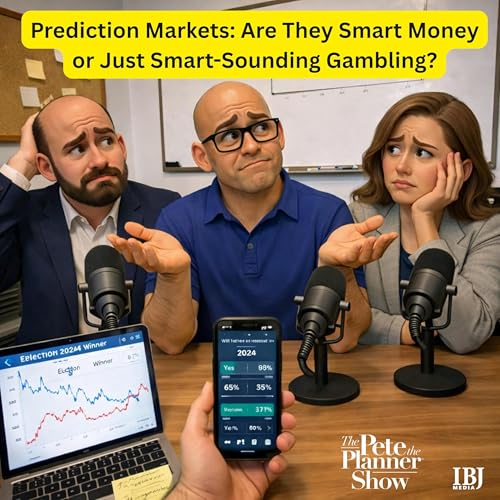
  • Prediction Markets: Are They Smart Money or Just Smart-Sounding Gambling?
    2026/02/13
    You can now bet on inflation, elections, interest rates, wars, and whether the Fed blinks—and people are calling it “information,” not gambling. This week on The Pete the Planner Show, we dig into prediction markets: what they are, why they’ve exploded in popularity, and what they really tell us about the economy, politics, and our collective anxiety about the future. Platforms like Polymarket and Kalshi claim that markets can forecast the future better than polls, experts, or pundits. But can they actually predict what’s going to happen—or are they just pricing fear, confidence, and narrative momentum? In this episode, we break down: How prediction markets work (in plain English) Why they sometimes outperform polls—and when they completely fall apart The role of incentives, emotion, and thin liquidity Why “probability” often gets mistaken for “certainty” What prediction markets get dangerously wrong during volatile moments Most importantly, we translate all of this into real life. Because while betting on the future can feel productive, it often replaces the boring, effective work of financial planning. If your financial plan requires you to correctly predict elections, rate cuts, or recessions… your plan is already broken. This episode isn’t about whether prediction markets are legal, smart, or fun. It’s about what they reveal: not about the future—but about us. Because fear has always been a terrible financial advisor.
    続きを読む 一部表示
    1 時間 8 分
  • Why the markets are unsettled right now
    2026/02/06
    Gold is pulling back. Silver is getting smacked. Tech stocks feel heavy, crypto feels frozen, and investors everywhere are asking the same question: If things are so uncertain, why aren’t the “safe” assets working? This week, Pete breaks down the psychology of a cranky market — one that isn’t panicking or crashing, but is deeply skeptical and increasingly impatient. We’ll explain why gold can fall even when people are uneasy, why silver drops harder when growth expectations soften, and how rising real yields, industrial demand, and investor fatigue all collide at the same time. This isn’t fear-driven selling. It’s narrative exhaustion. And understanding the difference matters for how you invest, rebalance, and stay disciplined when markets stop being exciting. If you’re feeling uneasy, bored, or quietly annoyed by your portfolio right now, this episode is for you.
    続きを読む 一部表示
    1 時間 5 分
  • Is the Retirement Our Parents and Grandparents Had Even Possible Anymore?
    2026/01/30
    Did retirement get harder — or did it just change? A listener writes in with a question a lot of people are quietly asking: Is the kind of retirement our parents and grandparents had even possible anymore? They remember a time when retirement felt automatic — pensions, Social Security, paid-off homes, and far less anxiety about markets or running out of money. Today, even people doing “everything right” feel like retirement is something they have to constantly manage and second-guess. In this episode, Pete breaks down what actually changed, why retirement feels more fragile now, and what we’re really chasing when we say we want “that kind of retirement.” This isn’t a nostalgia tour or a lecture about saving more — it’s a clear, honest look at how responsibility shifted from institutions to individuals, and what that means for modern households. If you’ve ever felt like you’re behind despite being responsible — or wondered whether peace of mind is still attainable — this episode is for you. Because retirement didn’t disappear. The system did.
    続きを読む 一部表示
    1 時間 4 分
  • Am I crazy, or is the economy teetering on the edge of boom and bust?
    2026/01/23
    Jobs are still there. Markets are still standing. Inflation isn’t spiraling. So why does everything feel… off? In this episode, Pete the Planner tackles the growing disconnect between what the economic data says and how people actually feel about their money. This isn’t a recession episode—but it’s definitely not a “everything’s great” episode either. We dig into why households feel financially exhausted even as incomes rise, why good headlines don’t translate into confidence, and how higher prices, frozen decisions, and lingering uncertainty are quietly changing behavior. People aren’t panicking—but they are pulling back. Less splurging. More hesitation. A constant sense of “we’re fine, but only barely.” The show explores whether this tension is temporary or if we’re entering a new era of permanent caution—where trust takes longer to rebuild than balance sheets, and reassurance alone doesn’t calm nerves. Because maybe the real question isn’t whether a recession is coming… It’s whether people believe things will actually get easier. Plus, we close with BWOM and the latest news shaping how all of this plays out in real life.
    続きを読む 一部表示
    1 時間
  • If You Need Cash: Ranking Debt from Least Bad to Absolutely Not
    2026/01/16
    Nobody wants debt. But sometimes life forces the issue. In this episode, Pete, Damian, and Kristen tackle a reality most people face at some point: needing cash quickly. This isn’t an endorsement of borrowing and it’s definitely not a how-to. It’s a ranking of consequences—a clear-eyed look at which debt options hurt the least, which ones quietly wreck your future, and which should be avoided almost entirely. The conversation starts with why people reach for the fastest money instead of the smartest option. Stress, fear, and urgency push otherwise rational people into bad decisions—especially during emergencies, income gaps, or unexpected medical or home expenses. The goal here isn’t perfection; it’s minimizing damage when options are limited. From there, the team works through a tiered ranking: The least bad (situational) options, like already-open HELOCs and family loans—tools that can work, but only with serious guardrails and clear boundaries. The middle ground, including personal loans and 401(k) loans, where predictability and structure help—but behavioral traps and long-term costs still loom. The high-risk zone, where credit cards, payday loans, and title loans turn short-term problems into long-term financial pain. Along the way, they break down why “easy” money is usually the most expensive, how minimum payments create dangerous illusions, and why slowing the decision—even briefly—can be the biggest financial win. If you’ve ever thought, “I just need some cash to get through this,” this episode helps you ask a better question: Which mistake does the least damage—and which ones should never be on the table? Plus, the episode wraps with BWOM and the latest financial news.
    続きを読む 一部表示
    1 時間 11 分
  • Why most people will retire later than they expect
    2026/01/09
    Most Americans believe retirement is just a math problem: invest consistently, ride the market, and everything will work out. The data says otherwise. In this episode, Pete digs into new retirement research that reveals a hard truth—retirement success isn’t being derailed by bad investing, it’s being quietly sabotaged by behavior, debt, and timing . You’ll learn why the vast majority of workers never save enough (even when they think they are), how credit card debt and 401(k) loans silently drain long-term wealth, and why two-thirds of retirees cash out their retirement plans far sooner than expected. Pete also explains why retirement spending is far more unpredictable than most plans assume—and how fear, not extravagance, causes many people to make their most damaging financial decisions right at the finish line. This isn’t a lecture about stock picking or beating the market. It’s a reality check about how real people actually behave with money—and what you can do now to avoid the most common retirement traps. If you’ve ever thought, “I’m doing everything right… I think,” this episode is for you.
    続きを読む 一部表示
    57 分