『The Lunch Hour with Washington Signal』のカバーアート

The Lunch Hour with Washington Signal

The Lunch Hour with Washington Signal

著者: The Washington Signal
無料で聴く

【Amazonプライム会員限定】今ならプレミアムプランが4か月 月額99円。

10月19日まで。※適用条件あり
The Lunch Hour with Washington Signal covers wide-ranging discussions with the Capitol city's policy movers, shakers, and thinkers. The Lunch Hour provides a unique look at the people behind the policy debates that are moving in DC.© 2026 The Lunch Hour with Federal Newswire 政治・政府
エピソード
  • Ep. 206 - IRS, Taxpayer Rights & Fighting Unfair Taxes w/Joe Bishop-Henchman
    2026/09/28

    Joe Bishop-Henchman, Executive Vice President of the National Taxpayers Union Foundation, joins Andrew Langer for a deep dive into taxpayer rights, tax enforcement and the legal battles shaping tax policy across the country.

    Bishop-Henchman discusses NTUF’s long-running lawsuit challenging IRS fees imposed on paid tax preparers, why taxpayers can face enormous obstacles when challenging the government, and the work of NTUF’s Taxpayer Defense Center. He also examines how artificial intelligence could change IRS enforcement and why protecting donor privacy remains an important legal issue.

    The conversation then turns to the states, including the lawsuit that helped spur reform of Louisiana’s complicated local sales tax system and the legal fight over Maryland’s first-in-the-nation digital advertising tax.

    Bishop-Henchman explains why Maryland’s tax has faced years of litigation, the arguments against taxing digital advertising differently from traditional advertising, and what the latest court ruling could mean for the future of the tax.

    00:00 — Introducing Joe Bishop-Henchman
    02:30 — Taking the IRS to Court
    05:00 — The IRS Tax Preparer Fee
    08:12 — Why Tax Cases Can Take Years
    10:09 — Defending Taxpayer Rights
    13:16 — AI & the Future of IRS Enforcement
    18:06 — Why Taxpayers Often Settle
    19:33 — The Fight Over Donor Privacy
    24:37 — Reforming Louisiana's Sales Tax System
    31:12 — Using Litigation to Change Tax Policy
    33:21 — Maryland's Digital Advertising Tax
    38:57 — The Legal Battle Over Maryland's Tax
    41:28 — Why the Court Struck It Down
    44:05 — What Happens Next?
    45:08 — Closing Thoughts

    Follow us on social media

    X: @TheLunchHourPod

    Instagram: the_lunchhour_pod

    LinkedIn: Lunch Hour Podcast

    TikTok: lunchhourpod

    Find more at Washington Signal

    Your source for policy, national security, and investigative journalism.

    https://washingtonsignal.com/

    続きを読む 一部表示
    47 分
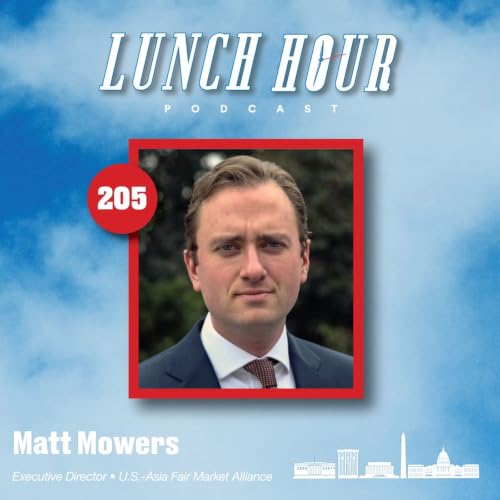
  • Ep. 205 - China, Trade Barriers & America’s Competition in Asia w/Matt Mowers
    2026/09/21

    Tariffs dominate the trade debate—but what about the barriers American companies face after entering a foreign market?

    On this episode of the Lunch Hour podcast, host Andrew Langer sits down with Matt Mowers, President of Valcour and Executive Director of the U.S.-Asia Fair Market Alliance, to examine the non-tariff barriers facing American businesses across Asia.

    Mowers discusses regulatory restrictions, market access, digital trade and enforcement practices that he argues can put U.S. companies at a disadvantage even when tariff rates appear fair. He explains why these issues are particularly important in countries such as South Korea, Japan, India and China—and how restrictions on American businesses can create opportunities for Chinese competitors.

    The conversation also explores China’s growing economic influence, international standards-setting, the Belt and Road Initiative, intellectual property and the competition for leadership in emerging technologies such as artificial intelligence and biotechnology.

    Finally, Mowers discusses the connection between economic strength and American foreign policy, and why he believes ensuring fair access for U.S. companies abroad is increasingly important to both economic competitiveness and national security.

    00:00 — Introducing Matt Mowers
    02:18 — What Are Non-Tariff Trade Barriers?
    04:37 — The U.S.-Asia Fair Market Alliance
    05:53 — How Trade Barriers Can Benefit China
    07:12 — American Tech Companies & Asian Regulations
    09:07 — China's Influence Across Asia
    12:59 — Free Trade, Tariffs & a Level Playing Field
    16:21 — The WTO & Bilateral Trade Negotiations
    17:44 — U.S.-South Korea Relations
    19:15 — China, Market Access & American Companies
    20:42 — China's Influence on International Standards
    23:00 — The Belt and Road Initiative
    26:45 — AI, Technology & the Competition With China
    28:18 — Pharmaceuticals, IP & American Innovation
    30:29 — What's Next for the U.S.-Asia Fair Market Alliance?
    32:30 — Chinese Technology, Data & Security
    34:13 — Mowers' Background in Foreign Policy
    37:12 — Closing Thoughts

    Follow us on social media

    X: @TheLunchHourPod

    Instagram: the_lunchhour_pod

    LinkedIn: Lunch Hour Podcast

    TikTok: lunchhourpod

    Find more at Washington Signal

    Your source for policy, national security, and investigative journalism.

    https://washingtonsignal.com/

    続きを読む 一部表示
    39 分
  • Ep. 204 - Natural Gas, LNG & America’s Energy Security w/Rob Jennings
    2026/09/14

    America has become the world’s largest producer of natural gas—but what does that mean for energy prices, electricity demand and U.S. energy security?

    On this episode of the Lunch Hour podcast, host Andrew Langer sits down with Rob Jennings, Vice President of Natural Gas Markets at the American Petroleum Institute, to discuss the transformation of America’s natural gas industry and its growing role at home and abroad.

    Jennings explains how the shale revolution dramatically increased U.S. natural gas production and helped reshape electricity generation, while providing a lower-cost alternative to coal. He and Langer also examine the surge in electricity demand from data centers and why natural gas-fired generation could play a major role in meeting those needs.

    The conversation turns to permitting reform, including API’s concerns with the National Environmental Policy Act and Clean Water Act, as well as the difficulties of building new pipelines and other energy infrastructure. Jennings discusses LNG exports, Europe’s reliance on imported natural gas, the importance of U.S. energy production during international conflicts and API’s American Energy Security Framework.

    Finally, Jennings shares how the United States can strengthen its energy infrastructure and maintain its position as a leading global energy producer.

    00:00 — Introducing Rob Jennings
    02:00 — America’s Natural Gas Revolution
    03:13 — Natural Gas & U.S. Electricity Generation
    07:30 — Pipelines, Infrastructure & Energy Transportation
    09:50 — Data Centers & Rising Power Demand
    11:06 — Natural Gas in American Homes
    15:23 — U.S. Natural Gas Production & Energy Security
    18:11 — Why Permitting Reform Matters
    20:24 — New England’s Natural Gas Problem
    23:26 — How Natural Gas Is Processed
    25:49 — LNG Exports & Global Energy Markets
    28:29 — Europe’s Dependence on Imported Energy
    31:10 — Strait of Hormuz & U.S. Energy Security
    32:04 — API’s American Energy Security Framework
    34:23 — Getting to Know Rob Jennings
    36:11 — Where to Learn More

    Follow us on social media

    X: @TheLunchHourPod

    Instagram: the_lunchhour_pod

    LinkedIn: Lunch Hour Podcast

    TikTok: lunchhourpod

    Find more at Washington Signal

    Your source for policy, national security, and investigative journalism.

    https://washingtonsignal.com/

    続きを読む 一部表示
    38 分
adbl_web_anon_alc_button_suppression_t1
まだレビューはありません