エピソード

  • US History 1492-1877, Unit 2: Colonial America: Representative Government
    2026/05/14

    In this final lesson of Unit 2: Colonial America, students examine the growth of representative government in the American colonies and explore how ideas about self-government, representation, English rights, and religious movements helped shape early American political identity.

    The lesson begins by defining representative government as a system in which citizens elect representatives to make laws and decisions on their behalf. Students also compare representative government to direct democracy and analyze why large societies historically developed representative systems as a more practical way to govern growing populations.

    Students then examine how ideas about government evolved over thousands of years through political trial and error in civilizations such as ancient Greece, Rome, England, and Colonial America. The lesson emphasizes that representative government developed as an imperfect but effective system for balancing freedom, stability, participation, and order.

    A major focus of the lesson is the reasons representative government grew in the colonies. Students investigate how necessity, distance from England, generational change, English political traditions, and Salutary Neglect encouraged the colonies to govern themselves. The lesson explains how England often allowed the colonies significant freedom as long as trade and economic profits continued flowing to the crown.

    Students also study important examples of representative government in Colonial America including the Mayflower Compact, the Fundamental Orders of Connecticut, and the Virginia House of Burgesses. The lesson highlights how these systems promoted self-government, majority rule, elections, and representative assemblies that influenced later American political traditions.

    The lesson also explores the First Great Awakening and the influence of religious revival movements led by figures such as Jonathan Edwards and George Whitefield. Students analyze how the movement encouraged people to question authority, think independently, and support greater religious freedom and tolerance.

    Finally, students connect these developments to the growing American identity and the increasing tensions between the colonies and England during the 1700s. The lesson concludes by explaining how traditions of self-government and representative institutions helped lay the foundation for the American Revolution and the future United States government.

    By the end of the lesson, students will understand how representative government developed in the colonies and how political traditions, geography, religion, and colonial experience shaped the democratic ideas that later influenced the founding of the United States.

    続きを読む 一部表示
    9 分
  • US History 1492-1877, Unit 2: Colonial America: Enlightenment Documents
    2026/05/14

    In this lesson from Unit 2: Colonial America, students explore major historical documents that helped shape modern ideas about government, individual rights, constitutional limits, and self-government. Students examine how political ideas evolved over centuries from medieval England through the Enlightenment and into the American and French Revolutions.

    The lesson begins with the Magna Carta of 1215 and the troubled reign of King John of England. Students investigate how heavy taxation, abuse of royal authority, and conflict with English nobles led to rebellion against the king. The lesson also introduces Fulk FitzWarin, an outlaw noble connected to resistance against King John and a possible inspiration for later Robin Hood legends. Students learn how the Magna Carta, although short-lived in its original form, became historically important because it marked one of the first major times an English king was forced to formally limit his own power under the law.

    Students then examine the Mayflower Compact and the Fundamental Orders of Connecticut as early examples of self-government and representative rule in the American colonies. The lesson explains how these documents promoted ideas such as majority rule, elected leadership, and government based on the consent of the governed.

    The lesson also focuses on the English Bill of Rights and its role in limiting the power of the monarchy after the Glorious Revolution while protecting certain individual liberties. Students explore how this document later influenced the United States Bill of Rights.

    Students then study the Virginia Declaration of Rights and its connection to Enlightenment ideas about natural rights including life, liberty, property, happiness, and safety.

    A major focus of the lesson is the French Declaration of the Rights of Man and Citizen during the French Revolution. Students examine how Enlightenment ideas and the success of the American Revolution influenced French revolutionaries. The lesson also highlights the collaboration between the Marquis de Lafayette and Thomas Jefferson in shaping parts of the declaration.

    Finally, students analyze the United States Bill of Rights and the protections guaranteed by the first ten amendments to the Constitution, including freedom of religion, speech, assembly, press, trial by jury, due process, and the right to bear arms.

    By the end of the lesson, students will understand how centuries of political conflict, revolutionary ideas, and Enlightenment philosophy contributed to the development of constitutional government, civil liberties, representative democracy, and individual rights in both the United States and the wider world.

    続きを読む 一部表示
    8 分
  • US History 1492-1877, Unit 2: Colonial America: Enlightenment Thinkers
    2026/05/14

    In this lesson from Unit 2: Colonial America, students examine the Enlightenment and the major thinkers whose ideas helped shape the foundations of the United States government and political system. Students explore how Enlightenment philosophers challenged traditional ideas about monarchy, government authority, religion, and individual rights during the 1600s and 1700s.

    The lesson begins with the concept of unalienable rights, or natural rights that people possess at birth rather than rights granted by government. Students analyze how these ideas later influenced the Declaration of Independence, including the famous phrase “Life, Liberty, and the Pursuit of Happiness.”

    Students then study the broader Enlightenment movement and learn how thinkers across Europe encouraged the use of reason, logic, education, and critical thinking to question traditional authority and improve society.

    A major focus of the lesson is John Locke and his theory of the social contract. Students examine Locke’s belief that governments exist through the consent of the governed, that government power should be limited, and that citizens have the right to change or overthrow governments that fail to protect their rights. The lesson also explores Locke’s ideas about natural rights and separation of governmental powers.

    The lesson also introduces Charles de Montesquieu and his expansion of Locke’s ideas through the concept of separation of powers into legislative, executive, and judicial branches. Students analyze how Montesquieu’s ideas later influenced the structure of the United States government.

    Students then examine William Blackstone and his influence on English common law, religious tolerance, natural rights, and legal traditions that later shaped American law and constitutional thinking.

    The lesson also revisits Thomas Hooker and William Penn, connecting their colonial leadership to Enlightenment principles such as representative government, religious freedom, elections, and government by consent.

    By the end of the lesson, students will understand how Enlightenment thinkers influenced colonial ideas about liberty, government, rights, democracy, and constitutional principles that later became central to the founding of the United States.

    続きを読む 一部表示
    8 分
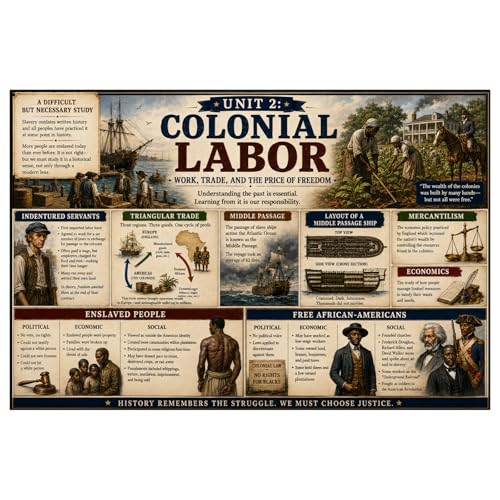
  • US History 1492-1877, Unit 2: Colonial America: Colonial Labor
    2026/05/14

    In this lesson from Unit 2: Colonial America, students examine the labor systems that developed in the American colonies, including indentured servitude, slavery, mercantilism, and the Atlantic trade system. The lesson explores how labor became essential to colonial economic growth while also examining the human impact of slavery and forced labor in Colonial America.

    The lesson begins with a historical overview explaining that slavery existed long before Colonial America and had appeared in many civilizations throughout world history. Students are encouraged to study slavery within its historical context while also recognizing that slavery and human trafficking still exist in parts of the modern world.

    Students then investigate indentured servitude as the first major labor system used in the English colonies. The lesson explains how indentured servants agreed to work for a certain number of years in exchange for passage to America and examines the harsh realities many servants faced once they arrived.

    A major focus of the lesson is the transition from indentured labor to race-based slavery in the colonies. Students examine the arrival of the first Africans in Virginia in 1619 and learn how early African laborers were not initially enslaved in the same way slavery later developed in Colonial America.

    The lesson also explores the story of Anthony Johnson, a formerly enslaved African who gained freedom, acquired land, and became a successful tobacco farmer. Students examine the important legal case involving Anthony Johnson and John Casor, which became one of the earliest examples of lifetime servitude being legally recognized in the English colonies.

    Students then study the Triangular Trade and the Middle Passage, analyzing how trade connected Europe, Africa, and the Americas through the exchange of manufactured goods, enslaved Africans, and raw materials. The lesson also explains how mercantilism shaped colonial economies and increased the demand for labor.

    Finally, students examine the political, economic, and social realities faced by enslaved and free African Americans in the colonies. Topics include slave codes, restrictions on rights, family separation, resistance to slavery, and the growth of free African American communities.

    By the end of the lesson, students will understand how labor systems, trade, economics, and slavery became deeply connected to the development of Colonial America and shaped the future history of the United States.

    続きを読む 一部表示
    8 分
  • US History 1492-1877, Unit 2: Colonial America: Southern Colonies
    2026/05/14

    In this lesson from Unit 2: Colonial America, students explore the development of the Southern Colonies and examine how geography, agriculture, economics, and slavery shaped life in the region. Students study the colonies of Virginia, Maryland, North Carolina, South Carolina, and Georgia while learning how the Southern Colonies became centers of plantation agriculture and cash crop production.

    The lesson begins with the founding of Virginia and Jamestown, the first permanent English settlement in North America. Students examine the growth of tobacco as a major cash crop and learn about the Virginia House of Burgesses as the first representative assembly in the English colonies.

    Students then explore the founding of Maryland by Lord Baltimore as a refuge for Catholics and analyze the significance of the Act of Toleration in promoting limited religious freedom for Christians within the colony.

    The lesson also examines the development of North Carolina and South Carolina, including the role of the Lords Proprietors and the economic growth of plantation agriculture. Students learn about Eliza Lucas Pinckney and her contribution to developing indigo as an important Southern cash crop.

    A major focus of the lesson is Georgia and the leadership of James Oglethorpe. Students investigate Georgia’s founding as a colony intended to provide debtors and convicts with a fresh start while also serving as a protective buffer between the English colonies and Spanish Florida.

    Students also study the geography and climate of the Southern Colonies, including fertile soil, warm weather, and long growing seasons that supported plantation farming. The lesson explains how crops such as tobacco, rice, indigo, and cotton became the foundation of the Southern economy.

    Finally, students examine the role of enslaved labor in the Southern Colonies and analyze how plantation agriculture created a rigid social hierarchy dominated by wealthy plantation owners.

    By the end of the lesson, students will understand how farming, cash crops, representative government, geography, and slavery shaped the Southern Colonies and contributed to the growth of Colonial America.

    続きを読む 一部表示
    6 分
  • US History 1492-1877, Unit 2: Colonial America: Middle Colonies
    2026/05/14

    In this lesson from Unit 2: Colonial America, students explore the development of the Middle Colonies and examine how geography, economics, diversity, and religious tolerance shaped life in the region. Students study the colonies of Delaware, New York, New Jersey, and Pennsylvania while analyzing how these colonies became some of the most economically successful and culturally diverse areas in Colonial America.

    The lesson begins by introducing the concept of regions and examining the geography and climate of the Middle Colonies, including fertile soil, mild winters, hot summers, and access to important rivers and ports. Students learn how these environmental advantages supported farming, trade, and economic growth.

    Students then investigate the founding of Delaware and New York, including the Dutch origins of New Netherland and New Amsterdam before English forces took control and renamed the colony New York. The lesson highlights the importance of trade, harbors, and economic competition between European powers in North America.

    A major focus of the lesson is Pennsylvania and the leadership of William Penn. Students examine Penn’s background as a wealthy Quaker with close ties to King Charles II and learn how Pennsylvania was granted to him partly as repayment for debts owed to his family by the English crown. The lesson explores Penn’s vision for a colony built on religious freedom, tolerance, and fair treatment of Native Americans.

    Students also analyze the beliefs of the Quakers, including equality among people, opposition to violence and slavery, and acceptance of people from different religious backgrounds. The lesson explains how these beliefs shaped Pennsylvania into one of the most tolerant and diverse colonies in North America.

    The lesson concludes with an examination of the economy of the Middle Colonies, including farming, grain production, trade, shipping, and growing cities such as Philadelphia. Students learn why the Middle Colonies became known as the “Bread Basket Colonies” due to their massive production of wheat, barley, oats, rye, and corn.

    By the end of the lesson, students will understand how the Middle Colonies became centers of diversity, economic opportunity, religious tolerance, and trade while helping shape the social and economic foundations of Colonial America.

    続きを読む 一部表示
    8 分
  • US History 1492-1877, Unit 2: Colonial America: New England Colonies
    2026/05/14

    In this lesson from Unit 2: Colonial America, students explore the development of the New England Colonies and examine how religion, geography, economics, and self-government shaped life in the region. Students learn how Massachusetts, Connecticut, Rhode Island, and New Hampshire each developed unique identities while sharing many common characteristics tied to New England’s climate and religious foundations.

    The lesson begins by introducing the concepts of region and plantation before examining the geography of New England, including its cold climate, rocky soil, dense forests, swift rivers, and natural harbors. Students analyze how geography influenced settlement patterns and led New England to develop industries such as fishing, whaling, timber, fur trading, shipbuilding, and Atlantic trade instead of large plantation agriculture.

    Students then study the Pilgrims and the founding of Plymouth Colony in 1620. The lesson explores why the Pilgrims separated from the Church of England, their voyage aboard the Mayflower, the leadership of William Bradford, and the importance of the Mayflower Compact as one of the earliest examples of self-government in the English colonies.

    The lesson also focuses heavily on the Puritans and the Massachusetts Bay Colony under John Winthrop. Students examine the Puritan goal of “purifying” the Anglican Church, the role of religion in daily life, and how strict religious control shaped colonial government and society.

    Students then investigate major challenges to Puritan leadership, including the ideas of Thomas Hooker, Roger Williams, and Anne Hutchinson. The lesson explains how disagreements over religion and government contributed to the founding of Connecticut and Rhode Island, while also introducing important concepts such as representative government, separation of church and state, religious tolerance, and the Fundamental Orders of Connecticut as the first written constitution in America.

    Finally, students examine the founding of New Hampshire and compare the economic and religious motivations behind the New England Colonies.

    By the end of the lesson, students will understand how religion, geography, economic opportunity, and ideas about self-government shaped the New England Colonies and helped lay the foundation for many of the democratic principles later associated with the United States.

    続きを読む 一部表示
    9 分
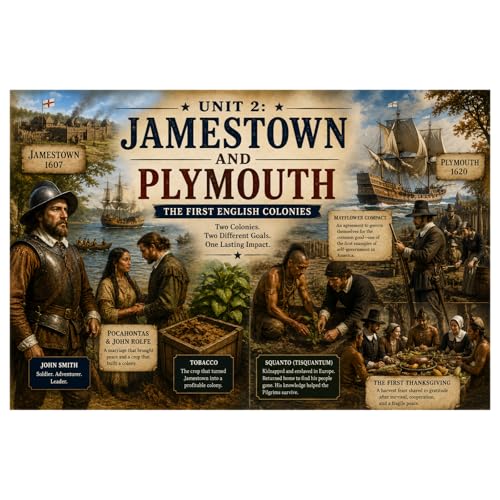
  • US History 1492-1877, Unit 2: Colonial America: Jamestown and Plymouth
    2026/05/14

    In this lesson from Unit 2: Colonial America, students examine the founding and struggles of two of the earliest English colonies in North America: Jamestown and Plymouth. Students explore how the goals, challenges, and survival strategies of these colonies helped shape the future development of Colonial America.

    The lesson begins with important vocabulary including charter and representative government before examining the founding of Jamestown in 1607 by the Virginia Company of London. Students learn how investors hoped to find gold and establish profitable trade, only to face disease, starvation, conflict, and near collapse during the colony’s early years.

    A major focus of the lesson is Captain John Smith and his remarkable background as a mercenary, adventurer, and sea fighter before arriving in Virginia. Students explore how Smith’s harsh leadership and survival experience helped keep Jamestown alive during periods of extreme hardship.

    The lesson also examines the relationship between the English settlers and the Powhatan Confederacy, including the role of Pocahontas as a cultural link between the groups. Students learn about Pocahontas’s kidnapping by the English, her forced conversion to Christianity, and her marriage to John Rolfe, whose successful tobacco cultivation transformed Jamestown into a profitable colony and secured its survival.

    The lesson then shifts to Plymouth Colony and the Pilgrims’ search for religious freedom after separating from the Anglican Church in England. Students study the Mayflower voyage, the creation of the Mayflower Compact as an early form of self-government, and the brutal conditions faced by the settlers during their first winter.

    Students also explore the complex history of Squanto, including his kidnapping and enslavement in Europe, his ability to speak English, and his return home to find his village destroyed by disease and Plymouth Colony established on the land where his people once lived. The lesson highlights how Squanto’s assistance became critical to the survival of the Pilgrims.

    Finally, students analyze how both colonies relied on Native American aid, defensive measures, diplomacy, and at times violence to survive. The lesson concludes with the development of temporary alliances between settlers and Native Americans that eventually led to the event remembered as the first Thanksgiving.

    By the end of the lesson, students will understand how Jamestown and Plymouth represented two very different colonial goals—profit and religion—while both laying the groundwork for permanent English settlement in North America.

    続きを読む 一部表示
    11 分