

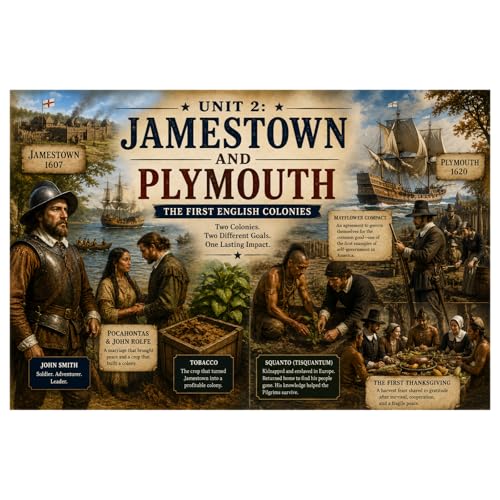
US History 1492-1877, Unit 2: Colonial America: Jamestown and Plymouth
カートのアイテムが多すぎます
カートに追加できませんでした。
ウィッシュリストに追加できませんでした。
ほしい物リストの削除に失敗しました。
ポッドキャストのフォローに失敗しました
ポッドキャストのフォロー解除に失敗しました

US History 1492-1877, Unit 2: Colonial America: Jamestown and Plymouth
-
ナレーター:
-
著者:
In this lesson from Unit 2: Colonial America, students examine the founding and struggles of two of the earliest English colonies in North America: Jamestown and Plymouth. Students explore how the goals, challenges, and survival strategies of these colonies helped shape the future development of Colonial America.
The lesson begins with important vocabulary including charter and representative government before examining the founding of Jamestown in 1607 by the Virginia Company of London. Students learn how investors hoped to find gold and establish profitable trade, only to face disease, starvation, conflict, and near collapse during the colony’s early years.
A major focus of the lesson is Captain John Smith and his remarkable background as a mercenary, adventurer, and sea fighter before arriving in Virginia. Students explore how Smith’s harsh leadership and survival experience helped keep Jamestown alive during periods of extreme hardship.
The lesson also examines the relationship between the English settlers and the Powhatan Confederacy, including the role of Pocahontas as a cultural link between the groups. Students learn about Pocahontas’s kidnapping by the English, her forced conversion to Christianity, and her marriage to John Rolfe, whose successful tobacco cultivation transformed Jamestown into a profitable colony and secured its survival.
The lesson then shifts to Plymouth Colony and the Pilgrims’ search for religious freedom after separating from the Anglican Church in England. Students study the Mayflower voyage, the creation of the Mayflower Compact as an early form of self-government, and the brutal conditions faced by the settlers during their first winter.
Students also explore the complex history of Squanto, including his kidnapping and enslavement in Europe, his ability to speak English, and his return home to find his village destroyed by disease and Plymouth Colony established on the land where his people once lived. The lesson highlights how Squanto’s assistance became critical to the survival of the Pilgrims.
Finally, students analyze how both colonies relied on Native American aid, defensive measures, diplomacy, and at times violence to survive. The lesson concludes with the development of temporary alliances between settlers and Native Americans that eventually led to the event remembered as the first Thanksgiving.
By the end of the lesson, students will understand how Jamestown and Plymouth represented two very different colonial goals—profit and religion—while both laying the groundwork for permanent English settlement in North America.