エピソード

  • Episode 12: “He Didn't Change 800 Women… They Changed Him.” -with Guest Brad Walsh
    2026/10/31

    What happens when a man stops trying to have all the answers and starts really listening to women?

    Apparently, his entire world changes.

    This week on The Conscious Leaders Unfiltered, Cheryl and Kiah welcome Brad Walsh, photographer, women's empowerment advocate, and host of the Empowerography podcast, where he's spent more than 800 conversations doing something beautifully simple, yet surprisingly rare: listening.

    Not the kind where you're already preparing your response. The kind where you put your ego aside, get curious, and allow someone else's story to change you.

    Brad's journey began behind a camera, helping women see themselves through a different lens. What started as photography became a mission to help women recognize their worth, reclaim their confidence, and feel truly seen.

    While Brad was helping women see themselves differently, they were teaching him to see the world differently, too.

    Through hundreds of conversations, he discovered the extraordinary resilience of women, the invisible weight so many carry, and just how much men still have to learn.

    And somewhere along the way, he started unlearning a few things himself.

    Comparison. Ego. The belief that he wasn't worthy.

    Together, we explore why conscious leadership isn't about having all the answers. Sometimes the most powerful thing we can do is stop talking, start listening, and make room for someone else's experience.

    • 800+ stories. One changed man. What women taught Brad about resilience, strength, and leadership.

    • More than a photograph. How boudoir photography became an experience of self-love, confidence, and empowerment.

    • Listening or just waiting to talk? Why presence matters more than having the perfect response.

    • What men don't always see. The emotional labour, expectations, and deeply rooted challenges women navigate.

    • Unlearning unworthiness. Letting go of comparison and realizing the only person worth competing with is yesterday's version of yourself.

    • Creating safety through connection. Helping people feel seen, heard, and valued.

    • The HERE method. Four simple practices for becoming a better listener and leader.

    One of our favourite takeaways? Brad's HERE method.

    H — Hold Space: Be present without judgment

    E — Empathize Without Ego: It's not about you.

    A — Ask Questions: Get curious. Listen to understand, not respond.

    R — Respond With Presence: Be intentional with your words and energy.

    Easy? Well… that's where the conscious part comes in.

    Because leadership isn't about being the loudest voice in the room. It's about making sure other voices are heard.

    💬 “Her voice matters as much as yours, so start to listen.”

    💬 “Conscious leadership means leading with presence instead of ego.”

    💬 “Confidence comes through doing.”

    You don't have to experience someone's journey to respect it. But you do have to be willing to listen.

    Sometimes our greatest growth happens when we allow someone else's story to challenge what we thought we knew.

    When we choose curiosity over defensiveness.

    Understanding over assumptions.

    Presence over ego.

    Being a conscious leader doesn't mean having all the answers. It means being willing to learn, unlearn, and occasionally admit that maybe we didn't know as much as we thought we did.

    And isn't that where the magic happens?

    🌐 Website: https://empowerographypodcast.com

    📸 Instagram: https://www.instagram.com/empowerographypodcast

    💼 LinkedIn: https://www.linkedin.com/in/bradwalsh70

    🎥 YouTube: https://www.youtube.com/@Empowerography

    🎙️ The Conscious Leaders Unfiltered — Episode 12

    📅 October 31, 2026 | 12 PM

    🎧 Available on Spotify, YouTube, and your favourite podcast platforms.

    Stay curious. Stay conscious. And never underestimate the power of making someone feel seen.

    With love,
    Cheryl & Kiah ❤️

    WHAT WE GET INTOTHE HERE METHOD: LESS EGO, MORE PRESENCEWORDS THAT STAYED WITH USOUR BIGGEST TAKEAWAYCONNECT WITH BRAD WALSHJOIN THE CONVERSATION

    続きを読む 一部表示
    1 時間 5 分
  • Episode 11: “Wait… You Can Lead With Heart AND Hold People Accountable?!” — With Guest Dianne White
    2026/10/24

    What happens when leadership gets messy, the future is uncertain, and the people looking to you for answers need more than a motivational speech?

    You lead with heart. You show up with intention. And sometimes, you learn that the most powerful thing you can ask someone is, “What do you need from me today?”

    In this episode of The Conscious Leaders Unfiltered, Cheryl and Kiah sit down with the incredible Dianne White, a seasoned retail leader who knows a thing or two about building strong teams, navigating change, and finding the human side of leadership when things get tough.

    And this one is personal!

    From first impressions and a memorable yellow jacket to the mentorship, laughter, and lessons that shaped their leadership journeys, there's plenty of history at this table.

    Dianne takes us behind the scenes of her leadership journey, sharing how her mother's resilience, her family's entrepreneurial roots, and more than two decades of experience taught her that leadership isn't about having all the answers. It's about helping people discover what they're capable of.

    We get into the uncomfortable stuff, too. Balancing empathy with accountability. And recognizing that sometimes the greatest impact you make as a leader has nothing to do with business results and everything to do with how someone felt because of you.

    Because here's the thing: You can care deeply about people AND hold them accountable. In fact, that's where conscious leadership really begins.

    • Leading when everything feels uncertain. What happens when you're responsible for motivating a team whose jobs may be disappearing? Dianne shares the reality of leading through liquidation with compassion and honesty.

    • The mentorship that came full circle. Kiah and Dianne share the stories, lessons, and unexpected moments that shaped their relationship and helped them grow as leaders.

    • Empathy and accountability can absolutely coexist. Caring about someone doesn't mean avoiding the tough conversations. It means having them with intention.

    • Are you catching people doing things right? Dianne shares a powerful lesson about recognition and why celebrating the good matters just as much as coaching the gaps.

    • Stop managing tasks. Start connecting with humans. From daily check-ins to meaningful conversations, we explore how trust is built in the smallest moments.

    • Customer experience starts with the leader. Forget robotic scripts and forced smiles. Genuine connection begins with how we show up for our teams.

    • Reflection without the self-criticism spiral. How do we learn from our mistakes without allowing them to define us?

    • The courage to fail. Why becoming a better leader means accepting that sometimes you'll get it wrong, and choosing to grow anyway.

    “If I'm not growing people, I'm not leading people.”

    That one deserves a moment. Because how often do we measure leadership by what gets done instead of who grows along the way?

    “Conscious leadership for me is leading with purpose, empathy, and intention.”

    Not just when things are going well. Especially when they're not.

    “Be prepared to fail to become a better leader.”

    Because perfection was never the goal. Growth was.

    Here's our challenge to you after listening:

    • Before you leave today, ask someone, “What do you need from me?” And really listen.

    • Catch someone doing something right and tell them why it mattered.

    • Give yourself permission to learn from yesterday without carrying the weight of it into tomorrow.

    • Remember that the people you lead are people first, with lives, challenges, dreams, and stories you may know nothing about.

    Because the true measure of leadership isn't just what you accomplish. It's who becomes better because you were part of their journey.

    So grab your coffee, settle in, and join us for a conversation filled with heart, honesty, a little laughter, and plenty of moments that might just make you rethink how you lead.

    And as always, go find the good and lead with love. ❤️


    続きを読む 一部表示
    58 分
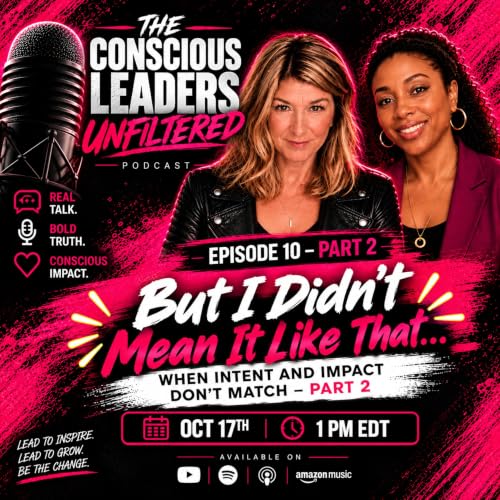
  • Episode 10 - Part 2: “But I Didn’t Mean It Like That…” — When Intent and Impact Don’t Match
    2026/10/17

    What happens when you genuinely didn’t mean to hurt someone… but you did?

    In this episode of The Conscious Leaders Unfiltered, Cheryl and Kiah get into one of those conversations that sounds simple until you’re actually living it: what happens when our intent and our impact don’t match?

    Because “But I didn’t mean it like that” might be completely true. But so is the other person’s experience.

    We unpack what happens when our instinct is to defend our character instead of getting curious about our impact, why being a good person doesn’t mean you’ll always get it right, and what accountability actually looks like when your intentions and someone else’s experience collide.

    And yes, we turn the mirror on ourselves too — because conscious leadership isn’t about mastering the perfect apology or never causing harm. It’s about becoming aware enough to notice your reaction, manage your ego, listen to what you may not fully understand, and choose what you do next.

    • Why intent and impact can both be true at the same time
    • Why “you hurt me” can immediately feel like “you think I’m a bad person”
    • What defensiveness is often trying to protect
    • How to pause before making someone else’s hurt about your discomfort
    • Why even a well-intended compliment can land differently than expected
    • The difference between explaining your intent and using it to dismiss impact
    • Why identity, lived experience, power and systemic barriers can influence how something lands
    • How curiosity can interrupt defensiveness in real time
    • Why reflection matters — not so we can beat ourselves up, but so we can show up differently next time
    • How to accept someone’s experience without necessarily agreeing with every part of their interpretation
    • Why conscious leadership asks us to care more about our response than proving we are a good person

    Your intent might explain the first moment. What you do after that reveals your leadership.

    You don’t have to erase your intention.

    You don’t have to absorb someone else’s entire interpretation of who you are.

    And you don’t have to get everything right.

    But when someone tells you that something you said or did hurt them, “I didn’t mean it like that” can’t always be where the conversation ends.

    There is an opportunity to pause long enough to ask:

    What is mine to own here?

    That’s where awareness becomes accountability.

    Two things can be true.
    You can have meant well and still have caused harm. Acknowledging one doesn’t automatically erase the other.

    Repair matters more than defense.
    Once we understand there has been an impact, the goal doesn’t have to be proving what we meant. It can become understanding what happened and deciding how we move forward.

    Reaction isn’t the end of the story.
    Defensiveness might show up first. Ego might show up first. Discomfort might show up first. Conscious leadership is noticing what showed up — and deciding whether you want it making the next decision.

    Reflection should change something.
    Looking back isn’t about endlessly replaying the moment. It’s about learning enough from it that the next version of you has another choice available.

    When someone tells you that you hurt them, what shows up first — curiosity or defense?

    Can you acknowledge someone’s impact without immediately explaining your intention?

    Are you apologizing because you understand, or because you desperately want the uncomfortable conversation to be over?

    And maybe the biggest one:

    When your intent and your impact don’t match, who do you choose to become next?

    Because conscious leadership was never about getting it right every single time.

    It’s about being willing to see yourself clearly enough to grow when you don’t.

    Intent can explain the moment.
    Awareness helps us understand it.
    But what we choose next is where leadership begins.

    In this conversationThe idea we kept coming back toA few things we’re taking with usQuestions we’re sitting with

    続きを読む 一部表示
    35 分
  • Episode 10: “But I Didn’t Mean It Like That…” — When Intent and Impact Don’t Match
    2026/10/17

    What happens when you genuinely didn’t mean to hurt someone… but you did?

    In this episode of The Conscious Leaders Unfiltered, Cheryl and Kiah get into one of those conversations that sounds simple until you’re actually living it: what happens when our intent and our impact don’t match?

    Because “But I didn’t mean it like that” might be completely true. But so is the other person’s experience.

    We unpack what happens when our instinct is to defend our character instead of getting curious about our impact, why being a good person doesn’t mean you’ll always get it right, and what accountability actually looks like when your intentions and someone else’s experience collide.

    And yes, we turn the mirror on ourselves too — because conscious leadership isn’t about mastering the perfect apology or never causing harm. It’s about becoming aware enough to notice your reaction, manage your ego, listen to what you may not fully understand, and choose what you do next.

    • Why intent and impact can both be true at the same time
    • Why “you hurt me” can immediately feel like “you think I’m a bad person”
    • What defensiveness is often trying to protect
    • How to pause before making someone else’s hurt about your discomfort
    • Why even a well-intended compliment can land differently than expected
    • The difference between explaining your intent and using it to dismiss impact
    • Why identity, lived experience, power and systemic barriers can influence how something lands
    • How curiosity can interrupt defensiveness in real time
    • Why reflection matters — not so we can beat ourselves up, but so we can show up differently next time
    • How to accept someone’s experience without necessarily agreeing with every part of their interpretation
    • Why conscious leadership asks us to care more about our response than proving we are a good person

    Your intent might explain the first moment. What you do after that reveals your leadership.

    You don’t have to erase your intention.

    You don’t have to absorb someone else’s entire interpretation of who you are.

    And you don’t have to get everything right.

    But when someone tells you that something you said or did hurt them, “I didn’t mean it like that” can’t always be where the conversation ends.

    There is an opportunity to pause long enough to ask:

    What is mine to own here?

    That’s where awareness becomes accountability.

    Two things can be true.
    You can have meant well and still have caused harm. Acknowledging one doesn’t automatically erase the other.

    Repair matters more than defense.
    Once we understand there has been an impact, the goal doesn’t have to be proving what we meant. It can become understanding what happened and deciding how we move forward.

    Reaction isn’t the end of the story.
    Defensiveness might show up first. Ego might show up first. Discomfort might show up first. Conscious leadership is noticing what showed up — and deciding whether you want it making the next decision.

    Reflection should change something.
    Looking back isn’t about endlessly replaying the moment. It’s about learning enough from it that the next version of you has another choice available.

    When someone tells you that you hurt them, what shows up first — curiosity or defense?

    Can you acknowledge someone’s impact without immediately explaining your intention?

    Are you apologizing because you understand, or because you desperately want the uncomfortable conversation to be over?

    And maybe the biggest one:

    When your intent and your impact don’t match, who do you choose to become next?

    Because conscious leadership was never about getting it right every single time.

    It’s about being willing to see yourself clearly enough to grow when you don’t.

    Intent can explain the moment.
    Awareness helps us understand it.
    But what we choose next is where leadership begins.

    In this conversationThe idea we kept coming back toA few things we’re taking with usQuestions we’re sitting with

    続きを読む 一部表示
    41 分
  • Episode 9: Your Sunshine Called. It Wants You Back. Deborah Mallow on Joy, Mindset & Coming Back to Yourself
    2026/10/10

    What if feeling better isn’t about becoming a whole new person—but finding your way back to the person who was there all along?

    In this episode of The Conscious Leaders Unfiltered, Cheryl and Kiah sit down with mindset and well-being strategist Deborah Mallow, author of Six Steps to Fewer Days That Suck, for a conversation about burnout, self-belief, resilience, kindness, and reconnecting with your inner sunshine.

    And yes… we absolutely had to talk about a book with “fewer days that suck” in the title. 😂

    Deborah shares the moment she found herself completely depleted on a New York City subway platform despite being successful on paper—and realized something had to change.

    That realization became the beginning of a much bigger journey.

    Together, we explore what happens when we stop waiting for our circumstances to change and start paying attention to the small choices, thoughts, and reactions that are actually within our control.

    Conscious Leadership begins with how you lead yourself.

    • The moment “successful” stopped feeling successful. Deborah shares how burnout during her career as a top pharmaceutical sales rep forced her to rethink how she was living.
    • Your brain isn’t as stuck as you think. We talk neuroplasticity and how small, repeated choices can gradually create entirely different thought patterns.
    • Where did your sunshine go? Deborah explains what “reconnecting with your sunshine” really means—and why joy, spirit, confidence, and our sense of self can get buried beneath responsibilities.
    • The problem with always putting yourself last. Women, parents, leaders, caregivers… we’re looking at you. Running on empty isn’t proof that you care more.
    • Failure might need a rebrand. Instead of treating mistakes as evidence that we aren’t capable, Deborah invites us to see them as education.
    • Self-kindness isn’t fluff. It’s difficult to build confidence, resilience, or sustainable leadership while constantly tearing yourself down internally.
    • Belief comes before change. Before the strategy, the habit tracker, or the perfect morning routine, there has to be some part of you willing to believe something different is possible.
    • Leadership creates ripples. How we treat ourselves affects how we show up for other people—and kindness, confidence, and positive energy rarely stop with us.

    This conversation is practical, vulnerable, occasionally hilarious, and full of those deceptively simple reminders that make you stop and think:

    Wait… why am I making this so much harder on myself?

    Maybe reconnecting with yourself doesn’t require one enormous transformation.

    Maybe it starts with noticing.

    Choosing differently.

    Giving yourself a little more grace.

    And remembering that your sunshine was never actually gone. ☀️

    “If I don't change something, nothing will ever change.”

    “We need to lift ourselves up and be kind and build confidence, build resilience, feel good about ourselves.”

    “I defend my dignity and I honor my value.”

    At its core, this episode is a reminder that becoming more conscious isn’t about getting everything right.

    It’s about becoming aware enough to recognize when something isn’t working, kind enough not to beat yourself up for it, and brave enough to make a different choice.

    Your sunshine didn’t disappear.

    Sometimes life, responsibility, stress, expectations, and everything we think we should be doing simply get in the way of seeing it.

    Maybe it’s time to answer the call. ☀️

    ☀️ Website: The Daily Decisions — thedailydecisions.com
    📸 Instagram: @daily.decisions
    💼 LinkedIn: Deborah Mallow — The Daily Decisions™️
    💙 Facebook: The Daily Decisions with Deborah Mallow
    📚 Book: Six Steps to Fewer Days That Suck

    Follow Deborah for more on mindset, happiness, resilience, self-kindness, and creating more days that feel like you.

    Find the good. Lead with love.

    In this episode, we get into:A few lines that stayed with usConnect with Deborah Mallow

    続きを読む 一部表示
    42 分
  • Episode 8: What If You’re Not Stuck… Just Really Comfortable? Kayleigh Kennedy on Mindset & Self-Sabotage
    2026/10/03

    What if you’re not actually stuck?

    What if your mind has just gotten really good at keeping you exactly where you are?

    In this episode of The Conscious Leaders Unfiltered, Cheryl and Kiah sit down with mindset coach, entrepreneur, and speaker Kayleigh Kennedy for a conversation about the beliefs we carry, the comfort zones we unknowingly protect, and why knowing we want something different doesn’t always mean we’re ready to behave differently.

    Kayleigh shares her journey from bartending to marketing, entrepreneurship, and eventually mindset coaching—and how some of her greatest inner work happened during one of the most challenging seasons of her life.

    Together, we unpack self-worth, visibility, perfectionism, self-sabotage, and the uncomfortable truth that sometimes the biggest thing standing between us and growth is the version of ourselves we’ve become really comfortable being.

    Kayleigh introduces the idea of mindset as an internal thermostat—the subconscious beliefs and self-image that quietly pull us back toward what feels familiar, even when we consciously want something more.

    We explore why visibility can feel so uncomfortable, particularly when we think showing up means performing some polished, perfect version of ourselves.

    Kayleigh also breaks down the connection between self-sabotage, perfectionism, and not-enoughness, and why positive thinking alone isn’t enough to create lasting change.

    Real transformation, she explains, comes through repetition + action + self-compassion.

    And maybe one of the biggest reminders from this conversation?

    You don’t have to feel confident before you move.

    Sometimes you take the imperfect action first. Then another. Then another.

    And somewhere along the way, confidence catches up.

    • Your self-image can quietly determine what feels possible.
    • Sometimes “stuck” is actually familiarity disguised as safety.
    • Visibility feels heavier when you’re performing instead of being yourself.
    • Perfectionism can look suspiciously like having “high standards.”
    • Awareness can reveal the pattern, but action begins changing it.
    • Imperfect action gives you something perfection never can: feedback.
    • Self-compassion isn’t lowering the bar—it’s changing how you treat yourself while reaching for it.
    • Conscious leadership begins with how you lead yourself.
    • Rest, regulation, and intentional pauses are leadership practices too.
    • Fear doesn’t have to disappear before you move forward.

    How self-aware are you, really?

    Not just about what you believe—but about the patterns, stories, comfort zones, and behaviours quietly influencing the way you lead, work, parent, connect, and show up.

    Because sometimes growth isn’t about figuring out how to get unstuck.

    It’s about becoming willing to leave what’s comfortable.

    Instagram: @thekayleighkennedy
    LinkedIn: Kayleigh Kennedy
    Website: kayleighkennedy.com

    Kayleigh also shares more about her Limitless Belief Mindset program and her work helping established entrepreneurs grow without burning out or sacrificing what matters most.

    In this episodeKey takeawaysA question worth sitting withConnect with Kayleigh Kennedy

    続きを読む 一部表示
    50 分
  • Episode 7: You Survived It. Now You Might Have to Unlearn It.
    2026/09/26

    What if some of the things that made you successful are the very things you now need to let go of?

    In this episode of The Conscious Leaders Unfiltered, Cheryl and Kiah get personal about the leadership habits they once thought were strengths—perfectionism, control, fixing everything, having all the answers, staying strong, and avoiding vulnerability.

    Because here’s the uncomfortable part: some behaviours weren’t flaws when we developed them. They helped us survive, succeed, earn praise, or feel safe. But survival skills can become limitations when we carry them into places they no longer belong.

    Cheryl and Kiah explore how childhood, school, early workplaces, and the validation we receive along the way quietly shape the leaders we become. And they ask a harder question: What happens when the version of you that got you here isn’t the version that can take you where you want to go next?

    This is a conversation about unlearning without shaming who you used to be—and recognizing that conscious leadership isn’t about getting everything right. It’s about being willing to notice, question, own, and change.

    Strong leadership gets redefined.
    Cheryl and Kiah unpack how having all the answers, being overly directive, and equating control with competence can look like strong leadership while actually creating distance, dependence, and resistance.

    Kiah examines where her directive leadership came from.
    She reflects on early experiences of being told what to do and how those experiences shaped a highly instructional, solution-focused leadership style that sometimes left too little room for collaboration.

    Cheryl confronts her identity as “the fixer.”
    Being the person who could solve anything earned recognition and validation—but eventually, always being available to fix everyone else’s problems became exhausting and unsustainable.

    They unpack survival behaviours that overstayed their welcome.
    Perfectionism. Emotional rigidity. Control. Over-functioning. Conflict avoidance. Always being strong. These patterns may have served a purpose once, but conscious leadership requires asking whether they still do.

    They explore the danger of rewarded behaviour.
    Sometimes the hardest patterns to change are the ones people applauded us for. Cheryl and Kiah examine what happens when praise reinforces behaviours that eventually limit us and the people we lead.

    Other people become mirrors.
    Instead of immediately judging someone’s reaction, body language, or energy, what if we became curious about what it might be reflecting back to us?

    Cheryl challenges our attachment to predetermined outcomes.
    Conscious leadership sometimes means loosening our grip on exactly how things “should” turn out and making room for possibilities we haven’t considered yet.

    Kiah gets real about limiting language.
    She shares how words like never can quietly become declarations about our future—and how she is learning to recognize and release defeatist thinking before it becomes a self-imposed boundary.

    They name the leadership identities that are hardest to release.
    Being infallible. Always strong. Always available. Never needing help. Never showing vulnerability. Sometimes growth means letting people see that you don’t have it all figured out.

    And ultimately, this episode comes back to compassion.
    You can take accountability for who you were without staying trapped there. Other people may forgive your mistakes—but eventually, you have to make room to forgive yourself, too.

    “What did I mistake for leadership? I guess in a way it was perfection—or pretending like I knew all the answers.”

    “You knew what you knew when you were there. That’s it.”

    “Listen more.”

    What helped you survive, succeed, or feel safe in an earlier version of your life—but might be asking to be unlearned now?

    Because growth isn’t always about becoming more.

    Sometimes growth is finally putting down what you no longer need to carry.

    Cheryl x Kiah

    続きを読む 一部表示
    55 分
  • Episode 6: Who Said You Had to Carry it All? Justine Asante on Leadership, Identity and Letting Go
    2026/09/19

    What happens when being “the strong one” becomes part of your identity?

    In this episode, Cheryl and Kiah sit down with Justine Asante, leadership identity architect, author, speaker, and founder of The Institute for Sustainable Authority and Glamorous Goddess Coaching, for an unfiltered conversation about what happens when being capable slowly turns into carrying everything.

    You know the person—the fixer, problem solver, emotional anchor, the one everyone calls because she’ll handle it. But what happens when being needed becomes so connected to who you are that putting something down feels almost impossible?

    Together, we unpack how performance can become tied to worth, why burnout may be a symptom of something deeper, and Justine’s concept of identity strain—when we begin losing touch with who we are outside of our titles, responsibilities and everything we do for everyone else.

    Justine introduces her Performance-to-Power Evolution, challenging us to move away from constantly proving our value through output and toward sustainable authority rooted in awareness, regulation, boundaries and choice.

    • When being capable turns into carrying too much
    • Why high-achieving women often become “the strong one”
    • Why burnout may not actually be the root problem
    • What happens when identity becomes fused with productivity
    • The difference between being needed and being empowered
    • Why pausing, delegating and allowing imperfection can feel so uncomfortable
    • When being busy becomes proof of our value
    • Why harmony may serve us better than chasing perfect “balance”
    • How leadership changes through different seasons of life
    • Why “No” is a full sentence
    • Why giving 200% isn't always better leadership
    • What sustainable authority actually looks like
    • Why conscious leadership always starts within

    One of our biggest takeaways? You don't have to become less ambitious, less caring or less capable. You may just need to stop measuring your value by how much you can carry.

    And maybe the question isn't “Can I handle it?”

    Maybe it's “Why am I still the one handling all of it?”

    📚 The Light We Carry: Overcoming in Uncertain Times — Michelle Obama

    Michelle Obama explores navigating uncertainty, relationships, self-doubt and change while finding practices that help us stay grounded within ourselves.

    🌐 Website: glamorousgoddesscoaching.com

    📸 Instagram: @glamorousgoddesscoaching

    💼 LinkedIn: Justine Asante — @justineasante

    📘 Facebook: @GlamorousGoddessCoaching

    🎵 TikTok: @glamgoddesscoaching

    ▶️ YouTube: @glamorousgoddesscoachingllc

    Listen to The Conscious Leaders Unfiltered on:

    🎧 Spotify
    ▶️ YouTube
    🍎 Apple Podcasts
    🎵 Amazon Music

    Come for the leadership conversation. Stay for the uncomfortable questions, laughter, unfiltered moments and the reminder that conscious leadership starts within.

    The Conscious Leaders Unfiltered
    Hosted by Cheryl x Kiah

    In this conversation:Mentioned in this episodeConnect with Justine Asante🎙️ NEW EPISODE DROPS SEPTEMBER 19 AT 12 PM EDT

    続きを読む 一部表示
    50 分