

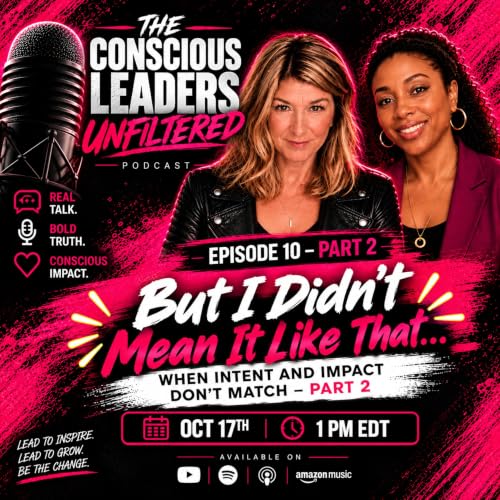
Episode 10 - Part 2: “But I Didn’t Mean It Like That…” — When Intent and Impact Don’t Match
カートのアイテムが多すぎます
カートに追加できませんでした。
ウィッシュリストに追加できませんでした。
ほしい物リストの削除に失敗しました。
ポッドキャストのフォローに失敗しました
ポッドキャストのフォロー解除に失敗しました

Episode 10 - Part 2: “But I Didn’t Mean It Like That…” — When Intent and Impact Don’t Match
-
ナレーター:
-
著者:
What happens when you genuinely didn’t mean to hurt someone… but you did?
In this episode of The Conscious Leaders Unfiltered, Cheryl and Kiah get into one of those conversations that sounds simple until you’re actually living it: what happens when our intent and our impact don’t match?
Because “But I didn’t mean it like that” might be completely true. But so is the other person’s experience.
We unpack what happens when our instinct is to defend our character instead of getting curious about our impact, why being a good person doesn’t mean you’ll always get it right, and what accountability actually looks like when your intentions and someone else’s experience collide.
And yes, we turn the mirror on ourselves too — because conscious leadership isn’t about mastering the perfect apology or never causing harm. It’s about becoming aware enough to notice your reaction, manage your ego, listen to what you may not fully understand, and choose what you do next.
- Why intent and impact can both be true at the same time
- Why “you hurt me” can immediately feel like “you think I’m a bad person”
- What defensiveness is often trying to protect
- How to pause before making someone else’s hurt about your discomfort
- Why even a well-intended compliment can land differently than expected
- The difference between explaining your intent and using it to dismiss impact
- Why identity, lived experience, power and systemic barriers can influence how something lands
- How curiosity can interrupt defensiveness in real time
- Why reflection matters — not so we can beat ourselves up, but so we can show up differently next time
- How to accept someone’s experience without necessarily agreeing with every part of their interpretation
- Why conscious leadership asks us to care more about our response than proving we are a good person
Your intent might explain the first moment. What you do after that reveals your leadership.
You don’t have to erase your intention.
You don’t have to absorb someone else’s entire interpretation of who you are.
And you don’t have to get everything right.
But when someone tells you that something you said or did hurt them, “I didn’t mean it like that” can’t always be where the conversation ends.
There is an opportunity to pause long enough to ask:
What is mine to own here?
That’s where awareness becomes accountability.
Two things can be true.
You can have meant well and still have caused harm. Acknowledging one doesn’t automatically erase the other.
Repair matters more than defense.
Once we understand there has been an impact, the goal doesn’t have to be proving what we meant. It can become understanding what happened and deciding how we move forward.
Reaction isn’t the end of the story.
Defensiveness might show up first. Ego might show up first. Discomfort might show up first. Conscious leadership is noticing what showed up — and deciding whether you want it making the next decision.
Reflection should change something.
Looking back isn’t about endlessly replaying the moment. It’s about learning enough from it that the next version of you has another choice available.
When someone tells you that you hurt them, what shows up first — curiosity or defense?
Can you acknowledge someone’s impact without immediately explaining your intention?
Are you apologizing because you understand, or because you desperately want the uncomfortable conversation to be over?
And maybe the biggest one:
When your intent and your impact don’t match, who do you choose to become next?
Because conscious leadership was never about getting it right every single time.
It’s about being willing to see yourself clearly enough to grow when you don’t.
Intent can explain the moment.
Awareness helps us understand it.
But what we choose next is where leadership begins.
In this conversationThe idea we kept coming back toA few things we’re taking with usQuestions we’re sitting with