エピソード

  • Dr Crippen: The Eyes of the World
    2026/09/22
    I investigated many murders during my career, more than I can count. But very few sent ripples much further than the communities in which they took place.Occasionally, though, I found myself at the centre of the country’s biggest news story.When your investigation dominates the headlines, the pressure is unreal.Every decision is scrutinised. Every delay criticised. Every mistake magnified.That attention ratchets up another level when a killer is identified and the manhunt becomes public.Suddenly, you’re not just trying to solve a murder and bring a killer to justice. You’re in a very public race against time. Every hour that passes without an arrest, fuels more speculation, more criticism and more questions about whether you’ll ever catch the person responsible.But it isn’t the criticism itself that keeps you awake at night.Throughout my career, the people I always felt most accountable to weren’t senior officers, politicians or journalists. They were the victim’s family. They had placed their trust in us at the darkest time of their lives.What you fear is that the constant public scrutiny begins to erode that trust. That they start to wonder whether the criticism they’re reading or hearing might be true. If that relationship begins to suffer, that’s when the pressure really hits.As I read about Walter Dew’s hunt for Dr Crippen, I couldn’t help wondering whether he felt that same burden of responsibility.The more I learned about his investigation, the greater the sense of kinship I felt with him. More than a century after Dew pursued Crippen, I found myself leading an international manhunt under remarkably similar circumstances.A celebrity reported missing.Murdered by her partner.The suspect fled abroad before the full picture emerged.The most heartbreaking difference was that my investigation also involved her two young sons.In almost every other aspect, the parallels were remarkable.In January 1910, American-born music hall singer, Cora Crippen, disappeared. A friend raised her concerns with the police, but initially not much appeared to have been done to locate her. But in July of that year, after the intervention of a police superintendent who had been contacted by friends of Cora, Chief Inspector Walter Dew visited the marital home and spoke with Cora’s husband, Dr Hawley Crippen.Just over a century later, concerns around the controlling behaviour by the partner of former Eastenders actress, Sian Blake, were raised by her family. As a result, police officers visited her home and spoke with her partner, Arthur Simpson-Kent.Both men gave seemingly plausible explanations as to their partner’s whereabouts.Crippen told Dew that Cora had left him for another man and travelled to America. Simpson-Kent said Sian had taken their two sons to visit a friend in Cambridge.Both homes were searched.Neither search revealed evidence to raise suspicion that either woman had come to any harm.For Walter Dew, verifying Cora’s whereabouts would have been extremely difficult, given the technology available in 1910.In Sian’s case, nobody could contact her after a text message was sent to her sister purportedly from Sian explaining that she needed to get away from everything. Sian was then officially reported as a missing person, along with her two sons, Zachary aged 8 and Amon aged 4. An investigation that was initially conducted by local police. Several weeks later, in the first week of January, her case was referred to us as the on-call murder team. A local superintendent feared serious harm may have come to them. Sadly, he was proven to be right.As detectives, you are taught to continually question the narrative.To never become fixed on one theory.What seems certain one day can change completely the next.Although Dew had accepted the explanation given to him, something about the story seemed to bother him. However, when he returned to make further enquiries with Crippen, the man had vanished.Whatever doubts Dew had been harbouring were now being confirmed by Crippen’s disappearance. After all, if he had been telling the truth, why would he run?Fearing what may have happened to Cora, he ordered a thorough search of the home, which led to a gruesome discovery.Below the brick floor of the basement lay the dismembered remains of a woman.Dew was convinced these were Cora Crippen.When Sian’s case came into my team, none of us believed we were being handed a simple missing persons case. One of the biggest alarm bells for me was the fact Sian had advanced motor neurone disease. She could just about care for herself, let alone the two boys. Added to this, by then, Simpson-Kent had disappeared, with all attempts to contact him having failed.Colleagues revisited the family home, intent on a more thorough search. They quickly discovered evidence of a violent incident, with substantial traces of blood having been painted over, in an apparent attempt to hide a crime.Within a few days of us taking ...
    続きを読む 一部表示
    21 分
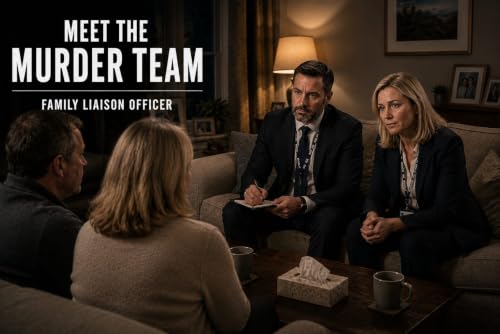
  • Meet the Murder Team: Family Liaison Officer
    2026/09/15
    As I sat there on the sofa, sitting across from me was what I could only describe as a broken family.Two parents who moments before had their whole world come crashing down around them.It was the message no parent ever expects to hear.I’m so sorry to tell you this but your son has died as the result of an assault.Murdered.Not even out of his teenage years.Less than an hour after he left the house saying he would see them later.Then my fellow murder detective and I rock up, telling them he wouldn’t be coming home.Ever.No matter how many times you deliver that message, it never gets easier. In fact, it probably gets harder because you know the impact those words are going to have. You’ve seen the devastation they cause.And there was no doubt those words had caused complete devastation.As a detective I had developed ways of dealing with most of what I saw in my career. The side that I found most difficult was witnessing the trauma of parents who have lost a child through murder.It was probably from being a parent myself. Some part of me wondering how I would cope in that situation (I’m not sure I could).It was that empathy I put down to what happened next.As I sat there, looking at this distraught couple, caught up in their emotions, I said something I had no place in saying.Out of nowhere I told them we would get them. That we would catch the people responsible for killing their son.You see, the thing is, how could I possibly promise that? How could I guarantee that would happen. Yes, we solve most murders, but there are those we don’t.I knew as soon as I said the words I shouldn’t have, and I regretted it straight away.If one of my detectives had said that I’d have had a go at them. You can’t promise something that isn’t in their gift.Thankfully, we did go on to catch his killers. And convict them. But at that time, I had no way of knowing that would happen.It was the only time I ever did that. But it was proof to me what I always knew.Being a family liaison officer wasn’t for me.It’s an unfortunate fact that some of the most important advances in policing come from the mistakes of the past.It often takes high-profile failings to adopt a better way of working. Which is how family liaison officers, or FLOs, came about.In 1992, one of the Metropolitan Police’s darkest moments occurred when 18-year-old Stephen Lawrence was murdered in a racist attack in Eltham, South-East London.The subsequent investigation into Stephen’s murder came under immense criticism, resulting in a public inquiry, chaired by Sir William Macpherson, that shone a light on numerous failings.One of those was the way in which investigators treated Stephen’s family.Up until then, how detectives engaged with bereaved relatives was far less structured than it is today.The Stephen Lawrence Inquiry became a catalyst for change.The Macpherson report made a number of recommendations about how police should work with bereaved families, including the use of designated and trained family liaison officers.Family liaison developed significantly in the years that followed and has since become a central part of murder investigations.So, that’s how the role developed, but what do they actually do?Well, let me dispel one myth straight away. A myth not only held by people outside of the police, but also many on the inside.They’re not there to look after the family.They’re most definitely not counsellors.They’re investigators.Detectives from the investigation team, whose role is to gather information that can assist the investigation.And for me, that’s at the heart of what makes this such an incredibly difficult role.But rather than me explain why, I want to try and put you in their place.Imagine you’re a detective on a murder team that has just taken on a new investigation.The victim is a 15-year-old who was stabbed and killed less than two hours ago.You have been allocated the role of lead family liaison officer. You will be assisted by a deputy, but the overall responsibility for that strand of the investigation is yours.The rest of the team have convened for their first meeting, where they will receive a briefing from the detectives who first attended the crime scene, but your initial meeting with the boy’s family is too important to wait for that briefing to conclude.As you make your way to their family home, you’re running through in your mind what will be required of you when you arrive.You know that you’re there to get what information you can that will help the investigation. You will want to build as good a picture as is possible of the boy’s life. Which school he went to. Who his friends were. Where he hung around. Had he had any issues recently. Was he involved in any criminality or gangs. What was his phone number. How did he normally travel around. And as far as they know, where had he been prior to the murder.If they’re open to it, you would like to look in his bedroom for anything that may...
    続きを読む 一部表示
    14 分
  • The Idaho Murders: Why?
    2026/09/08
    I can’t begin to imagine how many broken families I’ve sat opposite.People whose world has just been shattered by the news a loved one was murdered.If you hear me speak often enough, you will know I found this one of the hardest parts of being a murder detective.We all lose loved ones at some point in our lives. The pain is awful.But if that person has been taken by the actions of someone else, I can’t begin to imagine how much harder that must be.And that’s the thing. No matter how many times I witnessed that trauma, I could never truly know what they were going through.Unless it’s your loved one that’s been taken in that way, how can you possibly pretend to understand?But there was one thing I did learn to expect.One question I heard families ask time and time again.Why?The University of Idaho sits in the small town of Moscow, Idaho, about 300 miles east of Seattle.It’s the sort of university town you find all over the world. Thousands of young people living away from home for the first time, many living in shared student houses.One such house was at 1122 King Road, a three-storey house occupied by female students.On the night of 12th November 2022, those living at the house had been doing what most students do on a Saturday night, they were out socialising with friends.The first to arrive back were Dylan Mortensen (20) and Bethany Funke (20), who had been out separately that night. They each returned to their respective rooms.At around 1.45 a.m. on the Sunday morning, Xana Kernodle (20) came back to the house with her boyfriend, Ethan Chapin (20). The couple had been together for several months and Ethan was staying over for the night. They then went up to Xana’s room on the middle floor.At just before 2 a.m., best friends Madison “Maddie” Mogen (21) and Kaylee Goncalves (21) were dropped back to 1122 King Road by a cab after stopping at a late-night food truck. Kaylee was due to start a new job in Texas and had returned to Moscow to spend time with friends before she moved. That night she was staying with Maddie in her room on the top floor.But what had been a normal Saturday night changed when an intruder entered the house.According to the court records, shortly after 4 a.m. he entered through the rear sliding doors which, because the house was built into a slope, opened directly onto the middle floor.The suspect went to the top floor where he attacked and killed Maddie and Kaylee.The court records then say the suspect came back downstairs, where he encountered Xana before killing her and Ethan, who they say was asleep in Xana’s room.The suspect then left the house before leaving the area in a white car.It wasn’t until much later that the murders were discovered. Emergency services were called shortly before noon.Police arrived and established that they were dealing with a multiple murder, and the investigation began.WitnessesInvestigators needed to understand from the surviving housemates what they may have seen or heard that night. These were the accounts given to police:Dylan MortensenHaving returned home from her night out she went to her room on the middle floor and went to sleep.At around 4 a.m. Dylan was woken by noises from the floor above. She thought this was Kaylee playing with her dog. She also described hearing a female voice saying, “There’s someone here.”Dylan opened her bedroom door but saw nothing.She then heard what she described as sobbing coming from the direction of Xana’s room.Then she heard an unfamiliar male voice say “You’re going to be OK. I’m going to help you.” Dylan told investigators the tone wasn’t reassuring and was said in what she described as a weird way.She tried calling out to her housemates and contacting them by phone but had no response.Dylan then opened her bedroom door again. This time she saw a man dressed in dark clothing with his face partially covered. What stood out to her were his bushy eyebrows.The man continued past her and towards the sliding doors leading from the kitchen.Dylan went back into her room and began messaging Bethany. She told her that no one was answering and that she was confused and frightened. She said the man she had seen was wearing what looked like a ski mask.Bethany told Dylan to come downstairs to her room, telling her it would be better than being alone. Dylan did so, and the pair continued trying to contact their housemates without success.Later that morning, they contacted friends who came to the house. One of them discovered Xana’s body and at 11.58 a.m. a call was made to 911.Bethany FunkeBethany was in her bedroom on the bottom floor of the house.She told investigators that she didn’t recall anything particularly unusual that night, other than hearing what she thought was a firework and seeing what appeared to be a spark underneath her bedroom door.At around 4.22 a.m. she began receiving messages from Dylan, who told her that no one was answering and that she had seen a man ...
    続きを読む 一部表示
    31 分
  • Meet the Murder Team: The Senior Investigating Officer
    2026/09/01
    As I was running, I could feel my lungs burning and the lactic acid was starting to make my legs scream with pain. But there was no way he was getting away.For the last five minutes I’d been gaining on him, but each shot he fired back at me made me duck for cover.Then came my chance.As he sprinted across the next road, he failed to see the oncoming car.I saw him spin in the air like a cartwheel, landing in a heap on the floor. Although, somehow, he still had hold of the 9mm handgun, almost certainly the same one he’d used to dispatch his victim.I had no time to stop and think. I launched myself at him, kicking the gun from his hand. Then I threw all my weight into a right-hand cross that connected as sweet as a nut with his chin.He was knocked out cold.Before he had a chance to come to, I slapped the cuffs on him.Another killer caught, another case solved.Then I woke up.If the TV is to be believed, that would be just another day for me as a senior investigating officer. Thankfully, that couldn’t be further from the truth (which is lucky as I can’t run and I’m no fighter).So, if they aren’t chasing down killers and throwing themselves across car bonnets, what do they do?Well, a truer reflection of their role isn’t an action hero, it’s the conductor of an orchestra.The Senior Investigating Officer (SIO) plays a strategic role in an investigation. They don’t interview witnesses or interrogate suspects, in fact, they don’t do any of what we might think of as traditional detective work. So, yeah, pretty dull really.But, despite the lack of excitement, it’s one of the most important roles in any murder investigation, and they have the most influence on how successful the murder team is likely to be (or not).During these Meet the Murder Team articles I will introduce you to the various people who make up a murder investigation, and there are quite a few.In the UK murders aren’t investigated by individual detectives, it’s a team of anything from 20 to 100 officers, depending on the specific murder (although most will be at the lower end of that scale.)Each investigator will have a specific area that they’re responsible for. For instance, CCTV, phones, forensics or witnesses. They will be looking to gather the information and evidence from their area that, when brought together, can help solve the crime and convict those responsible.And this is where the SIO plays several very important roles.The first is making sure each of those officers knows what’s being asked of them.The CCTV officer has to know where to look for footage, what time parameters they need to cover and what on there they’re trying to find.The phones officer needs to know whose phone data to secure, how long back they should apply for it, which phone handsets to analyse and what it is they’re trying to prove.And that level of direction is required for every strand of evidence. If not, it would result in everyone running off in different directions, all doing whatever they think is best, not what’s best for the investigation.How do they get those instructions across? The answer is a written strategy.Every area of enquiry has its own document that outlines what is required from it. Where to look for evidence, how to look for it and what they’re trying to prove.If done properly, each of those strategy documents will take hours to complete. So, if you multiply that by each area of enquiry, it doesn’t leave much time for chasing down the killer.When I made the transition from detective sergeant to detective inspector, it was those hours sitting behind my desk I found the hardest. As a DS I’d be out there doing all the good stuff. One of the most rewarding times for me was arresting the suspects and getting to look them in the eye. As DI the closest I got was seeing the photo taken of them in custody.And of all the things I see in crime dramas, it’s that misrepresentation that annoys me the most.Now, don’t get me wrong, I get that it’s entertainment. If they did portray the truth, watching someone like Luther sat in an office for hours, banging away at his keyboard, is probably gonna damage their viewing figures.In fact, when I’ve been interviewed in the past, I often get asked what’s the worst crime drama on TV and, I will usually come back to Luther. Not because it’s badly acted, I actually really like Idris Elba, but because it’s just so blinking far-fetched. One national newspaper that interviewed me even used that as a headline “Murder Detective Names Worst Show on TV.”It did make me worry slightly if I ever were to cross paths with Mr Elba, that he may have got wind of me dissing his show. But we mix in very different circles, so that’s not likely to happen.Well, that’s what I thought, until I was invited to a production company to talk over some ideas for TV. Little did I know before I agreed that it was actually owned by the big man himself. To say I felt sheepish when I walked ...
    続きを読む 一部表示
    9 分
  • The Soham Murders: The Ones You Carry
    2026/08/24
    As we made our way through Great Ormond Street Hospital, it took a while to find the place we were looking for.It always did.No matter which hospital I visited, the mortuary always seemed hidden away.And for good reason.It’s the last department anyone wants to think about.Especially here.As many times as I’d walked similar corridors, this felt different.It was different.When I entered the room, the sights and smells were the same as every other mortuary I’d entered before.But not like this.Then I saw him.Three years old. Not much bigger than a baby.If I close my eyes now, I can still see his body lying on that metal table.None of my training had prepared me for this.Yet here I was.Ten-year-old best friends Holly Wells and Jessica Chapman lived just a few streets apart in Soham, a small Cambridgeshire market town surrounded by open countryside.On Sunday 4 August 2002, Jessica went to Holly’s house and spent the afternoon there. Holly’s family were having a barbecue and had guests over.The girls played on the computer in Holly’s bedroom before coming downstairs to eat with the rest of the family.Just after 5pm, Holly’s mum, Nicola, took a photograph of them wearing matching Manchester United shirts.After eating, the girls went back upstairs and continued playing on the computer.Later that evening, Nicola called upstairs for them to come down and say goodbye to the guests who were leaving.There was no reply.She called again.Still nothing.Nicola went upstairs expecting to find them in Holly’s bedroom.The room was empty.The girls had left the house, but nobody knew when they had gone or where they had gone.Jessica’s parents were contacted, but the girls weren’t there either.Family and friends began looking for them, searching around the house before checking places they thought the girls might have gone.As the evening wore on, their concern grew and, at around 10pm, the police were called.Local uniformed officers attended and began a missing person enquiry.They needed to establish when and where the girls had last been seen, obtain their descriptions, identify places they might have gone and understand whether their disappearance was out of character.It was.Officers began searching Soham and the surrounding countryside.A police helicopter was deployed, along with a dog handler, traffic officers and four-wheel-drive police vehicles.Local residents also came out to help.But despite their efforts, Holly and Jessica were not found that night.The following day, the search expanded beyond a local enquiry. Officers began arriving from surrounding forces to help.Public appeals increased, bringing in a significant amount of information. This included several potential sightings of the girls, each of which needed to be followed up urgently.One local resident reported seeing Holly and Jessica between 6.30pm and 6.40pm on Sunday evening. He said the girls had stopped outside his house to ask whether his partner, a teaching assistant from their primary school was at home. After telling them she was away, he watched them walk away towards St Andrew’s Church.As news of the case spread, more members of the public came to Soham to help with the searches until there were hundreds of people there offering their support.As part of the investigation, Family Liaison Officers (FLOs) were assigned to the Wells and Chapman families.After a couple of days, the enquiry developed into a major investigation, with resources reflecting the growing concern for the girls’ welfare.An incident room was established to provide a central point for information coming in from the public.A dedicated intelligence cell was set up to assess the growing amount of information and build a picture of the girls’ lives, people of potential interest and any links between them.The investigation now included house-to-house enquiries, examination of CCTV, vehicle checks, tracing witnesses and assessing every potential sighting of the girls.Specialist advisers coordinated searches of homes, gardens, business premises, waterways and open ground using police dogs, divers, aerial support and specially trained search officers.The photograph Nicola Wells had taken just before the girls disappeared became the image used in national appeals, showing exactly what they looked like and the clothing they had been wearing.Among the information coming into the police was a report from a taxi driver who said he had seen the driver of a dark green saloon car travelling erratically along the A142 from Soham towards Newmarket. He described the driver repeatedly turning towards the back seats and appearing to struggle with two children inside the car. The sighting became a major line of enquiry.Investigators were working to several theories of what may have happened to the girls.One was that harm had come to them. Detectives began identifying and checking known sex offenders in the area, as well as anyone who might pose a risk to children.Another line ...
    続きを読む 一部表示
    22 分
  • Rachel Nickell: The Detective's Trap
    2026/08/24
    If I look back over the murders that have shaped modern Britain, few victims are as immediately recognisable as Rachel Nickell.As I write this, I immediately picture that image of a happy, loving mother.More than three decades have passed since Rachel was murdered. In that time, tens of thousands of other people have lost their lives to homicide in the UK. Yet Rachel’s case remains one of the few almost everyone remembers.So, what is it about Rachel and her murder that has made it remain such a part of our nation’s psyche?Part of the answer is undoubtedly that familiar image of Rachel smiling into the camera. But I suspect an even bigger reason lies in what happened after her death.On the morning of her murder, 23-year-old Rachel was walking the family golden retriever, Molly, on Wimbledon Common with her two-year-old son, Alex. A route they regularly took to exercise the dog.What should have been nothing more than a routine walk in the park became one of Britain’s most notorious murders.Rachel was subjected to a sustained and frenzied knife attack, suffering 49 stab wounds to her upper body and neck. She was also sexually assaulted.Perhaps the most heartbreaking aspect of the case was that Alex witnessed the attack. When he was found, he was still clinging to his mother’s body, pleading with her to wake up.When the police arrived, it would have been immediately obvious they were dealing with an exceptionally unusual murder scene. I doubt many, if any, of those officers had witnessed anything like it.This wasn’t the sort of place where you expected to find such a brutal attack. Wimbledon Common was somewhere people went to walk their dogs, take their children or go for a run. An attack of this nature was almost unimaginable.That all of this happened in front of a young child would also have made the scene emotionally difficult for those first responders. I mean, what do they say to Alex in those circumstances? How do they comfort him? Even if those officers were parents themselves, that would have been incredibly tough.In fact, this would have been emotionally challenging for all involved, even the detectives, many of whom would have witnessed sights most people can’t comprehend.But there’s something about crimes involving children, that can affect the most hardened of us.Having seen the injuries sustained by Rachel and knowing what was witnessed by Alex, I have no doubt they were resolved to do everything they could to catch and convict her killer.When those detectives first arrived, they would have realised how difficult that task was going to be. This had happened in a huge park, with countless ways in and out.In 1992, CCTV was far less prevalent than it is today. In an area such as this? It would have been almost non-existent.DNA profiling was still in its early years and nowhere near as sensitive as it is today. I vividly remember how limited it was compared with the end of my career, when simply touching someone could leave an identifiable trace.At that early stage, the only apparent witness to the attack was a traumatised two-year-old boy. It would be incredibly unlikely that he would be able to identify whoever was responsible.For the detectives leading the enquiry, the immediate question wasn’t, “How are we going to solve this murder?” It was simply, “Where do we begin?”Something I see regularly is people misunderstanding how murder investigations work. Now, that probably stems from how they’re portrayed on screen, which is nearly always wrong.Contrary to what television dramas would have you believe, they don’t simply tell officers to go out and solve the murder. That would be chaos. Every line of enquiry needs to have a purpose.To give the enquiry direction, detectives begin by asking what is most likely to have happened. Those scenarios could revolve around a suspect, a motive or both. How detailed they are will depend on how much information you have at the time.The best way to demonstrate that principle is to apply it to Rachel’s murder.In those initial stages there was little evidence available to detectives or clear motive for the attack.It was the responsibility of the senior investigating officer to formulate hypotheses, which is police jargon for what I think of as working scenarios.At that early stage, there simply wasn’t enough information to form detailed hypotheses, so I would expect them to have looked something like this:1. Rachel was killed by someone known to her2. Rachel was killed by someone unknown to herWhatever the circumstances of her murder, the offender had to fall into one of those two broad categories. Conducting the investigation in this way would avoid focusing too narrowly on one explanation at such an early stage.It also gives every detective a clear purpose. Instead of carrying out random enquiries, each officer knows exactly what they’re trying to establish or eliminate.For the hypothesis that Rachel was killed by someone she ...
    続きを読む 一部表示
    17 分
  • Harold Shipman: Something Not Quite Right
    2026/08/24
    Harold Shipman: Can We Rule It Out?Every six weeks, we became the on-call murder team for South London.For seven days, twenty-four hours a day, we would respond to all murders in our area.That didn’t mean we were sat in a car, ready to put the lights and sirens on.We’d be getting on with our existing investigations.Gathering evidence, preparing for court, doing whatever was needed to progress our cases.For the duration of that week, we had a mobile phone. If we were needed, that’s where the call would come.It was known as The Phone.It might be that The Phone didn’t go off at all during your shift. It might go off in the first hour.When it did, the hairs on the back of my neck would stand up.Even after years of doing this, I still got that same reaction because I had no idea what was about to come my way.Whenever I answered, I could feel the tension growing in my stomach.Was it a shooting? A stabbing?Or was it the call I dreaded the most?“I’ve got a death…. And there’s something not quite right about it.”Harold Shipman was born in Nottingham in 1946.He was considered bright academically and was close to his mother.However, when he was 17, she died of lung cancer, after receiving morphine injections for pain.In 1970 he qualified as a doctor from the Leeds School of Medicine and initially worked in hospitals.In 1974, he became a GP in Todmorden, West Yorkshire.Around this time, he had developed an addiction to the powerful opioid painkiller pethidine, and between 1975 and 1976, he took to forging prescriptions to feed that addiction.This was discovered and led to him being convicted of obtaining pethidine by deception, forging NHS prescriptions and unlawfully possessing pethidine. The General Medical Council issued a formal warning but took no further disciplinary action.In 1977, the year after his conviction, he took up a GP position at Donneybrook Medical Centre in Hyde, Cheshire.Shipman began to build himself a reputation as a respected doctor. He was seen as particularly good with elderly patients and would frequently visit them in their homes. He became a trusted and popular figure in the Hyde community.To his patients he was known as Dr Shipman. To his friends and colleagues, he was simply known by his middle name, Fred. What none of them knew was that he was murdering his patients, nearly all of them elderly women.He would inject them with diamorphine, another powerful opioid painkiller, then certify their deaths as by natural causes. He would also encourage relatives that their bodies be cremated. A practice that continued unchecked for years.That was until 1998, when another Hyde GP, Dr Linda Reynolds, became concerned. There appeared to be an unusually high number of deaths among Shipman’s patients, along with the number of cremation forms he was asking Dr Reynolds’ practice to countersign.Dr Reynolds raised her concerns with the local coroner, who then asked Greater Manchester Police to conduct a confidential enquiry. They in turn appointed a detective inspector to lead an investigation into the suspicions surrounding Shipman.Detectives examined several recent deaths certified by Shipman, reviewed medical records, spoke to funeral directors and staff at the local crematorium, and interviewed Dr Linda Reynolds about the concerns she had raised. They also sought advice from a Home Office forensic pathologist, who concluded there was insufficient evidence to justify exhuming any of the bodies.Shipman was also interviewed by detectives. He denied any wrongdoing, explaining that he cared for an older, sicker patient population than neighbouring practices. He also said he frequently treated patients at home rather than admitting them to hospital, so was more likely to be present when they died.Detectives identified no evidence of criminality, and the investigation was closed in April 1998.Over the following ten weeks, Shipman went on to kill three more of his patients.The third of those was Kathleen Grundy, an 81-year-old widow, former Mayoress of Hyde and well known in the local community. Despite her age, she remained active and independent.On 24 June 1998, she was found dead in her home after Shipman had visited earlier that day. He certified the cause of death as old age.Several weeks later, her daughter, Angela Woodruff, a solicitor, was contacted by another solicitor acting on behalf of Shipman. He explained that a new will had been discovered.The will, apparently prepared shortly before Kathleen’s death, left almost her entire estate, worth around £386,000, to Dr Harold Shipman. Angela was left nothing apart from a small amount of jewellery.Angela immediately believed the will was a forgery. She knew her mother had intended her estate to pass to her family and was also suspicious that the will had been typed, even though Kathleen did not own a typewriter.She reported her concerns to the police.As detectives investigated the will, they also began to question the ...
    続きを読む 一部表示
    18 分
  • Murder Unpacked: The Learning Curve
    2026/08/22

    Everywhere you look today, there’s murder.

    I don’t mean literal crimes taking place, I mean some kind of media.

    Be it documentaries, crime fiction, books, podcasts, even Substack.

    So, we must know all there is to know, right?

    That’s definitely how I felt about murders.

    Until I started investigating them.

    I’d been a police officer for eighteen years, most of that time as a detective, investigating virtually every crime imaginable, but not murder.

    Looking back now, when I joined the murder teams as a Detective Sergeant in 2009, I think I was a bit naïve about what I was signing up for. I’d investigated shootings, stabbings and other serious assaults. I thought the investigative skills would be the same.

    Very quickly I realised I couldn’t have been more wrong.

    It wasn’t just the crime itself that was different.

    It was everything.

    The law.

    Forensics.

    Digital investigation.

    Human behaviour.

    Investigative strategy.

    The pressure.

    I realised murder investigation wasn’t simply another type of investigation.

    It was something unique.

    In total I spent twelve years on the murder teams, and every day taught me something new.

    Literally right up until my last day.

    I wish I’d had that knowledge when I first started investigating murders.

    When I retired from the police, all that knowledge left with me.

    But that never sat right with me.

    That journey I went on.

    The successes I had.

    The mistakes I made.

    I didn’t want all of that to be forgotten.

    That’s a big reason for what came afterwards.

    First the books.

    Then television.

    And now Murder Unpacked.

    And that is what will sit at the centre of every article I write and every podcast I record.

    Each will look at a well-known case, and occasionally a lesser-known one.

    But not simply to recount what happened.

    Each will unpack one aspect of murder investigation.

    Sometimes we’ll look at the techniques detectives use to solve cases.

    Sometimes we’ll explore why investigations go wrong.

    Sometimes we’ll examine the difficult decisions detectives face.

    Sometimes we’ll look at mistakes. Mine included.

    Because if we’re going to understand murder investigation properly, we have to be honest enough to talk about both the successes and the failures.

    No single article can explain murder investigation.

    But my hope is that, over time, they build into something much bigger.

    The goal for every article is simple.

    I want you to finish it understanding something you didn’t know before.

    If that happens, then Murder Unpacked has done exactly what I set out to do.

    I also hope this becomes more than just a place to read or listen.

    At the end of every written article you’ll find You’re the Detective.

    It’s your opportunity to ask questions, challenge ideas, share your thoughts and discuss the investigation with others who are just as curious about how murders are investigated.

    Over time, I hope that community will also help shape where Murder Unpacked goes next.

    Because although I spent twelve years investigating murder, I never reached the end of my own learning curve.

    Hopefully, each article becomes part of yours.

    Let’s begin.


    This is a public episode. If you would like to discuss this with other subscribers or get access to bonus episodes, visit www.murderunpacked.com
    続きを読む 一部表示
    4 分