『Steve Keogh: Murder Unpacked』のカバーアート

Steve Keogh: Murder Unpacked

Steve Keogh: Murder Unpacked

著者: Exploring how murders are investigated.
無料で聴く

【Amazonプライム会員限定】今ならプレミアムプランが4か月 月額99円。

10月19日まで。※適用条件あり
Hosted by former Scotland Yard homicide detective Steve Keogh, Murder Unpacked explores murder investigations to understand how detectives think and work.

www.murderunpacked.comSteve Keogh
ノンフィクション犯罪
エピソード
  • Dr Crippen: The Eyes of the World
    2026/09/22
    I investigated many murders during my career, more than I can count. But very few sent ripples much further than the communities in which they took place.Occasionally, though, I found myself at the centre of the country’s biggest news story.When your investigation dominates the headlines, the pressure is unreal.Every decision is scrutinised. Every delay criticised. Every mistake magnified.That attention ratchets up another level when a killer is identified and the manhunt becomes public.Suddenly, you’re not just trying to solve a murder and bring a killer to justice. You’re in a very public race against time. Every hour that passes without an arrest, fuels more speculation, more criticism and more questions about whether you’ll ever catch the person responsible.But it isn’t the criticism itself that keeps you awake at night.Throughout my career, the people I always felt most accountable to weren’t senior officers, politicians or journalists. They were the victim’s family. They had placed their trust in us at the darkest time of their lives.What you fear is that the constant public scrutiny begins to erode that trust. That they start to wonder whether the criticism they’re reading or hearing might be true. If that relationship begins to suffer, that’s when the pressure really hits.As I read about Walter Dew’s hunt for Dr Crippen, I couldn’t help wondering whether he felt that same burden of responsibility.The more I learned about his investigation, the greater the sense of kinship I felt with him. More than a century after Dew pursued Crippen, I found myself leading an international manhunt under remarkably similar circumstances.A celebrity reported missing.Murdered by her partner.The suspect fled abroad before the full picture emerged.The most heartbreaking difference was that my investigation also involved her two young sons.In almost every other aspect, the parallels were remarkable.In January 1910, American-born music hall singer, Cora Crippen, disappeared. A friend raised her concerns with the police, but initially not much appeared to have been done to locate her. But in July of that year, after the intervention of a police superintendent who had been contacted by friends of Cora, Chief Inspector Walter Dew visited the marital home and spoke with Cora’s husband, Dr Hawley Crippen.Just over a century later, concerns around the controlling behaviour by the partner of former Eastenders actress, Sian Blake, were raised by her family. As a result, police officers visited her home and spoke with her partner, Arthur Simpson-Kent.Both men gave seemingly plausible explanations as to their partner’s whereabouts.Crippen told Dew that Cora had left him for another man and travelled to America. Simpson-Kent said Sian had taken their two sons to visit a friend in Cambridge.Both homes were searched.Neither search revealed evidence to raise suspicion that either woman had come to any harm.For Walter Dew, verifying Cora’s whereabouts would have been extremely difficult, given the technology available in 1910.In Sian’s case, nobody could contact her after a text message was sent to her sister purportedly from Sian explaining that she needed to get away from everything. Sian was then officially reported as a missing person, along with her two sons, Zachary aged 8 and Amon aged 4. An investigation that was initially conducted by local police. Several weeks later, in the first week of January, her case was referred to us as the on-call murder team. A local superintendent feared serious harm may have come to them. Sadly, he was proven to be right.As detectives, you are taught to continually question the narrative.To never become fixed on one theory.What seems certain one day can change completely the next.Although Dew had accepted the explanation given to him, something about the story seemed to bother him. However, when he returned to make further enquiries with Crippen, the man had vanished.Whatever doubts Dew had been harbouring were now being confirmed by Crippen’s disappearance. After all, if he had been telling the truth, why would he run?Fearing what may have happened to Cora, he ordered a thorough search of the home, which led to a gruesome discovery.Below the brick floor of the basement lay the dismembered remains of a woman.Dew was convinced these were Cora Crippen.When Sian’s case came into my team, none of us believed we were being handed a simple missing persons case. One of the biggest alarm bells for me was the fact Sian had advanced motor neurone disease. She could just about care for herself, let alone the two boys. Added to this, by then, Simpson-Kent had disappeared, with all attempts to contact him having failed.Colleagues revisited the family home, intent on a more thorough search. They quickly discovered evidence of a violent incident, with substantial traces of blood having been painted over, in an apparent attempt to hide a crime.Within a few days of us taking ...
    続きを読む 一部表示
    21 分
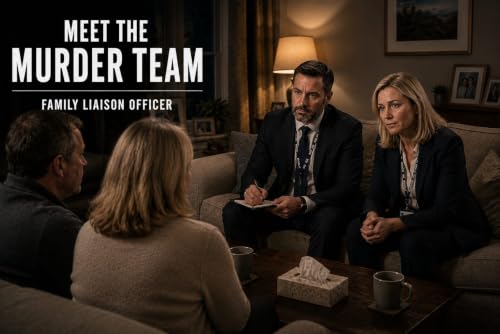
  • Meet the Murder Team: Family Liaison Officer
    2026/09/15
    As I sat there on the sofa, sitting across from me was what I could only describe as a broken family.Two parents who moments before had their whole world come crashing down around them.It was the message no parent ever expects to hear.I’m so sorry to tell you this but your son has died as the result of an assault.Murdered.Not even out of his teenage years.Less than an hour after he left the house saying he would see them later.Then my fellow murder detective and I rock up, telling them he wouldn’t be coming home.Ever.No matter how many times you deliver that message, it never gets easier. In fact, it probably gets harder because you know the impact those words are going to have. You’ve seen the devastation they cause.And there was no doubt those words had caused complete devastation.As a detective I had developed ways of dealing with most of what I saw in my career. The side that I found most difficult was witnessing the trauma of parents who have lost a child through murder.It was probably from being a parent myself. Some part of me wondering how I would cope in that situation (I’m not sure I could).It was that empathy I put down to what happened next.As I sat there, looking at this distraught couple, caught up in their emotions, I said something I had no place in saying.Out of nowhere I told them we would get them. That we would catch the people responsible for killing their son.You see, the thing is, how could I possibly promise that? How could I guarantee that would happen. Yes, we solve most murders, but there are those we don’t.I knew as soon as I said the words I shouldn’t have, and I regretted it straight away.If one of my detectives had said that I’d have had a go at them. You can’t promise something that isn’t in their gift.Thankfully, we did go on to catch his killers. And convict them. But at that time, I had no way of knowing that would happen.It was the only time I ever did that. But it was proof to me what I always knew.Being a family liaison officer wasn’t for me.It’s an unfortunate fact that some of the most important advances in policing come from the mistakes of the past.It often takes high-profile failings to adopt a better way of working. Which is how family liaison officers, or FLOs, came about.In 1992, one of the Metropolitan Police’s darkest moments occurred when 18-year-old Stephen Lawrence was murdered in a racist attack in Eltham, South-East London.The subsequent investigation into Stephen’s murder came under immense criticism, resulting in a public inquiry, chaired by Sir William Macpherson, that shone a light on numerous failings.One of those was the way in which investigators treated Stephen’s family.Up until then, how detectives engaged with bereaved relatives was far less structured than it is today.The Stephen Lawrence Inquiry became a catalyst for change.The Macpherson report made a number of recommendations about how police should work with bereaved families, including the use of designated and trained family liaison officers.Family liaison developed significantly in the years that followed and has since become a central part of murder investigations.So, that’s how the role developed, but what do they actually do?Well, let me dispel one myth straight away. A myth not only held by people outside of the police, but also many on the inside.They’re not there to look after the family.They’re most definitely not counsellors.They’re investigators.Detectives from the investigation team, whose role is to gather information that can assist the investigation.And for me, that’s at the heart of what makes this such an incredibly difficult role.But rather than me explain why, I want to try and put you in their place.Imagine you’re a detective on a murder team that has just taken on a new investigation.The victim is a 15-year-old who was stabbed and killed less than two hours ago.You have been allocated the role of lead family liaison officer. You will be assisted by a deputy, but the overall responsibility for that strand of the investigation is yours.The rest of the team have convened for their first meeting, where they will receive a briefing from the detectives who first attended the crime scene, but your initial meeting with the boy’s family is too important to wait for that briefing to conclude.As you make your way to their family home, you’re running through in your mind what will be required of you when you arrive.You know that you’re there to get what information you can that will help the investigation. You will want to build as good a picture as is possible of the boy’s life. Which school he went to. Who his friends were. Where he hung around. Had he had any issues recently. Was he involved in any criminality or gangs. What was his phone number. How did he normally travel around. And as far as they know, where had he been prior to the murder.If they’re open to it, you would like to look in his bedroom for anything that may...
    続きを読む 一部表示
    14 分
  • The Idaho Murders: Why?
    2026/09/08
    I can’t begin to imagine how many broken families I’ve sat opposite.People whose world has just been shattered by the news a loved one was murdered.If you hear me speak often enough, you will know I found this one of the hardest parts of being a murder detective.We all lose loved ones at some point in our lives. The pain is awful.But if that person has been taken by the actions of someone else, I can’t begin to imagine how much harder that must be.And that’s the thing. No matter how many times I witnessed that trauma, I could never truly know what they were going through.Unless it’s your loved one that’s been taken in that way, how can you possibly pretend to understand?But there was one thing I did learn to expect.One question I heard families ask time and time again.Why?The University of Idaho sits in the small town of Moscow, Idaho, about 300 miles east of Seattle.It’s the sort of university town you find all over the world. Thousands of young people living away from home for the first time, many living in shared student houses.One such house was at 1122 King Road, a three-storey house occupied by female students.On the night of 12th November 2022, those living at the house had been doing what most students do on a Saturday night, they were out socialising with friends.The first to arrive back were Dylan Mortensen (20) and Bethany Funke (20), who had been out separately that night. They each returned to their respective rooms.At around 1.45 a.m. on the Sunday morning, Xana Kernodle (20) came back to the house with her boyfriend, Ethan Chapin (20). The couple had been together for several months and Ethan was staying over for the night. They then went up to Xana’s room on the middle floor.At just before 2 a.m., best friends Madison “Maddie” Mogen (21) and Kaylee Goncalves (21) were dropped back to 1122 King Road by a cab after stopping at a late-night food truck. Kaylee was due to start a new job in Texas and had returned to Moscow to spend time with friends before she moved. That night she was staying with Maddie in her room on the top floor.But what had been a normal Saturday night changed when an intruder entered the house.According to the court records, shortly after 4 a.m. he entered through the rear sliding doors which, because the house was built into a slope, opened directly onto the middle floor.The suspect went to the top floor where he attacked and killed Maddie and Kaylee.The court records then say the suspect came back downstairs, where he encountered Xana before killing her and Ethan, who they say was asleep in Xana’s room.The suspect then left the house before leaving the area in a white car.It wasn’t until much later that the murders were discovered. Emergency services were called shortly before noon.Police arrived and established that they were dealing with a multiple murder, and the investigation began.WitnessesInvestigators needed to understand from the surviving housemates what they may have seen or heard that night. These were the accounts given to police:Dylan MortensenHaving returned home from her night out she went to her room on the middle floor and went to sleep.At around 4 a.m. Dylan was woken by noises from the floor above. She thought this was Kaylee playing with her dog. She also described hearing a female voice saying, “There’s someone here.”Dylan opened her bedroom door but saw nothing.She then heard what she described as sobbing coming from the direction of Xana’s room.Then she heard an unfamiliar male voice say “You’re going to be OK. I’m going to help you.” Dylan told investigators the tone wasn’t reassuring and was said in what she described as a weird way.She tried calling out to her housemates and contacting them by phone but had no response.Dylan then opened her bedroom door again. This time she saw a man dressed in dark clothing with his face partially covered. What stood out to her were his bushy eyebrows.The man continued past her and towards the sliding doors leading from the kitchen.Dylan went back into her room and began messaging Bethany. She told her that no one was answering and that she was confused and frightened. She said the man she had seen was wearing what looked like a ski mask.Bethany told Dylan to come downstairs to her room, telling her it would be better than being alone. Dylan did so, and the pair continued trying to contact their housemates without success.Later that morning, they contacted friends who came to the house. One of them discovered Xana’s body and at 11.58 a.m. a call was made to 911.Bethany FunkeBethany was in her bedroom on the bottom floor of the house.She told investigators that she didn’t recall anything particularly unusual that night, other than hearing what she thought was a firework and seeing what appeared to be a spark underneath her bedroom door.At around 4.22 a.m. she began receiving messages from Dylan, who told her that no one was answering and that she had seen a man ...
    続きを読む 一部表示
    31 分
adbl_web_anon_alc_button_suppression_t1
まだレビューはありません