エピソード

  • Bitcoin Accelerator on Mirissa Beach | James of Ârc SLP774
    2026/09/22

    Most Asian markets still make buying and saving Bitcoin painfully hard. James of Ârc argues the fix is not another protocol breakthrough — it is local founders shipping simple DCA and savings products market by market.

    James joins me from Mirissa Beach, Sri Lanka, where Arc is partnering with Fulgur Ventures on a continuous Bitcoin accelerator. He is a former EY advisor and Playfair Capital investor who previously built with Alexander Mann (now Fulgur GP) and later sold Consequence, an early LLM-on-databases company.

    The conversation covers why the program is continuous rather than a six- or twelve-week cohort, how to apply at arc.lk/Fulgur, why Sri Lanka ranks among his top-three country bets, the South Coast talent melting pot, funding DCA apps across Asia even where operators already exist, AI agents as Bitcoin users, and why Strike expanding should not scare local founders.

    Timestamps:

    00:00 — Intro: James of Ârc

    00:35 — From Accenture to Venture Capital

    02:13 — Building With Alex Singh

    03:21 — Fed Up With Monkey JPEGs

    05:10 — Ârc Fulgur Bitcoin Accelerator

    06:35 — Continuous Program at Mirissa

    07:34 — Two Paths Into Ârc Fulgur

    10:13 — Why Sri Lanka?

    12:02 — Top-Three Country Bet

    12:23 — Whales, Leopards, Beach Hub

    15:00 — South Coast Talent Melting Pot

    18:36 — 34 Local Founders Already In

    21:39 — Fund DCA Apps Across Asia

    25:23 — AI Agents Will Use Bitcoin

    28:18 — Room for Many Asian Operators

    32:23 — Just Focus on Your Customer

    32:39 — Apply Now

    Links:

    • https://x.com/James_of_Arc

    • https://x.com/FulgurVentures

    • https://arc.lk/

    Stephan Livera links:

    • Follow me on X: @stephanlivera

    • Subscribe to the podcast

    • Subscribe to Substack

    続きを読む 一部表示
    36 分
  • Institutional Custody, Multisig & the War on Cash | Mike Belshe SLP773
    2026/09/16

    Mike Belshe, co-founder and CEO of BitGo, walks through how institutional Bitcoin custody actually works in 2026: qualified custody, self-custody co-signing, and why BitGo still centers a 2-of-3 model after pioneering P2SH multisig in 2013.

    BitGo now operates as a US-regulated qualified custodian and public company, while still offering the same wallet stack individuals can run in self-custody mode. The conversation covers what “institutional security” means in practice — HSM-backed co-signing, open-source recovery paths, multi-jurisdictional key storage (including how BitGo moved WBTC when US regulation looked hostile), and why on-chain multisig still beats vendor-locked MPC for cold ops.

    They also dig into the political and operational risks around large Bitcoin holdings: KYC and PII as honeypots, France tying names to amounts, the war on cash reaching Bitcoin, and whether an EO 6102-style confiscation risk still belongs in the threat model. On the institutional side, Belshe pushes back on multi-custodian setups that add failure modes, explains insurance limits versus the size of the Bitcoin market, and why splitting wallets matters after events like Bybit.

    Timestamps

    00:00 — Intro: Mike Belshe of BitGo

    00:59 — Don't Lose Self-Custody's Power

    05:41 — Retail Deserves Institutional Security

    07:16 — Humans Are Terrible at OpSec

    09:56 — 2-of-3 Protects Theft and Loss

    14:35 — Retail Pays 160 Basis Points

    19:22 — Why People Drift Toward Banks

    20:35 — Self-Custody Is Never Trustless

    23:39 — Why BitGo Sticks to 2-of-3

    30:31 — A Public CEO Holds Zero at Home

    31:27 — KYC Leaks Are Government Honeypots

    39:28 — France Doxed Bitcoin Holdings

    41:30 — War on Cash Reaches Bitcoin

    43:45 — Multi-Jurisdictional Key Storage

    45:29 — Executive Order 6102 Could Return

    47:43 — Quantum-Resistant Wallets Today

    49:27 — Multisig Beats MPC

    53:33 — Splitting Custodians Adds Failures

    58:29 — 2-of-2 MPC Can't Recover Loss

    01:00:57 — $5–7B Insurance vs $1.6T Bitcoin

    01:03:35 — Bybit Lost 10x by Not Splitting

    01:05:21 — Multi-Institution vs Qualified Custody

    Links:

    • https://x.com/mikebelshe

    • https://x.com/bitgo

    Stephan Livera links:

    • Follow me on X: @stephanlivera

    • Subscribe to the podcast

    • Subscribe to Substack

    続きを読む 一部表示
    1 時間 7 分
  • Trustless Swaps Across Bitcoin Layers | Walter Maffione SLP772
    2026/09/15

    Walter Maffione, CEO and co-founder of KaleidoSwap, join me to explain how the project grew from an RGB Lightning DEX into a broader swap engine and LSP stack — Lightning as rails between Liquid, Arkade, Taproot Assets, Spark, and RGB — plus KaleidoSDK, desktop app, and browser Extension.

    We dig into web app and SDK integrations for merchants and unified-balance wallets, how HTLC atomicity works across layers, BOLT 12 multi-asset offers and Nostr discovery for competing providers, Bitcoin-only scope with Flashnet and Utexo bridges for external stables, and a product lineup of desktop app, browser extension, and dual SDKs.

    Walter also covers agentic payments via MCP plugins, self-sovereign local models with Tether’s QVAC, fee ranges around 0.5–1%, and a one-to-three-month mainnet launch path for the extension, swap provider, and web app.

    Timestamp:

    00:00 — Intro: Walter & KaleidoSwap

    00:50 — From RGB to Multi-Layer Swaps

    02:14 — LSP Plus Swap Provider Stack

    03:42 — Merchants, Stables, Unified Balance

    05:38 — Why Swap UX Took Over Wallets

    06:42 — Liquidity Ops and Mainnet Path

    07:58 — AI Attacks After Boltz Shutdown

    10:23 — Defending Non-Custodial Swaps

    12:18 — How Atomic Swaps Actually Work

    13:36 — RGB, Liquid, Arkade, Spark

    14:36 — Open Spec, BOLT 12, Nostr Discovery

    18:23 — Pay Anything via the SDK

    19:34 — Bitcoin Layers Only + Bridges

    22:05 — Desktop, Extension, Dual SDKs

    25:05 — UX That Adapts to the User

    26:32 — Agentic Payments and QVAC

    33:22 — MCP Plugins, Keep Your Own AI

    35:11 — Fees Around 0.5–1%

    35:57 — Launch Timeline: Next 1–3 Months

    37:05 — Find KaleidoSwap Online

    Links:

    • https://x.com/bit_walt

    • https://x.com/kaleidoswap

    • https://docs.kaleidoswap.com/whats-kaleidoswap/introduction

    Stephan Livera links:

    • Follow me on X: @stephanlivera

    • Subscribe to the podcast

    • Subscribe to Substack

    続きを読む 一部表示
    38 分
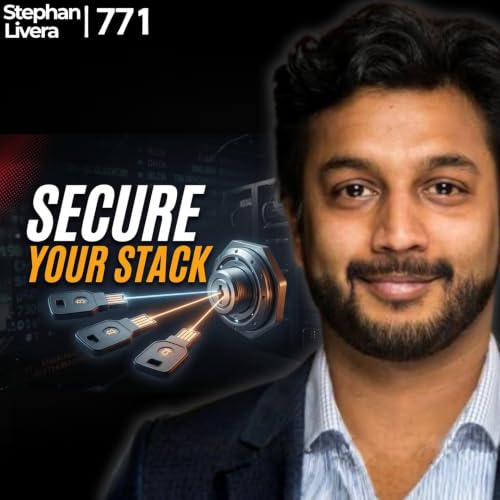
  • Bitcoiners Must Remove Single Points of Failure | Dhruv Bansal SLP771
    2026/09/10

    Recent attacks exposed how even large, educated Bitcoin holders remained exposed through single-vendor setups. The core lesson is that self-custody alone does not remove single points of failure; deliberate design is required.

    Dhruv Bansal, co-founder and CISO of Unchained, joins to examine these incidents and the practical barriers that keep most hardware wallet users on single sig despite years of warnings.

    The conversation covers the gap between theoretical multisig knowledge and actual adoption, the trade-offs between anonymity and regulated inheritance paths, why newer layers attract attacks first, and the need for human review of AI-generated code at Bitcoin firms.

    Bansal argues that cryptographic hardware will become ordinary infrastructure for everyone in an AI-driven internet, not a niche Bitcoin tool, and that mature risk systems rely on fractal networks rather than centralized controls.

    Timestamps:

    01:42 — No Single Points of Failure Allowed

    05:34 — Even Large Holders Skip Multisig?

    09:14 — You Could Be Your Own Failure Point

    13:35 — Anonymity vs KYC

    16:27 — Don't Half-Ass Your Bitcoin Security

    21:23 — One Wallet, True Multi-Vendor Security

    24:24 — Single Sig Can Still Lose Everything

    30:26 — Why Everyone Will Need Hardware Wallets

    32:06 — Why Attackers Hit Bitcoin L2s First

    36:32 — Bitcoin Firms Must Human-Review AI Code

    40:05 — Bitcoin as Humanity's AI Defense System

    42:59 — Remove Single Points of Failure Forever

    45:25 — Hardware Wallets at Every Gas Station

    47:34 — Bitcoiners and Key Entropy

    Links:

    • https://x.com/dhruvbansal

    • https://x.com/unchained

    • https://www.unchained.com/

    Stephan Livera links:

    • Follow me on X: @stephanlivera

    • Subscribe to the podcast

    • Subscribe to Substack

    続きを読む 一部表示
    49 分
  • Interviews at Origin Seoul 2026 | SLP770
    2026/09/03

    00:00 - Interview with Gabriele Vernetti of Stratum V2 @gitgab19

    15:38 - Interview with Jimmy Kostro @jimmykostro

    29:30 - Interview with James Check of checkonchain

    Links: https://x.com/gitgab19

    https://x.com/jimmykostro

    https://x.com/_checkonchain

    https://x.com/_checkmatey_

    https://x.com/stratumv2

    Bitcoinchiangmai.org


    続きを読む 一部表示
    42 分
  • Bitcoin Asia (HK) 2026 Day 2 Interviews | SLP769
    2026/08/31

    Interviews at Bitcoin Asia 2026 Day 2

    00:00 - Piriya Sambandaraksa

    05:14 - Alexander Mann

    11:04 - Shone Anstey of LQWD

    17:03 -Liam Eagen from Ideal Group

    Links:

    • https://x.com/piriya

    • https://x.com/idealgroup

    • https://x.com/liameagen

    • https://x.com/LQWDTech

    • https://x.com/shoneanstey

    • https://x.com/alex_singh_mann

    Stephan Livera links:

    • Follow me on X: @stephanlivera

    • Subscribe to the podcast

    • Subscribe to Substack


    続きを読む 一部表示
    27 分
  • Bitcoin Asia (HK) 2026 Day 1 Interviews | SLP768
    2026/08/29

    In this episode, I interviewed several people at Bitcoin Asia 2026.

    Timestamps:

    00:00 - Interview with Adam Poulton

    06:28 Interview with Giovanni Santostasi

    15:18 Interview Jeff Walton of Strive

    34:11 Interview with Alex B from ArkLabs

    Links:

    • http://x.com/Giovann35084111

    • http://x.com/adampoulton

    • http://x.com/bergealex4

    • http://x.com/arklabshq

    • http://x.com/punterjeff

    • http://x.com/strive

    Stephan Livera links:

    • Follow me on X: @stephanlivera

    • Subscribe to the podcast

    • Subscribe to Substack

    続きを読む 一部表示
    40 分
  • Wallet Playground for learning Bitcoin self custody with Piers Macrae | SLP767
    2026/08/25

    In this episode, Piers Macrae demonstrates Wallet Playground and explains why hardware wallets are signing devices, not wallets.

    Timestamps:

    01:10 — Teach Me vs Do It For Me

    03:23 — Test Any Wallet Free in Browser

    09:09 — Coldcard Drama Forced Early Release

    14:03 — Generate Seeds Using Your Webcam

    17:52 — Hardware Wallets Aren't Real Wallets

    21:52 — Only 1% Use Multisig for Life Savings

    25:33 — Self-Custody Like Firearms Drilling?

    27:30 — Only Tiny Percentage Will Self-Custody

    Links:

    • X: @mineracks — https://x.com/mineracks

    • Wallet Playground: https://walletplayground.com/

    • mineracks: https://www.mineracks.com/

    Stephan Livera links:

    • Follow me on X: @stephanlivera

    • Subscribe to the podcast

    • Subscribe to Substack

    続きを読む 一部表示
    30 分