『Soundwalk』のカバーアート

Soundwalk

Soundwalk

著者: Chad Crouch
無料で聴く

【Amazonプライム会員限定】今ならプレミアムプランが4か月 月額99円。

10月19日まで。※適用条件あり
Soundwalk combines roving field recordings with an original musical score. Each episode introduces you to a sound-rich environment, and embarks on an immersive listening journey.

chadcrouch.substack.comChad Crouch
個人的成功 自己啓発 音楽
エピソード
  • Appalachian Autumn
    2026/10/16

    I wasn’t sure what to expect from the soundscape of the Smoky Mountains in October. I’d been there in the fall 25 years ago, but my memories were mostly confined to images, and a generalized sense of topography. What I found on return was a soundscape of crickets in the valleys, stridulating in a glacial crescendo—from a murmur in the afternoon to a full-blown cacophony in the gloaming of dusk. This was not new to me. It was the sound early autumn from my childhood, living among fields and orchards on the fringe of suburbia.

    The soundscape that was truly novel to me, that I’m sharing today, has a little bit of that: the breathing hum of crickets in the early evening. But the real soundmarks come from mammals—squirrels, more plentiful and more active than I can ever recall hearing. This was the sound of peak mast season.

    What is mast season? Mast was a term that was new to me. It is taken to mean the food that comes from bushes and trees: fruits, nuts, and seeds. “Hard mast” is principally acorns, beech nuts and hickory nuts, here in the Sugarlands, the western foothills of the Great Smokies. A “mast year” is a particularly abundant year for acorn and nut production, and every indication suggests 2025 was a genuine mast year in southern Appalachia. A 2025 article described, “oak production as the heaviest since 2012, with beech crops heavy enough that ground beneath beech trees was ‘littered with hulls... after squirrels feasted.’"

    I was hearing a squirrel feast! Here in the Sugarlands, hardwoods and oak forest commingle, so there's a lot of mast dropping in a small area. Squirrels get frantic and vocal during the harvest push before winter arrives—chattering, barking, leaf-rustling, and branch-shaking as they work the canopy.

    It was this abundance, this sense of life in the trees that encouraged me to reach for woodwinds and harmonium-like sounds in my composition. I wanted it to conjure that peace that comes after a hard day’s work feeling. The music bears more than a passing resemblance to my vinyl LP release Wildwood Trail Soundwalk earlier this year. Both are built up very simply with eight slowly morphing chords per movement, stacked in equal measure, set in a slow, breathing tempo.

    I rarely have the conviction that any one album is a good starting place for getting to know my work, but as I listen now and write this, it strikes me that this may at least be more accessible than many others. The music is uncomplicated, warm and reassuring. The sound of humming crickets, the rustle of crisp leaves, the crystalline “kuk-quaa” of squirrels chiming out, all come together in a soothing velvet haze—like the “Smoky” blue air from the faraway mountaintops coming down to settle in the valleys, in the slow transition to nightfall.

    Thanks for listening and reading along. Appalachian Autumn is available under the artist name Listening Spot on all streaming platforms Friday, October 16th.


    This is a public episode. If you'd like to discuss this with other subscribers or get access to bonus episodes, visit chadcrouch.substack.com/subscribe
    続きを読む 一部表示
    39 分
  • Panthertown Valley
    2026/10/01
    Panthertown Valley is a relatively small 6311-acre wilderness area in Nantahala National Forest in western North Carolina, in the Blue Ridge Mountains. It’s a little bit off the beaten track, but far from obscure, as the old promoter’s trick of slapping the label “Yosemite of the East” seems to have piqued interest over the decades. The Yosemite comparison owes itself to the granite features of the mountains that surround the valley. Proto-Half Domes, I guess. These smooth outcrops are a far cry from El Capitan, but they do possess a distinct character. Unlike the tectonic uplift and glacial scouring that happened in Yosemite, these dome faces were the result of magma cooling deep underground before being exposed by millions of years of weathering. If there is any superlative aspect that can be drawn in the comparison, it is that the formation here is much, much older. The granite underlying Panthertown Valley, the Whiteside granitic pluton, was intruded into the earth’s crust approximately 466 million years ago. The granite forming the cliffs and domes of Yosemite Valley was formed just 105 to 85 million years ago. The popular Panthertown Valley Trail to Mac’s Gap Loop is one of the most memorable hikes I’ve ever taken, topographically speaking. Does anybody else catalog wilderness experiences this way—as perceptions of topography? The overwhelming impression this place gives is one of a basin. When you peer down into the valley and scan the horizon, you see what looks like a rim, almost circular in definition. Of course this is not the way hydrology works. Panthertown Creek does not go down a drain in the middle, but slips out through a fold in the hills. The creek does linger though, there in the center. Indeed, Panthertown Valley features a rare high-elevation mountain bog on its valley floor, a wetland ecosystem fed by groundwater seeping from the surrounding granite.While fall paints the trees in shades of yellow umber, Venetian red, cadmium orange and the grasses in Naples Yellow, I couldn’t help but wonder what colors spring brought to the valley floor, festooned as they are with Rosebay Rhododendron and rare Pinkshell Azalea, an endemic shrub native only to a few high-elevation pockets in western North Carolina. Here in the understory Carolina Chickadees and Golden-crowned Kinglets ranged in foraging flocks while Carolina Wrens buzzed as they hopped along the downed wood. The valley was very quiet, enhancing the perception of being acoustically sheltered in a basin—or “cove” as they say in Appalachia—insulated from the sounds that roads invariably bring. This allowed me to appreciate the manifold cricket sounds: they purred, cooed, buzzed and blinked on and off. It was so nice to hear crickets this way: not in a chorus but distributed across the patchy habitat, in conversation with each other. “Halloo over there,” I imagined them saying. I looked toward fuzzier electric piano voices with this in mind, placing them alongside breathy flutes, mirroring the breeze and the cricket textures. I kept it spartan, as is my way. There are moments, if you listen closely, where you really hear the space here: the collective fir trees played by the wind, the dull sound of footsteps on granite, the constellations of cricket hum. My pictures really don’t do it justice. This is not a place that is about one vista, or one waterfall. It’s about exploring its contours, and for me, listening deeply.I found myself pondering time. The long and lonely time that it took for these rocky slopes to become the Yosemite of the East. I tried to picture the solvent action of water in time-lapse carting off the hills. I pictured the forest lifting and falling like the subtle dilation of an animal’s belly, breathing. Along the trail, Schoolhouse Falls proved to be a popular destination. Here one can walk behind the falls. That splotch of red is one such person, taking a picture through the falling water. Somewhere I am a splotch of colored pixels in his digital photo album. The name “Schoolhouse” is literal. There was once a small schoolhouse nearby likely serving the settler and logging camp populations in the early 1900s. Likewise Panthertown Valley is said to have got its name from the abundant Eastern cougar population here. An 1898 Asheville Daily Citizen article eulogizing a hunter described the valley vividly: “Bear and deer were very numerous in those days, and almost every night lying around our camp fire, we could hear the panther’s shrill scream over in Panthertown.” Old Joe Dodgins, the article’s subject, reportedly calculated his bear kills year by year, summarizing, “I can’t tell exactly, but I can count up over 300 and think I have killed nearer 400.”Panthertown Valley became the domain of the Moltz Lumber Company beginning in 1916. Moltz then built a 16-mile railroad in the valley and a sawmill in the Lake Toxaway area. Hundreds of workers were hired to peel...
    続きを読む 一部表示
    35 分
  • Durham Night Soundwalk
    2026/09/18

    Last year, around this time, I travelled to Durham, NC for a record label conference. The city reminded me of Eugene, OR, where I went to school for a short time. Both are university towns. Durham has a bigger population, and is just one node of a much larger urban area, but the downtown cores are similarly compact, pedestrian-friendly, and relatively quiet.

    My mission at the conference was to figure out how to grow my business and innovate my way toward prosperity. A tall order. Given that my business model is hyper-niche—capturing environmental recordings and creating instrumental musical suites—I was sifting ideas and prospects, feeling good about taking time to reflect and plan.

    As I walked to an evening event downtown, I was taken in by the sound of crickets in a sparsely filled surface parking lot. We have crickets in Oregon, of course, but perhaps not as many in our cities. The sound was both familiar and novel. I had my Sennheiser binaural headset in my pocket, and decided to capture the moment. From there I took a meandering walk into the heart of the city. This is one of my first urban soundwalks in the US—something that had long occurred to me to do, but never seemed particularly promising, aesthetically or commercially.

    But, as I was feeling the sensory excitement that comes with being in a new place, I reasoned it was high time to experiment. I let my ears lead the way.

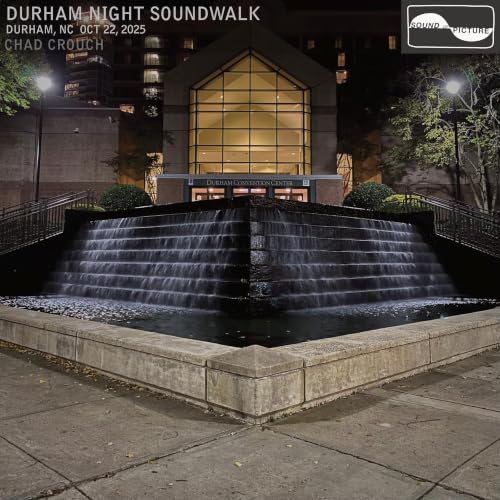
    There are urban sounds throughout the recording, but they largely seem confined to the auditory horizon. The near field sound of the city is so quiet it could almost read as pastoral. As I padded into the downtown blocks, a fountain in the plaza of the Durham Convention Center beckoned me toward it. The shimmering sound put me in a kind of audio trance. I just stood there for several minutes—long enough to become self-conscious—figuring passersby might take me for a tweaker staring at the ground. I took a photo of the sidewalk to memorialize the moment.

    I felt a peace wash over me there, surrounded by people, cars, trains, energy, life. It was all very ordinary, but as I stood listening, I began to sense the extraordinary qualities of it too. I know that might sound hokey, but it’s true. I tried to convey that feeling in the score. Maybe it will translate, listening to it? That’s the hope, anyways.

    Once again, thanks for reading along and listening. Durham Night Soundwalk is available on all music streaming services September 18, 2026.


    This is a public episode. If you'd like to discuss this with other subscribers or get access to bonus episodes, visit chadcrouch.substack.com/subscribe
    続きを読む 一部表示
    28 分
adbl_web_anon_alc_button_suppression_t1
まだレビューはありません